
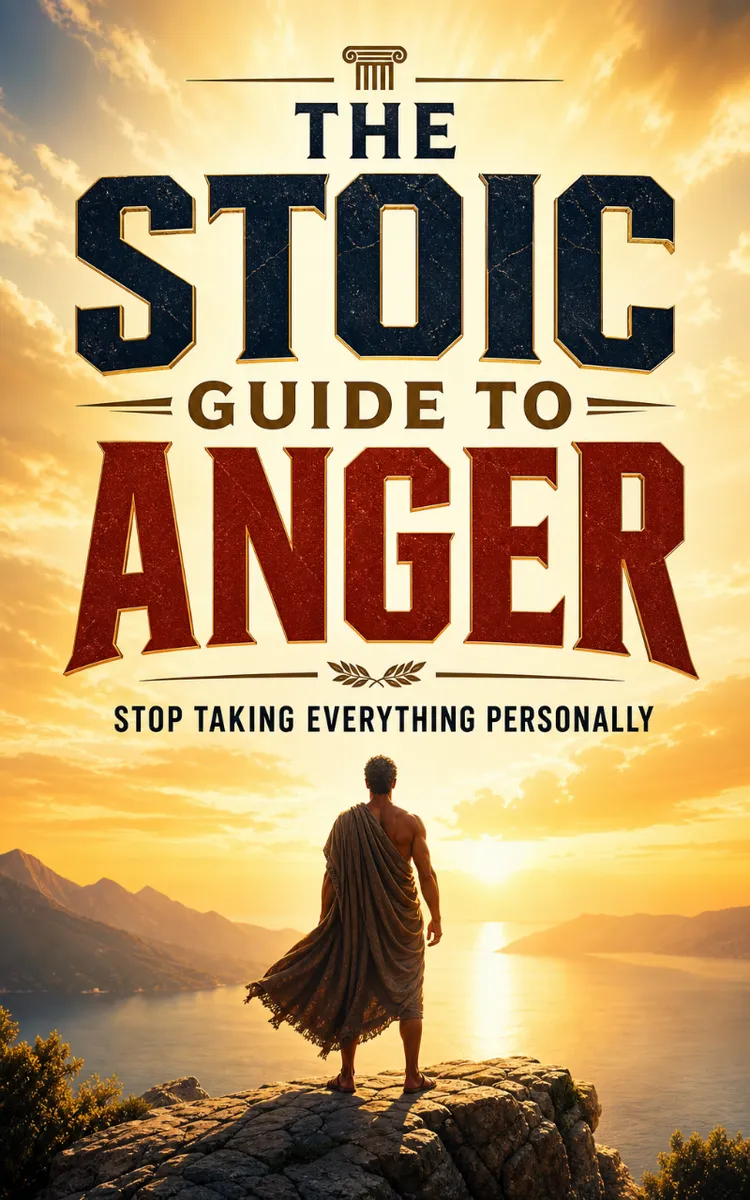
The Stoic Guide To Anger
Created with Inkfluence AI
Stoic-based strategies to manage anger and ego
Table of Contents
- 1. Anger Is a Pride Alarm
- 2. Ego vs. Character: The Real Self
- 3. Stop Taking Criticism as Identity
- 4. The Stoic Pause Before Speech
- 5. Control What’s Yours, Release What’s Not
- 6. Reframe Offense as a Choice
- 7. Your Thoughts Create the Heat
- 8. The Virtue Lens for Every Conflict
- 9. Build a Personal Anger Trigger Inventory
- 10. Defensiveness as Fear of Shame
- 11. Replace Retaliation with Reasoned Response
- 12. Speak the Truth Without the Bite
- 13. The “What Would a Wise Person Do?” Test
- 14. Set Boundaries Without Losing Temper
- 15. Practice Voluntary Discomfort for Calm
- 16. Turn Mistakes into Data, Not Doom
- 17. The Evening Review to Break Patterns
- 18. Forgive Without Excusing Harm
- 19. Resist Rumination with Mental Rewrites
- 20. Live with Quiet Confidence, Not Ego
Preview: Anger Is a Pride Alarm
A short excerpt from “Anger Is a Pride Alarm”. The full book contains 20 chapters and 28,523 words.
Picture This
Have you ever been halfway through a normal day, then-bam-someone questions you, cuts you off, or “corrects” you in a way that feels personal. Your body tightens first. Your mind starts grabbing receipts. And before you even realize it, you’re not trying to understand anymore-you’re trying to win.
Darius, 34, a sales manager, felt this hit hard during a team meeting. A younger rep said his numbers “didn’t make sense,” like it was a fact, not a discussion. Darius laughed it off for half a second, but inside he was boiling. He could feel the pride sting: So now I’m the guy who doesn’t know what he’s doing? When he responded, he came out sharp. He didn’t just want clarity-he wanted respect back, right there, in front of everyone.
What if that heat wasn’t proof you were right… but proof your pride alarm just went off?
**What if your anger is telling you, “Your pride just got threatened,” not “You must prove your point right now”?
---
The Mindset Shift
Old Belief: Anger means you’re seeing the truth clearly. If you feel this fired up, you must be defending something important.
New Reality: Anger often means your pride got stepped on. It’s information about threatened status, not a certificate that you’re correct.
This shift matters because anger loves to dress up as justice. It tells you, “This is the moment you stand your ground,” when what you’re really protecting is the image of yourself-competent, respected, not wrong, not overlooked. When you treat anger like truth, you move fast and you talk like you’re already convicted. Then later you wonder why the relationship feels colder, even if your facts were solid.
Here’s the concrete part: Darius didn’t start with a goal of helping the team. He started with a goal of restoring his self-image. His rep wasn’t just challenging numbers-they were threatening Darius’s sense of being the capable leader. So Darius’s brain went into defense mode: argue, explain, tighten control. And the more he pushed, the more the rep felt judged, which made the meeting worse. The anger “worked” in the short term (it made Darius feel powerful for a second), but it cost him trust.
Now imagine the same moment with the Pride-Alarm Map switched on. Darius hears the comment, and instead of jumping to “Let me prove I’m right,” he asks, What pride value is getting hit right now? Maybe it’s competence (“I know my numbers”), respect (“I’m supposed to be the authority”), or fairness (“I’m being treated like I’m wrong”). Once he names it, he can choose a response that matches the situation-not just the wound.
---
Going Deeper
Anger doesn’t only come from what’s happening. It comes from what your mind thinks is happening to you. Stoics would say your impression (what you interpret) is what triggers the reaction. Your anger is the alarm that says, “This matters to my ego.” It can still be useful-like a smoke detector-but it’s not the fire. A smoke detector doesn’t decide where to aim the water. It just tells you to check what’s burning.
So the Pride-Alarm Map is simple on purpose: you don’t treat anger as a verdict. You treat it as a signal. The signal points to a threatened value-usually tied to pride: being respected, being right, being seen as competent, being treated fairly, not being controlled, not being embarrassed. When you can spot that value, you can slow down long enough to respond instead of react.
Below are signs this pride-alarm pattern is running your life. If you recognize a few, it doesn’t mean you’re “bad.” It means your system learned a fast, familiar move-one you can retrain.
1. You feel anger when someone “questions” you, even if they might be trying to help. Your first thought is less “What do they mean?” and more “How dare they?”
2. You get locked on being seen as right. Even when the conversation is about solving a problem, your mind starts hunting for mistakes in the other person.
3. You feel embarrassed and defensive at the same time. Anger covers the sting. Underneath is often: I don’t want to look incompetent.
4. You replay the moment later to rehearse a better comeback. That replay isn’t processing-it’s defending your pride after the fact.
En résumé: Anger can be information about threatened pride, not proof you’re right.
The key is what you do with that information. The Pride-Alarm Map doesn’t ask you to suppress anger or pretend you feel nothing. It asks you to translate anger into a clearer question: What value is being threatened? Then you choose the response that protects that value without burning the room down.
For Darius, the “value threatened” wasn’t just his numbers. It was his leadership identity. Once he could see that, he could respond in a way that still honored his competence-without trying to humiliate the rep or crush the question. He could say, “Can you show me where it doesn’t make sense?” That keeps respect intact and still invites clarity. It’s not weak....
About this book
"The Stoic Guide To Anger" is a self-help book by Socratic Mastery with 20 chapters and approximately 28,523 words. Stoic-based strategies to manage anger and ego.
This book was created using Inkfluence AI, an AI-powered book generation platform that helps authors write, design, and publish complete books. It was made with the AI Self-Help Book Writer.
Frequently Asked Questions
What is "The Stoic Guide To Anger" about?
Stoic-based strategies to manage anger and ego
How many chapters are in "The Stoic Guide To Anger"?
The book contains 20 chapters and approximately 28,523 words. Topics covered include Anger Is a Pride Alarm, Ego vs. Character: The Real Self, Stop Taking Criticism as Identity, The Stoic Pause Before Speech, and more.
Who wrote "The Stoic Guide To Anger"?
This book was written by Socratic Mastery and created using Inkfluence AI, an AI book generation platform that helps authors write, design, and publish books.
How can I create a similar self-help book?
You can create your own self-help book using Inkfluence AI. Describe your idea, choose your style, and the AI writes the full book for you. It's free to start.
Write your own self-help book with AI
Describe your idea and Inkfluence writes the whole thing. Free to start.
Start writingCreated with Inkfluence AI


