
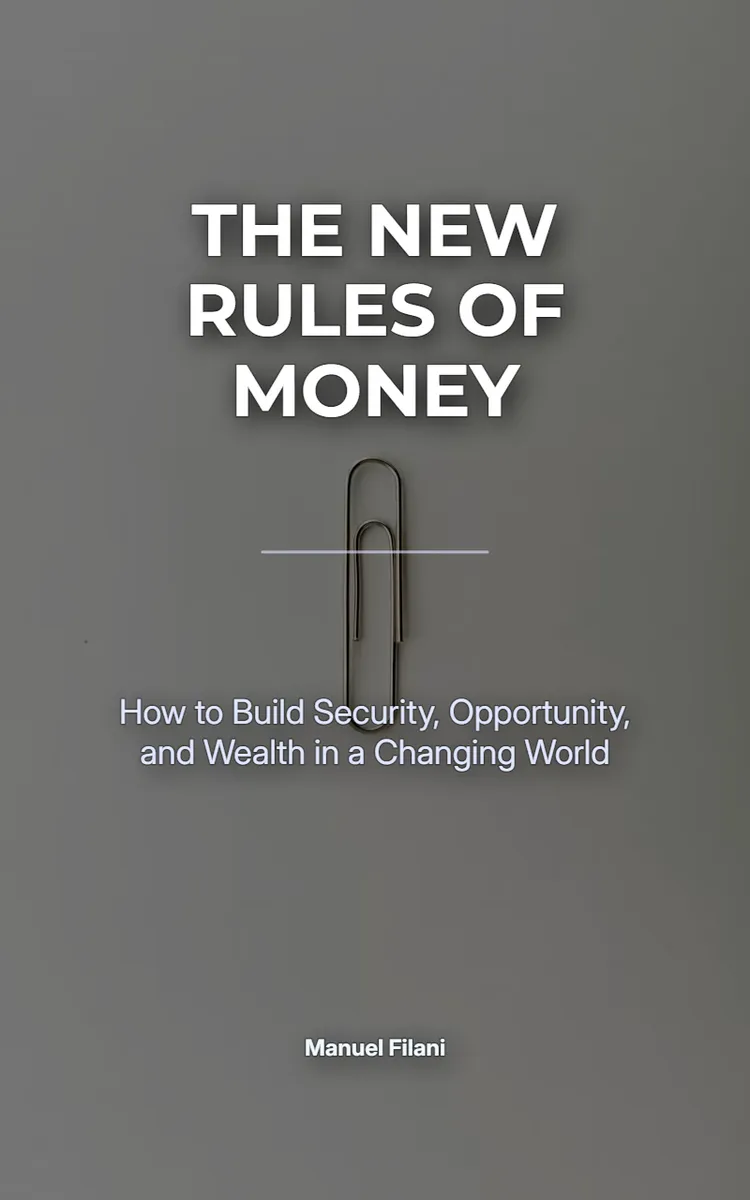
The new rules of money
Created with Inkfluence AI
Table of Contents
- 1. The World Changed Faster Than We Realized
- 2. The Myth of Job Security
- 3. Why Hard Work No Longer Guarantees Wealth
- 4. Inflation: The Silent Wealth Killer
- 5. The Skill Economy
- 6. The Rise of Multiple Income Streams
- 7. The Internet Changed Everything
- 8. AI, Automation, and the Future of Work
- 9. Why Most People Stay Financially Stuck
- 10. Income Is Not Wealth
- 11. Thinking Like an Owner
- 12. Building Financial Resilience
- 13. The New Rules of Money
Preview: The World Changed Faster Than We Realized
A short excerpt from “The World Changed Faster Than We Realized”. The full book contains 13 chapters and 19,327 words.
The first time I noticed the change was small and silly: a friend of mine, a thirty-something graphic designer, sent a screenshot of an invoice she’d just received. It wasn’t for a client job. It was for a subscription-her software, her fonts, a course she’d signed up for, a membership for marketing templates. The total was a number she hadn’t budgeted for because the charge came from three different platforms, each billed in a different currency, some on monthly cycles, some annual. She shrugged and typed, “This is modern life, I guess.” There was resignation in that shrug, and also a quiet, practical acceptance: money is no longer one file folder in the cabinet; it’s a swarm of small commitments and opportunities, constantly moving.
That shrug captures the central truth of this book: the economic world we live in is not a slightly altered version of the past. It has shifted in fundamental ways - the rules we learned at school, at the kitchen table, or from well-meaning parents no longer map cleanly to how money, work, and opportunity function today. If you treat them as if they do, you’ll be bewildered at best and hurt at worst.
This chapter is about noticing the change clearly and honestly. Before we get tactical, we need a map - not an academic lecture but a set of observations you can recognize in your daily life. These are the tectonic forces that have rearranged the landscape: globalization, technological acceleration, changing cost structures, and the evolving relationship between work and income. Each of these forces shifts how risk and reward flow through an economy, and together they produce an environment where old instincts are unreliable.
Globalization rewired opportunity and competition
There was a time when geography defined economic opportunity. You attended local schools, worked at local companies, and spent your earnings in your local community. That world still exists in pockets, but it’s been stretched thin.
Global trade, remote collaboration, and platforms turned many markets global overnight. A freelancer in Lagos competes for the same design brief as someone in Lisbon; a small e-commerce seller in a town with a good logistics link can reach customers on three continents. That’s liberating - but it also means competition arrives from places where costs are lower and expectations are different. Value is no longer strictly tethered to local norms. Price discovery happens globally. That amplifies winners and squeezes those who rely on local scarcity.
Globalization also redistributed risk. Shocks travel faster: a factory shutdown half a world away can empty a store shelf in your city. Financial flows cross borders at the click of a button. Policies, trade tensions, and currency moves that once felt remote now have immediate consequences. The upshot: opportunities are larger, but so are the sources of disruption.
Technology compressed time and expanded possibility
If globalization changed the playing field, technology changed the rules of the game.
Consider the smartphone. It didn’t merely add convenience; it turned a personal computer, a camera, a payment terminal, and a global marketplace into something everyone carries. Platforms like cloud services, marketplaces, and social media removed expensive gatekeepers. A single individual can now publish a product, test a market, or scale a service that would previously have required an office, staff, and significant capital.
That’s the promise and the peril. Technology magnifies leverage - the ability of a single idea, product, or person to reach millions - and it does so faster than before. But it also accelerates obsolescence. Technologies that create new winners often make many others redundant. Jobs that seemed stable are replaced by automated systems or offshore teams. Learning curves steepen: what was sufficient training five years ago can be obsolete today.
A consequence is uneven timing. Some people ride the wave early and gain disproportionate rewards. Many others struggle to catch up and feel the floor beneath them shift. The playing field becomes less about tenure and more about timing, adaptability, and the capacity to learn.
Costs are rising in new, hidden ways
We often talk about income rising or stagnating, but a subtler shift threatens purchasing power before paychecks do: the structure of costs changed.
Housing, healthcare, education, and certain regulated services have increased faster than wages in many places. At the same time, other goods and services - phones, clothing, software - became cheaper or more accessible through globalization and automation. The result is a bifurcated cost landscape: necessities consume more of people’s budgets while technology-enabled goods eat less.
On top of that, recurring costs are proliferating. Subscriptions, memberships, micro-fees, and platform charges fragment expenses into many small, recurring outflows that are easy to ignore until they aggregate into meaningful amounts....
About this book
"The new rules of money" is a general book by Manuel Filani with 13 chapters and approximately 19,327 words. It covers key insights and practical takeaways on the topic.
This book was created using Inkfluence AI, an AI-powered book generation platform that helps authors write, design, and publish complete books.
Frequently Asked Questions
What is "The new rules of money" about?
"The new rules of money" is a general book by Manuel Filani covering key insights and practical takeaways on the topic.
How many chapters are in "The new rules of money"?
The book contains 13 chapters and approximately 19,327 words. Topics covered include The World Changed Faster Than We Realized, The Myth of Job Security, Why Hard Work No Longer Guarantees Wealth, Inflation: The Silent Wealth Killer, and more.
Who wrote "The new rules of money"?
This book was written by Manuel Filani and created using Inkfluence AI, an AI book generation platform that helps authors write, design, and publish books.
Write your own book with AI
Describe your idea and Inkfluence writes the whole thing. Free to start.
Start writingCreated with Inkfluence AI


