
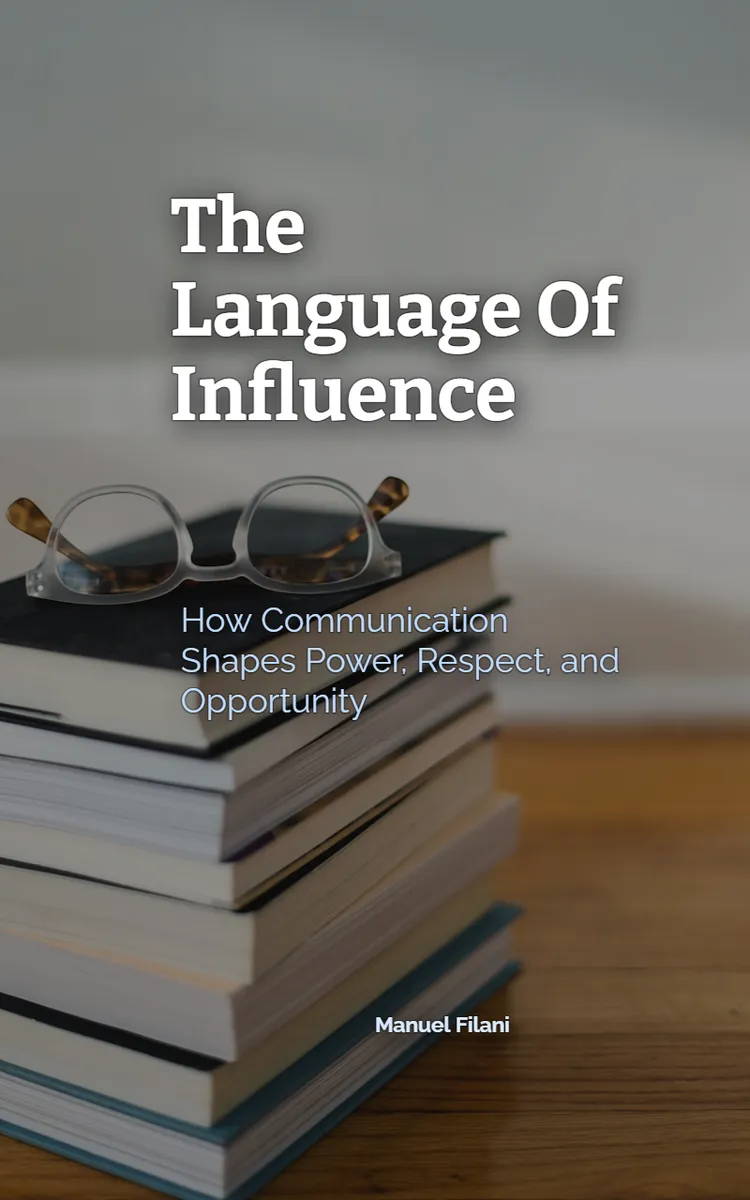
The language of influence
Created with Inkfluence AI
Table of Contents
- 1. Why Communication Controls Reality
- 2. First Impressions and Social Perception
- 3. The Psychology of Attention
- 4. Why Most People Are Never Truly Heard
- 5. Confidence in Conversation
- 6. The Power of Listening
- 7. Verbal Precision and Word Choice
- 8. Emotional Intelligence in Communication
- 9. Persuasion Without Manipulation
- 10. Conflict and Difficult Conversations
- 11. Social Intelligence and Reading People
- 12. Digital Communication and the Internet Age
- 13. Charisma and Presence
- 14. Negotiation and Influence
- 15. Becoming Someone People Remember
Preview: Why Communication Controls Reality
A short excerpt from “Why Communication Controls Reality”. The full book contains 15 chapters and 26,673 words.
The first time I watched two strangers decide the outcome of a meeting with a single sentence, I understood something I had only suspected: words do more than describe the world. They rearrange it.
It happened at a small design firm during a late-afternoon review. A junior designer stood in front of a screen, nervously explaining a risky visual concept. The lead partner-calm, minimally expressive-listened. Then he said, without changing his tone: "That risks our reputation with legacy clients." The room moved like it had been tugged. The junior's idea dimmed. A different colleague, who had been quiet until that moment, leaned forward and said, "Or it could open a new market we haven't captured." Two short phrases, offered from different positions in the room, produced two different realities: one tightened, one widened. By the end of the meeting the project was reframed, priorities shifted, a brief was rewritten, and a launch timeline altered. Nothing mystical had happened. Language had simply changed perception, and perception had changed what the group considered real and possible.
This is the engine behind influence. Communication is not a neutral conduit for facts; it's a tool that edits the map we all use to navigate social reality. When you call something a "risk," you invite caution; when you call it an "opportunity," you invite appetite. The content of what you say matters-but so does context, cadence, and credibility. Together, those elements determine which version of reality wins the room.
Language creates social facts
Consider commonplace social facts: who counts as an expert, which ideas are respectable, who is invited to the table. At their root, these are negotiated. They exist because enough people agree, explicitly or tacitly, to treat them as true. Language speeds that agreement. Titles, labels, introductions, the framing of data-these are not mere decorations. They are the scaffolding of social reality.
A simple example: introductions. When someone is introduced as "our founder," the audience assigns authority, credibility, and leadership expectations before that person speaks. When introduced as "a long-time collaborator," the same person walks into the room with different allowances. The words surrounding a person alter how their subsequent words will be received. You can be factually identical in skill and history and yet be treated differently depending on how you are linguistically placed.
Labels have gravitational pull. Call someone "brave" and you make bravery salient in their subsequent choices; call a situation "an emergency" and you change how people allocate attention and resources. This is not manipulation in the dark-art sense; it's ordinary human meaning-making. We live in a social world where naming is an act of construction.
Why attention bows to language
Attention is scarce. The human mind constantly filters sensory chaos into manageable narratives. Language helps by selecting, highlighting, and sequencing what matters. The person who can put the right word in the right place can guide that filter. In conversation, a well-placed qualifier ("notably," "most importantly," "consider") signals what to keep. In writing, the first sentence sets the axis around which readers orient.
This quality makes communication a power multiplier. A single phrase that reframes a problem will redirect attention, marshal resources, and change behavior. In leadership, this is why a mission statement or a single public line can unify a disjointed organization. In relationships, it's why the way you phrase a complaint determines whether it becomes a wedge or a bridge.
Language also creates expectations. When a manager says "Tell me your plan," they expect a structured answer; when they say "Tell me what's bothering you," they signal a different kind of space-less about data, more about emotion. People calibrate not only to the content but to the form of communication, and that calibration changes what they bring to the exchange.
The economy of credibility
Not every word has equal force. Influence is earned. The same sentence spoken by two people will have different effects depending on credibility, reputation, and perceived intent. Credibility is a kind of currency in conversational markets. It's built through consistent competence, clarity, and relational history. Once accumulated, it allows fewer words to do more work.
This explains practical dynamics in teams and networks. When a trusted voice offers an idea, others will often mirror that framing because it reduces cognitive cost: less debate, faster alignment. When an untrusted voice pushes the same framing, it meets resistance and scrutiny. Thus, influence is not simply about rhetorical skill; it's about the relationship between speaker and audience.
But credibility can be strategic....
About this book
"The language of influence" is a general book by Manuel Filani with 15 chapters and approximately 26,673 words. It covers key insights and practical takeaways on the topic.
This book was created using Inkfluence AI, an AI-powered book generation platform that helps authors write, design, and publish complete books.
Frequently Asked Questions
What is "The language of influence" about?
"The language of influence" is a general book by Manuel Filani covering key insights and practical takeaways on the topic.
How many chapters are in "The language of influence"?
The book contains 15 chapters and approximately 26,673 words. Topics covered include Why Communication Controls Reality, First Impressions and Social Perception, The Psychology of Attention, Why Most People Are Never Truly Heard, and more.
Who wrote "The language of influence"?
This book was written by Manuel Filani and created using Inkfluence AI, an AI book generation platform that helps authors write, design, and publish books.
Write your own book with AI
Describe your idea and Inkfluence writes the whole thing. Free to start.
Start writingCreated with Inkfluence AI


