
Read the first chapter
The whole of chapter one, free. About 7 min. Turn the pages with the arrows, your keyboard, or a swipe.
Chapter 1
Why “a” Feels Incomplete
Get started →
Have you noticed how a single little word - “a” - can make a sentence feel like it’s missing something? It’s supposed to be simple. In everyday English, “a” means “one,” “some,” “any,” and it usually causes no trouble at all. But in the middle of a book, a headline, or a confusing explanation, “a” can act like a loose thread: you keep pulling, and the fabric doesn’t show you what you want.
This chapter explores that specific itch. When the meaning behind “a” isn’t anchored - when the reader doesn’t know which “something,” which “kind,” or which “instance” - curiosity doesn’t just show up. It multiplies. The same missing context that frustrates you can also become the engine that drives you forward, because your brain hates leaving a question hanging.
We’ll look at how this works in reading and listening, how it shows up in real history and real science, and why the “incomplete” feeling can be more informative than the full answer. When a story hands you “a” and refuses to specify, what is your mind actually trying to recover?
The Deep Dive: One Word, Two Jobs, and a Missing Anchor
In English grammar, “a” is often called the indefinite article. The word’s basic job is to point you toward something without naming it: a cat, a theory, a reason. But “indefinite” doesn’t mean “random.” It means not uniquely identified to the listener or reader. That distinction matters because reading is an active process. Your mind doesn’t merely receive words; it tries to build a model of the situation those words describe.
Psycholinguists have long argued that comprehension involves prediction and updating. When you hear or read “a”, you’re invited to create a placeholder - an object or event that can be shaped by later details. If later details never arrive, the placeholder keeps waiting. That’s why “a” can feel incomplete: the grammar is doing its job, but the text fails to supply the information your mental model expects.
There’s also a cultural layer here. English writing often relies on shared context. In conversation, people can gesture, point, or rely on what’s already been said. In writing, those supports are removed, so the text has to provide its own anchors. When it doesn’t - when it says “a” and then keeps things vague - the reader fills the gaps with guesswork. This is not just a literary quirk. It’s a real cognitive cost: you spend effort maintaining uncertainty, and you keep revising your guesses as new words arrive.
A small, stubborn detail makes this clearer. In many languages, articles behave differently. Some languages don’t have a direct equivalent of English “a,” and they mark definiteness in other ways. Even within English, writers sometimes replace “a” with phrases like “one particular”, “the only”, or “this” when they want to stop the reader from hovering. The fact that English has both definite and indefinite forms tells you something important: writers know the difference between pointing and inviting. “a” is more of an invitation.
And invitations can be powerful. They create room for engagement. But they also create a demand: the reader wants the invitation to lead somewhere.
What You Did Not Expect: The Curiosity Gap Isn’t Just a Marketing Trick
There’s a well-known phenomenon in pop non-fiction and media: the curiosity gap - the feeling that you’re missing something and can’t stop thinking about it. What’s surprising is that the curiosity gap isn’t only about suspense or advertising. It also shows up in everyday comprehension, because uncertainty is a signal your mind can’t comfortably ignore.
Here’s the counterintuitive finding: incomplete context can increase attention and persistence, even when it frustrates you. That sounds contradictory, but it’s exactly how many people experience reading when key details are withheld. The mind treats the missing piece as a problem to solve. It doesn’t always feel good, but it keeps the topic active in your working memory long enough for you to seek resolution - by rereading, by scanning for clues, or by reaching for outside information.
Why does that matter for “a”? Because “a” is the linguistic tool that most naturally withholds identification. It doesn’t say which; it says some. When a writer uses “a” and then doesn’t supply the missing specification, the reader’s brain has to do extra work: it holds multiple candidate interpretations at once. That’s the frustration. Yet the same uncertainty is also what sustains momentum. The reader keeps the question alive because the text has created a gap worth filling.
This reframing changes how we understand the “incomplete” feeling. It’s not just a failure of clarity. It’s a kind of cognitive gear-shift. By leaving which one unspecified, the text implicitly triggers an internal search for the most likely candidate - based on genre, prior knowledge, and the surrounding phrasing. The reader isn’t only confused; the reader is also being recruited into the meaning-making process.
In other words, “a” doesn’t just mark absence. It marks a relationship between the text and the reader: you are part of the construction.
The Human Story: Nora and the Lecture Note That Wouldn’t Settle
Consider Nora, a 19-year-old first-year literature student who keeps a stack of lecture printouts in a folder that’s getting thicker every week. One afternoon she’s reading a short excerpt her seminar leader assigned - an argument about how stories make claims - and she stumbles over a line that begins, “ A reader will…” The sentence continues, but it never tells you which reader, and it never pins down what kind of reading situation the author has in mind. Nora reads it once, then again, expecting the missing specificity to arrive on the next page. It doesn’t.
What makes her reaction distinctive isn’t that she feels lost. It’s that she feels pulled. She can sense the author’s confidence - there’s a steady rhythm to the claim - but the anchor point is missing. When she tries to mentally substitute “the reader” for “a reader,” the sentence starts to behave differently. “The reader” sounds definite, like a known category. “A reader” sounds like a variable. Nora notices that her mind keeps generating versions: a student like her, a casual browser, someone reading for pleasure, someone reading for school. Each version makes the argument slightly different, and that’s exhausting.
Later, in a campus library where the air is cool and the shelves are tall enough to feel like walls, she turns to a reference style guide and checks how writers handle indefiniteness. She also tries a more practical tactic: she compares the excerpt to other essays in the course packet. In some of them, the authors use “the” when they mean a specific group or concept. In others, they use “a” when they’re being deliberately general. Nora realizes she’s not just wrestling with grammar; she’s wrestling with the writer’s intent - whether the author wants to describe a single stable phenomenon or keep the claim open-ended.
The deeper connection to the central theme shows up in a moment she doesn’t expect to matter: she starts writing margin notes, not to correct the author, but to capture the gap. She underlines “a reader” and scribbles what she thinks the author might mean. That act is her Curiosity Gap Loop in motion - her attention circles back to the unspecified element because it’s the only part that refuses to lock into place. The missing context creates a question, the question creates effort, and the effort keeps the passage from becoming background noise.
Her frustration is real, but it’s also productive in a particular way. She’s learning how meanings are negotiated between a text and a mind. The ambiguity forces her to notice the difference between what an author asserts and what an author leaves for the reader to supply.
What This Tells Us: The Mind Treats Uncertainty as a Promise
People often talk about clarity as if it’s purely kindness. Clear writing helps you understand faster, and yes, it does. But the feeling of incompleteness around “a” suggests something more subtle: uncertainty can function like a promise that the missing detail is nearby, waiting to be found. Your mind can’t help interpreting the text as a system that should eventually resolve. When it doesn’t, you don’t just stop; you keep searching.
That’s why the same linguistic looseness can generate two opposite emotional outcomes - annoyance and persistence. The annoyance comes from the cognitive bookkeeping required to hold multiple interpretations in mind. The persistence comes from the brain’s tendency to treat unresolved uncertainty as information, not as dead air. Even when the text is poorly anchored, it’s still doing work: it’s shaping where your attention lands.
There’s also a social implication. Writers and speakers use indefiniteness to manage how much they reveal, how broadly they claim, and how much authority they borrow from the reader’s assumptions. When “a” appears, it can be a choice about scope, not just grammar about “one.” That means the reader’s confusion isn’t merely personal weakness. It’s a sign that the text is asking you to do some of the meaning-making labor it didn’t want to spell out.
If you’ve ever reread a paragraph because one small word wouldn’t settle, you already know the secret: the mind doesn’t just consume information. It negotiates it. And when the text leaves you with “a,” it’s not only withholding an answer - it’s recruiting you into the search for one. So when the sentence never specifies, is the missing context a mistake, or is it the mechanism that keeps you reading?
End of chapter one. 4 more chapters in the full book.
Swipe or use the arrows to turn the page
What's inside: 5 chapters
- 1. Why “a” Feels Incomplete
- 2. The Hidden Story Inside One Letter
- 3. Guessing Games: Filling What’s Missing
- 4. The Emotional Physics of Ambiguity
- 5. The Universal Lesson of the Missing Page
About this book
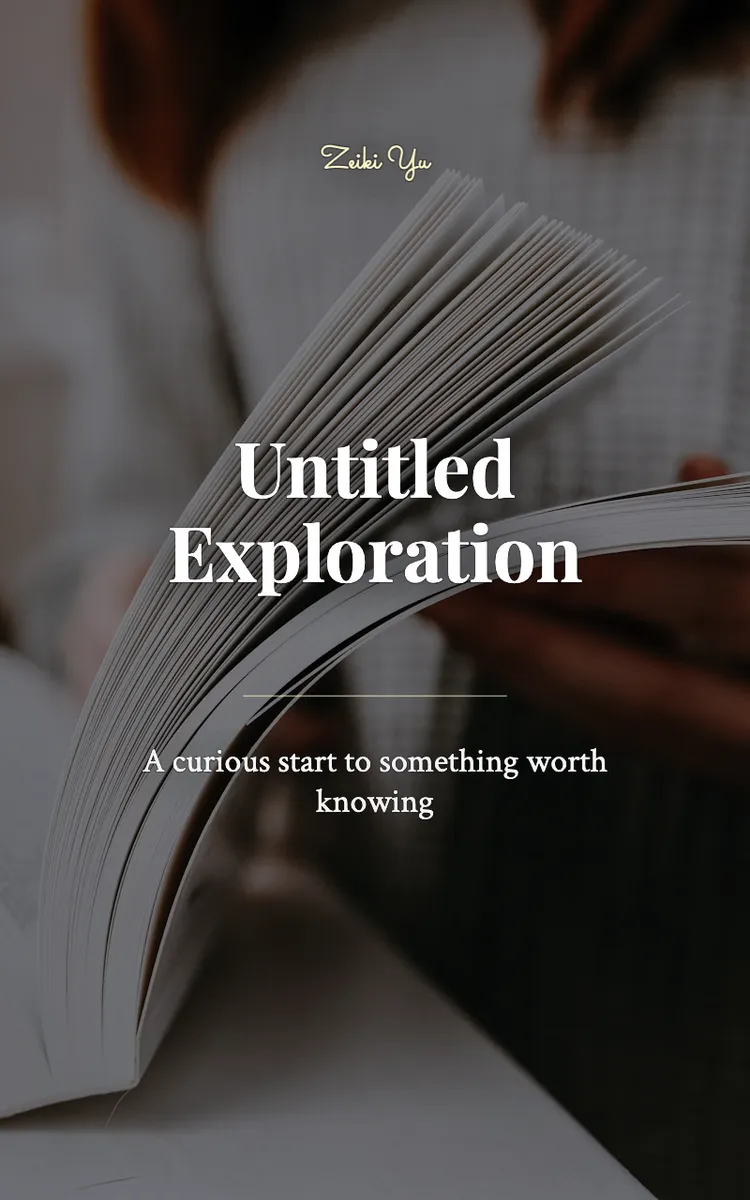
"Untitled Exploration" is a curiosity book by Zeiki Yu with 5 chapters and approximately 9,050 words. Unspecified topic from an incomplete book idea.
This book was created using Inkfluence AI, an AI-powered book generation platform that helps authors write, design, and publish complete books.
Frequently Asked Questions
What is "Untitled Exploration" about?
Unspecified topic from an incomplete book idea
How many chapters are in "Untitled Exploration"?
The book contains 5 chapters and approximately 9,050 words. Topics covered include Why “a” Feels Incomplete, The Hidden Story Inside One Letter, Guessing Games: Filling What’s Missing, The Emotional Physics of Ambiguity, and more.
Who wrote "Untitled Exploration"?
This book was written by Zeiki Yu and created using Inkfluence AI, an AI book generation platform that helps authors write, design, and publish books.
Write your own curiosity book with AI
Describe your idea and Inkfluence writes the whole thing. Free to start.
Start writingCreated with Inkfluence AI


