

Read the first chapter
The whole of chapter one, free. About 8 min. Turn the pages with the arrows, your keyboard, or a swipe.
Chapter 1
The Throne Demands New Taxes
Elara seized the iron rail before the Pelvic Throne-walk tilted beneath her boots.
A bell below struck once, then broke into a wet metallic cough. The ward-engine answered with a shudder. Blue fire withdrew from the channels in the floor, leaving the carved bones of Kael-Marak black and slick with condensation. Somewhere beyond the walls, a district furnace went dark. The sudden silence was worse than any scream.
“Close the eastern sluices,” Elara said.
Her voice carried along the curved passage, though the stone had been built to swallow voices. Priests in ash-white veils turned toward her. Engineers crouched over the exposed conduits. A woman from the lower kitchens clutched a basket of ration loaves against her ribs, as if bread could brace a city.
“The sluices are already closed,” said Master Orun, the oldest of the ward-keepers. His fingers were burned to the knuckles. “That is the problem.”
Elara looked down through the open ribs of the Throne-walk. The Pelvic Throne had been carved beneath the palace, where the first kings had believed the city’s foundation should be shaped like a body waiting to receive pain. Its stone thighs descended into the ward-engine. Its hollow pelvis housed the Cradles, where the dead had been bound in layers of glass and salt. Every street above depended on the blue fire rising through those chambers.
Malakor’s blood still darkened the steps behind her.
The city had called the night of his disappearance a miracle. The priests had called it an ascension. The nobles had called it succession, until Elara had broken Lord Vex Dorr’s seal and rewritten the first decree in her own hand.
Reduce the Tithe by half.
No child taken for a fever. No baker’s wife seized for a debt. No field hand marked because his father had once fled a levy. The decree had gone out at dawn, nailed to temple doors and shouted from the grain markets. People had wept in the streets. They had lifted their faces toward the palace and called Elara the Mercy-King, though she had forbidden the title.
By noon, the furnaces had begun to fail.
“Show me the eastern sluices,” she said.
Orun gave a humorless laugh. “You are standing in them.”
The floor trembled again. A hairline crack opened across the nearest channel. It ran through the painted sigils of the old Tithe, severing a line of silver script. Light flared, then vanished.
Above them, a distant bell began ringing without rhythm.
“Which ward?” Elara asked.
“Dockside first. Then the tanneries. The lower grain lifts stopped an hour ago.”
“The people there cannot be made to pay the old Tithe.”
“No.” Orun’s eyes lifted to hers. “They can only be made to pay something.”
The words struck more cleanly than accusation. Elara stepped over a fallen brass instrument and approached the broken channel. Heat crawled through the soles of her boots. Beneath the stone, something moved with the slow pressure of a buried animal.
“Cut another conduit,” she said. “Draw from the palace reserve.”
“There is no reserve.”
“Then from the noble vaults.”
“The vaults are not connected.”
“Connect them.”
Orun stared at her. Around him, the ward-keepers lowered their heads. They had served Malakor, then served the silence left by Malakor, and now they waited to see whether Elara’s mercy had a spine or only a bright name.
Lord Vex Dorr’s steward, a narrow man called Pell, stepped from behind the priests. “The noble vaults cannot be opened without a seal from the Council of Nine.”
“The Council of Nine dissolved itself when Malakor died.”
“Dissolved is not the same as powerless.”
Elara turned. Pell’s mouth was bloodless, but his velvet coat remained immaculate. He had come below in mourning colors and carried a ring of black iron at his throat.
“Tell me what is in the vaults,” she said.
“Family relics. Inheritance stores. Private ward-stones.”
“Pain?”
Pell hesitated.
The engine groaned. From somewhere beneath the Throne-walk came a muffled chorus, too many voices speaking through water.
Orun closed his eyes. “The private stones are fed by contracted sufferers. Prisoners. Debtors. Household servants who signed away their years.”
“Then open them.”
Pell’s face tightened. “That would be theft.”
Elara reached for the ring at his throat and tore it free. The chain cut his skin. He gasped, more offended than hurt.
“Everything beneath this palace is theft,” she said. “The question is whether we steal from the living or the dead.”
She pressed the ring against the nearest seal.
The stone accepted it.
Light rushed through the channel, not blue but red, the color of meat seen through a butcher’s glass. The Pelvic Throne lurched. Pell fell to his knees as a voice began screaming from the walls.
Not one voice. Hundreds.
The kitchen woman dropped her basket. Loaves rolled across the floor, steaming in the cold.
“Stop it,” she whispered.
Elara pulled her hand away. The seal remained open. Red fire poured through the passage, carrying the smell of iron and boiled herbs. Above, the city answered with a chain of sounds: lifts grinding into motion, furnaces coughing awake, bells changing from alarm to prayer.
For one breath, the ward held.
Then the red light thinned.
Orun looked toward the Cradles. “The private stores are too clean. They have been drained for years. Malakor burned through them.”
“Use the palace.”
“There is no palace reserve.”
“Use mine.”
The ward-keepers looked at her hands.
Elara understood before Orun spoke. “The crown?”
“The authority in you,” he said. “The thing that consumed him.”
The Throne-walk seemed to narrow around them. Her body still carried Malakor’s last heat. It lived behind her ribs, in the scar beneath her tongue, in the small black hunger that woke whenever someone knelt. She had thought defeating him meant taking the power he had made from other people’s pain and turning it against the order that fed him.
But the ward-engine did not know the difference between a tyrant’s cruelty and a savior’s intention.
It only knew what hurt.
“If I feed it,” Elara said, “the reduced Tithe becomes a lie.”
Orun’s burned fingers curled against his palm. “It becomes an administration.”
The kitchen woman bent to retrieve a loaf. Her hands shook. “My son works the lower lifts,” she said. “He was marked for the Tithe last winter. Your decree spared him.”
Elara looked at her.
“If the lifts stop,” the woman continued, “the grain will not rise. If the grain does not rise, no decree will feed us.”
A priest murmured, “The city must be balanced.”
The woman turned on him. “Balance is what you call it when someone else is underneath.”
No one answered.
A new tremor threw dust from the ceiling. The red channel snapped shut. The lifts above groaned to a halt.
Elara walked to the central dais.
The ward ledger lay there beneath a sheet of waxed cloth. It had belonged to Malakor, bound in the skin of condemned kings. Its pages were blank now, waiting. The old law had assigned pain by birth, debt, illness, loyalty, and usefulness. Elara had believed cutting the Tithe would loosen those bindings.
Instead, the engine had reached for another body.
“Bring me the condemned register,” she said.
Orun did not move. “There are three hundred names.”
“Not three hundred.”
“Any name will be a beginning.”
Pell rose slowly, rubbing his throat. “There is one who has already been condemned under the old order. Lord Vex Dorr.”
The priests shifted. Even the engine seemed to listen.
Vex had survived Malakor’s death by locking himself inside the western treasury. He had emerged only when Elara’s decree made his estates subject to seizure. Since then, he had claimed the king-eater had no lawful right to rule.
“Where is he?” Elara asked.
“Above,” Pell said. “In the Hall of Measures. He has gathered the remaining lords.”
Orun caught her sleeve. “If you put a noble’s pain into the ward, the city will call it justice.”
“And if I refuse?”
“The city will call it hunger.”
Elara looked through the broken ribs of the Throne-walk. Far below, the Cradles glimmered behind their glass. The trapped dead pressed against one another, faces flattened by centuries of pressure. Their mouths opened whenever the engine failed. Their suffering had been made infrastructure. Her reforms had not freed them. They had merely shifted the burden onto a new account.
She took the ledger.
“Open the Hall of Measures,” she said.
• * *
Vex Dorr stood beneath the old succession canopy with a sword in one hand and a decree in the other.
The hall smelled of rain, wax, and fear. Lords crowded the steps, their silk sleeves brushing as they whispered. Behind them, servants waited with empty trays. The palace kitchens had run out of flour before sunset.
“You cannot enter,” Vex said.
Elara crossed the threshold. “I have entered.”
“You have no crown.”
“I ate the man who wore one.”
The hall went still.
Vex’s face had the polished softness of someone whose pain had always been assigned to others. His white hair was tied with gold thread. The sword in his hand had never been drawn in battle.
“You promised mercy,” he said.
“I promised a reduced Tithe.”
“And now the furnaces fail.”
“They fail because your houses consumed the reserve.”
A murmur moved through the lords.
Vex lifted the decree. “This paper has already cost lives. Dock workers are collapsing. Grain rots in halted lifts. Your mercy is incompetence dressed in blood.”
Elara felt the ledger warm against her palm.
“Then help me repair what your order built.”
“I will not feed your machine.”
“No,” she said. “You fed it for thirty years. I am asking you to remain useful.”
His sword came free with a bright scrape.
The first cut was aimed at her throat. Elara caught his wrist. The power inside her answered before thought, and Vex’s arm twisted backward with a crack. He screamed. The sound passed through the hall and down into the ward-engine.
Below them, a furnace ignited.
The lords recoiled.
Elara forced Vex to his knees. His sword clattered across the marble. She opened the ledger and placed his broken hand on the page.
“Say your name,” she said.
“Go to the Void.”
“Say it.”
“I am Lord Vex Dorr.”
The ink moved beneath his palm.
He screamed again, louder. Red light burst through the floor, racing along the palace foundations. The hall’s chandeliers flared. Far away, the grain lifts began to turn.
The people below would hear the machinery return. They would cheer, perhaps. They would call it justice. They would not know that every revolution of those lifts now drew from Vex’s nerves, his memories, his terror. They would not know that Elara had signed his suffering into the city’s walls with her own hand.
Vex’s body sagged. His eyes remained open.
“Mercy,” he rasped.
Elara looked at the name burning beneath his fingers.
“No,” she said. “Maintenance.”
The ledger slammed shut.
The palace bells began to ring. In the lower districts, the furnaces answered one by one, and the city’s first new tax entered its veins.
End of chapter one. 7 more chapters in the full book.
Swipe or use the arrows to turn the page


What's inside: 8 chapters
- 1. The Throne Demands New Taxes
- 2. Starvation Follows Beneath the Ward
- 3. The Cradle Offers a Bad Choice
- 4. Autonomy Splinters the Meat-Gardens
- 5. Consent Becomes a Public Ritual
- 6. The Missing Variable Is Choice
- 7. The Next Tithe Finds No Volunteers
- 8. The Mirror Shows Her as the Rule
About this book
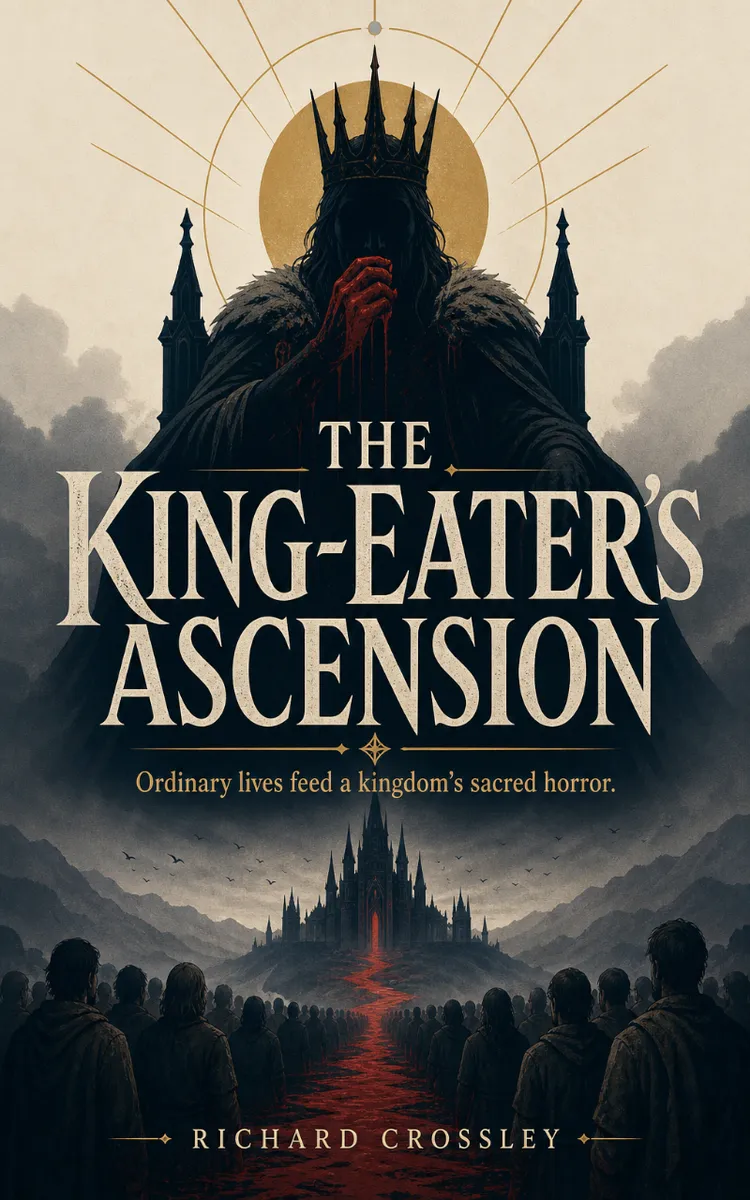
"The King-Eater’s Ascension" is a fiction book by Richard Crossley with 8 chapters and approximately 15,854 words. A fantasy kingdom where ordinary people sustain a king-eating regime..
This book was created using Inkfluence AI, an AI-powered book generation platform that helps authors write, design, and publish complete books. It was made with the AI Novel Writer.
Frequently Asked Questions
What is "The King-Eater’s Ascension" about?
A fantasy kingdom where ordinary people sustain a king-eating regime.
How many chapters are in "The King-Eater’s Ascension"?
The book contains 8 chapters and approximately 15,854 words. Topics covered include The Throne Demands New Taxes, Starvation Follows Beneath the Ward, The Cradle Offers a Bad Choice, Autonomy Splinters the Meat-Gardens, and more.
Who wrote "The King-Eater’s Ascension"?
This book was written by Richard Crossley and created using Inkfluence AI, an AI book generation platform that helps authors write, design, and publish books.
How can I create a similar fiction book?
You can create your own fiction book using Inkfluence AI. Describe your idea, choose your style, and the AI writes the full book for you. It's free to start.
Write your own fiction book with AI
Describe your idea and Inkfluence writes the whole thing. Free to start.
Start writingCreated with Inkfluence AI


