
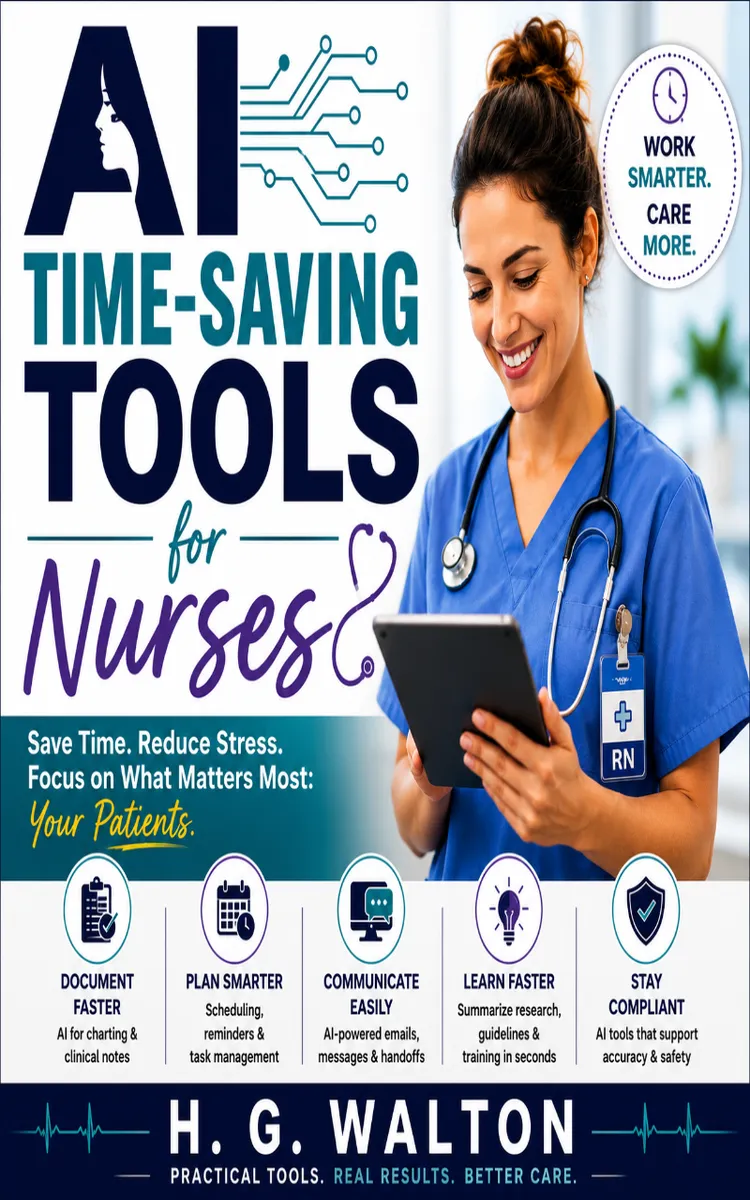
AI Time-Saving Tools for Nurses
Created with Inkfluence AI
🔀 Remixed from Budget Journal For College Students
Documentation is stealing your shift, not your patients. Every note rewrite, every guideline search, every “quick” message adds up until you are running out of time for the care only you can give. This workbook shows you how to use AI as a safe assistant, not a replacement. You will learn practical ways to summarize, draft, and automate the repetitive parts of nursing work, then verify outputs against your patient data and your unit protocols. You will also build two reusable systems that make the time savings stick: an AI-assisted handoff template and a simple category system for tracking the purchases that support your campus work. Start using it today, and reclaim minutes you can feel.
Table of Contents
- 1. Core concept: AI time-saving tools for nurses
- 2. AI Handoff Templates That Stick
- 3. Streamline Your First Category System
- 4. Clear concept: refine your first category system into a reliable routine
- 5. Make Tagging Automatic
Preview: Core concept: AI time-saving tools for nurses
A short excerpt from “Core concept: AI time-saving tools for nurses”. The full book contains 5 chapters and 4,910 words.
Core concept: AI time-saving tools for nurses
Nurses spend a lot of time on documentation, information lookup, and routine communications - tasks that steal hours from patient care. AI tools can speed those tasks by summarizing notes, drafting messages, automating simple decisions, and surfacing relevant guidelines. When you use AI as a helper, not a replacement, it reduces repetitive work and keeps you focused on the clinical judgment only you can provide. You’ve got this: small, consistent uses of AI can save 10-30 minutes per shift on average when matched to the right task.
Key components of effective nursing AI use:
Data capture: choose tools that connect to your charting system or accept quick voice/text entry.Summarization: use models that condense notes into concise problem lists, nursing assessments, or shift handoff bullets.Task automation: set up templates for common messages (family updates, handoffs, discharge instructions).Safety checks: always verify AI outputs against patient data and institutional protocols.
Bold takeaway: Use AI for repetitive, rule-based tasks - then confirm clinically - so you gain back time for hands-on care.
Guided practice: set up a quick AI-assisted handoff
Materials needed: smartphone or workstation with internet access and an AI summarization tool (example: a secure hospital-approved summarizer or a general tool you’re allowed to use).
Time required: about 15 minutes to set up templates, then 2-5 minutes per handoff.
Your Turn - step-by-step setup:
Open your chosen AI tool and create a new template called “Shift Handoff - Med/Social/Plan.”In the template, add headings you use every handoff: ID/room, problem list, vitals trend, meds due, recent changes, pending labs/tests, and plan for next shift.Paste or dictate a sample progress note (150-300 words) into the tool and request a “2-3 sentence clinical summary for handoff” plus “3 bullet nursing tasks for next shift.”Review the AI output and edit any inaccuracies. Save the corrected output as a reusable snippet.Use the snippet during your next actual handoff; time how long it takes you to produce the handoff compared with your old method.
Completed example (saved snippet):
Patient: J. Smith, Rm 312. Active problems: CHF exacerbation, A-fib, Stage 2 AKI. Vitals stable, O2 2L NC, urine output decreased past 6 hrs. Recent change: diuretic increased this morning; furosemide IV 40 mg given at 0800. Pending: BMP repeat at 1400, cardiology consult note. Tasks: monitor urine output q1h, hold further diuretics if K <3.5 or SBP <100, call cardiology if new palpitations or hypotension, prepare discharge med reconciliation.
Tips to make it easier: keep one template for similar patient types (medical, postop, psych) and reuse the saved snippet structure. You’ll notice the first few handoffs take longer while you refine prompts - after three shifts you’ll usually cut handoff prep time in half. Remember to verify labs and meds; you’re editing the AI, not outsourcing judgment.
Real-world application: everyday nursing scenarios
Clinical unit handoffs: Use AI to convert long nurse progress notes into a 3-point summary for the next nurse. For a 20-patient med-surg assignment, cutting 3 minutes per handoff saves an hour each shift. Expect clearer priorities, fewer missed meds, and reduced cognitive load when summaries consistently highlight pending tasks and safety checks.
Family communication: Drafting family updates after rounds takes emotional energy and time. Use AI to create a plain-language update from the plan and orders. Example outcome: a 2-4 sentence family message ready in 1-2 minutes rather than 10, with language you adjust for tone. You still choose what to share, but the AI speeds phrasing.
Medication reconciliation and discharge: AI can map current meds to common outpatient equivalents and generate a checklist for discharge teaching. For a straightforward discharge, this can reduce form-filling time by 5-10 minutes and help you catch one-off interactions (drug interactions or dose changes) you’d otherwise need to look up manually.
Triage and initial intake: On fast-paced units, use voice-to-text plus an AI summarizer to capture the intake quickly. Expect a usable problem list and immediate nursing tasks in under five minutes, freeing you to start care sooner. Always cross-check allergies and critical vitals yourself before acting.
Safety and compliance note: use only hospital-approved tools for protected health information (PHI). If you’re trying a general-purpose app, strip identifiers and treat outputs as drafts. The expected outcome is time saved without increased risk - if an AI step slows you or introduces errors, stop and revise your prompt or workflow.
Reflection and next steps
Apply It: Where would a saved AI handoff snippet help you right now?
__________
__________
...
About this book
"AI Time-Saving Tools for Nurses" is a workbook book by H. G. Walton with 5 chapters and approximately 4,910 words. Documentation is stealing your shift, not your patients. Every note rewrite, every guideline search, every “quick” message adds up until you are running out of time for the care only you can give.
This book was created using Inkfluence AI, an AI-powered book generation platform that helps authors write, design, and publish complete books. It was made with the Workbook Generator.
Frequently Asked Questions
What is "AI Time-Saving Tools for Nurses" about?
Documentation is stealing your shift, not your patients. Every note rewrite, every guideline search, every “quick” message adds up until you are running out of time for the care only you can give. This workbook shows you how to use AI as a safe assistant, not a replacement. You will learn practical ways to summarize, draft, and automate the repetitive parts of nursing work, then verify outputs against your patient data and your unit protocols. You will also build two reusable systems that make the time savings stick: an AI-assisted handoff template and a simple category system for tracking the purchases that support your campus work. Start using it today, and reclaim minutes you can feel.
How many chapters are in "AI Time-Saving Tools for Nurses"?
The book contains 5 chapters and approximately 4,910 words. Topics covered include Core concept: AI time-saving tools for nurses, AI Handoff Templates That Stick, Streamline Your First Category System, Clear concept: refine your first category system into a reliable routine, and more.
Who wrote "AI Time-Saving Tools for Nurses"?
This book was written by H. G. Walton and created using Inkfluence AI, an AI book generation platform that helps authors write, design, and publish books.
How can I create a similar workbook book?
You can create your own workbook book using Inkfluence AI. Describe your idea, choose your style, and the AI writes the full book for you. It's free to start.
Write your own workbook book with AI
Describe your idea and Inkfluence writes the whole thing. Free to start.
Start writingCreated with Inkfluence AI


