
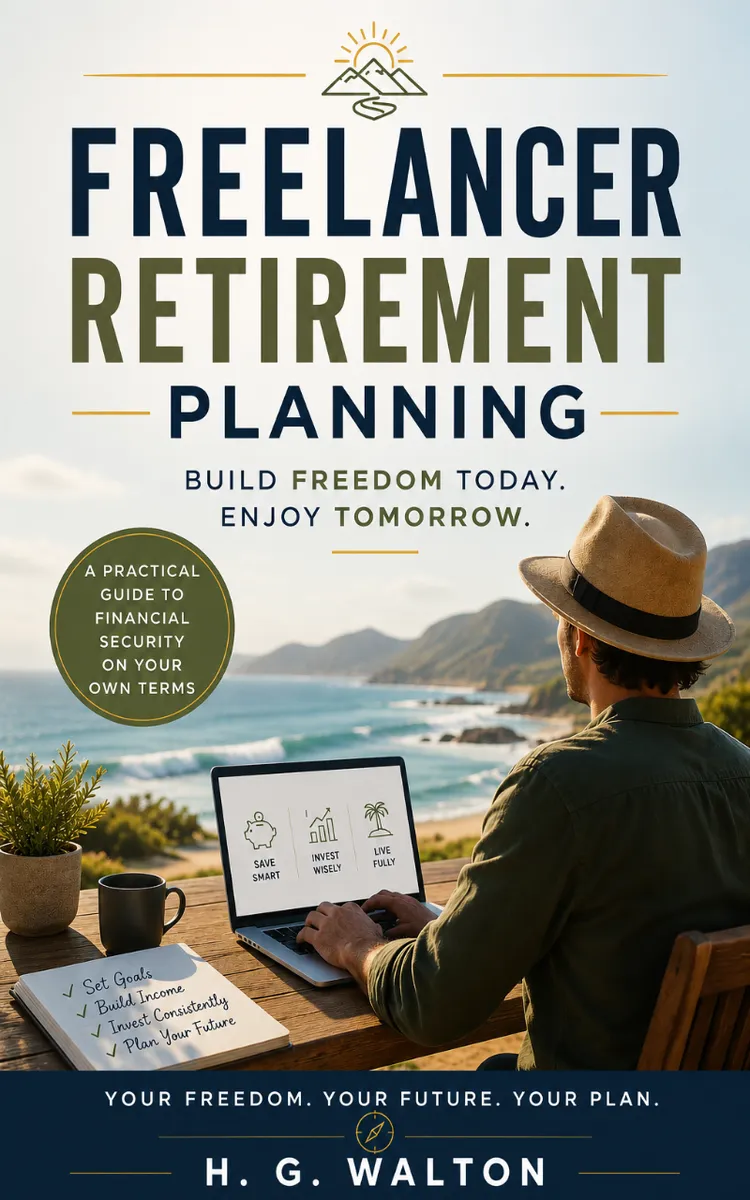
Freelancer Retirement Planning
Created with Inkfluence AI
Your retirement plan can fail long before you retire, because one wrong account choice or one shaky income forecast turns saving into paperwork, rework, and missed contributions. Freelancers and self-employed professionals face a unique problem: your income swings, your tax situation shifts, and your retirement income comes from multiple buckets that do not move together. This fast, five-chapter guide helps you stop guessing. You will learn how to match your work setup to the right retirement account types, forecast your retirement income gap in realistic calendar-year dollars, and set contributions that can handle variable cash flow without constant math. Build the expertise to choose accounts, run the numbers, and create a retirement strategy you can actually maintain.
Table of Contents
- 1. Choosing Retirement Account Types
- 2. Estimating Your Retirement Income Gap
- 3. Setting Contributions With Variable Income
- 4. Investing for Long-Term Growth
- 5. Managing Withdrawals and Tax Timing
Preview: Choosing Retirement Account Types
A short excerpt from “Choosing Retirement Account Types”. The full book contains 5 chapters and 11,111 words.
A single retirement account choice can lock you into years of paperwork, contribution limits, and tax timing. If you pick the wrong account type, you can still save, but you may end up with lower contributions, extra forms, or more hassle when you switch income patterns. For freelancers and self-employed professionals, this matters because your income can swing month to month, and your “best” account depends on how much you expect to earn and how consistently you can contribute.
This chapter helps you match your work setup to the right retirement account types: Solo 401(k), SEP IRA, and IRA options. After you finish it, you’ll be able to look at your tax situation, your expected contributions, and your comfort with paperwork, then choose an account type with a clear plan for eligibility and contributions - without guessing.
You will also learn what to check before you open an account, what numbers to run, and what mistakes typically cause rework. Use the Account Fit Compass to narrow your options quickly, then confirm the details with your plan provider or a tax professional if anything looks off.
Choosing the Right Account: Use the Account Fit Compass
Freelancers usually have three practical paths: (1) Solo 401(k) when you want higher contribution room and you run a business on your own, (2) SEP IRA when you want simple setup with employer-based contributions, and (3) Traditional or Roth IRA when you want an individual account that stays flexible even if your business income changes. The right fit comes down to who contributes, how much you can contribute, and how often you need to file forms.
Tasha, 34, works as a freelance web developer and files as a self-employed individual. She has a regular client base, but her monthly income varies. She wants a plan that lets her contribute more in good months without turning her bookkeeping into a second job. She also wants to understand the tradeoffs between “more room” and “more steps,” because she knows she won’t follow a complicated process if it depends on perfect timing.
Use the Account Fit Compass to match your situation to the account types by checking five points. You can run this in an hour with your last tax return and your best estimate for this year:
1. Confirm you qualify for a Solo 401(k)
- You can use a Solo 401(k) if you run your business as a sole proprietor (or single-member LLC taxed as a sole proprietorship) and you have no full-time employees. Part-time help can still matter, but the key check is whether you have eligible employees other than your spouse.
- Differentiator for Tasha: she has no employees, so she qualifies for Solo 401(k) as long as she stays in that setup.
2. Decide whether you want employee-style contributions, employer-style contributions, or both
- A Solo 401(k) lets you contribute two ways: you treat yourself as both an employee and an employer. That often means you can make personal contributions from your paycheck (even if you pay yourself irregularly) and also add an employer contribution.
- A SEP IRA mostly works through employer contributions only. You typically don’t make “employee deferrals” the way you do with a Solo 401(k) or some payroll-based plans.
3. Match your expected contribution pattern to the account mechanics
- If you can contribute more during the year when income spikes, a Solo 401(k) often fits well because it supports both employee and employer contributions.
- If your income changes and you want fewer decisions during the year, a SEP IRA can feel easier because you can base your employer contribution on your business income and decide the amount when you’re close to your filing deadline.
4. Choose between Traditional IRA and Roth IRA based on how you want taxes to work
- A Traditional IRA may let you deduct contributions depending on your income and whether you (or your spouse) have retirement plan coverage through your work.
- A Roth IRA does not rely on a deduction; you contribute after-tax dollars with the goal of qualified tax-free growth later.
- Differentiator for Tasha: if she expects her income to stay steady or rise, Roth often appeals because she can “pay taxes once” now. If she expects income to drop in later years, Traditional can be a better match.
5. Plan around paperwork and provider setup
- A Solo 401(k) and SEP IRA both require you to set up a plan with a financial institution that offers the plan. A Solo 401(k) usually involves more moving parts than a SEP IRA because it covers employee and employer contribution calculations.
- An IRA usually keeps things simpler because it’s an account in your name, not a business plan.
Once you map your answers, you can narrow down to the accounts that fit your real constraints....
About this book
"Freelancer Retirement Planning" is a finance book by H. G. Walton with 5 chapters and approximately 11,111 words. Your retirement plan can fail long before you retire, because one wrong account choice or one shaky income forecast turns saving into paperwork, rework, and missed contributions. Freelancers and self-employed professionals face a unique problem: your income swings, your tax situation shifts, and your retirement income comes from multiple buckets that do not move together.
This book was created using Inkfluence AI, an AI-powered book generation platform that helps authors write, design, and publish complete books. It was made with the AI Ebook Generator.
Frequently Asked Questions
What is "Freelancer Retirement Planning" about?
Your retirement plan can fail long before you retire, because one wrong account choice or one shaky income forecast turns saving into paperwork, rework, and missed contributions. Freelancers and self-employed professionals face a unique problem: your income swings, your tax situation shifts, and your retirement income comes from multiple buckets that do not move together. This fast, five-chapter guide helps you stop guessing. You will learn how to match your work setup to the right retirement account types, forecast your retirement income gap in realistic calendar-year dollars, and set contributions that can handle variable cash flow without constant math. Build the expertise to choose accounts, run the numbers, and create a retirement strategy you can actually maintain.
How many chapters are in "Freelancer Retirement Planning"?
The book contains 5 chapters and approximately 11,111 words. Topics covered include Choosing Retirement Account Types, Estimating Your Retirement Income Gap, Setting Contributions With Variable Income, Investing for Long-Term Growth, and more.
Who wrote "Freelancer Retirement Planning"?
This book was written by H. G. Walton and created using Inkfluence AI, an AI book generation platform that helps authors write, design, and publish books.
How can I create a similar finance book?
You can create your own finance book using Inkfluence AI. Describe your idea, choose your style, and the AI writes the full book for you. It's free to start.
Write your own finance book with AI
Describe your idea and Inkfluence writes the whole thing. Free to start.
Start writingCreated with Inkfluence AI


