
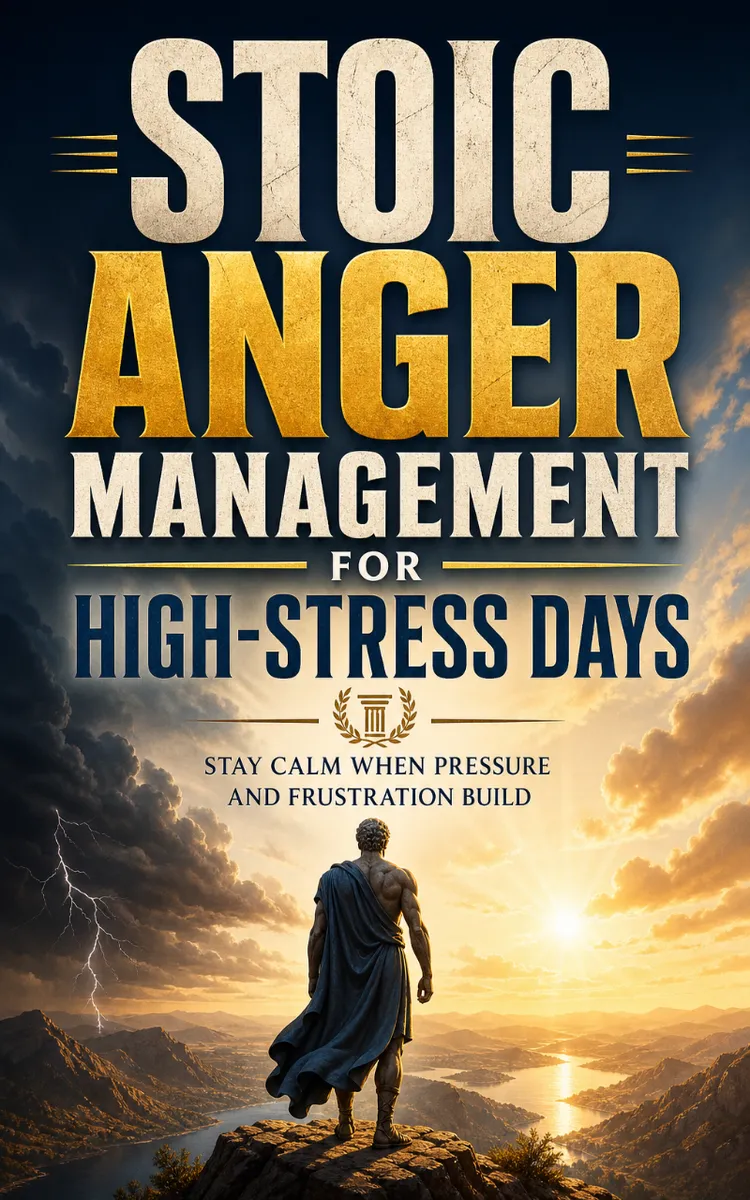
Stoic Anger Management For High-Stress Days
Created with Inkfluence AI
Stoic-based strategies to manage anger on high-stress days
Table of Contents
- 1. Choosing Your Inner Response
- 2. Spotting Anger’s First Signals
- 3. Separating Facts From Judgments
- 4. Using the Dichotomy of Control
- 5. Defining Your Values Under Pressure
- 6. Replacing Blame With Responsible Action
- 7. Breaking the Catastrophe Loop
- 8. Practicing Negative Visualization Briefly
- 9. Turning Irritation Into Useful Feedback
- 10. The Stoic Pause: Breathe and Choose
- 11. Communicating Without Winning the Argument
- 12. Setting Boundaries Without Emotional Debt
- 13. Handling Passive-Aggressive Triggers
- 14. Fatigue-Proofing Your Temper
- 15. Rehearsing Hard Conversations in Advance
- 16. Using “What Would a Good Person Do?”
- 17. Recovering After You Snap
- 18. Building a Daily Calm Routine
- 19. Practicing Voluntary Discomfort for Resilience
- 20. Living Anger-Free Through Purpose
Preview: Choosing Your Inner Response
A short excerpt from “Choosing Your Inner Response”. The full book contains 20 chapters and 28,723 words.
Picture This
“Between the event and your reaction, there’s a hinge. If you don’t touch it, anger swings the whole door.”
Dante, 34, is three hours into a night shift that’s already gone sideways. A patient starts declining fast. A family member calls out for updates-loudly-while the charge nurse is juggling three emergencies at once. Dante’s been running on coffee and adrenaline, and now there’s a new request, a new interruption, and a new reason to feel like everything is stacked against them.
Then it happens: a coworker snaps a comment-something small, but delivered like a slap. Dante feels heat rise immediately, the kind that makes your chest tighten and your voice get ready before your brain does. You know the moment: you’re not choosing anger, you’re just… sliding into it.
What if the “you can’t control what happens” part is only half the story-and the other half is where your calm actually lives?
The Mindset Shift
Old Belief: “If I didn’t get disrespected / overwhelmed / blindsided, I wouldn’t be angry.”
New Reality: “The event can push me, but my judgment decides what I become in response.”
That shift is small on paper, but it’s huge in your body. Because when you believe the old belief, you hand over the steering wheel. Every rude comment, every sudden change in workload, every delay in supplies becomes a remote control for your emotions. You don’t feel angry-you feel made angry.
The Stoic hinge flips that. You can’t control what happens-Dante can’t control a patient’s condition, a family member’s tone, or the fact that the night is short-staffed. But Dante can control the judgment that shows up right after the event: “They’re attacking me.” “I’m being treated unfairly.” “This is unacceptable.” Those judgments are the hinge. They’re what turn pressure into anger.
Here’s a concrete example from Dante’s world. The coworker’s snap lands, and Dante’s mind starts drafting a story: “Of course they’d say it like that. I’m doing everything right, and still I’m the one taking hits.” That story doesn’t just feel bad-it speeds anger up like a motor. It also steals attention from what Dante actually needs to do next: care, communicate, and stay steady.
Now try the new reality judgment, not as a “positive” thought, but as a clean one: “A sharp comment happened. My job is to choose how I interpret it and what I do next.” Same moment. Same pressure. Different hinge position. Instead of anger taking the wheel, Dante can choose a calmer response-like pausing one breath longer before answering, or using a neutral tone to clarify the need. That’s not pretending everything is fine. It’s deciding that your reaction is still yours to steer.
And notice the difference between judgment and denial. Stoicism isn’t saying, “That comment didn’t matter.” It’s saying, “Your interpretation is the lever. If you don’t touch it, anger touches you.”
Going Deeper
Stoics didn’t treat anger like a random storm that hits you from nowhere. They treated it like a response built from your mind’s quick interpretation. The hinge is the point where an event becomes a meaning, and the meaning becomes your action.
In plain terms: your brain reacts to what you think the event means, not just the event itself. Pressure is the wind. Judgment is the sail. You can’t always stop the wind, but you can change how you catch it. That’s why the hinge matters so much on high-stress days-because you usually don’t get one big decision. You get dozens of tiny ones. The hinge is where those tiny decisions stack up into either calm or chaos.
When Dante is exhausted, the hinge gets touchy. Fatigue makes the mind faster and less accurate. So the coworker’s snap becomes “proof” of disrespect. A delay becomes “evidence” of being unsupported. A hard patient moment becomes “another reason I can’t handle this.” That chain is how anger forms its own storyline and then demands you act it out.
Here are signs this pattern is running your life-especially when you’re tired, rushed, or stuck under pressure:
1. You replay the moment like it’s a courtroom case. You keep building arguments in your head about who was wrong and why you were disrespected.
2. Your body reacts before you can name what you’re feeling. Heat first, then thoughts, then words. Later you realize you were already “decided.”
3. You treat your interpretation as fact. If you think “they meant it,” you behave like it’s proven. If it’s “unfair,” you start acting like fairness is owed immediately.
4. You get stuck on response instead of next step. Anger doesn’t just feel bad-it blocks the practical move you actually need, like asking a question, clarifying a task, or staying focused on the patient.
En résumé: You can’t always control the event, but you can train your judgment so anger stops deciding your next action.
The Response Hinge isn’t about suppressing feelings....
About this book
"Stoic Anger Management For High-Stress Days" is a self-help book by Socratic Mastery with 20 chapters and approximately 28,723 words. Stoic-based strategies to manage anger on high-stress days.
This book was created using Inkfluence AI, an AI-powered book generation platform that helps authors write, design, and publish complete books. It was made with the AI Self-Help Book Writer.
Frequently Asked Questions
What is "Stoic Anger Management For High-Stress Days" about?
Stoic-based strategies to manage anger on high-stress days
How many chapters are in "Stoic Anger Management For High-Stress Days"?
The book contains 20 chapters and approximately 28,723 words. Topics covered include Choosing Your Inner Response, Spotting Anger’s First Signals, Separating Facts From Judgments, Using the Dichotomy of Control, and more.
Who wrote "Stoic Anger Management For High-Stress Days"?
This book was written by Socratic Mastery and created using Inkfluence AI, an AI book generation platform that helps authors write, design, and publish books.
How can I create a similar self-help book?
You can create your own self-help book using Inkfluence AI. Describe your idea, choose your style, and the AI writes the full book for you. It's free to start.
Write your own self-help book with AI
Describe your idea and Inkfluence writes the whole thing. Free to start.
Start writingCreated with Inkfluence AI


