

Read the first chapter
The whole of chapter one, free. About 10 min. Turn the pages with the arrows, your keyboard, or a swipe.
Chapter 1
The Moment the Halo Appears
The First-Second Halo: Why the Earliest Glimpse Sticks
An unusual paradox shows up again and again in modern angel accounts: people don’t remember the whole event clearly, but they remember the first second with a kind of stubborn precision. The more carefully they try to describe it later, the more that opening moment seems to “hold still,” like a camera frame that refuses to blur. That’s the part witnesses reach for first - before the details, before the explanation, before the fear or the awe.
This chapter explores the First-Second Recall Loop: the way the brain anchors on the earliest sensory impression and then builds everything else around it. We’ll look at why that happens, where it has shown up historically in religious and near-death reports, and how modern conditions - streetlights, phone cameras, emergency-room lighting - reshape what gets remembered. You’ll also see how culture and expectation can steer attention toward “halo-like” cues without requiring anyone to invent a story.
The mystery isn’t whether humans can see angels; it’s why the first flicker feels so exact, even when the rest of the scene feels slippery. What if the most vivid “proof” in these encounters is actually the way our brains mark the first moment of meaning?
The First-Second Recall Loop in Modern Angel Sightings
To understand why the earliest instant matters, it helps to start with something non-miraculous: how memory works under pressure. Sensory input hits the brain fast, before you can label it. In moments of surprise - especially when safety is uncertain - the brain tends to prioritize detection and threat appraisal over careful recording. That means the first second often becomes a kind of mental headline: a short, high-contrast summary your mind can return to later.
Witness accounts of “halo” moments - whether the halo is described as a ring of light, a bright outline behind a person, or a glow that makes shadows behave differently - share a pattern. People often struggle to narrate the middle, but they can still point to the opening: the first change in the room, the first turn of the air, the first sensation that something had shifted in a way that couldn’t be explained by ordinary lighting. Even when they don’t use the word “halo,” they describe the same sensory cue: light that seems to come from nowhere conventional, or edges that look too crisp to be just a reflection.
That tendency isn’t only spiritual. Psychologists and neuroscientists talk about flashbulb memory - the idea that some memories feel unusually clear because of the emotional intensity at the time of encoding. The term can be misleading if it makes you think the memory is literally photographic. Clear-feeling recall can still be imperfect. But the underlying mechanism - strong emotion plus novelty plus attention - does make certain moments easier to retrieve, especially when people later discuss them with others.
There’s also a practical reason angel sightings are remembered in beginnings. Many accounts begin with a sensory anomaly. A window glare becomes a “ring.” A streetlight through blinds becomes an “outline.” A reflection in a mirror becomes a “face that shouldn’t be there.” The event may last minutes, but the brain often treats the first odd cue as the moment the story begins. In that way, the halo isn’t just an image; it’s a trigger for meaning-making.
A helpful comparison comes from the world of emergency work. In hospitals, clinicians learn to distrust their first impressions and then to verify them quickly. But they also know that first impressions can be accurate about the shape of the situation. The brain’s early pattern-matching can tell you “something is wrong here” before it tells you exactly what. Angel witnesses frequently describe the same sequence: first, the world appears to reorganize; later, they try to give it language.
When the Halo Looks Like Lighting: ER Witness Lena
Lena, 34, works night shifts in an emergency room. Like many ER staff, she’s trained to notice small changes - whether it’s a patient’s color, a smell, or how the room lighting lands on skin. Her account centers on a time when the ER was unusually quiet, the kind of quiet that makes fluorescent hum feel louder and shadows feel more deliberate.
She described the first second in terms of edges. Not a full “figure standing there,” not a cinematic apparition - just a sudden clarity around a presence she couldn’t immediately place. In her words, the light didn’t behave like the overhead fixtures. It wasn’t “bright everywhere.” Instead, it seemed to gather where it shouldn’t, outlining a shape in a way that made her look twice before her brain could sort it into normal categories like reflections, glare, or passing headlights.
What’s striking is how often witnesses - especially those used to medical environments - talk about attention like a switch. In a busy ER, your mind gets trained to scan, triage, and keep moving. But when something doesn’t fit the scanning pattern, the first second becomes a kind of pause. Lena said that after the initial moment, her thoughts raced to explanations that were familiar: lighting angles, moving equipment, someone walking in from a dark corridor. Those explanations landed for a few beats, and then they didn’t. The “halo-like” cue remained stubbornly different.
This is where the First-Second Recall Loop matters. In high-stress settings, the brain tends to compress the event into a few key sensory anchors - what you saw first, what felt wrong immediately, what your attention latched onto. Lena’s memory returned most reliably to that early outline, the way the light seemed to separate from ordinary sources. She found it harder to recall the exact order of smaller details that came after, like what someone was wearing or what direction they moved in, because those pieces were layered onto the opening impression rather than encoded as independent facts.
Lena’s story also shows how modern spaces shape the halo image. ERs run on controlled lighting, but they also have fluorescent flicker, polished surfaces, and glass partitions. A bright ring can form from a reflection. A glow can appear behind someone’s head from a backlit doorway. The brain knows these possibilities, and yet witnesses often describe the halo moment as resistant to them. That doesn’t mean the explanation is supernatural; it means the first cue was strong enough to reorganize perception faster than verification could catch up.
Even when people don’t describe a full religious scene, the “halo” is a culturally loaded visual. Medieval Christian art, Renaissance depictions, and contemporary film language have trained many eyes to interpret certain light arrangements as sacred. That training doesn’t guarantee a literal angel; it can steer attention toward a meaning. The first-second anchor then locks in that meaning before the mind has time to interrogate it.
Why the Brain Picks the First Second (and How Culture Tags It)
Here’s the counterintuitive finding: the most vivid “halo proof” in modern accounts is often the least information-rich moment. The first second contains fewer verifiable details than what comes later, yet it becomes the memory people can’t stop touching. That sharply matters because it changes how you weigh testimony. You don’t have to dismiss witness reports to notice that the brain may be preserving impact rather than data.
This reframing matters because it shifts the conversation from “Was the witness literally seeing an angel?” to “What kinds of cues make the brain treat something as a meaningful entity?” In other words, the halo may be less a stable object in the world and more a stable label the brain assigns to an early sensory pattern. The label can feel profoundly certain because it arrives early, before doubt has time to form.
Scientific grounding helps without flattening the spiritual meaning. Perception is not a passive recording; it’s a prediction process. The brain continually guesses what’s out there based on context, experience, and expectation. When something violates those predictions - like light outlining a shape where it shouldn’t - the brain revises quickly. That revision is sticky. It can later feel like “I saw it clearly,” even if the finer-grained features were never firmly encoded.
Cultural context amplifies that stickiness. “Halo” is not a neutral description. It’s a specific religious symbol, and people raised in traditions that include halos in art learn to recognize the pattern quickly. When a witness says the light looked like a halo, they aren’t only describing brightness; they’re translating perception into culturally familiar categories. That translation can happen instantly, during the first second, which makes it even more likely to become the anchor memory.
Historical records show that this anchoring is not new. Accounts of heavenly beings across centuries often start with light - sometimes with a blinding glow, sometimes with a ring-like radiance, sometimes with a sudden sense of presence. The details differ by era, language, and belief, but the opening cue tends to be luminous. That consistency suggests something about human perception and narrative: we tend to begin stories with what breaks the ordinary rules of sight.
At the same time, modern conditions can intensify the “light first” experience. People now live with sudden illumination from car headlights, phone screens, emergency strobes, and indoor LEDs that can shift color temperature when they flicker or change modes. When someone reports a halo-like glow, they may be describing a real optical event filtered through a mind primed to interpret light as sacred. The First-Second Recall Loop then turns that filtered interpretation into a memory that feels unshakeable.
There’s a single-sentence fact that pulls these threads together: the first thing you notice is often the thing you remember best, even if it’s not the thing you later understand most. That’s not an accusation - it’s just how attention and memory cooperate.
The Human Story Behind the Halo Moment
One reason Lena’s ER account feels more concrete than many is that her job trained her to separate “seeing” from “assessing.” She wasn’t looking for miracles. She was looking for causes. When the halo-like cue appeared, her mind did what it had been paid to do: it tried to fit the observation into the catalog of plausible explanations - equipment position, lighting angle, someone passing through a beam, a reflection in a glossy surface.
But her recollection kept returning to the opening instant, as if that first second had its own gravity. She didn’t describe it as a long conversation or a dramatic scene. She described it as a sudden reorganization of the room’s visual logic. The light seemed to outline a presence; the presence felt “there” before her mind could decide what “there” meant. That’s why, later, she could remember the halo-like quality even when she couldn’t remember smaller specifics with the same confidence.
This is the part that makes modern angel sightings distinct from purely historical ones: the witnesses often stand inside a world full of cameras and controls, yet the memory still gravitates toward the first moment. Phones are everywhere now, and yet many accounts either don’t include a photo or describe images that don’t match the lived experience. Sometimes people capture blurry light artifacts - screenshots of glare, streaks, or overexposed frames - while the witness remembers a coherent outline and a distinct “ring” quality.
The gap between what the camera records and what the human senses anchor to is a real-world theme in contemporary testimony. Cameras measure light; people interpret meaning. A sensor can clip highlights and lose edges. A person can notice edges and interpret them through expectation. If the halo moment was primarily an edge-and-outline experience lasting a second, it makes sense that it would be vivid in memory and difficult to preserve in a photograph.
Lena’s ER setting also highlights how community dynamics shape recall. Medical workers talk. They compare sensations, they trade explanations, they decide what’s worth filing away. That social layer can reinforce a shared interpretation - sometimes spiritual, sometimes skeptical, often both at once. But the First-Second Recall Loop is private too. Even after conversation, people tend to return to the opening sensation as the one reliable piece they carry unchanged.
So the human story isn’t just “someone saw something.” It’s the way a particular type of environment - controlled lighting, constant motion, high vigilance - interacts with the brain’s attention system. The halo is where those forces meet: a light cue strong enough to seize attention instantly, then meaningful enough (because of culture and personal context) to become the anchor memory that organizes the rest.
What the First-Second Halo Reveals About Human Perception
When you follow the first second, you start to see angel accounts less like mysteries that float above the world and more like reports that cling to the brain’s most efficient recording method. Humans don’t remember everything; we remember what mattered at the moment our attention decided it mattered. The halo, whether literal or symbolic, becomes a shorthand for that decision.
It’s unsettling and beautiful at once. If the most vivid part of an encounter is the least verifiable part, then certainty can be powered by perception rather than evidence. And yet that doesn’t make the experience meaningless. It means we’re reading the human mind as much as the world outside it - watching how a person translates unfamiliar sensation into familiar form.
Somewhere between light and meaning, a witness finds a certainty strong enough to carry for years. And that raises the question that lingers long after the glow fades: if the first second can make a halo feel real, what other “ordinary” moments are we walking past without noticing the same kind of anchoring?
End of chapter one. 7 more chapters in the full book.
Swipe or use the arrows to turn the page

The World In Chaos 6x9 Interior

When Everyone Else Has Moved On 8 5x11 196p REVISED v3

The Blind Spot of Reality EDITED Garamond 6x9
What's inside: 8 chapters
- 1. The Moment the Halo Appears
- 2. Why Near-Death Stories Feel Guided
- 3. The Uncanny Message Test
- 4. When Dreams Turn Into Directions
- 5. The Angel in the Ordinary Room
- 6. Photos, Proof, and the Ethics Line
- 7. Fear, Faith, and the After-Glow
- 8. Your Life’s Safety Net Pattern
About this book
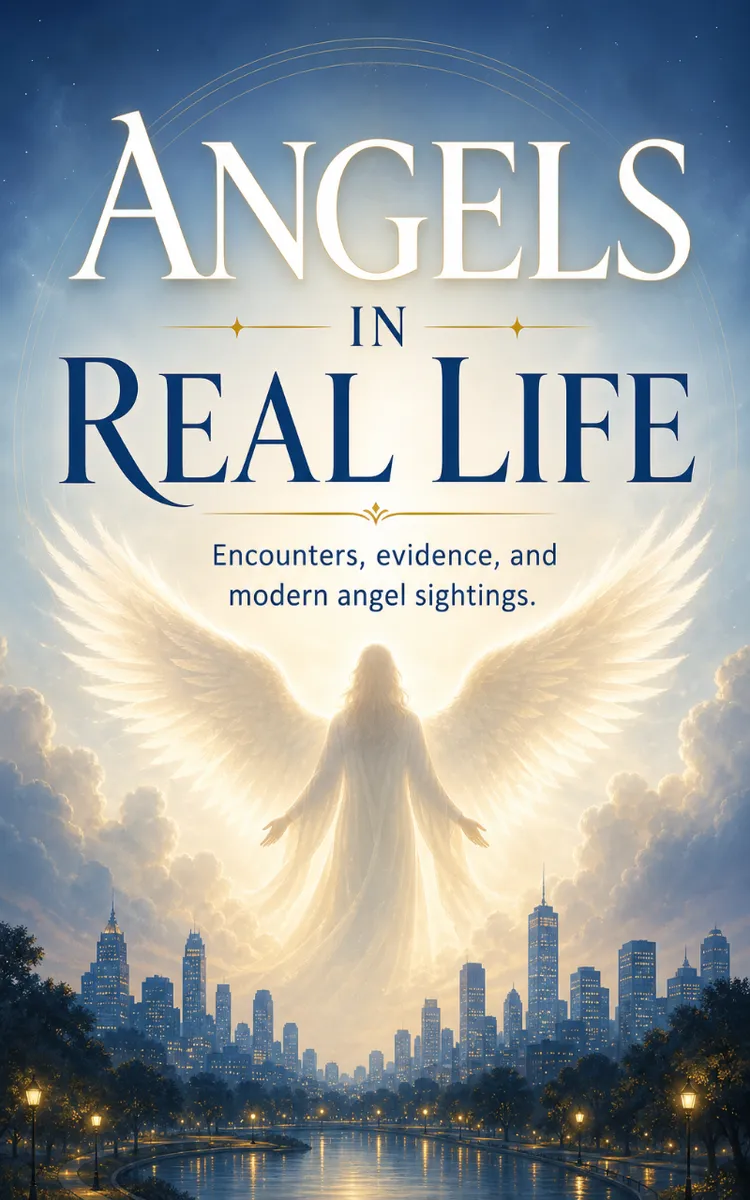
"Angels In Real Life" is a curiosity book by Lilly Marrs with 8 chapters and approximately 15,656 words. Nonfiction accounts of angels and modern encounters with photos.
This book was created using Inkfluence AI, an AI-powered book generation platform that helps authors write, design, and publish complete books.
Frequently Asked Questions
What is "Angels In Real Life" about?
Nonfiction accounts of angels and modern encounters with photos
How many chapters are in "Angels In Real Life"?
The book contains 8 chapters and approximately 15,656 words. Topics covered include The Moment the Halo Appears, Why Near-Death Stories Feel Guided, The Uncanny Message Test, When Dreams Turn Into Directions, and more.
Who wrote "Angels In Real Life"?
This book was written by Lilly Marrs and created using Inkfluence AI, an AI book generation platform that helps authors write, design, and publish books.
Write your own curiosity book with AI
Describe your idea and Inkfluence writes the whole thing. Free to start.
Start writingCreated with Inkfluence AI


