
Read the first chapter
The whole of chapter one, free. About 9 min. Turn the pages with the arrows, your keyboard, or a swipe.
Chapter 1
The 1862 Uprising’s Spark
The Pressure-to-Flash Timeline: How 1862’s Tensions Became War
In late 1862, the U.S. government was trying to solve one problem - food and order - while Sioux communities were living another - hunger, broken promises, and fear of punishment. The paradox is that both sides believed they were acting on necessity, and yet the same chain of pressures pushed them toward violence that neither could neatly step back from. Once the first blows landed, control became harder, not easier, and the response shifted from negotiation to long-term control.
This chapter follows a specific kind of change: the way pressure builds until it stops behaving like “policy” and starts behaving like fire. We’ll trace the Pressure-to-Flash Timeline - the narrowing window where decisions about rations, treaties, and military movement stopped being adjustable and started locking everyone into worse outcomes.
To anchor the story, we’ll spend time with a museum educator’s point of view: Evelyn (34), who has spent years helping visitors make sense of the Dakota War of 1862 without turning it into a blur of dates and names. Her work matters here because the uprising is often told as a single explosion; the evidence shows it was more like a fuse - lit by many hands, fed by many fears, and consumed by a system that hardened as it burned.
What happens when “control” becomes the only language left between people who can’t afford trust?
The Pressure-to-Flash Timeline in 1862: Rations, Promises, and the Narrow Window
A useful way to understand 1862 is to watch how everyday needs turned into high-stakes signals. For the Dakota, food wasn’t just comfort - it was survival tied to seasonal movement, hunting, and the stability of trade. For the United States, the mid - Civil War years strained attention and money, but the frontier still demanded “order,” which meant officials looked for ways to manage populations they saw as hard to predict.
In the years leading up to the uprising, the Dakota faced mounting pressure from multiple directions at once: encroachment on land, disrupted hunting and travel routes, and the way federal promises about goods and payments could lag or fail. The U.S. - Dakota relations were not simply one broken promise; they were a moving target of agreements, misunderstandings, and enforcement. When a supply line falters, people don’t experience it as “bureaucracy.” They experience it as empty storage and a stomach that doesn’t care whose signature is on which paper.
From a scientific perspective, there’s a familiar principle: when systems get tight enough, small triggers can produce large outcomes. In risk and safety research, this is sometimes described as “tight coupling” - when parts of a system are so dependent that a delay or shock propagates quickly. 1862 had tight coupling: delayed rations could lead to desperate decisions, desperate decisions could lead to retaliation, and retaliation could lead to military escalations. The “spark” wasn’t a single moment of madness; it was the point where feedback loops turned punishment into further fear and fear into further resistance.
Evelyn puts it simply when she teaches visitors how to read objects rather than rumors. In her museum work, she sees how people want a clean villain and a clean hero because it feels safer than admitting complexity. But the Dakota War shows something sharper: when communication breaks down, people fill gaps with the worst possible interpretation. That’s not a moral judgment - it’s how humans behave when uncertainty meets hunger and violence.
A single sentence that changes the picture A failed supply promise can function like a weapon even when no one intends it to be.
That sentence matters because it reframes responsibility. Hunger and fear don’t justify violence - but they explain why the “chain of pressures” moved so fast. It also changes how we read the U.S. response: if officials believed the only answer to disorder was force, then each act of resistance would be treated not as a symptom but as proof that force was required.
The Deep Dive: Why the U.S. Response Hardened After the First Violence
Once violence started, the U.S. didn’t just respond to events; it responded to what those events seemed to predict. Frontier war is a brutal teacher: it teaches leaders that negotiation can be slow, that mixed signals are dangerous, and that mercy can be interpreted as weakness. In 1862, military and political actors faced an expanding problem - remote communities, limited control, and a population that could not be managed with the old tools.
The hardening wasn’t only about battlefield tactics. It also took shape in governance - how people were classified, how movement was controlled, and how punishment was used to reduce future resistance. The U.S. government had to decide what “security” meant on the frontier, and its choices tended to treat Sioux communities as a collective threat rather than as separate groups with different motivations and roles. That matters, because when a society begins to treat whole communities as the problem, it narrows the range of outcomes that can be considered legitimate.
Here’s where Evelyn’s museum perspective becomes unexpectedly useful. She tells visitors that one of the biggest reasons people misread 1862 is that they picture the conflict as a straight line: uprising → crackdown → peace. The documents and timelines show something more layered: uprising → urgent fear → expanded authority → longer-term control. The goal shifted from stopping immediate violence to preventing future resistance, and that shift made later decisions harder to soften.
There’s also a structural reason the response hardened. In the Civil War era, the U.S. was stretched. When a government is already fighting for its survival, it tends to treat distant conflicts as administrative burdens - until they erupt, and then those conflicts become tests of authority. After an eruption, officials often move from “manage” to “dominate,” because domination looks measurable and immediate. Even when officials wanted stability, the tools available for stability were often coercive.
And coercion has its own physics. It can reduce some threats quickly, but it also increases resentment, disrupts daily life, and makes trust less likely to return. That doesn’t mean coercion always fails; it means it changes what kind of future is possible. In 1862, the U.S. response helped create the conditions under which control would remain the default.
What You Did Not Expect: The “Spark” Wasn’t the Beginning - It Was the Moment the System Chose Force
A surprise for many readers is how rarely the uprising can be explained as a single act of rage. The counterintuitive finding is that the violence functioned less like a break in history and more like a visible outcome of earlier pressures that had already narrowed choices. The spark came when multiple strains - hunger tied to disrupted supplies, fear tied to military movement, and mistrust tied to broken or delayed promises - lined up in a way that made restraint harder.
Why does that matter? Because it changes how we interpret “the uprising” as an event. If we treat it as the start, we end up asking, “Why did they suddenly do this?” If we treat it as the flash at the end of a tight timeline, we ask a different and more unsettling question: what choices were being made before the first shots, and what did those choices do to the range of human options? The answers point toward a system that kept tightening even when everyone involved was trying to survive.
This is also where the timeline view connects to science, not as a buzzword, but as a way of seeing human behavior under stress. When people are hungry and frightened, decision-making changes. Under chronic stress, attention narrows; risk assessment becomes less patient; communication turns harsher. Add the uncertainty of rumors across distance and the speed of military movement, and the “chain of pressures” becomes almost predictable in its direction, if not its exact timing.
Evelyn often compares it to what visitors know about fires in dry seasons. You can’t always point to the first flame you saw, but you can often point to the conditions that made ignition likely. In 1862, the conditions were not only emotional - they were material, political, and logistical.
The Human Story: Evelyn’s Museum Lesson and the Dakota War’s Real Places
Evelyn’s museum work usually starts with a simple question from visitors: “Why is this history so complicated?” She answers by guiding them through how artifacts and records force complexity. In her reading room, she has maps and letters that show how quickly geography could turn into danger. The conflict wasn’t an abstract “war between peoples.” It was tied to specific routes, supply points, and the way military units could move faster than diplomacy.
One of the most vivid parts of her teaching comes from the geography of the Minnesota River Valley. That landscape holds a lot of the story’s tension: places where movement was normal for seasonal life, places where encroachment made hunting harder, and places where the arrival or withdrawal of supplies could change what “tomorrow” meant. When visitors stand in front of a map, they can feel how a delayed wagon or a rumor carried along a travel path could change the mood of a community within days.
Evelyn also emphasizes how museums handle difficult history: not by softening it, and not by turning it into a single moral punchline. She points out that the Dakota War involved different actors with different motives - some were involved directly in violence, others were caught up in it, and many people were trying to protect their families amid chaos. That doesn’t erase wrongdoing; it clarifies why the conflict spread and why it was hard to contain once it started.
Her most memorable moment with visitors is when she asks them to hold two truths at once: the Dakota experienced pressure that threatened survival, and the U.S. experienced violence that threatened authority. In a classroom, people often want to pick one truth. In a museum, the objects and timelines make picking feel dishonest. The Pressure-to-Flash Timeline helps her explain why both sides moved toward actions that were understandable to the people making them - while still producing outcomes that were catastrophic.
The human story, then, isn’t just about war. It’s about how a place and a system can squeeze people until small events become irreversible. In 1862, the narrowing window was short enough that even those who might have preferred restraint were pushed toward choices with fewer exits.
What This Tells Us: When Control Replaces Communication, Violence Becomes a Policy
If there’s a lesson that reaches beyond 1862, it’s this: societies often harden their responses when they feel they’re losing control, and that hardening can make future peace harder to achieve. The U.S. response after the uprising didn’t simply end a rebellion; it shaped the long-term way power was exercised on the frontier. Once control becomes the main tool, it tends to reproduce itself - because the people living under it stop believing that normal rules will protect them.
Human beings are not machines, and history is not a lab experiment. Still, the chain of pressures in 1862 shows how material needs, political uncertainty, and fear can compress time. In that compression, communication loses ground. What’s left is force, classification, and a narrower set of permitted outcomes.
Evelyn’s work reminds her that visitors come in wanting a single explanation, but history rarely offers one. The Dakota War of 1862 asks us to sit with a more uncomfortable idea: that violence can be the endpoint of stress, not the beginning of it; and that once a government decides force is the only reliable language, the future starts to sound like the past.
If “control” explains the response, what explains the escape from it?
End of chapter one. 7 more chapters in the full book.
Swipe or use the arrows to turn the page
What's inside: 8 chapters
- 1. The 1862 Uprising’s Spark
- 2. Treaties That Became Paper Promises
- 3. Fort Laramie’s Promise, Then Its Price
- 4. The Ghost Dance and Fear’s Engine
- 5. Wounded Knee: How Stories Compete
- 6. Reservation Life Under the Assimilation Machine
- 7. Sioux Resistance Beyond Battle Lines
- 8. What This Fight Teaches Today
About this book
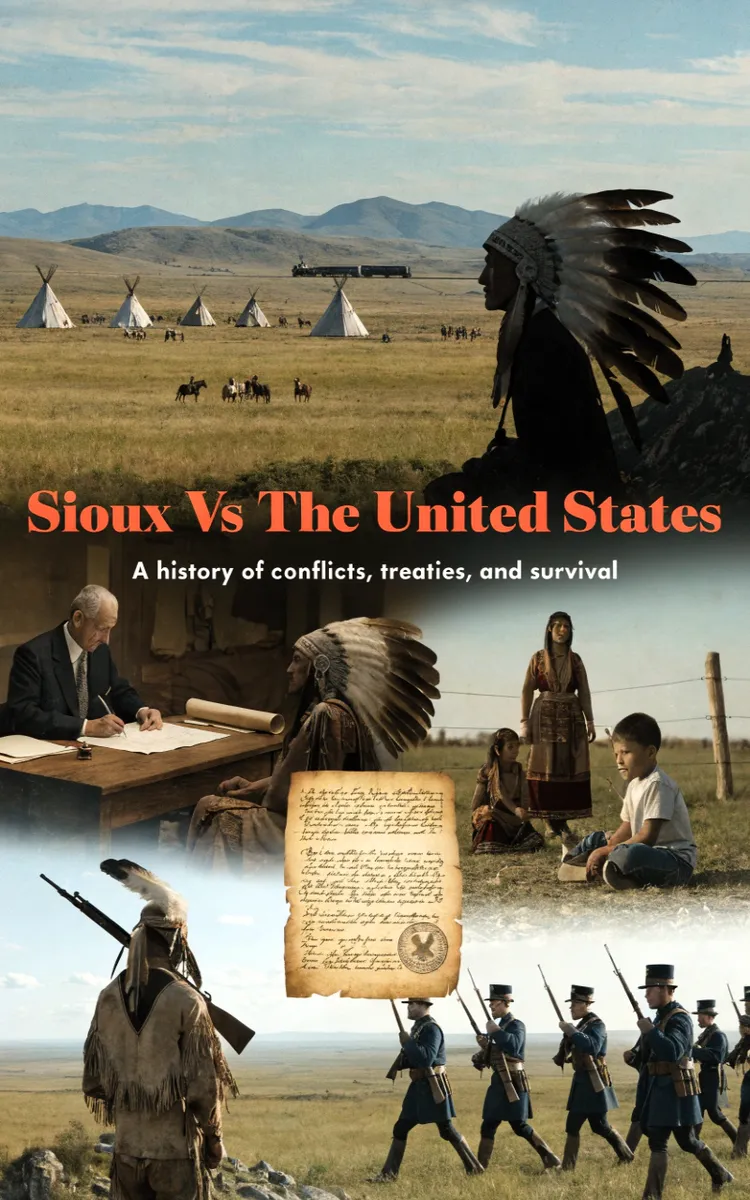
"Sioux Vs The United States" is a curiosity book by Anonymous with 8 chapters and approximately 13,927 words. Historical conflict between Sioux nations and the U.S.
This book was created using Inkfluence AI, an AI-powered book generation platform that helps authors write, design, and publish complete books.
Frequently Asked Questions
What is "Sioux Vs The United States" about?
Historical conflict between Sioux nations and the U.S. government
How many chapters are in "Sioux Vs The United States"?
The book contains 8 chapters and approximately 13,927 words. Topics covered include The 1862 Uprising’s Spark, Treaties That Became Paper Promises, Fort Laramie’s Promise, Then Its Price, The Ghost Dance and Fear’s Engine, and more.
Who wrote "Sioux Vs The United States"?
This book was written by Anonymous and created using Inkfluence AI, an AI book generation platform that helps authors write, design, and publish books.
Write your own curiosity book with AI
Describe your idea and Inkfluence writes the whole thing. Free to start.
Start writingCreated with Inkfluence AI


