
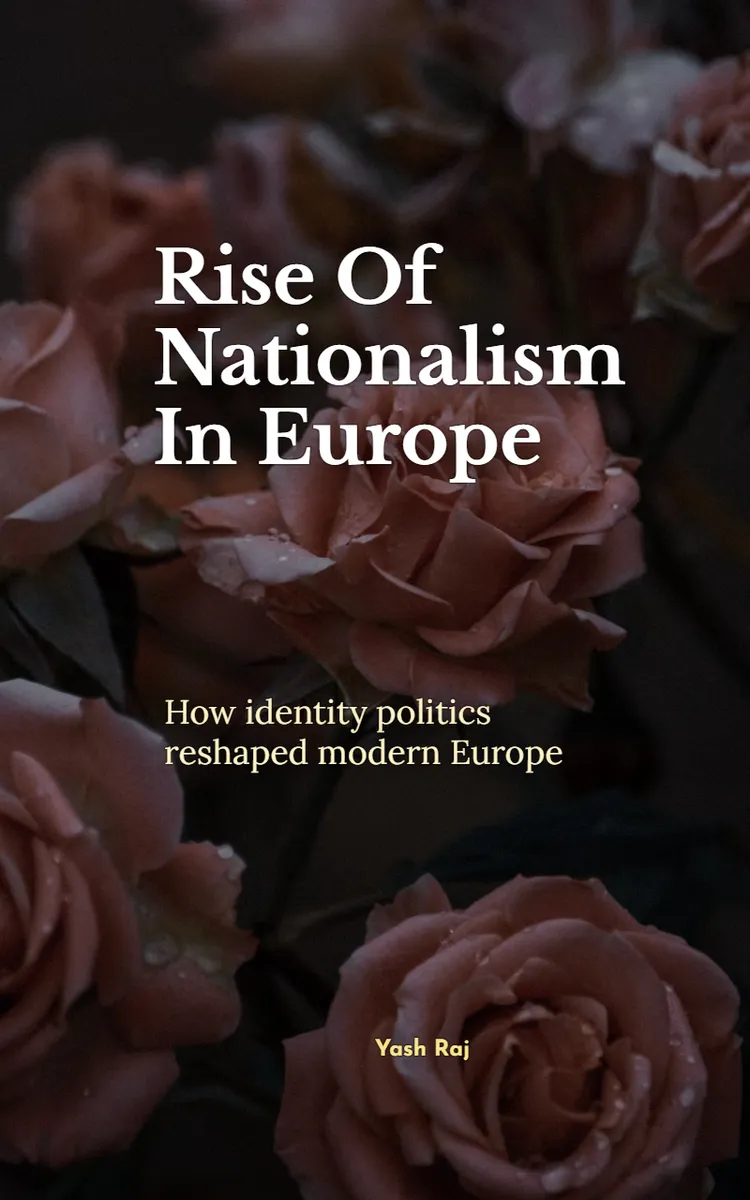
Read the first chapter
The whole of chapter one, free. About 8 min. Turn the pages with the arrows, your keyboard, or a swipe.
Chapter 1
The Language That Became a Flag
The Tongue-to-Community Ladder: How Standard Language Became Political Loyalty
At 5:43 in the morning, the tram doors slide open in Vienna and passengers step into a moving pocket of noise - ticket taps, coat rustles, the cough that rides in on cold air. Klara, 19, checks her route board, then calls out the stops in a steady rhythm that sounds “normal” to her. What’s striking is how much of that normal sound is not just personal habit. It’s part of a shared system: the words, pronunciations, and sentence patterns that make strangers feel like they belong to the same world.
That’s the paradox at the heart of language and nationalism: the thing that helps people understand each other day to day - common speech - can also become the thing that tells them who truly belongs. When a language is standardized, it stops being merely a tool for talking and starts acting like a badge for membership.
In this chapter, we’ll follow that shift as it happened across Europe: how standardizing language helped people imagine a shared nation, and how everyday speech gradually braided itself into political loyalty. We’ll look at the forces that pushed languages toward uniformity, the social habits that carried those choices into daily life, and the surprising science of why consistent wording makes groups feel real.
What if the first step toward a nation wasn’t a battlefield, but a pronunciation everyone agreed to treat as correct?
Standardizing Speech Into a Shared Nation
Think about how language works in a crowd. In any city, people don’t speak identically: accents vary, vocabulary changes street by street, and grammar has its own local quirks. Yet the machinery of modern life - schools, newspapers, rail timetables, military paperwork - keeps nudging societies toward uniformity. Standardization is the slow process of picking one variety as the reference point and teaching everyone else to align with it.
In the nineteenth century, European states built that alignment with deliberate stubbornness. Mass schooling mattered, not only because it taught reading and writing, but because schools also enforced patterns: how to pronounce, how to spell, how to structure a sentence. Printing mattered too. A newspaper that spells a name one way, day after day, trains readers to expect that spelling as “the” spelling. Administration mattered in a more mechanical way: forms, courts, and military records needed consistency, so scribes and officials converged on shared templates.
Here’s a single-sentence fact that helps the mechanism click: once writing becomes standardized, speaking tends to follow, because people treat the written form as a guide for how they “should” sound. Literacy doesn’t just spread information; it spreads models. A child who learns to read a standard language learns, almost incidentally, what counts as correct and what counts as “off.”
That is where the imagination of a nation begins. A nation isn’t only a map; it’s a mental picture of many people living together under a common set of norms. Standard language supplies those norms in a form people can repeatedly encounter - on paper, in classrooms, in official announcements, and eventually in the sounds of daily life. The result is a kind of invisibly organized community: strangers who will never meet you still feel close because they share the same linguistic expectations.
And Vienna provides a vivid window into how this could feel. The city sat within the Habsburg world - multi-ethnic, multi-lingual, and politically complicated. Klara’s day-to-day environment was not a neat single-language bubble. Passengers might shift languages mid-sentence, and different neighborhoods could carry different speech habits. Yet the tram system, like many urban systems, depended on clarity and predictability. A standardized language - along with standardized signage and announcements - helped turn a diverse population into a workable public.
When “Correct” Became Belonging
Klara’s route is a small thing, but the social power of small things is one of the oldest stories in human history. A standardized language doesn’t only reduce confusion; it quietly organizes status. If one way of speaking is treated as the model, then other ways become something to fix, hide, or explain.
That’s why nationalism often latches onto language. It’s not just about communication; it’s about recognition. When people tell each other, “That’s the right way to speak,” they’re also saying, “That’s the right kind of person - or at least the right kind of participant.” Over time, linguistic “correctness” can slide into loyalty, because both are measured through the same daily behaviors: how you speak, how you write, what you choose to correct in yourself, and what you expect others to understand.
There’s another layer, too - one that surprised many people who thought language was only a cultural choice. Standard language creates a powerful feeling of shared time. In a standardized press, the same phrases appear across distances; in a standardized school system, the same lessons repeat; in standardized administration, the same categories get applied. This means that linguistic sameness doesn’t just connect people spatially - it connects them through repeated encounters that feel like they happen to everyone at once.
For Klara, this shows up in routine. A tram conductor’s work depends on being understood instantly, often by people under time pressure. The conductor’s voice becomes part of the infrastructure. When passengers respond - by recognizing the stop names, matching the announcements to the route board, and following the system’s rhythm - they participate in the shared language environment without needing to think of themselves as “political.” That’s the key: the political meaning arrives later, but the practice is immediate.
And once the practice is familiar, it can be reinterpreted. Nationalist movements didn’t have to invent loyalty from scratch. They could redirect what already existed: the habit of treating a standard form as normal. In that redirection, everyday speech becomes evidence. If you speak the standard, you’re not just communicating - you’re signaling membership in the community that standard is meant to represent.
The Science of Why Uniform Words Feel Like a Real Group
To understand why this works, it helps to borrow a bit of psychology and cognitive science - without turning language into a lab experiment. One relevant idea is that humans use categories to reduce complexity. When you sort the world into “us” and “them,” you can predict behavior more easily. Language standardization provides a ready-made category: the standard variety, with its spelling rules and pronunciation patterns, becomes a simple marker that can stand in for deeper social membership.
There’s also the question of attention. Standard language is easier to process in many settings because it reduces variability. A consistent phrase on a sign, a consistent form in a newspaper, a consistent script in official notices - these remove friction. Less friction means more repeated exposure without breakdown. Repetition matters because it builds familiarity, and familiarity tends to be interpreted socially as belonging.
Here’s the counterintuitive finding: people often feel closer to a group because of how consistently they experience its language - not because they personally share the same background. In other words, the bond can be created by the pattern of encounters, not by shared life history. That matters because it shifts nationalism from “ancient ethnic ties” to something more modern and engineered: coordinated systems of education, publishing, and bureaucracy that make certain words feel universal.
Why does this change our understanding? Because it places standard language at the center of nation-building as a social technology. Nationalism didn’t only grow from romantic ideas about culture; it grew from the practical decision to make communication predictable. Once the standard becomes the default, it can be treated as the natural expression of “the people.” That treatment is where loyalty gets recruited.
The science doesn’t make nationalism harmless - it just explains the lever. A standardized language can make strangers feel like neighbors, and that feeling can be powerful enough to override other loyalties. In the tram example, the same voice that keeps the system running can later be used to define who counts as fully part of the public.
Klara’s Vienna: A Multi-Language City With a Standard Voice
Klara works in Vienna, a city where people have long lived side by side with more than one language. That doesn’t mean everyone speaks the standard all the time; real life is messier than any ideal. But the tram system is designed for quick comprehension: stop names appear, schedules repeat, announcements follow patterns. Klara’s job turns language into a daily requirement, and daily requirements create habits.
On her route, she isn’t doing national politics with speeches; she’s doing a service that depends on shared understanding. Passengers hear the stop sequence and match it to the physical layout of the line. Some may be lifelong locals; others may be newcomers. In either case, the standardized elements help them navigate together. That shared navigation is a kind of rehearsal for a larger idea: that there is a public world you can enter because the rules feel familiar.
Vienna’s political history also adds texture. The Habsburg realm included many groups with their own languages and aspirations. Standardization in such an environment could be both inclusive and tense. A standard variety could give people a common platform for education and administration, but it could also be experienced as a demand - an expectation that local speech habits should yield to the reference form.
Klara’s everyday practice sits right on that line. The same standardized language that makes the tram run smoothly can also become a quiet measure of legitimacy. People who already speak the standard may experience it as neutral convenience. People who don’t may experience it as a hurdle or a sign of distance. Over time, those experiences can feed nationalist narratives: not only “we share words,” but also “we share the right ones.”
And when language becomes a measure of belonging, it becomes easier for political movements to attach themselves to it. A newspaper editorial, a school curriculum, a public slogan - each one can point back to the standard as the symbol of unity. The tram doesn’t cause nationalism by itself, but it shows how language standardization seeps into the body of social life, where later political meanings can latch on.
What This Tells Us About Nations, Not Just Words
The deeper lesson here is that nations are built out of ordinary materials. They don’t arrive fully formed; they emerge from repeated routines - school lessons, printed spellings, official forms, and public announcements - that make a particular way of speaking feel like the world’s default setting. Standard language turns a speech community into a recognizable public, and once it’s recognizable, it can be treated as politically meaningful.
Human beings are especially good at turning patterns into identity. When a society repeatedly rewards one linguistic form, people learn to connect that form with trust, competence, and membership. Nationalism then becomes one of the ways that society interprets those connections - sometimes as pride, sometimes as exclusion, often as both at once.
So the mystery isn’t only how language helped create nations. It’s how easily language - something we mostly experience as sound and habit - can become a political map that tells us who we are allowed to be.
End of chapter one. 4 more chapters in the full book.
Swipe or use the arrows to turn the page
What's inside: 5 chapters
- 1. The Language That Became a Flag
- 2. Borders Drawn by Fear, Not Maps
- 3. Newspapers, Posters, and the Daily Nation
- 4. The Myth-Maker: Heroes, Martyrs, Memory
- 5. When Identity Demands a State
About this book
"Rise Of Nationalism In Europe" is a curiosity book by Yash Raj with 5 chapters and approximately 9,321 words. The historical rise of nationalism across Europe.
This book was created using Inkfluence AI, an AI-powered book generation platform that helps authors write, design, and publish complete books.
Frequently Asked Questions
What is "Rise Of Nationalism In Europe" about?
The historical rise of nationalism across Europe
How many chapters are in "Rise Of Nationalism In Europe"?
The book contains 5 chapters and approximately 9,321 words. Topics covered include The Language That Became a Flag, Borders Drawn by Fear, Not Maps, Newspapers, Posters, and the Daily Nation, The Myth-Maker: Heroes, Martyrs, Memory, and more.
Who wrote "Rise Of Nationalism In Europe"?
This book was written by Yash Raj and created using Inkfluence AI, an AI book generation platform that helps authors write, design, and publish books.
Write your own curiosity book with AI
Describe your idea and Inkfluence writes the whole thing. Free to start.
Start writingCreated with Inkfluence AI


