
Read the first chapter
The whole of chapter one, free. About 8 min. Turn the pages with the arrows, your keyboard, or a swipe.
Chapter 1
The Job That Writes Back
When the Task Answers Back
A plumber stands in a customer’s kitchen with a photograph of a leaking pipe, a manufacturer’s manual, and a phone in one hand. Instead of searching page after page, he describes the problem to an artificial intelligence assistant and receives a plain-language explanation, a list of likely causes, and a draft message for the customer. The work has not become automatic. It has become conversational.
That change is easy to underestimate because conversation feels ordinary. Yet for centuries, most tools required people to learn the tool’s language: accounting codes, database commands, design software, filing systems. Newer AI systems reverse part of that arrangement. The worker can speak in everyday terms, and the machine attempts to interpret the task behind the words.
The result is not simply faster typing or better search. It is a different shape of work, in which instructions, questions, corrections, and drafts form a continuous exchange. A task once divided among forms, applications, reference books, and colleagues can begin to resemble a dialogue with an assistant that never occupies a chair.
What happens when the basic unit of work is no longer the task, but the conversation around it?
From Commands to Conversation
The idea of a machine responding to language is older than today’s chat windows. In the 1960s, ELIZA, created by computer scientist Joseph Weizenbaum at MIT, used simple patterns to respond to typed statements. It could not understand a person’s problems, but some users still experienced its replies as surprisingly personal. The episode revealed an enduring fact: people do not need a machine to possess human understanding before they begin treating its language as meaningful.
For decades afterward, interacting with computers generally required a narrow vocabulary. A worker opened a particular program, selected a menu, entered information in the expected fields, and followed the system’s sequence. Software was powerful, but its usefulness depended on learning its procedures.
Modern language models alter that relationship. Trained on large collections of text and other data, they generate responses by estimating which words and structures are likely to follow a prompt. They do not retrieve thoughts from a hidden human mind. They produce language through statistical patterns shaped by training and later adjustment. Their fluency can make the process seem like reasoning, even when the system is uncertain or wrong.
That distinction matters in everyday work. A language model may write a service email, explain a legal phrase, reorganize meeting notes, or suggest spreadsheet formulas. In each case, the worker supplies context and judgment. The assistant supplies a provisional response that can be questioned, revised, or rejected.
The exchange is closer to a junior colleague’s draft than to a vending machine delivering an answer. It may be quick, knowledgeable, and tireless, but it may also misunderstand the assignment or confidently invent a detail. Conversation makes correction easier, but it does not remove the need for correction.
The Task-to-Dialogue Map
The most useful way to understand this shift is through the Task-to-Dialogue Map. A traditional task often appears as a single instruction: write an estimate, summarize a contract, schedule an appointment, compare two products. In practice, each task contains smaller decisions about purpose, audience, tone, missing information, and acceptable risk.
A conversation exposes those hidden decisions. A shop owner might begin by asking an AI assistant to draft a response to a difficult customer. The first answer may sound too formal. The owner can add that the customer has visited for years, that the delay was caused by a supplier, and that the message should preserve the relationship without promising a date that cannot be met. The task has become a sequence of clarifications.
This is not merely a more convenient interface. It changes where expertise appears. Previously, part of a worker’s skill involved remembering which software feature to use and where to find it. With an assistant, skill may appear in the ability to describe the real problem, recognize a weak answer, and supply the context the machine lacks.
A brief exchange can also connect several kinds of work. A fitness business owner might ask for a membership announcement, then request versions suited to email, a text message, and a printed notice. A mechanic might turn a technical diagnosis into an explanation a customer can understand. A teacher might ask for a passage to be rewritten at different reading levels, then examine whether the changes have distorted its meaning.
The assistant does not simply complete one task. It helps move information from one form to another. That movement - technical language into ordinary language, rough notes into a record, scattered facts into a plan - is where much office and service work actually lives.
A surprising fact about conversational AI is that its most important contribution may be reducing the cost of asking for a second draft.
That matters because many workers have long known what a better document should sound like but lacked the time to produce it. The assistant makes revision cheap enough to become part of the normal exchange. It does not eliminate judgment; it gives judgment more material to inspect.
The Office as a Conversation
Many workplaces already contain invisible conversations. A purchase order asks one department to act on another’s information. A spreadsheet records an argument about what counts as a cost. A customer ticket translates frustration into a category that a company can process. AI assistants enter these existing exchanges and make some of them more direct.
Consider the modern customer-service desk. A representative may read a customer’s message, search a knowledge base, check an account, interpret a policy, and write a reply. An AI system can summarize the message, locate relevant policy language, propose a response, and identify information that appears to be missing. The representative remains responsible for deciding whether the response is accurate and appropriate, but the work is no longer a series of separate searches.
In software development, conversational tools can explain unfamiliar code, propose tests, and turn a description of a desired change into a first draft. In marketing, they can transform a product description into several versions for different audiences. In administration, they can organize notes into minutes or extract dates and obligations from documents. The common feature is not the industry. It is the movement between language and action.
The cultural effect is subtle. Workplaces have traditionally rewarded people who know where information is stored and how systems are operated. Conversational assistants make information feel less tied to its original container. A worker can ask about a document without knowing the exact folder, or request a summary without mastering the software that created it.
That convenience also creates a new kind of dependency. If an assistant produces a polished answer, its errors may pass unnoticed more easily than the errors of a clumsy system. Smooth language can conceal missing evidence. A confident paragraph about a company policy is still wrong if the policy was misunderstood.
The central problem is therefore not whether the assistant can speak. It is whether the organization has preserved a clear path back to sources, records, and human responsibility.
The Human Story Inside the Prompt
At Morgan Stanley, financial advisers began using an internal AI assistant built to search and summarize the firm’s research and guidance. The setting is important: advisers work with sensitive information, complex regulations, and clients whose questions cannot be answered safely by a generic internet search. An internal system can be connected to approved material and designed around the firm’s particular work.
The assistant does not replace the adviser’s relationship with a client. It changes the preparation surrounding that relationship. Finding relevant documents, comparing guidance, and turning technical material into a usable explanation can become a dialogue rather than a hunt through separate systems. The adviser still has to judge whether the answer fits the client’s circumstances and whether the underlying sources support it.
This pattern appears far beyond finance. A nurse may use a system to organize clinical notes, while a doctor checks the result against the patient’s record. A small-business owner may ask for a clear explanation of a tax document, then confirm the details with an accountant. A construction manager may turn a long safety document into a briefing, while retaining responsibility for what workers are told.
The human story is not one of a person handing work to a machine. It is one of a person moving through layers of interpretation with a machine beside them. The conversation can shorten the distance between a question and a draft, but it cannot decide what deserves trust.
That is the counterintuitive turn in the story: conversational AI may make work feel more personal while making the machinery underneath it more opaque. The interface resembles a colleague; the process is a probabilistic system operating across enormous amounts of learned language. The more natural the exchange becomes, the easier it is to forget that natural conversation is not the same as understanding.
The New Shape of Ordinary Work
A task that once ended when a form was submitted may now continue through questions about tone, exceptions, evidence, and consequences. This is why the Task-to-Dialogue Map is more than a description of a new software feature. It is a way of seeing how work is being reorganized around successive drafts and replies.
The change is visible in small moments: a contractor turning a voice note into an invoice description, a restaurant owner rewriting a supplier email, a receptionist asking an assistant to explain a policy without sounding evasive. None of these acts is spectacular. Together, they show AI entering the ordinary texture of employment - not as a robot walking into a workplace, but as language appearing wherever a worker needs a second pair of eyes.
Human beings have always extended their abilities through tools. What is unusual here is that the tool returns not only a result, but a sentence about the result, followed by another possible version. The work begins to reveal its hidden questions.
The future of employment may therefore be shaped less by machines that perform tasks alone than by systems that participate in the conversations through which tasks are defined. The unanswered question is not whether these assistants can write back. It is what we will ask them to notice when they do.
End of chapter one. 7 more chapters in the full book.
Swipe or use the arrows to turn the page
What's inside: 8 chapters
- 1. The Job That Writes Back
- 2. Your Creative Output Gets a Co-Author
- 3. The Algorithmic Mirror in Your Feed
- 4. When AI Meets the Law of Trust
- 5. The Bias You Can’t See Until It Hurts
- 6. Deepfakes and the Proof Problem
- 7. The Human Skills AI Can’t Replace
- 8. The Future Files: Your Next Era
About this book
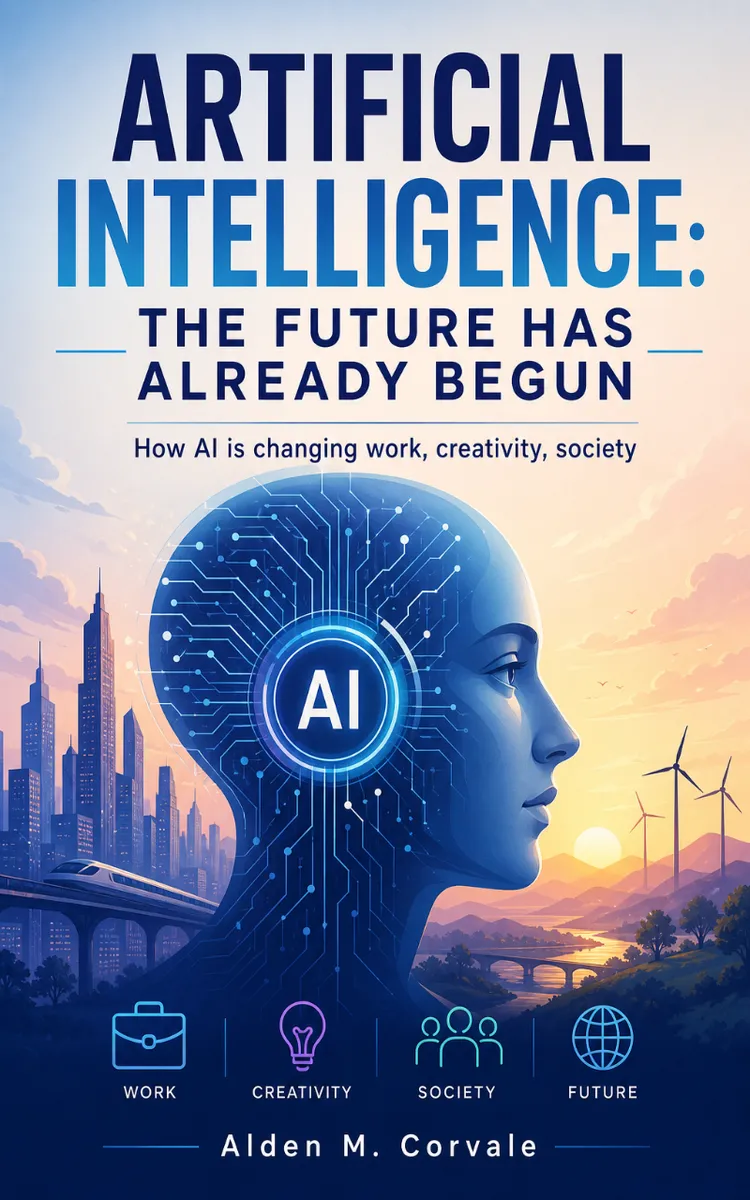
"Artificial Intelligence: The Future Has Already Begun" is a curiosity book by Alden M. Corvale with 8 chapters and approximately 13,982 words. Artificial intelligence’s impact on work, creativity, society, and human life.
This book was created using Inkfluence AI, an AI-powered book generation platform that helps authors write, design, and publish complete books.
Frequently Asked Questions
What is "Artificial Intelligence: The Future Has Already Begun" about?
Artificial intelligence’s impact on work, creativity, society, and human life
How many chapters are in "Artificial Intelligence: The Future Has Already Begun"?
The book contains 8 chapters and approximately 13,982 words. Topics covered include The Job That Writes Back, Your Creative Output Gets a Co-Author, The Algorithmic Mirror in Your Feed, When AI Meets the Law of Trust, and more.
Who wrote "Artificial Intelligence: The Future Has Already Begun"?
This book was written by Alden M. Corvale and created using Inkfluence AI, an AI book generation platform that helps authors write, design, and publish books.
Write your own curiosity book with AI
Describe your idea and Inkfluence writes the whole thing. Free to start.
Start writingCreated with Inkfluence AI


