
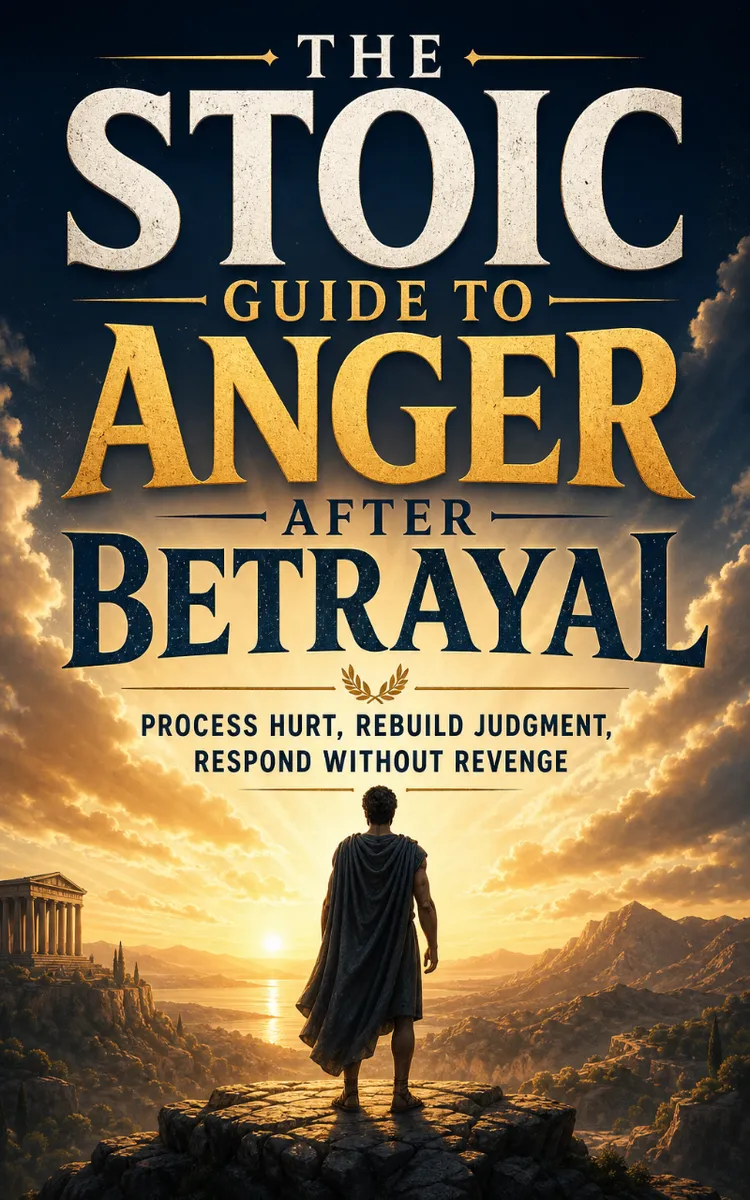
The Stoic Guide to Anger After Betrayal
Created with Inkfluence AI
Stoic-based guidance for anger after betrayal and rebuilding trust
Table of Contents
- 1. Naming Betrayal Without Identity Collapse
- 2. Distinguish What’s Yours to Control
- 3. Turning Hurt Into Accurate Perception
- 4. The Two-Stage Anger Response
- 5. Rewriting the Story of ‘Unfair’
- 6. Building Boundaries Without Guilt
- 7. Practicing Voluntary Discomfort After Betrayal
- 8. Letting Go of Revenge Scripts
- 9. Regaining Self-Respect Through Stoic Actions
- 10. Using Negative Visualization for Calm Clarity
- 11. Rebuilding Judgment With the ‘Reason Test’
- 12. Communicating Without Threat or Pleading
- 13. Repairing Trust: What ‘Rebuild’ Really Means
- 14. Choosing Forgiveness as a Personal Practice
- 15. Grieving the Loss Without Staying Stuck
- 16. Designing a Daily Stoic Reset Routine
- 17. Handling Betrayal Triggers in Real Time
- 18. Turning Anger Into Purposeful Energy
- 19. Rebuilding Social Safety and Support
- 20. Living With Virtue After Betrayal
Preview: Naming Betrayal Without Identity Collapse
A short excerpt from “Naming Betrayal Without Identity Collapse”. The full book contains 20 chapters and 30,321 words.
Picture This
Have you ever caught yourself staring at the same memory like it’s a live wire-replaying the moment you realized you couldn’t trust what you thought you knew? You’re not even trying to be angry anymore. You’re just… stuck. Your chest tightens, your jaw sets, and somehow the betrayal doesn’t stay in the past. It moves in.
Darius, 34, a sales manager, told me he could walk out of a meeting and still feel the sting from an earlier conversation with his partner. Not because he was “thinking about it” on purpose. It was because his mind kept treating the betrayal like a verdict on his judgment: Maybe I’m the kind of person who gets fooled. Maybe I should’ve seen it. Maybe I’m not good at this. The anger wasn’t only about what happened. It started speaking like it was telling him who he was.
Bold question: When you replay the betrayal, are you labeling the act-or letting it label your identity?
---
The Mindset Shift
Old Belief: “What happened says something about who I am.”
New Reality: “What happened is an event. It doesn’t get to become my identity.”
That shift sounds simple until you feel how attached you are to the story. Because identity-based anger feels powerful. It makes the hurt feel meaningful. If the betrayal is proof you’re stupid, unlucky, unlovable, or “not enough,” then anger becomes a way of staying connected to the pain. It’s like your mind thinks: If I suffer hard enough, maybe I can prevent it from happening again. But here’s the catch-identity collapse doesn’t make you safer. It just makes you smaller.
Stoic clarity draws a hard line: events happen. Your values, your choices, your response-those belong to you. The betrayal can be accurate. Your identity can still be intact. Darius didn’t need to deny what happened. He needed to stop letting the betrayal turn into a permanent character trait. He practiced telling the truth in plain language: “I was betrayed,” not “I am the kind of person who gets betrayed.” That one change reduced the pressure. His anger stopped trying to be his biography.
Try this example today, in real time. When the memory hits, don’t argue with it. Just label it precisely: “This is betrayal recall.” Then add the boundary: “It happened to me, not as me.” If you can’t stop the anger yet, that’s okay. You’re not trying to erase it. You’re teaching your mind that anger is a visitor, not the landlord.
Because anger that becomes identity doesn’t just hurt. It starts driving. You end up making decisions to protect a wounded self-image instead of living from your actual judgment.
---
Going Deeper
The Identity Separation Lens is built on one Stoic move: separate facts from meaning. The fact is what was done. The meaning is what your mind declares about your worth, your competence, your “type,” your future. Betrayal is already heavy enough without turning it into a verdict.
When you merge the betrayal with your identity, you create a trap: every reminder becomes self-attack. A text you didn’t get. A detail you missed. A tone in someone’s voice. Your brain treats each one like evidence in a trial where the defendant is you. That’s why resentment lingers. Resentment isn’t only anger at the person who crossed the line. It’s anger at the identity story that grew roots inside you.
Here’s the psychology under the hood, without the cold language. Your mind needs consistency. If it can’t trust what happened, it tries to regain control by making the meaning consistent-usually by making you the problem. That’s how “I should’ve known” turns into “I’m unsafe.” “I got lied to” turns into “I can’t trust myself.” And then anger becomes a guardrail for a self-concept you never agreed to.
Signs this pattern is running your life
1. You don’t just replay the betrayal-you replay your “failure” inside it (like you’re grading yourself for being human).
2. You feel anger and shame together, as if the betrayal was proof you deserved it or were careless enough to earn it.
3. You start predicting the future based on identity, not evidence: “I’ll get fooled again,” “I can’t handle trust,” “I’m always the one who suffers.”
4. You keep seeking certainty from the past-trying to “figure it out” so you can finally stop feeling exposed. The problem is, the past can’t restore trust. Your choices can.
En résumé: Separate the event from your identity, and the anger loses its job description.
When you label betrayal precisely, you take the power back to the present. You can still be hurt. You can still be angry. But you stop letting anger claim ownership of your name.
---
Reflection & Self-Assessment
1. What exact sentence does your anger use to describe you?
Example of an honest answer: “I think I’m naive,” or “I think I’m not worth honesty.” If you can’t name it, write the first harsh thought that shows up.
2....
About this book
"The Stoic Guide to Anger After Betrayal" is a self-help book by Socratic Mastery with 20 chapters and approximately 30,321 words. Stoic-based guidance for anger after betrayal and rebuilding trust.
This book was created using Inkfluence AI, an AI-powered book generation platform that helps authors write, design, and publish complete books. It was made with the AI Self-Help Book Writer.
Frequently Asked Questions
What is "The Stoic Guide to Anger After Betrayal" about?
Stoic-based guidance for anger after betrayal and rebuilding trust
How many chapters are in "The Stoic Guide to Anger After Betrayal"?
The book contains 20 chapters and approximately 30,321 words. Topics covered include Naming Betrayal Without Identity Collapse, Distinguish What’s Yours to Control, Turning Hurt Into Accurate Perception, The Two-Stage Anger Response, and more.
Who wrote "The Stoic Guide to Anger After Betrayal"?
This book was written by Socratic Mastery and created using Inkfluence AI, an AI book generation platform that helps authors write, design, and publish books.
How can I create a similar self-help book?
You can create your own self-help book using Inkfluence AI. Describe your idea, choose your style, and the AI writes the full book for you. It's free to start.
Write your own self-help book with AI
Describe your idea and Inkfluence writes the whole thing. Free to start.
Start writingCreated with Inkfluence AI


