

Read the first chapter
The whole of chapter one, free. About 9 min. Turn the pages with the arrows, your keyboard, or a swipe.
Chapter 1
Why Four Heavens Feel Intuitive
The Opening: A Philosophy Student and the “Too-Perfect” Shape of Heaven
Leila, a first-year philosophy student, once tried to explain why religious maps of the afterlife feel so easy to picture. She wasn’t talking about one tradition in particular. She was talking about the shape - how many layers there seem to be, how the layers often look like a gentle staircase, and how each step feels “named” before she could even find the words for it. When she first encountered the idea of four heavens, she didn’t react with confusion. She reacted with recognition, as if her mind had been waiting for a familiar pattern.
That’s the paradox that starts this chapter: four-tier heavens don’t feel strange to most people - they feel strangely compatible with how minds already sort the world. The count may vary across religions, but the sense of tiered distance - nearer and farther, purer and less pure, closer to the Source and farther from it - keeps showing up like a repeating melody.
What we’ll explore is the mental pattern that makes four heavens easy to imagine across cultures, even when the details differ. We’ll follow how people ended up drawing vertical afterlives, how history and language nudged those drawings into place, and what psychology and brain science can tell us about why a multi-layer heaven can feel intuitive rather than invented.
If your mind keeps reaching for “levels” when it tries to picture the divine, are you seeing theology - or the architecture of thought itself?
The Deep Dive: The Pattern-Preference Ladder
Leila’s reaction isn’t just a personal quirk. There’s a general mental habit researchers often describe as a preference for structured categories - our brains like to organize messy experience into clean groupings that make navigation easier. When someone says “heaven,” the mind doesn’t only ask what heaven is; it asks what kind of place it is. Is it one room? A single level? Or a layered system where different kinds of beings (or different kinds of moral lives) fit into different zones?
One way to name this habit is through what we can call the Pattern-Preference Ladder: a tendency to prefer explanations that sort reality into a small number of ordered steps. Human beings are surrounded by gradients - temperature changes, skill improvements, social status, darkness to light - and we learn early that “step-like” descriptions can be easier to hold than perfectly continuous ones. A ladder isn’t a scientific measurement, but it’s a practical mental tool. It lets you say, quickly, “this is higher than that,” even when the underlying reality changes smoothly.
That helps explain why tiered afterlives feel plausible even before you learn the doctrine. Many religious traditions - across Judaism, Christianity, Islam, Hinduism, and others - have long histories of imagining the afterlife not as one uniform destination but as staged realms. Sometimes these stages are described as heavens, sometimes as worlds, sometimes as degrees of nearness to God, sometimes as levels of spiritual refinement. The vocabulary varies, but the cognitive impulse is similar: to picture meaning as something you move toward, not something you simply arrive at.
Historical context matters here, because the ladder-like imagination wasn’t floating in a vacuum. Communities needed vivid language for experiences that were hard to verify - repentance, purity, mercy, judgment, love, transformation. When a tradition wants to teach that moral and spiritual life has consequences beyond death, it often reaches for spatial metaphors. Space is a powerful metaphor system: it’s easier to say “closer” and “farther,” “above” and “below,” than to describe a process that only exists in the soul. Once spatial metaphors enter the picture, the mind naturally wants order. If there are multiple realms, why not arrange them?
There’s also a language piece. Many ancient religious texts use numbers not merely as arithmetic but as organizing symbols. Four is one of those numbers that shows up with surprising frequency in human cultures - think of directions (north, south, east, west), seasons, and the way many societies structure time in repeating blocks. Four-tier systems are not the only way people imagine divinity, but they’re often “ready-made” for the mind, the way a familiar shelf spacing makes it easier to store books.
And then there’s the social side. Religious communities pass down teachings through memorization, preaching, and teaching circles. A multi-tier model can be easier to teach when it’s compact - again, not because it’s scientifically precise, but because it’s memorable. If you can reduce a sprawling spiritual map into a small ordered set, it travels well in oral culture and later becomes stable in written form. Leila’s “recognition” starts to look less like instant belief and more like the brain finding a familiar storage pattern.
The most striking part is that this mental ladder doesn’t require a person to have been raised with a specific doctrine. People can encounter the idea and feel it click into place because the underlying cognitive preference - small ordered steps - already exists. The doctrine supplies the content; the mind supplies the structure.
What You Did Not Expect: Why “Fewer Steps” Can Feel More Real
Here’s the counterintuitive finding: a four-part heaven can feel more intuitive than a one-part heaven, even though both are equally untestable claims. If you think of heaven as “ultimate reality,” you might expect it to be simple. But when people picture the afterlife, they often want difference without chaos. They want a system that can hold contrasts - reward and mercy, purification and joy, distance from and closeness to God - without turning into an endless fog of possibilities.
This matters because it changes what you think you’re doing when you learn religious maps. You might assume the “tiered” structure is purely theological invention. The Pattern-Preference Ladder suggests another angle: part of the structure may arise from how the mind organizes meaning. A four-tier model is a compromise. It’s complex enough to distinguish experiences, yet small enough to remain graspable. That balance - limited steps with clear ordering - can feel like truth to the mind, even when the doctrine is culturally specific.
The surprise is sharper when you consider how the brain handles uncertain information. Psychologists have long noted that humans tend to impose structure under ambiguity. When a topic is emotionally loaded - like death or justice - that pull intensifies. A tiered afterlife gives the mind something it can “place” emotionally and conceptually. Instead of wrestling with one enormous unknown, you can sort, rank, and anticipate. The model becomes not only a teaching but a cognitive home.
To make that idea concrete, look at how people talk about spiritual progress in everyday life. Even outside formal theology, people use language of movement through stages: “learning,” “maturing,” “becoming,” “getting better,” “moving on.” Those phrases aren’t metaphysical proofs, but they show a basic expectation that inner life changes in phases. When religious texts then offer a staged afterlife, they plug into an already-running mental engine.
So when Leila felt that the four-heavens idea “fit,” it may have been her mind doing something ordinary: matching a new concept to an old organizing instinct. The doctrine becomes easier to picture because the structure is psychologically compatible. That compatibility doesn’t make the claim automatically correct - but it makes it understandable, and that is often the first step toward serious study.
The Human Story: Leila’s Notes, and the Map Her Mind Already Knew
After her first encounter, Leila didn’t just repeat the idea. She scribbled it into the margins of her notebook like a diagram she’d seen before. In her notes, she kept returning to a single question: why do so many traditions - across time and place - end up with layered heavens or ranked realms? She wasn’t trying to score a point in class. She was trying to solve a puzzle that felt personal.
A few days later, she brought it up with a classmate who had grown up in a different religious environment. The details were different, but the conversation circled the same shape: a sense that the afterlife isn’t just a single “yes” or “no.” It’s a gradation. It’s a way of saying that the moral and spiritual life matters differently depending on what it produced - sometimes described as closeness, sometimes as purification, sometimes as reward. Even when the theological explanations diverged, the mental picture of ordered distance stayed consistent.
Leila’s campus library offered a practical window into how this pattern spreads. She wasn’t reading one “source” that told her the ladder was real. She was reading a stack of introductions - study guides, annotated excerpts, and cultural histories - that each tried to make complex doctrines teachable. Many of those resources did something subtle: they translated lofty ideas into schemes. They laid out stages, compared terms, and emphasized structure because readers need handles. When the same handle keeps appearing across books, it starts to feel like a discovery rather than a teaching device.
That’s how the Pattern-Preference Ladder becomes more than a private instinct. It becomes a public tool. Scholars and teachers often present religious concepts in layered form because it helps readers follow the logic. Over time, those presentations can harden into expectations. A newcomer like Leila doesn’t arrive with the doctrine already installed; she arrives with a mind that likes ordered maps. Then she meets the doctrine through explanatory frameworks that often highlight tiers. The result is a kind of feedback loop: the doctrine seems intuitive because the instruction style matches the mind’s organizing preference.
In Leila’s case, the “four” mattered because it’s a number that holds together well. It’s not too small to feel meaningful, and not too large to blur. Four steps can be remembered in sequence. It can be drawn without clutter. It can be compared across traditions without turning the comparison into an incomprehensible spreadsheet. Even if a specific religion teaches a different count, the four-tier model sits in the middle of how many people naturally want to chunk reality.
The human story here isn’t that Leila magically discovered the truth of the afterlife. It’s that her mind reached for a familiar structure and found it echoed in how religious teachings are explained. The intuition wasn’t random; it was patterned.
What This Tells Us: The Mind Loves Ordered Distance
When you step back, the four-heavens idea becomes a window into something bigger than theology. It suggests that religious imagination often runs on the same mental engines that help us understand other life experiences: we compare, we order, we classify, we look for gradations. We’re not born with a blueprint for “heaven,” but we’re born with a tendency to organize meaning into steps that feel navigable. The afterlife becomes, in a sense, a final map - one that turns moral and spiritual difference into a visible structure.
Society reinforces the pattern. Traditions survive by teaching. Teaching favors structures that can be carried - by memory, by conversation, by texts that can be summarized. A four-tier model is not guaranteed, but it’s a natural candidate: small enough to remember, ordered enough to picture, detailed enough to hold emotional and moral distinctions.
And science, in a cautious way, supports the plausibility of the mechanism even if it can’t confirm the metaphysics. Brains built for living in a world of gradients often prefer step-like models when certainty is limited. The “ladder” isn’t only religious - it’s cognitive. That means four heavens can feel intuitive not because the universe is structured that way, but because minds like ours do a lot of work to make meaning stable.
If the divine is described as a set of ascending realms, maybe we’re not just hearing doctrine - we’re watching our species translate awe into something we can hold. And if that translation keeps appearing, year after year, across cultures, what else about our spiritual pictures is really a mirror of how human minds make order out of the unknown?
End of chapter one. 7 more chapters in the full book.
Swipe or use the arrows to turn the page

The World In Chaos 6x9 Interior

When Everyone Else Has Moved On 8 5x11 196p REVISED v3

The Blind Spot of Reality EDITED Garamond 6x9
What's inside: 8 chapters
- 1. Why Four Heavens Feel Intuitive
- 2. The Four Heavens as a Map
- 3. Ritual Timing Across Heavenly Levels
- 4. The Gatekeeping Problem of Access
- 5. When Texts Disagree: Four vs. Five
- 6. Astronomy, Weather, and Heavenly Layers
- 7. The Afterlife Ladder in Personal Grief
- 8. The Four Heavens That Still Shape Us
About this book
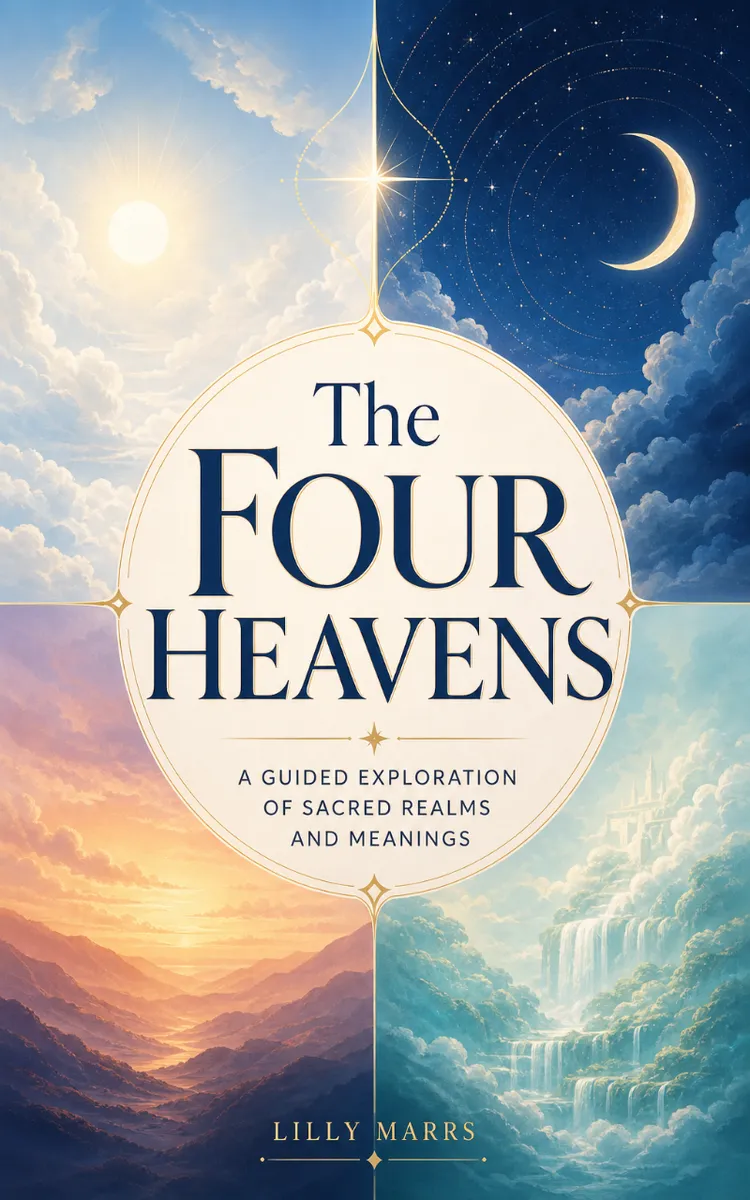
"The Four Heavens" is a curiosity book by Lilly Marrs with 8 chapters and approximately 15,306 words. Exploration of the concept of four heavens in religion.
This book was created using Inkfluence AI, an AI-powered book generation platform that helps authors write, design, and publish complete books.
Frequently Asked Questions
What is "The Four Heavens" about?
Exploration of the concept of four heavens in religion
How many chapters are in "The Four Heavens"?
The book contains 8 chapters and approximately 15,306 words. Topics covered include Why Four Heavens Feel Intuitive, The Four Heavens as a Map, Ritual Timing Across Heavenly Levels, The Gatekeeping Problem of Access, and more.
Who wrote "The Four Heavens"?
This book was written by Lilly Marrs and created using Inkfluence AI, an AI book generation platform that helps authors write, design, and publish books.
Write your own curiosity book with AI
Describe your idea and Inkfluence writes the whole thing. Free to start.
Start writingCreated with Inkfluence AI


