
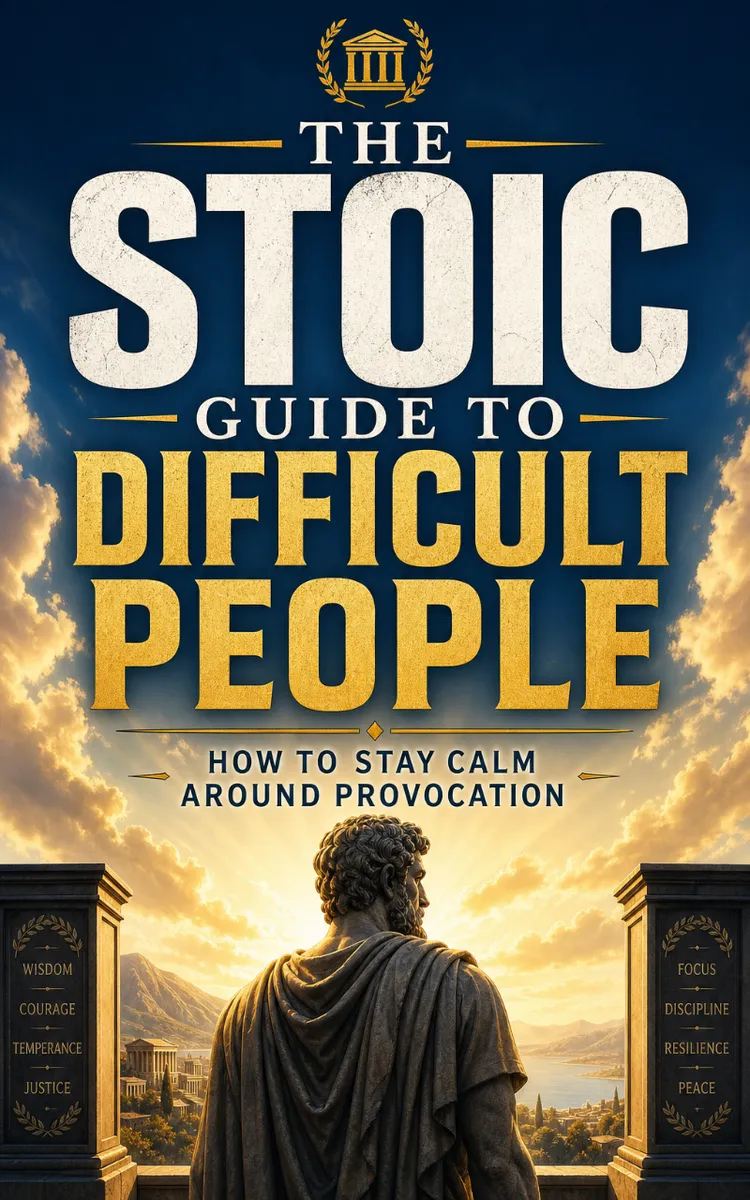
The Stoic Guide To Difficult People
Created with Inkfluence AI
Stoic-based strategies for handling difficult people calmly
Table of Contents
- 1. Own Your Circle of Control
- 2. Reclaim Your Inner Authority
- 3. Stop Treating Criticism as Threat
- 4. Practice the Pause That Changes Everything
- 5. Build Boundaries Without Guilt
- 6. Replace Rumination With Stoic Reframing
- 7. Respond, Don’t React: The Judgment Gap
- 8. Use “What Would Virtue Do?”
- 9. Disarm Drama With Neutral Curiosity
- 10. Stop Over-Explaining Under Pressure
- 11. Turn Passive Aggression Into Direct Clarity
- 12. Handle Gaslighting With Reality Anchors
- 13. Choose Courage Over Winning
- 14. Practice Empathy Without Self-Surrender
- 15. De-Escalate in Real Time With Scripts
- 16. Stop Taking Their Mood Personally
- 17. Recover Fast After a Blow-Up
- 18. Train Your Mind With Negative Visualization
- 19. Build a Daily Stoic Reset Habit
- 20. Live Your Purpose Through Conflict
Preview: Own Your Circle of Control
A short excerpt from “Own Your Circle of Control”. The full book contains 20 chapters and 28,435 words.
Picture This
Have you ever sat through a meeting where the other person wasn’t actually talking to solve anything? They were pushing buttons-slowly, politely, like they were just “asking questions,” while you could feel your brain start sprinting to keep up. Nina, 34 and working customer success, knows that feeling well. One of her customers would go from “We need an answer” to “Your team doesn’t care” in the same breath. If she didn’t respond fast enough, the tone sharpened. If she did respond, she’d get a new complaint within minutes-always something else, always moving the goalposts.
After a while, Nina noticed something that made her feel both annoyed and impressed with the chaos: she was spending energy on the wrong part. She’d replay her phrasing in her head, then reread the last email like it was a crime scene. Meanwhile, the customer’s choices weren’t slowing down for her mental work. The more she tried to “fix” their reaction, the more it expanded. Her control was shrinking while their drama grew.
Are you trying to steer someone else’s choices with your own energy?
The Mindset Shift
Old Belief: “If I can just say the right thing, they’ll calm down and the conflict will stop.”
New Reality: “Their reaction is their responsibility. My job is to steer what I can steer-my response, my boundaries, and my next move.”
That shift matters because provocation works like a tug-of-war. Someone yanks; you brace. You start pulling back, and suddenly you’re not managing the situation-you’re managing their leverage. Stoics didn’t pretend other people will suddenly become reasonable. They focused on the one lever that never stops being yours: your judgments and actions.
Nina saw this in a messy customer call. The customer challenged her competence again (“I don’t understand why it took this long”), and Nina felt the urge to over-explain. In her head, she was thinking, If I justify myself clearly enough, they’ll finally hear me. But that justification wasn’t reducing conflict. It was giving the other person more material to argue with. The call ended with the customer sounding unimpressed and promising to “escalate if this happens again.”
When Nina applied the new reality, she didn’t stop being helpful. She stopped trying to control their emotional weather. She chose a response that stayed inside her circle of control: acknowledge the issue, state the next concrete step, and set a boundary on tone. Instead of defending her entire process, she anchored on what could be measured and scheduled. The conflict didn’t vanish overnight, but the energy drain did. She wasn’t stuck proving herself anymore-she was handling her work.
Here’s the concrete example that makes this real: Nina started ending certain threads with a simple structure:
- what happened (facts),
- what she’d do next (timed action),
- and what she needed from them (cooperation, not attitude).
That’s not “letting them win.” That’s refusing to turn her brain into a hostage negotiator.
Going Deeper
The Control Compass is your way to stop guessing which pieces of the situation you can actually influence. “Circle of control” isn’t a vibe-it’s a sorting system. You’re not trying to be cold. You’re trying to be accurate.
When someone provokes you, your mind usually treats the moment like a puzzle that must be solved: How do I get them to stop? How do I make them understand? The Stoic move is different. You ask: What parts of this situation are driven by me, and what parts are driven by them? Then you act only on the “me-driven” parts.
A lot of people get stuck because they confuse influence with control. Influence is you shaping your own next action (your words, your calm, your boundary, your follow-up). Control is you forcing another person’s internal state. You can influence your tone. You can’t control whether they feel insulted, threatened, bored, or determined to escalate.
Signs this pattern is running your life
1. You keep rewriting your messages after sending them. Not to improve the next one-just to soothe the feeling that you “didn’t handle it right.”
2. You take bait that doesn’t change the outcome. For example, you respond to insults with explanations, even though the person’s goal is clearly not understanding.
3. You feel guilty for their reaction. Like your calm is only “allowed” if they agree with you.
4. Your plan depends on their mood. You’re waiting for them to “be reasonable” before you move forward.
En résumé: You can’t control their choices, but you can control your next decision-so stop spending your power trying to rewrite theirs.
To make this practical, the Control Compass sorts the moment into four directions. It’s not fancy. It’s fast. You use it when provocation hits, not after you’re already exhausted.
- What I control: my response, my tone, my boundaries, my follow-up, the next action I take....
About this book
"The Stoic Guide To Difficult People" is a self-help book by Socratic Mastery with 20 chapters and approximately 28,435 words. Stoic-based strategies for handling difficult people calmly.
This book was created using Inkfluence AI, an AI-powered book generation platform that helps authors write, design, and publish complete books. It was made with the AI Self-Help Book Writer.
Frequently Asked Questions
What is "The Stoic Guide To Difficult People" about?
Stoic-based strategies for handling difficult people calmly
How many chapters are in "The Stoic Guide To Difficult People"?
The book contains 20 chapters and approximately 28,435 words. Topics covered include Own Your Circle of Control, Reclaim Your Inner Authority, Stop Treating Criticism as Threat, Practice the Pause That Changes Everything, and more.
Who wrote "The Stoic Guide To Difficult People"?
This book was written by Socratic Mastery and created using Inkfluence AI, an AI book generation platform that helps authors write, design, and publish books.
How can I create a similar self-help book?
You can create your own self-help book using Inkfluence AI. Describe your idea, choose your style, and the AI writes the full book for you. It's free to start.
Write your own self-help book with AI
Describe your idea and Inkfluence writes the whole thing. Free to start.
Start writingCreated with Inkfluence AI


