
Read the first chapter
The whole of chapter one, free. About 10 min. Turn the pages with the arrows, your keyboard, or a swipe.
Chapter 1
The Lie Detector You Already Use
The Lie Detector You Already Use: Certainty’s Hidden Switch
A lot of people think they’re using evidence. What they’re really using is a feeling - one that arrives before they can explain how they got it. You hear a claim, your brain predicts how it “should” feel, and if the feeling arrives on time, you call it truth. The paradox is that this process can be fast enough to feel like a lie detector, even when it’s doing the opposite.
Talia, a 19-year-old first-year college student, didn’t come looking for misinformation. She came looking for certainty - something to lean on while everything else was new: new classes, new friends, new schedules, new ways of talking. In her dorm, certainty looked like clean answers. It sounded like a confident summary. It arrived with a neat little sense of closure: problem solved.
This chapter is about the moment your brain quietly swaps evidence for comfort. Not in a dramatic “gotcha” way - no trapdoor, no villain, no cartoon villain twirling a moustache. Just the ordinary mental machinery that turns uncertainty into certainty, and then uses that certainty as a substitute for reasons.
What if the thing you trust most - the certainty itself - is the first clue you should question?
The Moment Evidence Becomes Comfort
The brain is not a courtroom. It doesn’t sit there weighing arguments like a judge with a stack of exhibits. It’s more like a prediction engine that’s always trying to keep you oriented: what’s happening, what’s likely to happen next, and what you should do about it. That orientation is valuable. Without it, you’d drown in every unknown.
But that same machinery has a weakness: certainty is rewarding. When your mind detects a pattern that fits, it doesn’t just understand - it “locks in.” The lock-in is what people confuse with reliability. You feel the world become legible. You can finally relax your attention.
Psychologists have long described this as confirmation bias - the tendency to search for, interpret, and remember information in ways that support what you already believe. What’s easy to miss is how often the “already believe” part isn’t a settled opinion. Sometimes it’s simply the sensation of coherence. A claim feels right because it fits your existing mental furniture - your background knowledge, your moral instincts, the way you think your group works, the language you grew up with.
There’s a historical reason this feels like a lie detector. For centuries, people used public tests to separate truth from falsehood. Trial by oath. Trial by ordeal. Later, “scientific” sounding procedures. The modern world took a sharper turn when the polygraph became a household idea: measure the body, infer the mind. It’s become shorthand for “truth you can read.”
The trouble is that the polygraph doesn’t directly measure truth. It measures physiological arousal while a person answers questions. A person can be aroused because they’re lying, but also because they’re anxious, confused, ashamed, or simply alarmed by being tested. In other words, it measures a kind of emotional activation - not truth. The lie detector worked as theater because people wanted a machine that could turn uncertainty into an official answer.
Your brain does something similar without the wires. It measures internal state - not your pulse, but your sense of “this makes sense.” When that internal state arrives quickly, you treat it like a verdict.
To make this concrete, consider how Talia encountered confident claims. She didn’t track them like a researcher. She met them like most people do: through friends, feeds, casual talk, group chats, the language of “everyone knows.” She’d read a short explanation and feel her attention snap into place. The claim didn’t have to be airtight; it just had to arrive with a satisfying shape. Her mind was performing a kind of rapid internal grading, and the grade came back as “this is probably right.”
That’s where the Certainty Swap Test begins: a simple observation about how your brain behaves when it’s trying to protect your comfort. When certainty arrives, ask what just happened to your reasoning.
Did you move from evidence to conclusion? Or did you start with a conclusion-shaped feeling and then look for evidence that fits it?
The Brain’s Certainty Machine (and Why It’s So Good at It)
The brain’s job is not to be correct. Its job is to be effective. That difference matters, because “effective” can mean “good enough for survival” rather than “matched perfectly to reality.” In daily life, being slightly wrong is often less dangerous than being paralyzed by doubt.
A core piece of how it works is predictive processing: the brain constantly generates expectations and then updates them when incoming information doesn’t match. When there’s a mismatch, you pay attention. When things match, the brain reduces costly effort. In a world full of noise, this is a blessing.
Now add a second ingredient: the brain doesn’t just predict what will happen. It also predicts what will be meaningful. It uses patterns to produce a narrative - sometimes one you didn’t consciously create, but still feel as if you “came up with it.” That narrative is what certainty feels like: the sense that the world has lined up in a way your mind can hold.
Here’s the counterintuitive part. Certainty can increase when your evidence is worse, not better. It’s not that the brain is blind to evidence. It’s that the brain can substitute something else when evidence is thin: familiarity, story coherence, social alignment, or the emotional relief of not having to keep looking.
Talia experienced this in the ordinary friction of college life. She was trying to make sense of identity, politics, health, and “how things work.” Those topics come with moral baggage and personal stakes. When a claim flatters your sense of belonging or simplifies a complex issue into a clean moral line, the brain can experience it as both true and safe. That’s not a logic error; it’s a comfort mechanism.
The Certainty Swap Test is built around that mechanism. It asks you to notice a specific transition: the point where evidence stops being consulted and replaced by a feeling of closure. You can’t always catch it while it’s happening, but you can learn to recognize its tell.
One tell is the speed of confidence. Another is the way the claim resists “small doubts.” If you try to locate the evidence - sources, dates, mechanisms, numbers - does the certainty remain, or does it wobble? If certainty remains sturdy while evidence is fuzzy, you’re watching the swap.
This is where popular misinformation often thrives. It doesn’t need to be wildly implausible. It needs to be coherent enough to satisfy the brain’s predictive machinery. Add a dash of moral certainty and a tidy explanation, and you’ve built a mental product that feels like a complete package.
And once the package is purchased internally, the brain defends it - through memory. You remember the parts that fit. You forget the parts that didn’t. Later, you don’t just believe; you feel like you always knew.
The Unexpected Connection: Confidence Is a Social Signal
Here’s a surprise that lands hard if you’ve ever assumed your own certainty means you’re thinking well: your certainty often tracks your social environment more than your evidence does. In other words, you may be reading the room, not the facts.
That matters because misinformation isn’t only a cognitive problem. It’s a community problem. Human beings coordinate. We share language, norms, and expectations. We look to others for cues about what’s acceptable to doubt. When a claim becomes a badge - of sophistication, loyalty, toughness, or good taste - doubt starts to feel like disrespect.
So when you meet a confident narrative, the brain can interpret it as a social signal: “This is what people like me say.” The certainty then comes pre-loaded with belonging.
Talia saw this in how some claims spread. They weren’t just repeated; they were performed. People talked as if the conclusion was already settled, and the performance itself did the work of persuasion. You didn’t have to confront evidence; you had to match the tone. When the conversation rewards matching confidence, the Certainty Swap Test becomes urgent. You need to separate “I sound certain” from “I have reasons.”
This also reframes why “fact-checking” sometimes disappoints. If a claim is serving as a social glue, correcting the factual part can feel like a personal threat. The brain doesn’t just protect beliefs; it protects identity. You can think you’re arguing about data when, underneath, you’re arguing about safety.
Even the older history of truth-telling hints at this. “Truth” wasn’t always a matter of evidence; it was often a matter of status. Who is allowed to speak? Who is believed? In courtrooms and religious institutions, in newspapers and political movements, the authority to declare truth has always been entangled with social power. The brain learned long ago that certainty from the right source is a shortcut to stability.
So the human mind developed a habit that’s both clever and dangerous: treat confidence as a proxy for truth.
The Certainty Swap Test asks you to look for the exact moment that proxy takes over. When the social cue becomes more important than the evidence, the swap is already in motion.
Talia’s Dorm Room Test: Where Closure Wins
Talia’s first semester had the usual chaos: deadlines piling up, friendships forming fast, and a constant stream of claims that sounded like they came with receipts. She’d sit on her bed with her phone, scrolling through threads that moved quickly - too quickly for careful reading, but just slow enough for the brain to settle into a rhythm.
One night, a topic that was popular in her circles showed up again: a short explanation that seemed to “connect the dots” better than anything else she’d heard. It had a strong moral angle and a clean villain-free story. People in the thread spoke as if the conclusion was obvious. Replies added extra certainty without adding much in the way of evidence - more emphasis, more certainty, more “you see?”
Talia felt the familiar click: the sense that the world made sense now. She didn’t feel confused. She didn’t feel the urge to check primary sources. The certainty arrived like a finished meal.
Then she tried, almost casually, to locate the basis for it. Not deeply. Just enough to see whether the story stood on anything solid: what the original claim was based on, whether it cited a credible source, whether it explained the mechanism or just asserted the outcome. The thread offered reassurance, not proof. When she asked for specifics, the conversation shifted back to tone - why her doubts were naive, why the “obvious” answer shouldn’t need extra research.
That shift - the move from evidence to reassurance - was the moment she realized what her brain had been doing. She felt certain first, then looked for reasons that would keep the feeling intact.
The dorm setting matters because it’s a compression chamber. College life is a high-density environment for social cues and rapid narratives. There’s less time for slow verification, and more pressure to have an opinion that sounds coherent when you speak. Talia wasn’t special. She was just human in a place where certainty spreads easily.
She didn’t need a dramatic “gotcha” to notice it. She needed to notice the transition: the point where evidence became optional.
That’s what the Certainty Swap Test is for. Not to shame yourself for believing. Not to chase purity. Just to catch the swap while it’s happening - or at least to recognize the residue it leaves behind.
What the Certainty Swap Test Reveals About Human Nature
The deeper you look, the more you realize that misinformation isn’t just a set of false statements. It’s an interaction between claims and brains. Your mind is built to reduce uncertainty because uncertainty is expensive. So when a claim offers closure, it gets processed as if it were a solution - even when it hasn’t earned the right to be one.
The uncomfortable part is that this doesn’t only happen with obvious lies. It happens with “reasonable” stories, with arguments that sound well-structured, with narratives that match your moral instincts, and with confidence that comes packaged in the right social tone. The swap is subtle because it’s useful. You wouldn’t function without it.
And society, for its part, rewards certainty. People repeat what sounds settled. Platforms surface what holds attention. Communities build identity around what’s “obvious.” When these forces combine, the certainty machine becomes a public tool, not just a personal habit.
So the mystery at the center of this chapter isn’t whether you can detect lies. It’s whether you can detect the comfort mechanism that makes certain things feel like truth before you’ve checked them.
If certainty is a shortcut, what else are you taking shortcuts with - without noticing the moment the evidence gets left behind?
End of chapter one. 4 more chapters in the full book.
Swipe or use the arrows to turn the page

What's inside: 5 chapters
- 1. The Lie Detector You Already Use
- 2. Why Your Brain Loves a Ghost
- 3. The Feed That Trains Your Beliefs
- 4. The Authority Costume Test
- 5. Build Your Own Truth Ritual
About this book
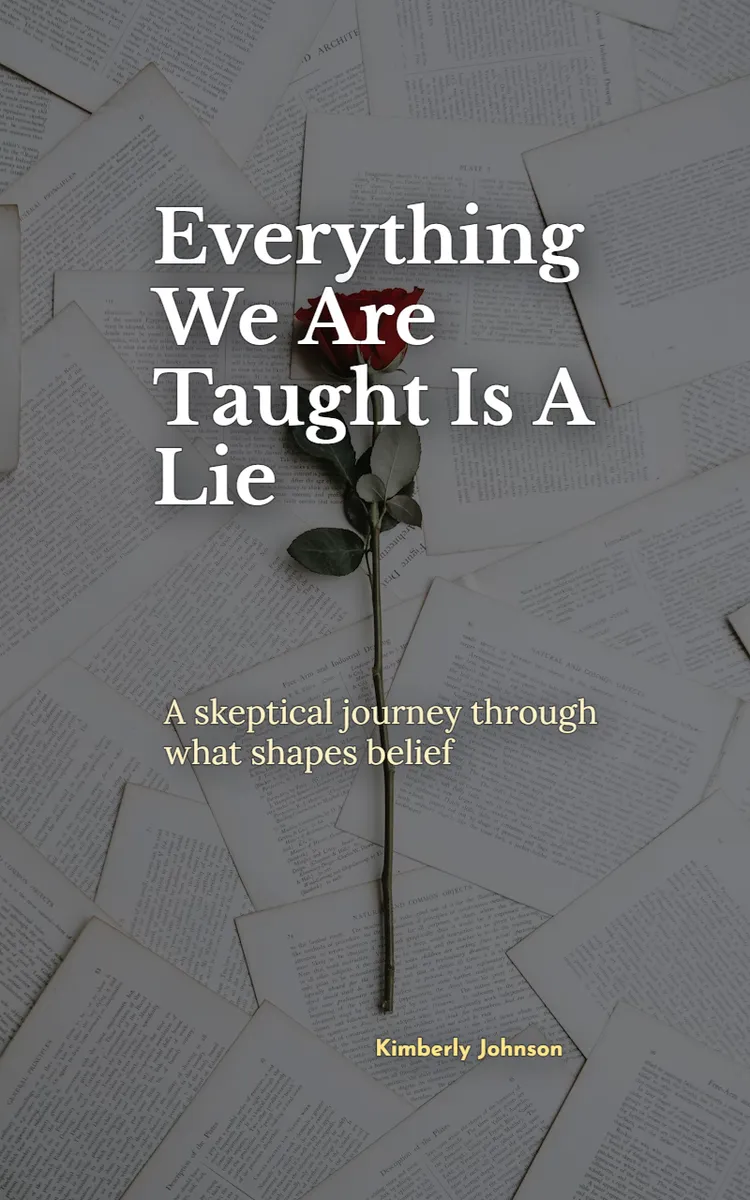
"Everything We Are Taught Is A Lie" is a curiosity book by Kimberly Johnson with 5 chapters and approximately 8,087 words. Critical examination of misinformation, ideology, and learned beliefs.
This book was created using Inkfluence AI, an AI-powered book generation platform that helps authors write, design, and publish complete books.
Frequently Asked Questions
What is "Everything We Are Taught Is A Lie" about?
Critical examination of misinformation, ideology, and learned beliefs
How many chapters are in "Everything We Are Taught Is A Lie"?
The book contains 5 chapters and approximately 8,087 words. Topics covered include The Lie Detector You Already Use, Why Your Brain Loves a Ghost, The Feed That Trains Your Beliefs, The Authority Costume Test, and more.
Who wrote "Everything We Are Taught Is A Lie"?
This book was written by Kimberly Johnson and created using Inkfluence AI, an AI book generation platform that helps authors write, design, and publish books.
Write your own curiosity book with AI
Describe your idea and Inkfluence writes the whole thing. Free to start.
Start writingCreated with Inkfluence AI


