
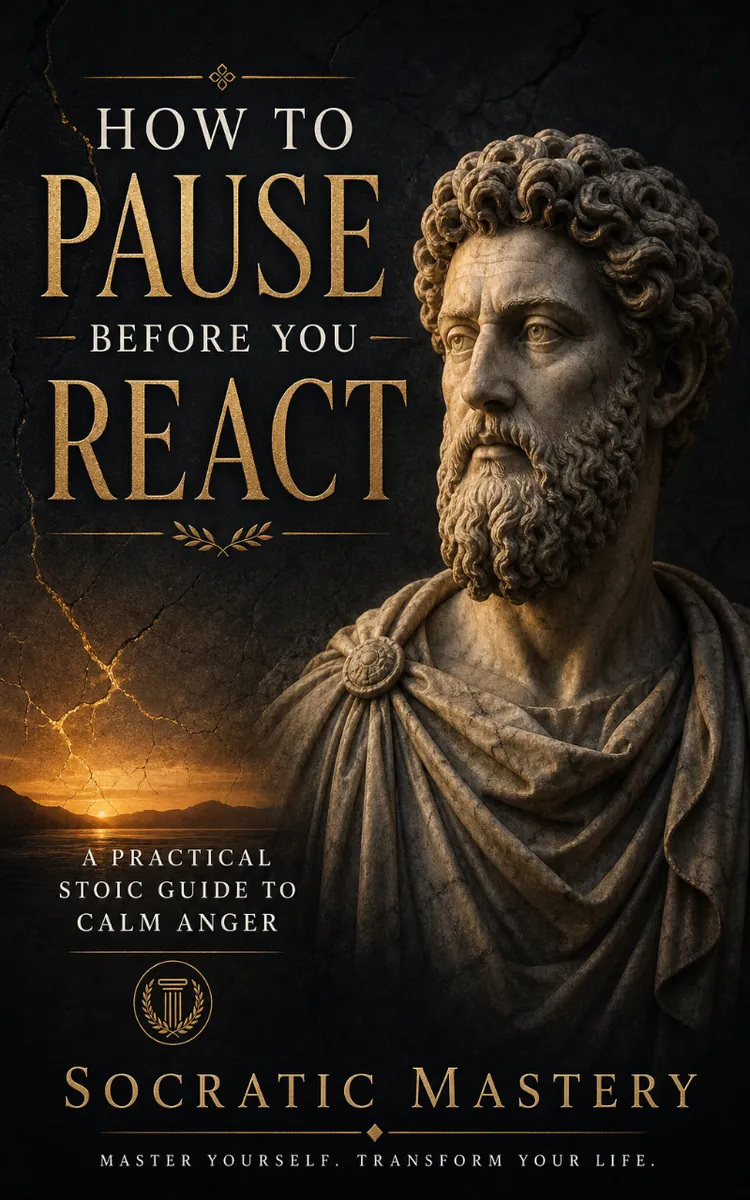
How To Pause Before You React
Created with Inkfluence AI
Stoic system for pausing before reacting to anger
Table of Contents
- 1. Recognizing the Pattern
- 2. The Mindset Behind the Struggle
- 3. Rewriting Your Inner Narrative
- 4. Building Daily Practices
- 5. Navigating Setbacks and Resistance
- 6. Strengthening Your Support System
- 7. Sustaining Long-Term Growth
- 8. Your Next Chapter
- 9. Recognizing the Pattern (Phase 2)
- 10. The Mindset Behind the Struggle (Phase 2)
- 11. Rewriting Your Inner Narrative (Phase 2)
- 12. Building Daily Practices (Phase 2)
- 13. Navigating Setbacks and Resistance (Phase 2)
- 14. Strengthening Your Support System (Phase 2)
- 15. Sustaining Long-Term Growth (Phase 2)
- 16. Your Next Chapter (Phase 2)
- 17. Recognizing the Pattern (Phase 3)
- 18. The Mindset Behind the Struggle (Phase 3)
- 19. Chapter 19 - The Stoic Foundation: What the Ancients Knew About Anger
- 20. Chapter 20 - The Physiology of Anger: What Happens in Your Body
- 21. Chapter 21 - Anger in the Digital Age
- 22. Chapter 22 - Anger at Work: Managing Conflict in Professional Settings
- 23. Chapter 23 - Anger in Relationships
- 24. Chapter 24 - The Anger of Others: How to Respond
- 25. Chapter 25 - Rebuilding Trust After an Outburst
- 26. Chapter 26 - Meditation and Breathwork
- 27. Chapter 27 - Your Personal Pause Plan
- 28. Chapter 28 - Glossary of Stoic Terms
- 29. Chapter 29 - Resources and Further Reading
Preview: Recognizing the Pattern
A short excerpt from “Recognizing the Pattern”. The full book contains 29 chapters and 64,068 words.
Chapter One
The Moment That Changes Everything
Most people think their anger problem lives in the outburst-the raised voice, the harsh words, the slammed door, the text message they wish they could unsend. They replay it later, wincing at their own reflection in the scene. They promise themselves it won't happen again. And then, a few hours or a few days later, it does.
If you feel like you're trapped in a cycle you can't escape, you're not alone. And you're not broken. What you're experiencing is the most predictable pattern in human psychology: when your nervous system senses a threat-real or imagined-it takes over before your thinking mind has any say. The ancient Stoics understood this over two thousand years ago, and their insight still holds today. The problem isn't anger itself. The problem is that you've never been taught to see the gap that exists between what happens to you and how you respond.
That gap-sometimes just a breath, sometimes a few seconds-is where your entire life bends toward peace or regret. Ignore it, and your body reacts on its own. Learn to notice it, strengthen it, and use it, and you become someone who can stay composed when others explode, someone who chooses strength over shame, someone whose reactions match the person they actually want to be.
This chapter is about finding that gap. And once you find it, learning what to do with it.
The Gap Between Stimulus and Response
Picture this. You're sitting at your desk, trying to focus, when a message pops up. It's from that coworker again-the one who always CCs your manager on emails about things you haven't done wrong. Your chest tightens instantly. Your jaw clenches. A rush of heat spreads through your body. Within seconds, you're typing a response-sharp, defensive, justified-and hitting send before you've even taken a breath.
Or maybe it's your partner, again, making the same comment that never lands the right way. You feel that familiar tightening behind your eyes, the internal pressure building, and before you know it, you're in a full argument about something that started as nothing.
In moments like these, it doesn't feel like you have a choice. It feels instantaneous. Automatic. Unavoidable. It feels like the anger was just always there, waiting for permission, and the trigger simply gave it what it wanted.
The Stoic insight is radical: between the event and your reaction, there is always a space. The Stoic philosopher Epictetus, writing in the first century, put it simply: "Men are disturbed not by things, but by the view which they take of them." In other words, the event itself is neutral. What matters is the story you tell yourself about it-and that story unfolds in the seconds between stimulus and response.
Most people rush through those seconds without noticing them at all. They've spent a lifetime training themselves to react, not to observe. But those few seconds are everything. They are the difference between the person you are right now and the person you want to become.
Why You Almost Always Miss the Pause
If the gap is always there, why don't you see it? Why does anger feel like a takeover every single time?
The first reason is modern life itself. You live in a world that rewards speed, outrage, and instant response. Notifications demand your attention. Social media algorithms are specifically designed to trigger emotional reactions-because engagement is highest when people are angry. You've been conditioned for years to respond quickly, to fire back, to prove your point immediately. Your brain has been trained like a reflex.
The second reason is deeper. Many people grew up in environments where anger erupted fast and unresolved. If you watched your parents or caregivers handle conflict by yelling, shutting down, or launching into arguments without pause, you learned that pattern by default. You didn't learn what a pause looked like because no one modeled it for you.
The third reason is your biology. When you feel threatened-even by an email, a tone of voice, or a memory-your amygdala fires. Your body floods with stress hormones. Your heart rate increases. Your breathing shallowly accelerates. Your rational, thinking brain-the prefrontal cortex-literally goes offline. You are now in a state psychologists call emotional hijacking. In this state, you cannot think clearly. You cannot reason. You can only act on impulse.
By the time your thinking brain comes back online, the damage is done: the words are said, the look has been given, the trust has been shaken. And you're left with the familiar aftertaste of regret.
The Real Price of Uncontrolled Reactions
Here's what most people don't fully understand about the cost of their anger: it is cumulative. One outburst here, one sharp reply there-it doesn't seem like much in the moment. You might even feel right. You might feel justified. And sometimes, you are right. But being right is not the same as being effective.
...
About this book
"How To Pause Before You React" is a self-help book by Socratic Mastery with 29 chapters and approximately 64,068 words. Stoic system for pausing before reacting to anger.
This book was created using Inkfluence AI, an AI-powered book generation platform that helps authors write, design, and publish complete books. It was made with the AI Self-Help Book Writer.
Frequently Asked Questions
What is "How To Pause Before You React" about?
Stoic system for pausing before reacting to anger
How many chapters are in "How To Pause Before You React"?
The book contains 29 chapters and approximately 64,068 words. Topics covered include Recognizing the Pattern, The Mindset Behind the Struggle, Rewriting Your Inner Narrative, Building Daily Practices, and more.
Who wrote "How To Pause Before You React"?
This book was written by Socratic Mastery and created using Inkfluence AI, an AI book generation platform that helps authors write, design, and publish books.
How can I create a similar self-help book?
You can create your own self-help book using Inkfluence AI. Describe your idea, choose your style, and the AI writes the full book for you. It's free to start.
Write your own self-help book with AI
Describe your idea and Inkfluence writes the whole thing. Free to start.
Start writingCreated with Inkfluence AI


