
Read the first chapter
The whole of chapter one, free. About 8 min. Turn the pages with the arrows, your keyboard, or a swipe.
Chapter 1
Following the Road That Vanished
The dashboard clock blinked 3:17 beneath a film of gray dust when the highway lost its left lane.
Mara Ellison jerked the wheel right. The tires skidded across three lanes of cracked asphalt, and the sedan’s rear end swung toward the concrete divider. She caught it before impact, fighting the steering until the car straightened. Ahead, the road vanished into fog thick enough to erase the overpass towers one at a time.
The engine coughed.
“Not now,” Mara said.
The fuel gauge trembled just above empty. Her hands tightened around the wheel. Somewhere beyond the fog, milepost 118 waited. She had seen the marker twice on the dead highway, each time farther away, each time standing beside a different stretch of broken pavement. If she reached it before the road broke again, she might find the service route marked on the old paper map folded beneath her seat.
The engine coughed a second time.
Mara pressed the accelerator.
The sedan crawled forward, shuddering beneath her. Wind pushed grit against the windows with a dry, insect-like rattle. On the right, abandoned cars emerged from the fog and disappeared again - burned vans, a school bus on its side, a delivery truck with its doors hanging open. Their metal frames leaned toward the road as if they had been dragged there.
She kept her eyes on the white line.
It ended twenty yards ahead.
Not faded. Not buried. Ended.
The asphalt beyond it dropped into a pale, empty basin. No guardrail. No rubble. No torn edge. The highway simply stopped, its continuation removed as cleanly as a strip of film.
Mara braked hard.
The sedan slid to the line and stopped with its bumper hanging over nothing. Fog moved below her, slow and thick, filling a depth that had not been there a second before. Far beneath the broken road, something struck metal. Once. Then again.
She reversed.
The tires spun. The engine screamed, and the car rocked backward onto solid pavement. Mara shifted into park and stared through the windshield.
A green sign stood in the median.
It had not been there before.
MILE 118 TRAVELERS KEEP RIGHT
The letters were bright beneath the dirt, too bright for anything left outdoors. Beneath the sign, a narrow ramp curved into the fog.
Mara looked at the fuel gauge. The needle rested on the red line.
“Right,” she muttered. “Of course.”
She pulled onto the ramp.
The fog swallowed the sedan’s headlights. Moisture filmed the windshield, and the wipers dragged gray streaks across the glass. The ramp narrowed until the tires ran over weeds and fractured concrete. A row of black posts appeared on either side, each one capped with a small white lamp. None of the lamps were lit.
The radio clicked on.
Mara flinched and reached for the dial. Static filled the cabin, broken by a faint repeating tone: three short pulses, then two long ones.
She turned the knob. The tone remained.
“Come on,” she whispered, striking the radio with her palm.
The engine faltered.
She eased off the accelerator. The car rolled down the ramp on its own, gathering speed toward a wall of fog. A second sign surfaced ahead, yellow this time.
NEXT MILEPOST NO STOPPING
The ramp ended at a four-way split.
Mara slowed. The left branch disappeared under a collapsed bridge. The right branch led toward a line of concrete barriers. Straight ahead, the pavement continued, smooth and black, with milepost 118 visible at the far end.
She smiled despite herself.
“There you are.”
She chose straight.
The road dropped sharply. Her stomach rose as the sedan plunged between high walls of concrete. The fog thinned, revealing a highway cut through a dry riverbed. The smooth pavement stretched ahead, but the milepost remained the same distance away.
Mara pressed the accelerator.
The needle on the fuel gauge dipped below the red.
The sedan began to lose power.
“No.”
She pushed harder. The engine rattled, then surged. The milepost grew larger. One hundred yards. Seventy. Fifty.
The road ahead buckled.
A crack raced across the pavement from shoulder to shoulder. Asphalt folded upward like a wave. Mara slammed the brakes. The sedan stopped inches from the rising ridge.
Beyond it, the milepost stood in the middle of the road.
118.
The number had been painted over another number. She could see the old black shape beneath the white paint: 117.
Mara shut off the engine.
The sudden silence pressed against the windows. Static whispered from the radio. Somewhere in the fog, a horn sounded once, low and mournful.
She climbed out.
Cold dampness touched her face. The ground vibrated beneath her boots, faintly, as if machinery moved under the road. She walked toward the marker with her crowbar in one hand. The asphalt around it was unbroken. No foundation showed. No tire tracks crossed the dust.
At the base of the post, someone had carved words into the metal.
KEEP MOVING UNTIL IT ASKS.
Mara read the sentence twice.
A soft click came from the sedan.
She turned.
The radio had gone quiet. The driver’s door stood open.
Mara had left it shut.
She ran back, boots striking the pavement. The inside of the car was empty. A strip of paper lay across the steering wheel, held in place by a rusted bolt.
She snatched it up.
A hand-drawn arrow pointed toward the right-hand shoulder. Beneath it, in block letters:
FUEL FOR PASSAGE.
Mara looked past the car.
A line of lamps had appeared in the fog, one after another, leading away from the broken highway. At the end of them stood a barricade gate. Its striped arm stretched across a narrow road that had not been visible before.
A figure stood beside it.
Mara raised the crowbar.
The figure did not move. It wore a long coat, a hood, and a pale mask or perhaps a face washed blank by the fog. One hand rested on the gate’s control box.
Mara took a step forward.
“Are you real?”
The figure lifted its arm and pointed at the back of the sedan.
Mara followed the gesture. Her last usable fuel can sat behind the driver’s seat, strapped beneath a blanket. Ten liters. Enough to carry her perhaps another hundred miles if the road behaved.
The figure pointed again.
“No,” Mara called. “That’s not happening.”
The gate remained closed.
She returned to the car and opened the rear door. The fuel can was where she had left it, dented along one side, its cap wrapped in tape. She lifted it free. The metal handle bit into her palm.
Behind her, the radio clicked.
Three short pulses. Two long.
Then a voice came through the static, thin and distant.
“Keep right.”
Mara froze.
The voice sounded like her own.
She turned toward the figure. “Did you say that?”
The figure lowered its arm and pointed toward the fuel can.
Mara’s grip tightened. “I need this.”
The road beneath her boots shuddered. Behind the sedan, the smooth black pavement split along a widening seam. Fog poured through the crack. The highway began to sink, not collapse in a roar but descend with a slow grinding motion, lane markings sliding downward into the white.
Mara looked at the milepost.
118 stood untouched.
The road around it dropped away.
She ran.
Fuel can in hand, she crossed the narrow strip of pavement toward the gate. The figure stepped aside. Up close, she saw there was no face beneath the hood - only fog, curling in the shape of a head.
Mara stopped short.
The gate’s control box had no buttons. It held a shallow metal tray and a speaker grille black with dust.
A message had been scratched into the tray.
LEAVE WHAT CARRIES YOU.
The sedan gave a long mechanical groan behind her.
Mara looked back. Its front wheels hung over the sinking road. The car slid another inch.
She could throw the can into the tray and keep moving on foot. Or she could return for the car and lose the gate, the road, perhaps both. Her pack contained water, a knife, two tins of beans, a flare, and the map. None of it would matter if she could not get past the wasteland.
The figure waited.
“Who built this?” Mara asked.
The speaker crackled.
A voice answered from inside the box.
“Ask again.”
The same words came through the radio in the sedan.
Mara stared at the fog where the figure’s face should have been. “What is this place?”
“Ask again.”
The highway groaned louder. A slab of asphalt behind the sedan folded and dropped. The car slid forward, its rear tires lifting from the ground.
Mara moved.
She carried the fuel can to the tray and set it down. The metal struck with a hollow clang. For a moment, nothing happened.
Then the gate’s lamps flared white.
The figure pressed one hand against the control box.
From somewhere beneath the road came a deep, resonant tone. Three short pulses. Two long.
Mara heard the pattern in her bones.
The barricade arm rose.
Beyond it, the road ran through the fog, narrow but intact. Small signs lined its edges, each painted with the same instruction.
KEEP RIGHT.
Mara glanced at the sedan.
The car had fallen halfway into the broken highway. Its headlights still shone, illuminating the fog from below. The driver’s door swung open and shut in the wind.
She had lost the vehicle. Her supplies were inside. The map lay beneath the seat, along with the water and the flare. Only the pack on her shoulders remained.
The figure moved toward the open gate.
Mara stepped after it, then stopped.
“Wait.”
The figure turned.
She pointed at the fuel can. “That was my last fuel.”
The fog inside the hood shifted.
The speaker crackled again.
“Passage.”
Mara looked beyond the gate. The road disappeared after a few hundred yards, but the lamps continued, marking a path into the white. Far ahead, another green sign flickered into view.
MILE 119.
The number glowed once, then vanished.
Mara crossed beneath the raised barricade.
Behind her, the gate slammed shut.
The sound rolled through the fog like a gunshot. When she turned, the figure was gone, the tray was empty, and the road back had become a flat wall of gray.
On the other side of the gate, a small black receiver hung from a post. Its red light blinked in the same rhythm as the radio had.
Three short pulses.
Two long.
Mara reached toward it.
The receiver spoke before her fingers touched it.
“Where are you going?”
The road ahead waited, smooth and narrow, leading nowhere she could see.
Mara pulled her pack higher on her shoulders.
“Forward,” she said.
The receiver clicked.
“Ask again.”
End of chapter one. 14 more chapters in the full book.
Swipe or use the arrows to turn the page


What's inside: 15 chapters
- 1. Following the Road That Vanished
- 2. Barter at the Milepost Gate
- 3. The Radio That Only Answers
- 4. Choosing the Wrong Turn Marker
- 5. A Promise Made in Dust
- 6. The Token That Burns Maps
- 7. Crossing the Flooded Causeway
- 8. Rellan Voss and the False Coordinates
- 9. When Mara Lies to Survive
- 10. The Anchor Site Eats the Signal
- 11. Hunger Forces the Hard Choice
- 12. Chasing the Road’s Hidden Logic
- 13. Forcing the Truth Pattern
- 14. The Road Finally Points Through
- 15. A Destination Named by Silence
About this book
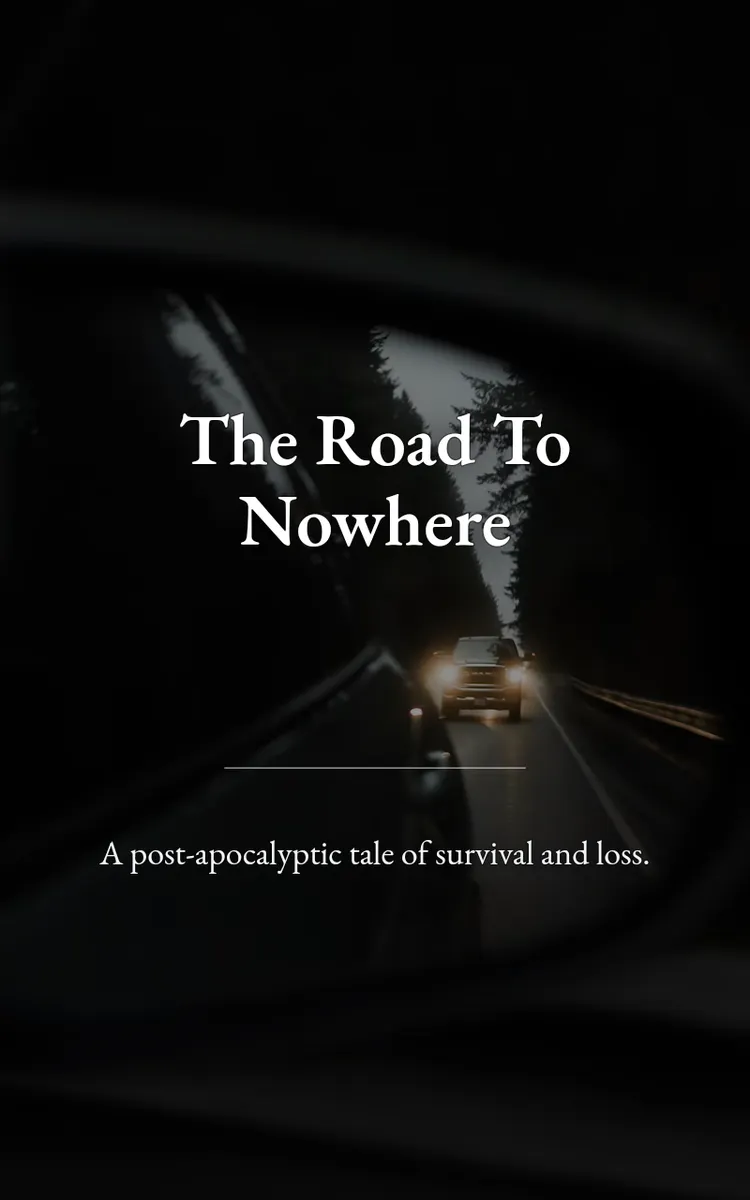
"The Road To Nowhere" is a fiction book by Ronell Naude with 15 chapters and approximately 29,591 words. A post-apocalyptic journey through a collapsing world.
This book was created using Inkfluence AI, an AI-powered book generation platform that helps authors write, design, and publish complete books. It was made with the AI Novel Writer.
Frequently Asked Questions
What is "The Road To Nowhere" about?
A post-apocalyptic journey through a collapsing world
How many chapters are in "The Road To Nowhere"?
The book contains 15 chapters and approximately 29,591 words. Topics covered include Following the Road That Vanished, Barter at the Milepost Gate, The Radio That Only Answers, Choosing the Wrong Turn Marker, and more.
Who wrote "The Road To Nowhere"?
This book was written by Ronell Naude and created using Inkfluence AI, an AI book generation platform that helps authors write, design, and publish books.
How can I create a similar fiction book?
You can create your own fiction book using Inkfluence AI. Describe your idea, choose your style, and the AI writes the full book for you. It's free to start.
Write your own fiction book with AI
Describe your idea and Inkfluence writes the whole thing. Free to start.
Start writingCreated with Inkfluence AI


