
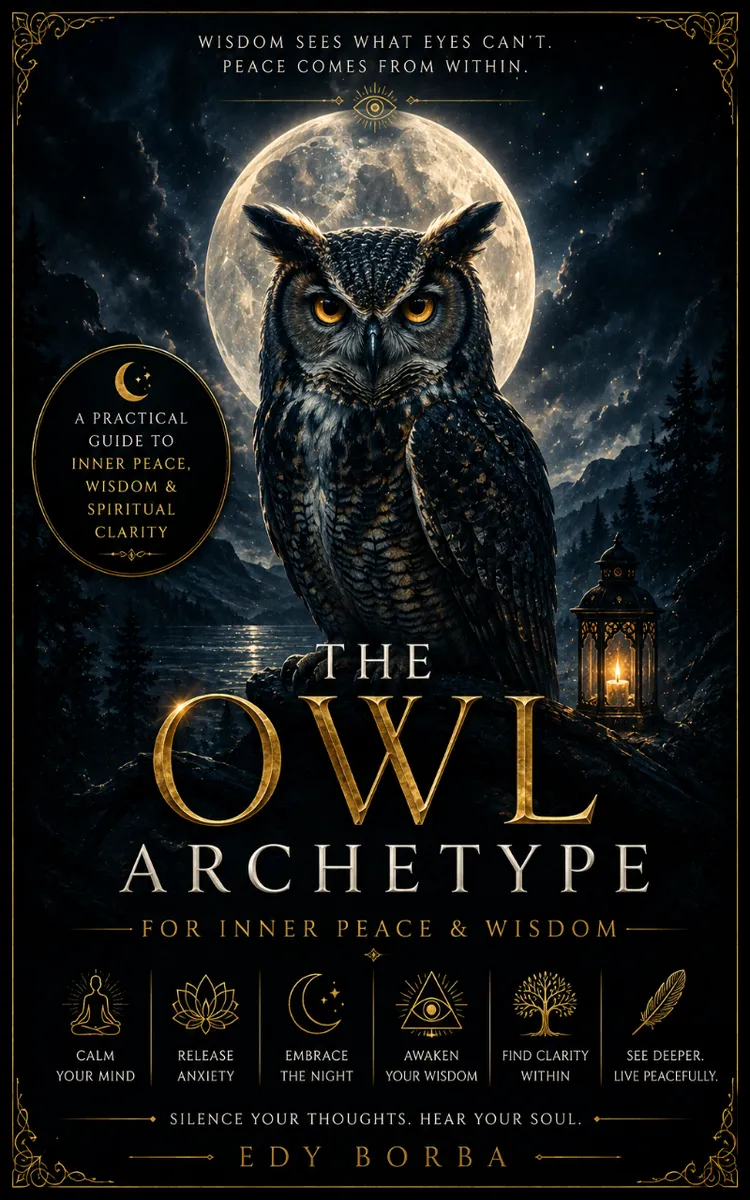
The Owl Archetype
Created with Inkfluence AI
Meditation, anxiety reduction, and spiritual clarity practices
Table of Contents
- 1. Quieting the Mind Through Owl Breath
- 2. Unhooking From Anxiety With Thought Clouds
- 3. Seeing Beliefs That Create Your Reality
- 4. Detaching From Emotions Without Numbing
- 5. Shadow Awareness for Gentle Inner Healing
- 6. Silence Rituals That Restore Mental Clarity
- 7. Wisdom Psychology for Rewriting Inner Scripts
- 8. Becoming the Owl: Purpose Through Stillness
Preview: Quieting the Mind Through Owl Breath
A short excerpt from “Quieting the Mind Through Owl Breath”. The full book contains 8 chapters and 12,112 words.
A Moment of Truth
Have you ever felt your mind rev up like a dashboard light you can’t turn off-work emails, old conversations, tomorrow’s problems-all of it firing at once, even while your body is trying to rest?
Nadia, 34, trauma-informed yoga teacher, knew that feeling too well. One night after a long class, she sat on her mat with her usual intention-soft eyes, slow breath, a clean return to herself. But as soon as she closed her eyes, the noise came back: the next workshop, the student who triggered her boundaries, the quiet fear that she’d “mess it up” again. Her chest tightened, her jaw locked, and she realized the real problem wasn’t that she had too many thoughts. It was that her nervous system kept treating thoughts like threats. (And it didn’t care that she was spiritually awake.)
She opened her phone to distract herself-then stopped. Her hands hovered above the screen for one second longer than usual, like she was listening for something beneath the static. In that tiny pause, she felt the tension between one decision and one truth: you can’t out-think a body that’s already on alert.
What Changes Everything
Nadia tried a familiar reset: she counted breaths for a few minutes. It helped… until it didn’t. The moment her mind wandered, she felt a quick spike of frustration-like she’d failed at “doing it right.” Then the next thought arrived, and the next. The cycle kept feeding itself.
So she switched the method. She didn’t chase calm through effort; she downshifted it through rhythm. One evening, she practiced Owl Breath Descent with a simple “down” sequence-exhale first, then let the breath travel like moonlight. Her shoulders dropped before her thoughts did.
Here are three moments that look small on paper, but changed everything in practice:
- Nadia (34, trauma-informed yoga teacher): “Counting made me tense.” She used Owl Breath Descent on days when her body felt braced, not just her mind crowded.
- Mark (gym owner): “My best ideas came after I felt safe.” He noticed that the harder he tried to think clearly, the more his body tightened-then he practiced Owl Breath Descent before strategy calls.
- Leila (small business owner): “I kept spiraling on ‘what if.’” She used Owl Breath Descent when her thoughts turned repetitive, especially late at night.
What all these have in common
- None of them tried to bully their minds into silence.
- Each one treated anxiety like a body signal, not a personal flaw.
- The shift happened when breath became the language the nervous system could actually understand.
The underlying principle is simple, but it’s not simplistic: your mind follows your body’s timing. When your exhale is long and your breath movement feels “contained,” your system stops scanning for danger. Thoughts don’t magically disappear-they lose their grip. It’s like turning down the volume instead of arguing with the radio.
Owl Breath Descent is built for that exact moment: when you’re stuck between “I know what to do” and “I can’t feel it.” The breath becomes a doorway. And once your body recognizes safety, clarity stops being a performance and starts being a presence.
The Deeper Truth
There’s a sneaky psychology at work when your mind gets loud. Thoughts aren’t just thoughts; they’re meaning-making. When you’re anxious, your brain starts attaching stories to sensations: tight chest = danger, racing thoughts = I’m behind, restless mind = something is wrong with me. That story turns breath into a battleground.
Owl Breath Descent changes the relationship. Instead of using breath to “fix yourself,” you use breath to communicate: I’m here. I’m not fighting. I’m descending into quiet. The nervous system responds to patterns-especially exhale-led patterns-because it can’t fully distinguish “imagined threat” from “real threat” in the heat of the moment. So you give it something real: a calming rhythm it can trust.
This is also why the practice feels different from typical meditation. Many people try to sit and “think less,” and then their mind punishes them for thinking. Owl Breath Descent doesn’t demand mental perfection. It invites emotional detachment in a gentle way-like watching a wave from shore instead of jumping into the ocean to wrestle it.
Here are the signs you need this chapter:
1. You can meditate, but you still feel wound up afterward. Your mind calms, yet your body stays braced.
2. Your thoughts intensify when you try harder. The effort creates pressure, and pressure creates more thinking.
3. At night, your brain replays old conversations like they’re live. You don’t just have thoughts-you have re-experiencing.
4. You want spiritual clarity, but anxiety keeps interrupting the channel. You feel blocked, not because you lack insight, but because your system can’t settle.
Bold truth-summary: When the nervous system feels safe, the mind stops acting like a courtroom and starts acting like a mirror.
...
About this book
"The Owl Archetype" is a self-help book by Edicarlos Content Creator · Self-Knowledge & Personal Development with 8 chapters and approximately 12,112 words. Meditation, anxiety reduction, and spiritual clarity practices.
This book was created using Inkfluence AI, an AI-powered book generation platform that helps authors write, design, and publish complete books. It was made with the AI Self-Help Book Writer.
Frequently Asked Questions
What is "The Owl Archetype" about?
Meditation, anxiety reduction, and spiritual clarity practices
How many chapters are in "The Owl Archetype"?
The book contains 8 chapters and approximately 12,112 words. Topics covered include Quieting the Mind Through Owl Breath, Unhooking From Anxiety With Thought Clouds, Seeing Beliefs That Create Your Reality, Detaching From Emotions Without Numbing, and more.
Who wrote "The Owl Archetype"?
This book was written by Edicarlos Content Creator · Self-Knowledge & Personal Development and created using Inkfluence AI, an AI book generation platform that helps authors write, design, and publish books.
How can I create a similar self-help book?
You can create your own self-help book using Inkfluence AI. Describe your idea, choose your style, and the AI writes the full book for you. It's free to start.
Write your own self-help book with AI
Describe your idea and Inkfluence writes the whole thing. Free to start.
Start writingCreated with Inkfluence AI


