
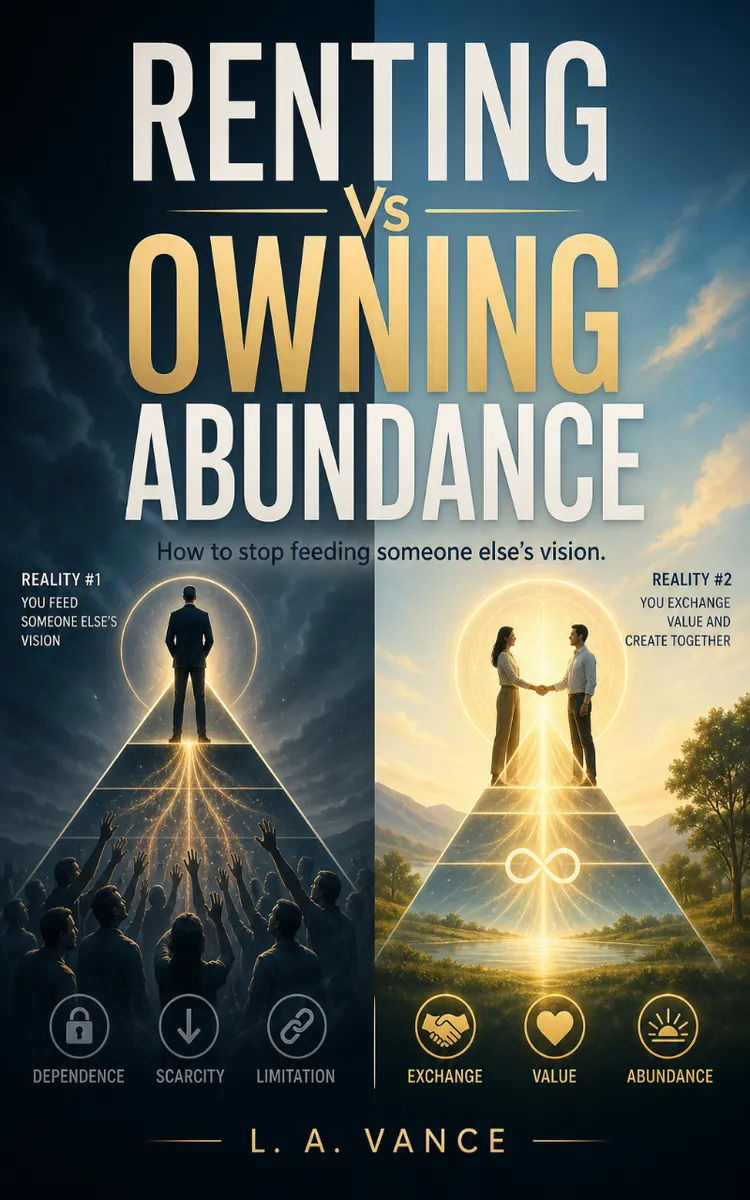

Read the first chapter
The whole of chapter one, free. About 8 min. Turn the pages with the arrows, your keyboard, or a swipe.
Chapter 1
Unmasking Worthiness Through Exhaustion
The Exhaustion That Gets You Paid (and the Approval That Never Does)
Talia, 41, VP Operations at a Fortune 500, could run a meeting like a control room. She could tighten timelines, calm escalations, and translate chaos into clean action items. On paper, she was winning.
But every win had a cost she didn’t name out loud. After the QBRs, she’d disappear into her calendar, working late to “be sure” she didn’t miss something. She’d wake up with her jaw clenched like her body still expected an emergency briefing. When someone praised her - “Great job, Talia” - she felt a brief warmth, then immediately returned to the familiar question: What if it wasn’t enough? The praise didn’t land. The exhaustion did.
Here’s the tension: grind-culture trained her to believe pain is proof. And when pain becomes the currency, you eventually stop asking whether the transaction is even worth it - because the system taught you that worthiness only arrives after you’ve bled for it.
At what point does your “value” become a self-inflicted leash?
Unworthiness in Work Boots: How Grind-Culture Links Pain to Value
Old Belief: If I’m exhausted, I must be valuable. If I’m not strained, I’m not performing.
New Reality: Exhaustion is often an energetic withdrawal signal, not a performance metric. Worthiness isn’t earned through suffering - it’s revealed through alignment, clean intention, and sovereign contribution.
This shift matters because the exhaustion isn’t just fatigue. It’s a conditioning pattern - an identity-level agreement with a scarcity reality. When you equate pain with value, you build your life around “proving” rather than creating. You stop listening for your Source Consciousness and start scanning for approval signals: the boss’s response time, the team’s tone, the next deliverable, the next escalation. Your attention becomes a rented asset, and your energy gets spent to keep someone else’s architecture stable.
Talia felt this in a very specific moment. She’d stayed up late before a major operational rollout, rewriting the same plan three different ways because she didn’t trust that “good enough” would protect her reputation. The rollout went fine. Stakeholders praised her. And yet, instead of relief, she felt hollow - like the praise was just a receipt for something she didn’t even want to keep buying. The plan wasn’t the problem. The underlying belief was: my worth is measured by how hard I push through discomfort.
Once you see that, you can’t unsee it: pain isn’t a reliable indicator of true value. It’s often a sign that you’re operating from a scarcity programming trap - where your nervous system confuses pressure for purpose.
Signs Grind-Culture Is Running Your Life Through the Exhaustion-to-Approval Loop
Your mindset shift isn’t just “a nicer way to think.” It changes the operating system you use to decide what’s worth doing, what’s safe to stop doing, and what kind of wealth you’re actually available to receive.
Grind-culture doesn’t only teach you to work hard. It quietly teaches you that your nervous system should stay in a low-level state of threat so you’ll never “fall behind.” And when you live there long enough, you start craving the rush of urgency because it feels like motion, and motion feels like proof. That’s the trap: exhaustion becomes the measurement device. Approval becomes the payment. And the bill keeps arriving even when you’re financially “successful.”
Let’s name the loop in plain terms: the Exhaustion-to-Approval Loop Model. You push past ease → you generate measurable output → you seek recognition to confirm you’re safe → recognition fades → you push again to feel solid. The loop doesn’t end because it’s not designed to end. It’s designed to keep you predictable.
Signs that this pattern is running your life
• You feel “clear” only when you’re overwhelmed. Calm feels suspicious, like you’re about to be judged for not doing enough.
• You keep over-delivering even when nobody asked for it. You’re not serving the work anymore - you’re maintaining worthiness.
• Recognition gives you a temporary high, then instantly turns into doubt. The compliment stops feeling like closure and starts feeling like a new standard.
• You struggle to trust your own instincts unless the pressure is high. Your inner guidance gets drowned out by the need to “prove” externally.
The real giveaway is this: when your nervous system believes pain equals worthiness, your life stops being yours.
The Mindset Shift That Breaks the Identity Contract (Before It Breaks You)
The core explanation is simple, but it lands deep: grind-culture trains you to outsource your internal legitimacy. You don’t just work hard - you borrow your sense of value from external systems. That’s why the exhaustion feels “productive.” It’s not producing value; it’s producing reassurance.
In sovereign wealth terms, this is structural. The energetic matrix of employment isn’t neutral. When you plug your life force into someone else’s outcomes, your identity tends to become calibrated to their approval rhythms. You’re not wrong for being high-performing. You’re just being high-performing in a way that keeps your Source Consciousness on a short leash.
Here’s the difference that matters for Talia: when she was exhausted, she was “accurate” and “reliable.” But she was also operating from fear-based intention - fear of being seen as sloppy, fear of being replaceable, fear of being found out. That fear doesn’t only affect her mood. It affects her choices: what she takes on, what she ignores, how she negotiates, and what she believes she’s allowed to want.
And because the law of circulation responds to pure value and clean intention, fear-based labor creates a cap. You can earn money, sure. But long-lasting abundance - abundance that feels like freedom rather than strain - doesn’t fully open when your identity is still bargaining for legitimacy through suffering.
So the mindset shift is not “stop working.” It’s: stop using pain as your authentication method.
Reflection & Self-Assessment: Where Your Worthiness Is Being Paid Out
You don’t need a dramatic breakdown to locate the loop. You need honest signal-reading. That’s what the reflection prompts below are for - because the scarcity programming trap doesn’t usually announce itself as scarcity. It disguises itself as professionalism.
Questions to ask yourself
• When was the last time you felt proud - and then quickly tried to erase that feeling by working more?
If you notice a pattern, pay attention to what you feared would happen if you stopped. The fear is usually older than the current job.
• What do you do when you’re not under pressure?
Many high performers tighten. They check emails “just to be safe,” or they create a new task to replace the urgency. That’s the loop trying to keep you familiar.
• What kind of recognition do you chase, specifically?
Not “praise” in general - name it. Is it permission? Rescue? Being the hero? Being seen as indispensable? Your answer shows where your worthiness is being rented out.
• Where in your body do you feel the “proof” requirement?
Jaw, chest, shoulders, stomach - your body keeps receipts. If your body reads exhaustion as safety, your identity contract is active.
• If you removed the need for external approval for one week, what would you build differently?
Your honest answer reveals your actual Source Consciousness. The life you’d choose without fear is the life your nervous system is currently blocking.
Permit yourself to answer without editing. The point isn’t to judge your past choices. The point is to see the mechanism clearly enough to interrupt it.
The 7-Day Unplug Protocol: Interrupt the Exhaustion-to-Approval Loop
This is not a journaling exercise where you write nice things about yourself and then go back to the same loop. This is an interruption protocol - small, measurable, and identity-level.
Challenge Title: 7 Days of Worthiness-Without-Warfare
• For the next 7 days, track one metric each day: How much of your work came from pressure versus intention?
Use a simple scale from 0-10 (0 = purely ease, 10 = purely pressure).
• Pick one “approval trigger” task you typically overdo when you’re anxious (for Talia, this might be rewriting a deck “one more time,” or staying late to “make it perfect”).
On Day 1, do it as if you are already safe - same deliverable, but stop 20 minutes earlier than your usual.
• Do one “exit move” daily.
An exit move is a deliberate closure: send the message, finish the file, stop checking, leave the room. No extra polishing. No “just in case.”
• End each day with one sentence: “Today I chose _ over _.”
Fill in the blanks with something real (e.g., “Today I chose ease over proof.”)
Expected difficulty rating: Medium (it will feel slightly wrong at first - good. That’s the old identity protesting.)
You'll know it's working when...
• Your body starts to believe you can stop without consequence.
• Praise feels less like a drug and more like information.
• Your pressure scale drops even if your output stays solid.
• You notice the loop earlier - before you’ve already burned the evening to earn relief.
If you want a grounded check: do you feel more spaciousness in your decision-making by Day 5? That’s the sign your identity contract is loosening.
Key Takeaway: Worthiness Isn’t a Result - It’s the Operating Frequency
When you stop treating exhaustion as your proof, you stop feeding the approval system that keeps you structurally capped.
And that’s not just a “mindset.” It’s a shift in energetic architecture. You’re beginning to relocate legitimacy from external validation back into Source Consciousness - where value can actually compound.
• You learned how grind culture turns pain into a measurement device and approval into a payment system.
• You mapped the Exhaustion-to-Approval Loop Model as an identity-level contract, not a work habit.
• You used a time-bound protocol to interrupt the loop without harming your output.
• You clarified that sovereign abundance requires clean intention, not fear-based overperformance.
Next, we’ll go one level deeper: how the corporate structure itself distributes energy - where value is created, where it’s extracted, and why your “hard work” can still be a form of renting unless you redesign the flow.
The moment you stop earning worth through suffering, your life force stops being billed.
End of chapter one. 7 more chapters in the full book.
Swipe or use the arrows to turn the page


What's inside: 8 chapters
- 1. Unmasking Worthiness Through Exhaustion
- 2. Mapping the 9-to-5 Energetic Matrix
- 3. Breaking the Rent-Your-Source Agreement
- 4. Exposing the Illusion of Outsourced Creation
- 5. Discovering Your Earthly Assignment Physics
- 6. Activating Source Consciousness With Intention
- 7. Building Scalable Assets From Your Purpose
- 8. Compounding Sovereign Wealth Through Ecosystems
About this book
"Renting Vs Owning Abundance" is a self-help book by L. A. Vance with 8 chapters and approximately 13,593 words. Transition from paycheck work to purpose-driven sovereign wealth.
This book was created using Inkfluence AI, an AI-powered book generation platform that helps authors write, design, and publish complete books. It was made with the AI Self-Help Book Writer.
Frequently Asked Questions
What is "Renting Vs Owning Abundance" about?
Transition from paycheck work to purpose-driven sovereign wealth
How many chapters are in "Renting Vs Owning Abundance"?
The book contains 8 chapters and approximately 13,593 words. Topics covered include Unmasking Worthiness Through Exhaustion, Mapping the 9-to-5 Energetic Matrix, Breaking the Rent-Your-Source Agreement, Exposing the Illusion of Outsourced Creation, and more.
Who wrote "Renting Vs Owning Abundance"?
This book was written by L. A. Vance and created using Inkfluence AI, an AI book generation platform that helps authors write, design, and publish books.
How can I create a similar self-help book?
You can create your own self-help book using Inkfluence AI. Describe your idea, choose your style, and the AI writes the full book for you. It's free to start.
Write your own self-help book with AI
Describe your idea and Inkfluence writes the whole thing. Free to start.
Start writingCreated with Inkfluence AI


