

Read the first chapter
The whole of chapter one, free. About 11 min. Turn the pages with the arrows, your keyboard, or a swipe.
Chapter 1
The Déjà Vu Receipt
The Déjà Vu Receipt: How Small “I’ve Been Here” Moments Can Point Back to Your Future Intent
The strangest thing about déjà vu isn’t that it feels supernatural - it’s that it often arrives dressed as something mundane. One second you’re standing in line or reaching for a familiar mug, and the next you have the unshakeable sense that you’ve already done exactly this, down to the tilt of the cashier’s head or the timing of a song in the background.
Lena, an ER nurse, kept a private log for years - not because she was chasing meaning, but because she couldn’t stop noticing the pattern in her own body. She didn’t write down every weird thought. She wrote down moments when the feeling was sharp enough to be unmistakable: the brief, cold certainty that the next few seconds had already happened somewhere else. She called it her “strange timing” record. Over time, it became less like a diary and more like a receipt - proof that the mind had printed something before the moment arrived.
This chapter is about treating those small déjà vu hits as feedback signals from your future intent - not as a game, not as a mystical decoration on top of ordinary life, but as a clue. We’ll follow the trail from how déjà vu became a measurable phenomenon to why retrocausality - your future shaping your present - keeps resurfacing in metaphysical explanations. And we’ll do it through Lena’s lived, practical obsession with timing: the kind that happens in fluorescent-lit rooms where you can’t afford to be vague.
If déjà vu is a receipt, what exactly is paying for it - your past memory, or your future direction?
The Déjà Vu Receipt Protocol: Turning “I’ve Been Here” Into Evidence, Not Mystery
The Déjà Vu Receipt Protocol starts with a simple refusal: don’t explain the feeling away too fast. In most people, déjà vu is treated like a curiosity, a glitch to laugh off. In Lena’s log, the moments were treated like data - small, time-stamped events with a consistent texture. She wasn’t trying to prove anything to anyone. She was trying to understand what kind of “message” her mind was delivering when it delivered that message.
What matters is how the feeling behaves. Déjà vu is usually brief, often seconds long, and it comes with a specific flavor: an eerie familiarity that isn’t just “I recognize this place.” It’s closer to “I recognize what will happen next” - even if you can’t predict the details. That “next” quality is why it catches the attention of anyone drawn to retrocausal ideas. It tempts the mind to ask whether the brain is working backward from a sense of completion.
Historically, déjà vu has been described for centuries. The term itself is French - literally “already seen” - and the experience has been reported long enough that you can find it referenced in older medical writings. But modern interest took off when researchers began to treat it as something you can study without treating it as pure folklore. Laboratories can’t easily manufacture “already seen,” but they can measure related patterns: recognition errors, memory timing, and the brain’s rapid sense-making.
Lena’s entries weren’t elaborate. She noted what she was doing, where she was, and the emotional temperature of the moment - calm, alert, tense. She didn’t assume the feeling meant danger. She didn’t assume it meant destiny. She just observed whether it tended to appear during transitions: the hand moving from one task to another, the shift from one conversation to the next, the moment a room changed its rhythm. That’s a key detail for the Déjà Vu Receipt Protocol. Déjà vu often shows up when the mind is updating its model of what’s happening - when it’s stitching the present to its internal expectations.
Even without metaphysics, that expectation-update angle is compelling. Neuroscience has long proposed that déjà vu may involve memory mismatch - a situation where the brain treats a present stimulus as if it had already been encoded. One widely discussed line of explanation involves the timing and coordination of recognition systems in the brain. The brain is a prediction engine; it’s always comparing what’s incoming to what it already has. If that comparison briefly misfires, you can get a strong familiarity sensation without a matching conscious memory.
But retrocausality metaphysics adds a twist: what if the comparison isn’t only anchored to the past? What if the brain is also reacting to the future - through intent, attention, or some deeper “set point” the mind is moving toward? In that framing, déjà vu becomes less like a misfiled memory and more like a preview. Not a full movie. A receipt slip - one line of proof that your system is aligning with an outcome.
What the Brain Studies When It Tries to Explain Déjà Vu
There’s a reason déjà vu refuses to stay in the realm of “just vibes.” It has neurological associations that researchers can’t ignore. In clinical settings, déjà vu can appear in people with certain types of temporal lobe seizure activity. The temporal lobe is heavily involved in memory and familiarity. When that region misfires, the brain can produce recognition without the supporting context, creating a sensation that something has already happened.
That doesn’t mean every déjà vu moment is a seizure, and most people who experience it are not having epileptic episodes. But the clinical connection matters because it suggests the feeling has a real biological mechanism. It’s not purely imaginative. It’s a state the brain can enter.
At the same time, the brain’s mechanism doesn’t automatically settle the direction of causality. Even if the sensation arises from internal circuitry, metaphysical retrocausality asks a different question: not “how does the feeling arise?” but “why does it arrive when it does, and why does it carry a sense of sequence?” Lena’s log kept returning to that “sequence” quality. When she wrote about a déjà vu hit, it usually wasn’t random scenery. It was a moment embedded in a chain - turning toward a doorway, preparing to document something, stepping into a pattern of motion that would soon feel inevitable.
A surprising single-sentence anchor from the scientific side is this: déjà vu is often reported alongside strong familiarity judgments without matching recall. That’s a mouthful, but it’s the crux. The brain can generate the “I know this” response while failing to retrieve the “I remember this” story. It’s like being certain of the conclusion while missing the evidence trail.
Now add the cultural layer. People don’t just experience déjà vu; they interpret it. Some treat it as psychic; others treat it as a stress symptom; many treat it as a brain quirk. The interpretations matter because they shape what people attend to afterward - whether they dismiss the feeling, chase patterns, or ignore the emotional signal. Lena didn’t chase it in the supernatural sense. She chased it in the observational sense. Her log became a way to keep her interpretation from drifting into whatever story she might later prefer.
That’s where the Déjà Vu Receipt Protocol starts to feel different from a normal journal. It’s not “dear diary, I felt weird.” It’s “here is the exact moment, and here is what the mind presented.” When you treat it like a receipt, you stop asking, “Was it magic?” and start asking, “What kind of information does my mind attach to this feeling?”
In the retrocausality metaphysics framing, that information isn’t necessarily about the past. It’s about alignment - about the mind’s internal trajectory toward what you’re about to do, even if you don’t consciously choose it yet. That trajectory could be shaped by future intent, attention, or some non-linear influence that doesn’t respect the one-way timeline we’re used to.
The Counterintuitive Connection: Déjà Vu as Future-Alignment, Not Memory Glitch
Here’s the surprise: the retrocausality reading flips the usual intuition. Instead of saying, “Déjà vu is what happens when the brain mislabels the present as past,” the metaphysical angle says, “Déjà vu is what happens when the present is pulled into alignment with a future state already ‘known’ to the system.”
That matters because it changes what you’re looking for. If déjà vu is only a memory glitch, then the feeling should correlate mostly with memory errors, fatigue, or neurological conditions - interesting, but not meaningful in the way Lena’s log kept implying. If déjà vu is future-alignment, then the feeling becomes a signal about intent - not intent as a wishful thought, but intent as the mind’s direction-setting function.
What changes most is the question of timing. Memory explanations can account for “already seen” sensations, but they don’t naturally explain why the feeling often seems to include a forward-looking sense of sequence. Retrocausality metaphysics treats that forward sense as the point. It suggests the mind is sampling a future configuration and then feeling it as familiarity before the conscious narrative catches up.
In Lena’s experience, the moments she wrote down often carried an emotional cue: not always fear, but sometimes a tight readiness, like her attention was already halfway into the next task. That’s not proof of retrocausality. It’s a pattern worth noticing because it suggests the feeling isn’t merely sensory confusion. It’s tied to how attention organizes time.
The metaphysical claim isn’t that every déjà vu moment is a cosmic message. It’s that some déjà vu episodes behave like feedback - like an internal notification system that your future direction is already shaping the present moment’s structure. In that view, your future intent is not a vague destiny. It’s something closer to a constraint: a shape your mind and body are moving toward, and the “receipt” is the system verifying the alignment.
Lena’s ER Log: Fluorescent Reality and the Timing That Wouldn’t Behave
If you want to understand why someone like Lena would take déjà vu seriously, you have to picture the environment she worked in. The ER isn’t a place where you can drift into poetic speculation for long. It’s busy, bright, procedural. People move through tasks with practiced urgency - triage, documentation, room handoffs, medication timing, imaging requests. The rhythm is tight. The margins are small.
Lena’s “strange timing” log lived outside her professional records. It wasn’t kept on hospital systems. It wasn’t shared with colleagues. It was private, the way people keep certain observations private when they fear they’ll be treated as eccentric. She wrote entries after shifts, when the day’s impressions had cooled enough to be pinned down. She wasn’t trying to predict outcomes. She was trying to understand why her mind kept generating that same unsettling familiarity in moments where she expected her memory to be doing something else.
One entry described a transition in a way that made her stop and reread her own words later: she had the sense - sharp enough to be physical - that she’d already experienced the exact sequence of events that followed. She couldn’t recall a prior version of the case. She couldn’t name the patient. But she remembered the feeling of certainty about what would come next. In her log, she marked it with the same kind of note she used for other strong déjà vu moments: the “next” sensation, the emotional temperature, and the specific kind of setting shift.
Another entry, from a different week, was quieter. It wasn’t dramatic. It was the familiarity of a hallway bend, the timing of a door opening, the moment her attention locked onto a particular sound. The point wasn’t that the details were “predicting the future.” The point was that her brain seemed to be arriving early to the structure of the moment, as if her future awareness had already stamped a pattern onto her present perception.
That’s why the Déjà Vu Receipt Protocol matters here. In an ER, you learn quickly that sensations can be misleading. You learn that stress can color perception. You learn that attention can misread. Lena wasn’t ignoring that. She was separating two things: the fact of the sensation and the context in which it appeared. The entries weren’t “I knew what would happen.” They were “my mind treated this moment as already completed.”
Community culture also plays a role. Healthcare workers talk about weird experiences - dreams that match later events, uncanny recognition, odd bodily certainty. Some dismiss it; some collect it as a curiosity. Lena’s difference wasn’t her openness to the strange. It was her discipline in recording it as something repeatable in her own life. That repeatability is what makes a metaphysical interpretation possible without turning into fantasy.
Retrocausality metaphysics, in this context, becomes a way to respect the pattern without claiming certainty. It invites the possibility that the mind’s sense of “completion” could be influenced by future intent - by the way attention and decision-making are already being shaped by outcomes not yet unfolded in ordinary time.
What This Tells Us About the Mind, the Timeline, and the Stories We Don’t Notice
There’s a reason déjà vu feels like a cosmic interruption even when your life is ordinary. Humans don’t experience time as a sequence of raw events. We experience time as a story we keep updating. The brain is constantly building coherence, smoothing the edges, filling gaps so the world feels continuous. Déjà vu is what happens when that coherence generator produces a moment of “too much familiarity” without the supporting narrative.
If retrocausality is even partly true in the metaphysical sense - if future intent can feed back into present experience - then déjà vu becomes more than a weird brain sensation. It becomes a clue about how consciousness might relate to time: not as a one-way river, but as something looped, negotiated, and subject to feedback.
And if you’re honest, you can feel how tempting it would be to dismiss it. To label it as stress, to call it a memory quirk, to file it away. But Lena’s receipts suggest something harder to ignore: that the feeling often comes with structure, and structure is where meaning hides.
Maybe the most unsettling possibility is also the most human one: we don’t just live inside time. We participate in shaping the version of time our minds can recognize. What if déjà vu isn’t your past tapping you on the shoulder at all - what if it’s your future trying to make itself familiar?
End of chapter one. 7 more chapters in the full book.
Swipe or use the arrows to turn the page


What's inside: 8 chapters
- 1. The Déjà Vu Receipt
- 2. Future-Intent Before-Action
- 3. The Timeline Trap in Your Mind
- 4. Synchronicity With Teeth
- 5. The Echo-Choice Journal
- 6. Fear We Pay to Feel
- 7. The Loop You Can’t Unsee
- 8. Future Shapes Now, Not Later
About this book
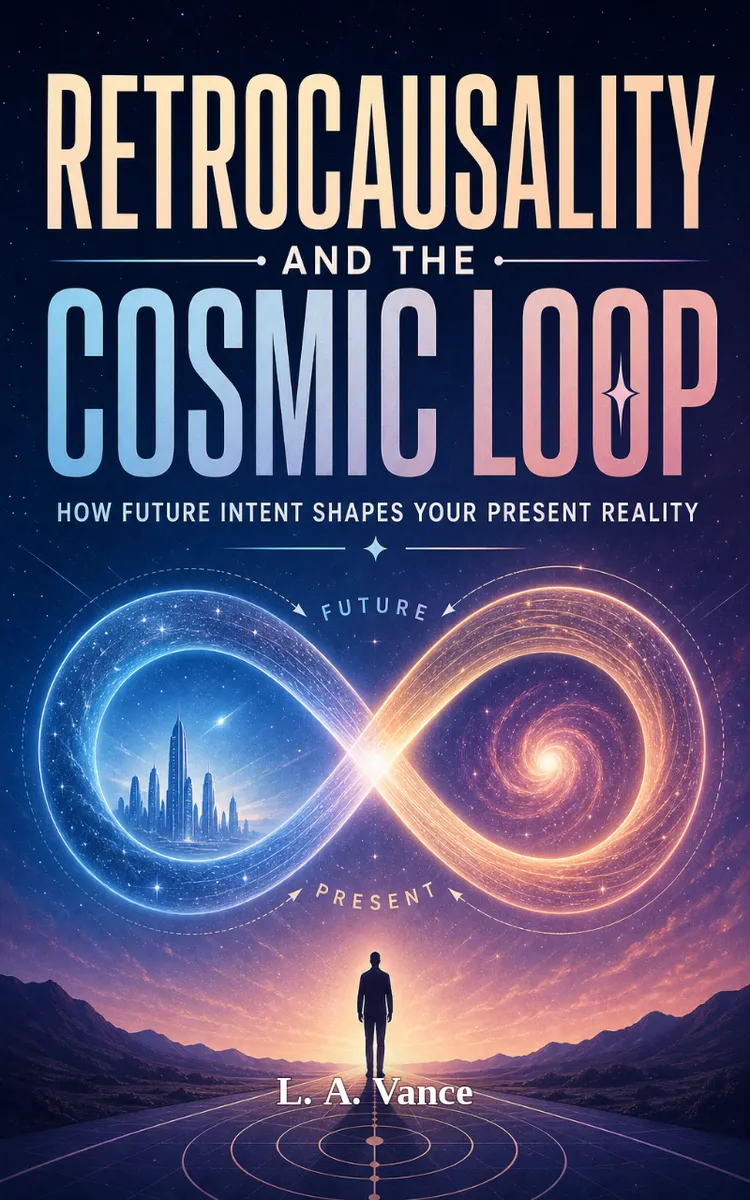
"Retrocausality And The Cosmic Loop" is a curiosity book by L. A. Vance with 8 chapters and approximately 15,754 words. Metaphysical explanation of retrocausality and how to notice it.
This book was created using Inkfluence AI, an AI-powered book generation platform that helps authors write, design, and publish complete books.
Frequently Asked Questions
What is "Retrocausality And The Cosmic Loop" about?
Metaphysical explanation of retrocausality and how to notice it
How many chapters are in "Retrocausality And The Cosmic Loop"?
The book contains 8 chapters and approximately 15,754 words. Topics covered include The Déjà Vu Receipt, Future-Intent Before-Action, The Timeline Trap in Your Mind, Synchronicity With Teeth, and more.
Who wrote "Retrocausality And The Cosmic Loop"?
This book was written by L. A. Vance and created using Inkfluence AI, an AI book generation platform that helps authors write, design, and publish books.
Write your own curiosity book with AI
Describe your idea and Inkfluence writes the whole thing. Free to start.
Start writingCreated with Inkfluence AI


