
Read the first chapter
The whole of chapter one, free. About 12 min. Turn the pages with the arrows, your keyboard, or a swipe.
Chapter 1
Mandrake Burning-Bush Escape Party
Moses had the burning bush on a short leash tonight, mostly because the bush kept trying to hop out of the firelight and get closer to the snack table. The desert air tasted like hot dust and old goat, and the bush’s flames smelled faintly of sweet sap and something medicinal-like a pharmacy that lost a fight with a campfire. Moses stood barefoot in the sand, jaw working like he was chewing through a court case, mandrake roots pulsing bitter and earthy between his teeth. Every few seconds he’d spit, wipe his mouth with his sleeve, and announce-way too confidently-that the whole thing was “just a vibe.”
“Buddy,” he said to the bush, voice carrying over the camp’s grumbling. “We all love a good light show, but don’t get weird. I’m here for the commandments. Free. With purchase.”
Behind him, the people shifted in their tents and pressed closer to the edge of the fire. Someone’s kid had found a stick and was poking the sand with it like that would summon meaning. Moses didn’t look back. He was locked in, cheeks flexing, eyes glassy with mandrake-fueled certainty. The flame flickered higher and Moses swore it leaned toward him like it had opinions.
Then the bush spoke-sort of. It didn’t so much form sentences as it delivered a feeling, like a prophet’s app notification arriving late and still rude. Moses inhaled, mandrake breath mixing with smoke, and heard the laws start sliding into his head as if they’d been packed inside his skull like leftovers.
“Thou shalt-” he started, and the air went sharp as flint.
The next words didn’t land like thunder. They landed like a DJ dropping rules into a party mix. Moses’s lips kept moving, but his brain-helped along by the mandrake-turned every command into a suggestion with vibes attached. He pointed at the flames as if they were a clerk behind a counter.
“Okay, okay,” he muttered. “I got it. No murdering. No stealing. Be chill. And also-” He blinked hard. The letters in the air rearranged themselves like a prankster’s alphabet. “Also, apparently, we’re leaving Egypt. Like… today. Cool.”
The camp erupted in the kind of excitement that sounded less like worship and more like a crowd noticing the locks had been left unlatched. People began gathering bags, yanking blankets, shouting over the crackle of fire. Someone started screaming prayers like they were trying to win an argument with the universe. Moses felt the burning bush’s attention tighten, and he grinned-because of course he did. He was a man who believed the cosmos was basically a coworker who could be negotiated with.
“Don’t worry,” Moses called out, loud enough to get his own echo. “This is an escape plan. We’re doing it. We’re-” He searched for the phrase that would sound holy and organized at the same time. Mandrake offered him something unhelpful. “We’re doing it as a… baked party.”
His own words offended him for being too accurate, and the flame snapped like it agreed. The bush flared, and the laws poured faster. Moses tried to keep up, chewing harder, saliva slick and bitter. Every command came with an urge to add a comment, like the universe had hired him as an MC.
The first mishap arrived before anyone had even finished pretending they were ready. The people surged toward the exits and the exit surge became a stampede, which became a traffic jam made of sandals and panic. Someone grabbed the wrong bundle. Someone let go of the right one. A goat got loose and charged directly into a pile of drums, producing a sound like war turning into comedy.
Moses tried to restore order by doing what he always did: talking louder than reality. He ran to the front, waving both arms, mandrake root stuck between his teeth like a stubborn comma.
“Listen!” he shouted. “The bush says we go! The laws say we go! The vibes say we go!”
A woman-eyes wide, hair full of dust-pointed at Moses’s mouth. “You’re chewing something,” she said, as if that was the scandal.
“It’s medicine,” Moses answered, offended on behalf of his jaw. “Mandrake. It’s-” He swallowed, and his tongue betrayed him with a bitter clench. “It’s for prophecy. Don’t act like you don’t know.”
The people stared. The flames snapped again, and Moses, high on his own confidence, decided the staring meant agreement. So he did what any reasonable prophet would do when reality starts misbehaving: he doubled down.
“Okay!” he declared. “Everyone follow me. I’ll lead. I’m the-” he paused, searching for the holy title that would make the desert obey. “I’m the burning-bush guy. That’s official.”
He started walking with the authority of a man who had never once met a wall he couldn’t insult. The people followed, dragging carts, holding children, hauling bread that steamed up into the cold night like regret. Behind them, Egypt’s last cries faded into the distance, replaced by wind and the rustle of tents and the constant sound of someone saying, “Wait, where’s my-” and then discovering they’d lost it.
Moses felt the commandments in his head like a playlist that wouldn’t let him skip songs. He kept speaking them aloud, partly to sound official and partly because the words seemed to keep him upright.
“Thou shalt not-” he began.
A man carrying a basket tripped over a loose stone and went down hard. The basket exploded. Dates, flatbread, and something wrapped in cloth rolled across the sand. A small, offended dog chased a date like it had been personally insulted by heaven.
Moses lunged to help, slipped, caught himself, and then-because the desert is committed to slapstick-his heel landed on a mandrake root chunk he’d dropped earlier. The root stuck to his foot like chewing gum from hell. He hopped sideways, arms flailing, and shouted, “No! Not-this isn’t-”
The crowd watched him with the stunned respect people reserve for disasters that look like they’re trying their best.
“Is he… okay?” someone asked.
“He’s burning,” another replied, pointing at the bush’s distant glow. “Or he’s drunk.”
“I’m not drunk,” Moses said immediately, which was how you could tell he was exactly the kind of person who would say that while actively being drunk.
He tried to peel the mandrake off his foot and ended up yanking too hard. The root tore with a wet sound. His breath came out sharp and loud. For a second, the world wobbled-then the burning bush’s “vibe” hit full volume in his mind like a drumline.
The laws spilled through him faster than he could spit them out.
“Thou shalt not covet,” Moses announced, pointing at a passing donkey as if it had committed a crime. The donkey, insulted, brayed and kicked a tent rope. The tent rope snapped. A tent collapsed with a loud thump, spilling blankets like a defeated magician’s cape.
Someone grabbed Moses’s sleeve. “Prophet!” a man yelled, half-panicked, half-angry. “Are we obeying God or are we running a circus?”
Moses opened his mouth to answer, but his mandrake mouth betrayed him again. He tasted bitterness, smoke, and something sweet underneath-like the universe was slipping him a prank. His eyes watered. The bush’s light made his pupils look like he’d been staring at a candle too long.
“We’re doing both,” he said finally. “God likes… performance.”
The man blinked, as if deciding whether to fight the prophet or laugh at him. He chose neither. He just stood there, holding Moses’s sleeve, staring like Moses had accidentally become a riddle.
Moses yanked free and staggered toward the nearest group of elders. “We need a schedule,” he said, and immediately regretted it. The desert did not do schedules. It did thirst. It did wind. It did people losing their sandals in the same dramatic sweep they lost their dignity.
The elders tried to form order, which meant everyone started arguing about who should walk where. A cart wheel cracked. A child fell. Someone’s stew pot tipped and poured out like the Exodus had decided to season itself in public. Moses kept trying to bless the chaos with commandments, but the more he spoke, the more his words turned into suggestions.
“Take this route,” he said, pointing.
A family followed the route and then discovered it led straight into a patch of sharp stones. Their feet screamed. Their sandals immediately decided to quit. One man hopped on one leg like he was auditioning for a dance called “Curses.”
Moses tried to fix it by moving everyone around the stones. He turned, stepped, and-because mandrake had made his balance a rumor-he landed in a shallow ditch and sat down hard in the sand. The ditch turned out to be full of mud. The mud took his robe and clung to it like it wanted a long-term relationship.
He stood up with a sucking sound.
“Okay,” Moses said through clenched teeth, mud dripping from his hem. “We… adjust.”
The crowd moved again, and the next problem arrived wearing a smile. A man carrying a sack of provisions tripped over a rope, and the sack burst open. Grain spilled everywhere. Birds swooped down, feathers flashing, and the grain turned into a feeding frenzy. People lunged to save what they could. Someone shouted, “Don’t let them-” and then the birds ignored him with the pure confidence of creatures who had never been told not to steal.
The whole escape party became a festival of wrong decisions. Moses’s voice kept cutting through it-part lawgiver, part over-caffeinated announcer at a chaotic street fair.
“Thou shalt not steal!” he yelled at the birds.
The birds stole. Loudly.
Then, at the worst possible moment-because the universe loves timing-a gust of wind carried smoke from the burning bush’s direction. The scent hit Moses’s face: sweet, resinous, like something medicinal and stupidly pleasant. His body reacted before his brain could. He inhaled too deeply.
The world tilted.
The burning bush looked suddenly bigger, closer, like it had stepped out of the horizon and into the middle of the camp. Moses saw it in vivid clarity: flames shaped like letters, letters reshaping themselves into commandments, commandments turning into party decorations. Moses laughed-an actual laugh, high and startled-because the bush’s vibe now felt like a prank being performed by God’s most overconfident intern.
“Oh!” Moses gasped. “It’s a-” He couldn’t finish the sentence. His laughter turned into a cough. His eyes watered. He tried to wipe his face and only spread mud and smoke across his cheekbones.
The camp went quiet for a second, the way people do when they’re deciding whether to panic or watch. Moses stood in the middle of the chaos, robe smeared, mandrake taste in his mouth, and he pointed at the sky like he’d discovered something profound.
“You know what this is?” he asked, voice cracking with ridiculous certainty. “This is the bush’s way of giving us… a free trial.”
The elders stared. The birds continued stealing. A child cried because their foot was now a collection of sand and scraped skin. Someone’s goat had gotten into a pile of cloth and was dragging it like a trophy. The wind carried laughter from the wrong direction-someone else was laughing too, because when the prophet starts talking like a drunken marketer, the only sane response is to treat it as entertainment.
Moses lifted his hands as if conducting a choir.
“Thou shalt keep the feast,” he declared, and then his mouth, traitor that it was, finished the thought with a flourish of absurdity that didn’t match any law he’d ever heard cleanly. “And thou shalt… share the vibes!”
For a breath, it was pure disaster theatre. Then the bush’s “voice” hit him again-harder. The commandments arrived in a rush, and Moses began reciting them in a cadence that made them sound like lyrics. He was halfway through, gesturing wildly, when he tripped over a fallen blanket, caught himself on a tent pole, and knocked the pole loose.
The tent collapsed right around him with a soft, humiliating crush. Sand puffed up. Dust coated his tongue. The crowd’s sound shifted from chaos to a stunned, involuntary hush-followed immediately by new chaos, because people started pulling at the tent to free him.
Moses emerged from the wreckage looking like a man who’d been buried in a bad idea. His robe was half torn. His hair stuck to his face with sweat and smoke. Mud and sand clung to his shoulders like he’d been mugged by the desert.
He stood up anyway, because prophets are trained to stand up after everything.
“Okay,” he said, dusting his hands with the seriousness of a judge. “We learned something.”
Nobody asked what.
He continued anyway, because he couldn’t help it. “The bush is… giving us commandments with accessories.”
A man barked, “Accessories?”
Moses nodded, eyes bright with the last sting of mandrake. “Yeah. Like… rules. But also-” He searched for the right word and found a phrase that was way too funny to be holy. “Like snacks.”
He looked toward the scattered provisions. Dates, flatbread, cloth, grain-everything was now mixed into one dusty mess. The birds were hovering with the smugness of tiny thieves who knew they’d won. Someone reached for a piece of bread and then stopped, because it had been pecked and dropped into mud.
“We can still eat,” Moses offered, then realized the smell rising from the mess was not edible in any spiritual sense. He swallowed hard. “Maybe we can… pray first.”
An elder rubbed his forehead with a hand that looked tired. “Prophet,” she said, voice low and furious, “how did God’s law become a baked escape party?”
Moses opened his mouth to defend himself, but the burning bush’s glow in the distance flickered, and his mind filled with the next instruction-except it came tangled with the taste of mandrake and the smell of smoke.
He blinked and said, “Because God has a sense of humor.”
The elder stared at him like he’d just proposed arson as worship. “God has a sense of humor,” she repeated flatly.
“Yeah,” Moses insisted, pointing at the collapsing tent behind him like evidence. “See? He’s laughing.”
The elders didn’t laugh. Moses did, again, softer this time, because the tent had left him with a sore back and a mouth full of dust, and pain made his comedy feel more personal.
They gathered around the wreckage with wounded dignity, as if they were inspecting a holy crime scene. Someone counted missing blankets. Someone scolded a goat. Someone hunted for a missing sack, only to find it under a half-collapsed cart, where it had absorbed mud and bird attention. A man muttered about stoning someone for theft, then thought better of it because there was nobody left who wasn’t covered in the evidence.
Moses stood near the edge of the campfire’s fading glow, mud drying on his robe like a second skin. He watched the people sort through the mess, and his mind tried to cling to order. He could feel the laws still stirring in him, but now they weren’t arriving like clear messages. They were arriving like a party schedule written by a drunk poet.
“Okay,” he said under his breath, as if speaking to the bush even though the bush was miles away. “Next time, we do it… cleaner.”
The desert wind carried laughter from somewhere deeper in the camp. A voice shouted, “Who brought the mandrakes?” and then another voice answered, “Who brought the birds?”
Moses looked down at his torn robe, at the mandrake bits stuck in the mud like little green accusations, and felt the next mishap warming up on the horizon-quietly, patiently, like it had been invited.
End of chapter one. 12 more chapters in the full book.
Swipe or use the arrows to turn the page
What's inside: 13 chapters
- 1. Mandrake Burning-Bush Escape Party
- 2. Isaiah’s Cannabis Virgin-Claim
- 3. Jeremiah’s Balm-High Betrayal Rants
- 4. Malachi’s Stoning-Then-Soap Cover-Up
- 5. Ezekiel’s Opium Wheel-Bone Proof
- 6. Daniel’s Myrrh-Not-So-Performer Beasts
- 7. Elijah’s Wildfire Show
- 8. Jonah's Sulk and Swallow
- 9. Amos’ Roast and the Sheepfold Verdict
- 10. The Marrying of Mess
- 11. The Sequel Who Burned Twice
- 12. Zechariah’s Paper Storm
- 13. The Marrying of Mess
About this book
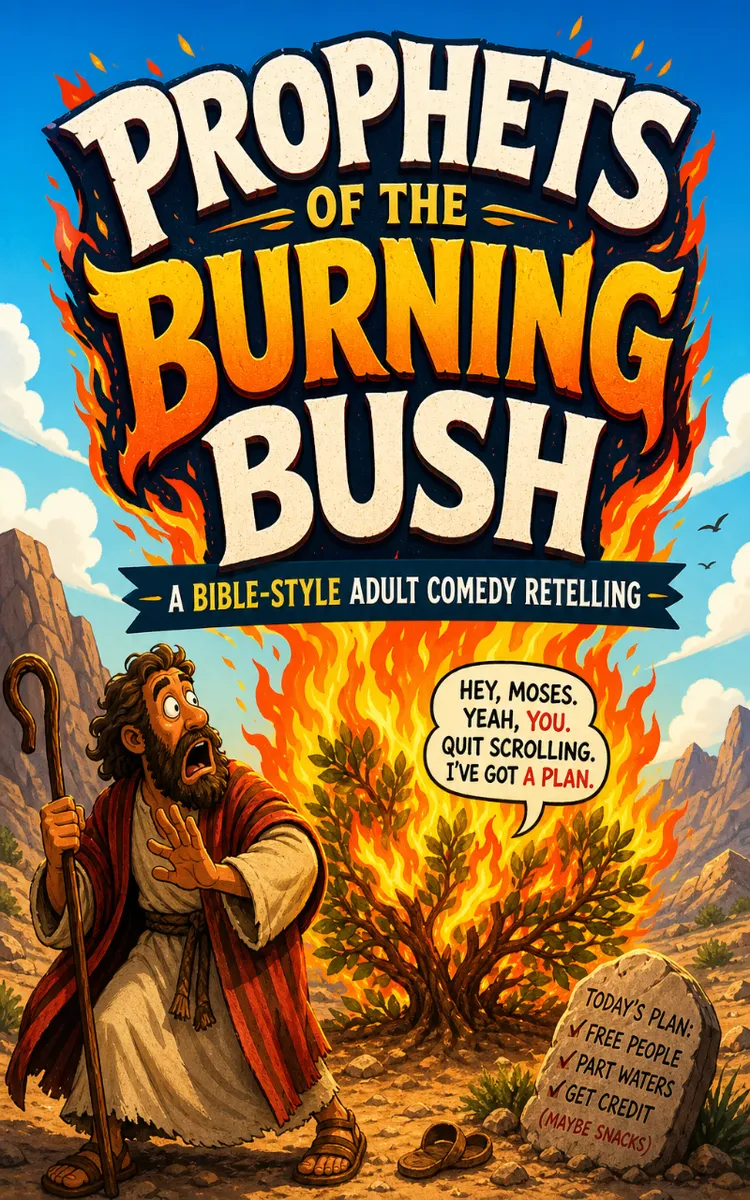
"Prophets Of The Burning Bush" is a comedy book by Kaspen Kain with 13 chapters and approximately 26,296 words. Adult comedic retelling of biblical prophets and Mary-Joseph drama.
This book was created using Inkfluence AI, an AI-powered book generation platform that helps authors write, design, and publish complete books. It was made with the AI Novel Writer.
Frequently Asked Questions
What is "Prophets Of The Burning Bush" about?
Adult comedic retelling of biblical prophets and Mary-Joseph drama
How many chapters are in "Prophets Of The Burning Bush"?
The book contains 13 chapters and approximately 26,296 words. Topics covered include Mandrake Burning-Bush Escape Party, Isaiah’s Cannabis Virgin-Claim, Jeremiah’s Balm-High Betrayal Rants, Malachi’s Stoning-Then-Soap Cover-Up, and more.
Who wrote "Prophets Of The Burning Bush"?
This book was written by Kaspen Kain and created using Inkfluence AI, an AI book generation platform that helps authors write, design, and publish books.
How can I create a similar general book?
You can create your own general book using Inkfluence AI. Describe your idea, choose your style, and the AI writes the full book for you. It's free to start.
Write your own comedy book with AI
Describe your idea and Inkfluence writes the whole thing. Free to start.
Start writingCreated with Inkfluence AI


