

Read the first chapter
The whole of chapter one, free. About 11 min. Turn the pages with the arrows, your keyboard, or a swipe.
Chapter 1
The First Time You Hear Mothman
A video can go viral faster than a witness can file a report, and yet the part people remember most often has nothing to do with what can be verified. That’s the paradox at the heart of Mothman stories: the first sighting feels sharp and specific, but the proof arrives late - or not at all. What spreads first is the shock, and the explanation comes rummaging around afterward.
The modern Mothman wave didn’t begin with a creature or a prophecy. It began with people noticing something strange at the edge of ordinary life and then realizing, in real time, that their neighbors were noticing too. This chapter follows that moment - where the story outruns the evidence - and looks at why “I saw it” so often becomes “everyone knows it.”
At the center of this is a small, human kind of network. Not a secret society, not a lab, not a government briefing - just the way information moves when the night is quiet, the signal is weak, and fear travels faster than facts. So how does a creature that can’t be proven still manage to become real in everyone’s mind the same week?
The Opening: When a Night Signal Turns Into a Rumor Machine
The first time people hear Mothman is rarely the first time they hear about “something in the dark.” It’s the way the story arrives - through a friend’s voice, a late-night broadcast, a grainy clip, a comment thread that won’t stop refreshing. The creature’s name feels invented, but the experience behind it is familiar: that sudden tightening in the chest when your brain tries to match a pattern to a place it doesn’t understand.
One of the clearest modern examples of how the story spreads comes from the kind of volunteer who lives close to the signal. Talia, 19, was a night-shift radio volunteer at a small station, the sort that keeps a schedule because it has to - local updates, call-ins, the steady hum of people talking to stay awake. Her shift ran through the hours when phones buzz less and curiosity buzzes more. When a caller asked - carefully at first - whether anyone else had heard about a strange “winged thing” near a river area, Talia didn’t treat it like entertainment. She treated it like a thread: if one person had noticed, more people might have.
That’s how the first whispers work. Not as a single announcement, but as repeated, overlapping fragments from different mouths. In a community, the radio can act like a drum that keeps time with everyone’s private worry. One caller mentions the same location another caller already knows. A second caller adds a detail that doesn’t contradict the first - just changes the emphasis. Before long, the story stops being “a rumor” and starts becoming a shared experience, because your mind hates blank spaces and fills them with whatever fits.
And then comes the part that matters for Mothman specifically: the story’s shock is visual and immediate, but the evidence is slippery. People describe shapes and movement; they rarely capture anything clean enough to satisfy a skeptic. The result is a First-Whisper Funnel - a pattern where early reactions collect attention first, long before proof can catch up. The funnel doesn’t need “truth” to function. It needs only that the details feel plausible and the timing feels urgent.
In places where the sky is dark and the roads are familiar, “plausible” is powerful. A strange light becomes a “thing.” A thing becomes a “creature.” And once the name Mothman exists - whether it was coined by a journalist, repeated by a caller, or echoed from one story to another - it behaves like a label that lets people store a frightening memory in a neat folder. The folder travels faster than the file.
The Deep Dive: Why Shock Beats Proof in the Human Brain
There’s a reason this happens across fairy tales, urban legends, and monster myths around the world. Most people think “proof” spreads because it’s convincing, but the real engine is usually emotion plus coherence. When people feel a shared jolt, they scan for confirmation - especially from familiar sources. That’s not superstition; it’s how humans manage uncertainty.
Psychologists have long pointed out that narrative - a sequence of events that feels like it makes sense - can be more sticky than raw data. A clean scientific measurement can be ignored if it doesn’t connect to a story people already live inside. Meanwhile, a messy report can spread rapidly if it plugs into existing expectations: something unusual is happening; it has a pattern; it may be connected to danger.
The Mothman stories have a particular kind of narrative fuel. They’re often described as nocturnal and unnerving, with flight implied by witnesses and with an atmosphere of “watching.” Even when the sightings are inconsistent in details, they share enough features to let listeners stitch them together. That stitching is the opposite of proof, but it’s very effective at creating belief.
Historically, this isn’t new. The late 1800s and early 1900s were packed with “non-scientific” reports that later got reframed through better understanding - everything from supposed sea monsters to mysterious lights. What changes with modern myths is not the human urge; it’s the speed of transmission. Today, a single comment can reach hundreds of people before someone finishes writing down the facts.
Even the tools shape the outcome. A radio call, a photo, a short clip - these don’t just carry information. They compress it. Compression makes stories easier to pass along and harder to verify. A witness statement in a local newspaper might include context and caveats, but a late-night broadcast segment might include only the most memorable piece: the winged silhouette, the eerie sound, the sense of being observed. The story arrives as a vivid fragment, and vivid fragments get retold.
There’s also the matter of attention. People don’t look for evidence in the same way they look for an explanation. Evidence requires patience: checking, comparing, waiting for corroboration. Explanation can appear instantly in the mind if it matches the feeling. That’s why shock beats proof. Proof asks for time; shock supplies urgency.
And here’s the key twist for modern Mothman culture: the myth doesn’t just spread because people are gullible. It spreads because early reports create a map. Once that map exists, anyone in the area begins to interpret their environment through it. Even neutral observations - an owl, a distant aircraft, a reflection - can be pulled into the story’s orbit. The myth becomes a lens, and the lens makes new “sightings” easier to imagine and harder to separate from older ones.
Talia noticed this shift in miniature. After the first mention on air, callers didn’t just say they’d heard. They started refining - where they were standing, what direction they’d faced, what time the sky seemed to change. The stories gained detail not because someone had collected more proof, but because the community had learned what details “fit” the myth.
What You Did Not Expect: The “Better Story” Can Outperform Reality
Here’s the counterintuitive finding that surprises even people who think they already understand urban legends: the myth can become more coherent as it becomes less provable. The tightening of the tale - consistent terms, repeated motifs, familiar phrases - doesn’t require a single definitive piece of evidence. It can happen through retelling, because communities naturally smooth out the rough edges.
This matters because it flips the usual assumption. We tend to think, more consistency means more truth. With monster myths, consistency can be a sign of social editing - people aligning their descriptions to what others have already said. Once a story is circulating, a later witness may genuinely remember a similar experience, but their memory can also be nudged by the version they heard first. Memory isn’t a camera recording; it’s more like a draft that gets revised as new context arrives.
What changes, then, is how we interpret the “shape” of the myth. A coherent creature with recurring features isn’t automatically a clue to physical evidence. Sometimes it’s a clue to the way communities coordinate their understanding under uncertainty. That doesn’t mean the experiences were fake. It means the shared story can become a tool for making sense of fear, darkness, and the brain’s hunger for patterns.
In the Mothman case, the name itself functions like a stabilizer. A name makes a phenomenon easier to track, easier to talk about, and easier to compare across conversations. It’s not just label-work; it’s story-work. People can now say, “That’s the thing I mean,” instead of describing the whole event from scratch. The myth becomes a shortcut for explanation, and shortcuts spread fast.
There’s a science-adjacent way to picture what’s going on. When people talk about an event they don’t fully understand, they rely on shared cultural scripts - how a “monster” should behave, what “danger” should feel like, what kind of imagery belongs in the dark. The myth supplies the script. Reality supplies the raw sensory input. The final “sighting” can be the blend.
Talia’s station got calls that sounded different at first - some emphasized a light, others emphasized shape, others emphasized a feeling of being watched. But the language people used kept converging. The story became easier to repeat, and that ease is what helped it travel. In a community, repetition can be mistaken for confirmation.
So the shock doesn’t just create belief. It creates a common vocabulary that makes future reports sound like they belong to the same event. That’s why the rumor can outrun proof so cleanly. The myth doesn’t have to win by being true in a laboratory sense. It wins by being usable in everyday life.
The Human Story: A Community Reads the Night Together
The most vivid part of the modern Mothman phenomenon isn’t a creature on a screen. It’s the way a community starts behaving differently once the story is in the air. People notice the same roads. They mention the same landmarks. They talk about the same hours. Even those who doubt the myth can’t escape it, because the myth changes what they pay attention to.
Talia remembered the feeling on air when the calls began to line up. It wasn’t panic, exactly. It was that careful tone people use when they’re trying to sound rational while their body is already bracing. She didn’t have access to some secret archive; she had a microphone, a phone line, and a local audience. But she could feel the story hardening into something shared.
One caller described a strange silhouette near a river area, another mentioned an unnerving presence in the same general region, and a third - later - connected it to something they’d seen before but never had a name for. None of them offered clean “proof” in the sense a skeptic would want. What they offered was alignment: similar timing, similar mood, similar geography.
That alignment is the real engine of the First-Whisper Funnel. It’s how a myth becomes a local weather system. Once it’s in the air, people react. They compare notes. They fill in gaps. They borrow each other’s language. And as more people repeat the same core idea, the story gets sturdier - even if the evidence remains thin.
The place matters too. River corridors, open fields, and dark stretches of road are exactly where humans experience the limits of perception. Distance makes shapes slippery. Low light makes colors unreliable. Sound carries oddly. In those conditions, a witness’s mind tries to restore order, and the myth provides a ready-made order to restore.
Even the skepticism in a community can feed the myth. When people say, “I don’t believe it,” they’re still repeating the terms of the story. They still mention the location and the time window. In doing so, they keep the myth alive long enough for someone else to notice something strange and interpret it through the established frame.
Talia’s role as a night-shift volunteer gave her a front-row view of that social mechanism. She didn’t need to push belief. The audience did the pushing for her. Listeners called in because the story made their own memories feel less lonely. If everyone is talking about the same dark moment, then your experience - whatever it was - doesn’t have to be an isolated misunderstanding.
That’s why the story spreads faster than proof. Proof requires a stable subject and stable measurement. Rumor requires only repeated attention and a shared pattern. The night supplies the confusion; the community supplies the stitching.
What This Tells Us: The Gap Between Evidence and Meaning
When we watch Mothman stories unfold, we’re seeing something deeper than a single monster myth. We’re seeing how humans convert uncertainty into meaning. A dark sky plus a strange impression can produce fear, but it can also produce a story that holds fear in a shape people can carry and discuss. That doesn’t make the experience harmless. It makes it social.
The most revealing part is that the myth’s power doesn’t depend on whether it’s “real” in the way a textbook would define. It depends on whether it gives people a way to talk about something they can’t otherwise explain. That’s why the story can keep going even when no decisive evidence appears. Meaning travels; proof waits.
If you want to understand why Mothman became a worldwide talking point, the crucial fact isn’t that people saw something unexplainable. It’s that, once the first whispers appeared, the community learned how to hear the night together. And when enough people learn the same way of listening, the myth stops being a question and starts being a language.
So the mystery isn’t only whether something flew in the dark. The mystery is why our minds - and our networks - keep turning shadowy impressions into shared stories that feel truer than any delayed confirmation, every time the night turns quiet enough to hear it coming.
End of chapter one. 15 more chapters in the full book.
Swipe or use the arrows to turn the page

The World In Chaos 6x9 Interior

When Everyone Else Has Moved On 8 5x11 196p REVISED v3

The Blind Spot of Reality EDITED Garamond 6x9
What's inside: 16 chapters
- 1. The First Time You Hear Mothman
- 2. Why Fairy Circles Look Like Traps
- 3. Devil’s Bottom: The Name That Hunts
- 4. The Blood-Drinkers People Swear By
- 5. What Your Brain Does With Unseen Threats
- 6. Fairy Etiquette: The Rules Nobody Writes
- 7. How Stories Travel: From Campfire to Feed
- 8. Native Folklore’s Living Geography
- 9. When a Monster Is a Warning System
- 10. The “Wrong Place” Effect of Fairy Rings
- 11. Why Blood Myths Target the Vulnerable
- 12. The Mothman Motif: Light, Silence, Meaning
- 13. Fairy Bargains and the Cost of Wanting
- 14. Devil Stories as Social Contracts
- 15. How to Read a Legend Without Worshipping It
- 16. The Shared Function of Every Monster
About this book
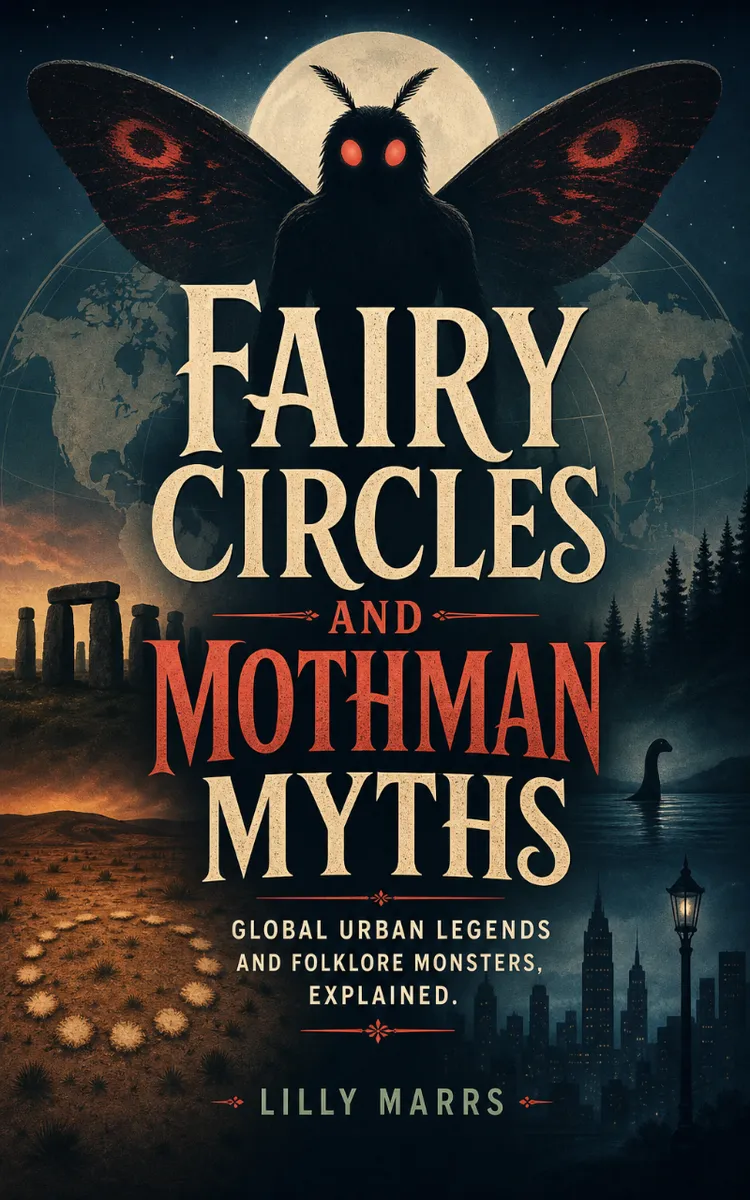
"Fairy Circles And Mothman Myths" is a curiosity book by Lilly Marrs with 16 chapters and approximately 32,268 words. Worldwide fairy tales and urban legend myths with monsters.
This book was created using Inkfluence AI, an AI-powered book generation platform that helps authors write, design, and publish complete books.
Frequently Asked Questions
What is "Fairy Circles And Mothman Myths" about?
Worldwide fairy tales and urban legend myths with monsters
How many chapters are in "Fairy Circles And Mothman Myths"?
The book contains 16 chapters and approximately 32,268 words. Topics covered include The First Time You Hear Mothman, Why Fairy Circles Look Like Traps, Devil’s Bottom: The Name That Hunts, The Blood-Drinkers People Swear By, and more.
Who wrote "Fairy Circles And Mothman Myths"?
This book was written by Lilly Marrs and created using Inkfluence AI, an AI book generation platform that helps authors write, design, and publish books.
Write your own curiosity book with AI
Describe your idea and Inkfluence writes the whole thing. Free to start.
Start writingCreated with Inkfluence AI


