
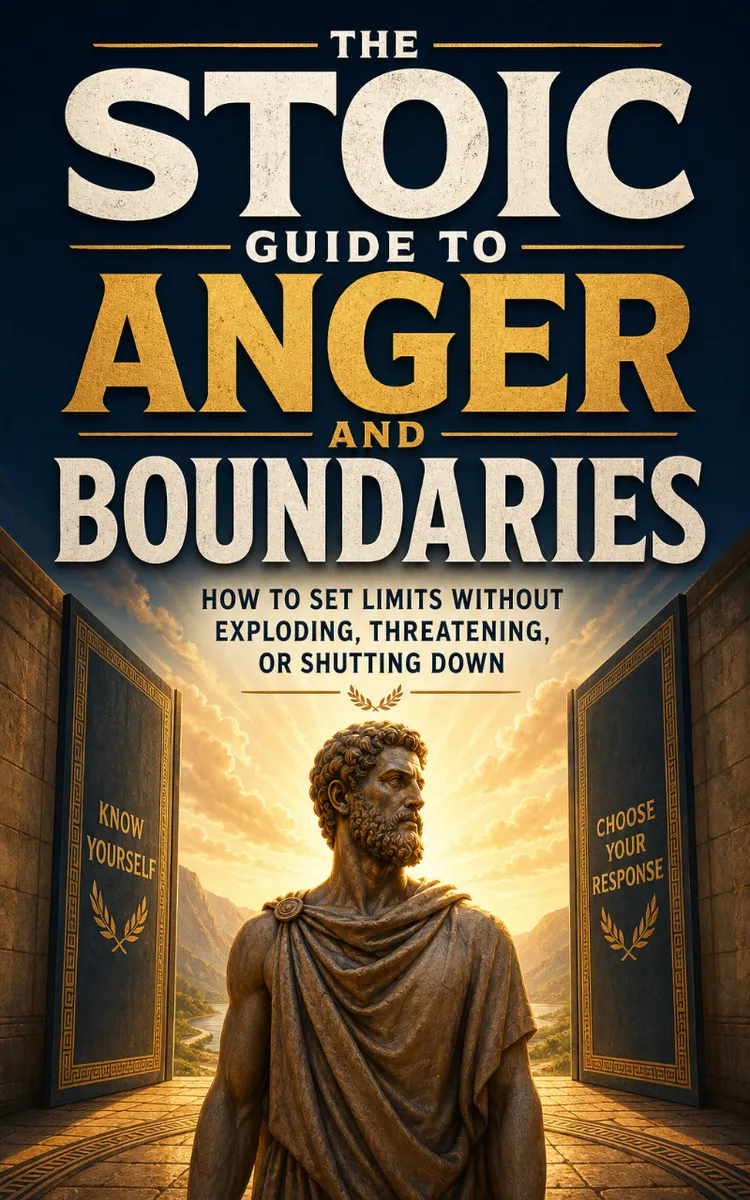
The Stoic Guide to Anger and Boundaries
Created with Inkfluence AI
Stoic-based strategies for managing anger and setting boundaries
Table of Contents
- 1. Reframe Anger as Boundary Signal
- 2. Separate Judgment From the Trigger
- 3. Choose Your Response in One Breath
- 4. Define Your Non-Negotiable Values
- 5. Replace Threats With Clear Consequences
- 6. Stop Boundary Guilt With Stoic Duty
- 7. Build the ‘No’ You Can Stand Behind
- 8. Use the ‘Pause, Then Name’ Technique
- 9. Practice Boundary Timing and Tone
- 10. Turn Rumination Into a Stoic Review
- 11. Set Limits Without Over-Explaining
- 12. Handle Pushback With the ‘Respect, Repeat’ Move
- 13. Stop Threat Spirals Before They Start
- 14. Break the Shut-Down Freeze Pattern
- 15. Speak From Your ‘Inner Witness’
- 16. Practice ‘What’s Up to Me’ Clarity
- 17. Repair After a Boundary Slip
- 18. Strengthen Boundaries With Repetition Plans
- 19. Use Virtue to Guide Tough Conversations
- 20. Live a Calm Boundary Identity
Preview: Reframe Anger as Boundary Signal
A short excerpt from “Reframe Anger as Boundary Signal”. The full book contains 20 chapters and 28,981 words.
You don’t get angry because you’re “bad at control.” You get angry because something inside you just sounded an alarm: this limit matters. The moment you treat anger like noise, you miss the message. The moment you treat it like information, you get your power back.
Picture Daria, 34, a customer success manager. Her day is packed with calls, tickets, and follow-ups. Then a client email lands that basically says, “We’ll do it your way… whenever we feel like it.” Daria’s chest tightens. Her fingers start typing before she can even decide what she wants to say. She doesn’t just feel annoyed-she feels disrespected. And if she’s honest, she’s also scared that if she doesn’t push back right now, the client will keep walking boundaries down like it’s nothing.
That’s the fork in the road. Anger can push you into a reaction-or it can point you to the boundary you need to state with clarity.
The Pattern
Daria recognises the pattern fast once she names it. It usually starts with a small, unfair “push” that hits her values: reliability, respect, follow-through. It might be a client who changes the timeline again, a coworker who slaps a last-minute request on her desk, or a partner who dismisses her “no” like it’s negotiable. The first sign isn’t even the argument. It’s the physical spike: jaw tension, heat in the face, a tight stomach, the urge to speak quickly so the moment doesn’t slip away.
Then the mind does its part. It searches for proof that she’s right to be angry and quickly builds a case. She starts thinking in “always/never” language-They always do this. She imagines the future consequence-If I don’t shut it down, they’ll keep escalating. And when the conversation finally happens, she either goes sharp (the “fine, do it your way” tone), or she goes loud (a full-on boundary fight), or she goes silent and stews because speaking feels too risky. In all three versions, the anger is loud, but the boundary is unclear. By the time she responds, she’s reacting to the insult instead of addressing the limit. Does that feel familiar in your own life?
A New Perspective
Here’s the question that changes everything: What if your anger isn’t the problem-what if it’s the warning light that your boundary got crossed?
When you ask that, you stop treating anger like a character flaw. You start treating it like a signal. A boundary is not just “what you want.” It’s the line where your values and responsibilities are protected. Anger shows up when someone-sometimes them, often you too-steps over that line. It’s your system saying, “Hey. Pay attention. Something important is at risk.”
Try this before-and-after example from Daria’s week. Before: the client’s email triggers her anger, and she writes a reply that sounds like a lecture. She ends up sounding defensive, even if she’s technically correct. The client escalates, and now the real issue isn’t the timeline-it’s tone and conflict. After: she pauses for five breaths and asks, What boundary got crossed? She realises it’s not “they disagreed.” It’s “they disregarded the agreed process.” Then she replies calmly with a clear limit: “To keep delivery predictable, we need X by Friday. If that date can’t hold, we’ll adjust the plan together-otherwise I’ll proceed with the current timeline.” Same situation, different outcome. The anger didn’t disappear; it just stopped driving the steering wheel.
This is the heart of the Boundary Signal Map: you’re learning to translate anger into a boundary statement. Not perfect wording. Not a dramatic speech. Just the correct meaning: “This matters, and here’s what happens next.”
Breaking It Down
1. When you get a trigger (someone disrespects your “no,” ignores an agreement, delays your work, or treats your time like it’s optional), your body reacts fast-tight chest, heat, fast thoughts.
2. You feel anger with a specific flavor: “That’s unfair,” “That’s disrespectful,” “That’s irresponsible,” or “That’s not what we agreed.”
3. So you reach for a response that matches the emotion: argue to prove your point, snap to stop the disrespect, or shut down because pushing back feels dangerous.
4. Which leads to a predictable result: either the conflict grows, the boundary stays unspoken, or you resent yourself for not saying what needed saying.
Now the alternative chain, using the same trigger:
1. When you get a trigger, you don’t ask “How do I stop feeling this?” You ask “What boundary did this cross?”
2. You feel the anger and you treat it like a signal you can read, not a verdict on the other person.
3. So you translate it into a Boundary Signal Map entry: the value hit + the limit needed + the next step you can live with.
4. Which leads to a different outcome: you respond with structure instead of heat. The other person may still be difficult-but the conversation becomes about the limit, not your emotional reaction.
...
About this book
"The Stoic Guide to Anger and Boundaries" is a self-help book by Socratic Mastery with 20 chapters and approximately 28,981 words. Stoic-based strategies for managing anger and setting boundaries.
This book was created using Inkfluence AI, an AI-powered book generation platform that helps authors write, design, and publish complete books. It was made with the AI Self-Help Book Writer.
Frequently Asked Questions
What is "The Stoic Guide to Anger and Boundaries" about?
Stoic-based strategies for managing anger and setting boundaries
How many chapters are in "The Stoic Guide to Anger and Boundaries"?
The book contains 20 chapters and approximately 28,981 words. Topics covered include Reframe Anger as Boundary Signal, Separate Judgment From the Trigger, Choose Your Response in One Breath, Define Your Non-Negotiable Values, and more.
Who wrote "The Stoic Guide to Anger and Boundaries"?
This book was written by Socratic Mastery and created using Inkfluence AI, an AI book generation platform that helps authors write, design, and publish books.
How can I create a similar self-help book?
You can create your own self-help book using Inkfluence AI. Describe your idea, choose your style, and the AI writes the full book for you. It's free to start.
Write your own self-help book with AI
Describe your idea and Inkfluence writes the whole thing. Free to start.
Start writingCreated with Inkfluence AI


