
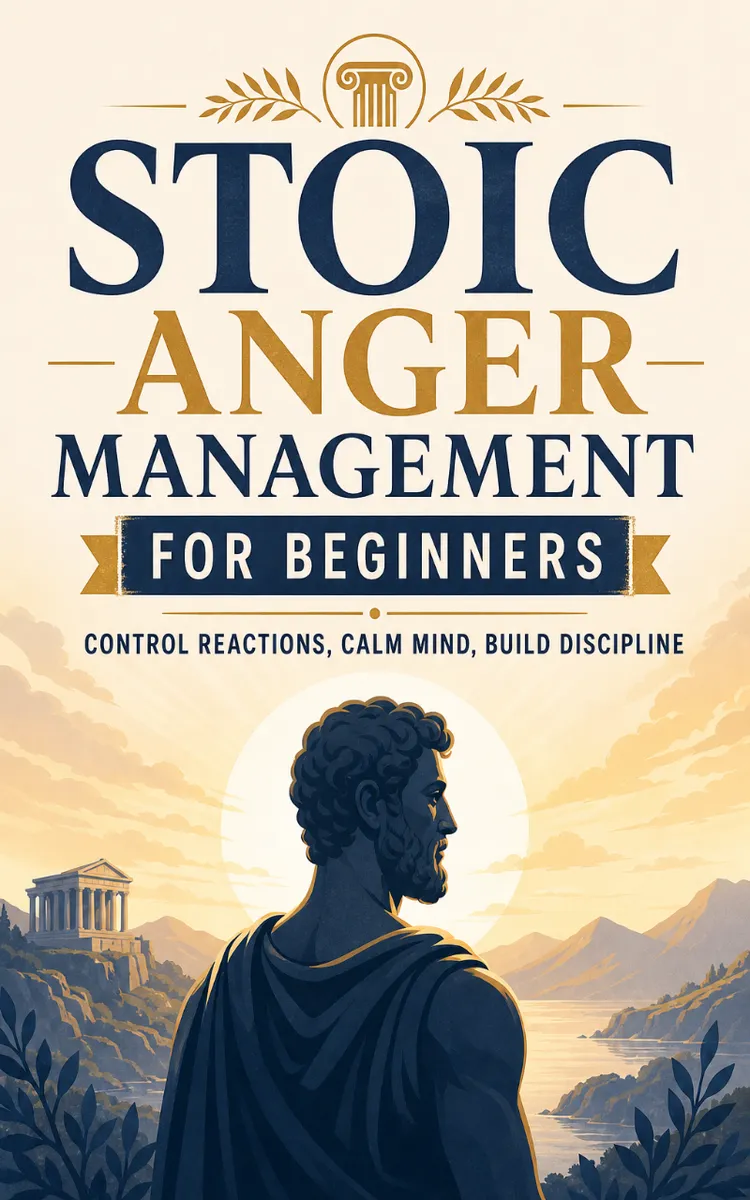
Stoic Anger Management For Beginners
Created with Inkfluence AI
Beginner-friendly anger management using Stoic principles
Table of Contents
- 1. Anger’s Real Job: Protecting You
- 2. Your Trigger Story, Not Your Fate
- 3. The Stoic Pause Before Reacting
- 4. Replacing Blame With Ownership
- 5. Judgment Calibration: Check Your Assumptions
- 6. The Virtue Target: Choose the Better Outcome
- 7. Calm Breath for Fast Emotional Reset
- 8. Thought Labeling: Name It to Tame It
- 9. Guilt vs. Growth: Stop Beating Yourself Up
- 10. Rehearse Responses With a Script
- 11. Boundary Words Without Exploding
- 12. Active Listening to Defuse Heat
- 13. The One-Message Rule for Anger
- 14. Turn Complaints Into Requests
- 15. Pre-Decide Your Exit Plan
- 16. Use Negative Visualization Wisely
- 17. Handle Criticism Without Losing Temper
- 18. Build a Daily Emotional Discipline Habit
- 19. Weekly Review: What Worked, What Changed
- 20. Live the Stoic Life: Anger With Purpose
Preview: Anger’s Real Job: Protecting You
A short excerpt from “Anger’s Real Job: Protecting You”. The full book contains 20 chapters and 27,442 words.
> “Anger is not the problem. Anger is the alarm.”
Marcus, 34, warehouse supervisor, knows this alarm too well. It’s 7:12 a.m., the dock is already behind, and one coworker keeps “misreading” the schedule. Marcus feels it rise fast-heat in his face, tightness in his chest, words ready to fire. Then the worst part: he says something sharp, not even the kind he’d be proud of. A minute later he’s stuck replaying it like a broken song, wondering how he could’ve been so… him.
Later, when things calm down, he tells himself he should’ve controlled it. He starts treating anger like proof that he’s failing. And because he feels ashamed, he gets even more tense the next morning-like his anger is waiting to attack again.
So what if your anger isn’t a personal failure, but a protective signal trying to keep you safe-right before it pushes you to regret?
The Mindset Shift
Old Belief: “Anger means I’m wrong, out of control, or becoming a bad version of myself.”
New Reality: “Anger is a signal with a protective purpose. The job isn’t to kill it-it’s to read it and respond on purpose.”
This shift matters because the old belief turns anger into a threat to your identity. When you think “I’m becoming someone I don’t like,” your nervous system goes louder. You don’t just feel anger-you feel danger about the anger. That’s when overreaction becomes more likely, because the mind tries to solve a “problem” that isn’t actually fixable in the moment: how you should have been.
Stoicism reframes anger as information. Not polite information. Not always useful information. But information. If your anger shows up, it’s pointing to something your mind thinks is at stake-respect, fairness, safety, order, time, responsibility. The signal may be too intense, and it may come in a rough package, but it’s still pointing.
Here’s a concrete example from Marcus. That coworker “misreads” the schedule again. Marcus’s anger flares. Under the old belief, he hears: “I’m losing control. I’m embarrassing myself.” Under the new reality, he can hear: “My mind thinks something important is being threatened-efficiency, reliability, maybe my team’s trust.” Then the question changes from “Why did I say that?” to “What was I trying to protect right then?” That doesn’t excuse the harsh words. It gives him a direction for the next moment.
When you treat anger as a protective signal, you stop fighting it like an enemy and start working with it like a warning light. Warning lights don’t drive the car. They just tell you where to look.
Going Deeper
In Stoicism, anger isn’t automatically “bad.” It becomes bad when it takes over your judgment-when you start believing the anger’s story instead of checking what’s actually true. The Stoic move is simple but not easy: separate the signal from the conclusion.
Think of it like this: your body reacts first, your mind tells a story next, and then your actions follow. Anger is often the body’s part of the sequence. The story is where you can get tricked. If Marcus believes “They did this to disrespect me,” he’ll feel justified in snapping. But if he slows down long enough to ask, “What else could be true?” he might realize the coworker is overwhelmed, confused, or dealing with something Marcus doesn’t know about. The anger may still be there, but it loses its power to lead the steering wheel.
That’s where The Anger Signal Map comes in. It’s a way to read anger as a signal with a job to do-so you don’t confuse “I feel angry” with “I must respond aggressively.”
Use it like this: when anger hits, you map it. You don’t argue with it. You locate it. You ask what protective purpose it’s trying to serve.
Signs this pattern is running your life
1. You feel anger, then you immediately judge yourself for it.
Example: “I shouldn’t be like this,” even while you’re still mid-breathing-fire.
2. Your mind turns a small trigger into a big meaning.
Example: one mistake becomes “They don’t respect me,” and suddenly the situation is personal.
3. You regret the words, but you do it again anyway.
That’s not just impulsiveness-it’s a loop where anger tells a story, and you act before the story gets checked.
4. You try to “control anger” by force.
For Marcus, it looks like clenching harder, swallowing harder, and then exploding anyway-because the signal wasn’t read, only suppressed.
En résumé: Anger is a protective alarm; regret usually comes from acting on the alarm’s story instead of reading the signal.
Now, what’s the protective purpose? For Marcus, it might be “keep the operation running” or “protect fairness and responsibility.” For you, it might be “don’t let people walk all over you,” or “don’t risk being disrespected,” or “make sure I’m safe from chaos.” The point isn’t to pick the “right” answer. The point is to notice that your anger is trying to protect something you care about.
...
About this book
"Stoic Anger Management For Beginners" is a self-help book by Socratic Mastery with 20 chapters and approximately 27,442 words. Beginner-friendly anger management using Stoic principles.
This book was created using Inkfluence AI, an AI-powered book generation platform that helps authors write, design, and publish complete books. It was made with the AI Self-Help Book Writer.
Frequently Asked Questions
What is "Stoic Anger Management For Beginners" about?
Beginner-friendly anger management using Stoic principles
How many chapters are in "Stoic Anger Management For Beginners"?
The book contains 20 chapters and approximately 27,442 words. Topics covered include Anger’s Real Job: Protecting You, Your Trigger Story, Not Your Fate, The Stoic Pause Before Reacting, Replacing Blame With Ownership, and more.
Who wrote "Stoic Anger Management For Beginners"?
This book was written by Socratic Mastery and created using Inkfluence AI, an AI book generation platform that helps authors write, design, and publish books.
How can I create a similar self-help book?
You can create your own self-help book using Inkfluence AI. Describe your idea, choose your style, and the AI writes the full book for you. It's free to start.
Write your own self-help book with AI
Describe your idea and Inkfluence writes the whole thing. Free to start.
Start writingCreated with Inkfluence AI


