

Read the first chapter
The whole of chapter one, free. About 9 min. Turn the pages with the arrows, your keyboard, or a swipe.
Chapter 1
MeshCore vs Meshtastic Basics
Choose the Right Mesh Before You Configure a Radio
Will your off-grid network carry short status messages across a neighborhood, or must it support regular position updates, direct messages, and several different apps? That answer matters before you flash firmware, mount an antenna, or buy a second radio. MeshCore and Meshtastic both use low-power long-range radio, but they solve different communication problems.
Meshtastic is the broader, easier starting point for many do-it-yourself users. It supports text messaging, location sharing, telemetry, channels, managed repeaters, and several mature phone applications. MeshCore takes a more focused approach. It emphasizes efficient messaging through a network of repeaters and clients, with less background traffic and a simpler job for each radio.
Choosing the wrong platform can leave you fighting settings that do not match your goal. A Meshtastic network may offer more features than a simple repeater-and-message setup needs. A MeshCore network may feel too limited if your group depends on built-in location sharing or a specific Meshtastic application. After comparing them here, you will know what each platform does, which app to install, how to plan a small network, and how to make a practical choice using the Right-Tool Decision Matrix.
The key takeaway: choose the platform around the traffic your network must carry, not around the name printed on the radio.
MeshCore, Meshtastic, and the Right-Tool Decision Matrix
Both platforms run on compatible classes of low-power radio hardware, often using LoRa, a radio method designed for long range at low data rates. The radio still needs a suitable antenna, clean power, and a legal operating frequency for your location. Neither platform turns a poor antenna installation into a reliable network.
Meshtastic works as a feature-rich mesh system. A node can connect to a phone, send text messages, share location, report battery or sensor information, and pass traffic through other nodes. Its strongest advantage comes from its ecosystem: the Android application, Apple application, web tools, and a large collection of supported boards and accessories. Meshtastic fits groups that want several kinds of information on one network.
MeshCore separates the network into clearer jobs. A client radio connects to your phone and sends messages. A repeater extends coverage. A room or field node can provide a useful access point without carrying every kind of network traffic. That focused design can reduce unnecessary radio activity, which helps when you want a quiet network for messages rather than constant position and telemetry updates. MeshCore’s available apps and features can vary by operating system and firmware release, so check current project documentation before purchasing hardware.
Use the Right-Tool Decision Matrix before you configure anything:
| Your main requirement | Better starting choice | Why | |---|---|---| | Text, location, telemetry, and several device types | Meshtastic | It provides a broad feature set and mature phone apps | | A small message network with dedicated repeaters | MeshCore | Its client-and-repeater structure keeps the job focused | | A large existing Meshtastic group | Meshtastic | Compatibility with the group matters more than theoretical advantages | | A low-traffic emergency message system | MeshCore or Meshtastic | Choose based on the devices and apps your group already uses | | Frequent map and position sharing | Meshtastic | Location tools are a central part of its ecosystem | | A custom repeater network with minimal extra traffic | MeshCore | Dedicated repeaters suit a controlled message path |
For Meshtastic, start with the official Meshtastic application for Android or iPhone. The Android app usually exposes more device controls, while the iPhone app offers a clean setup for supported hardware. Use the web client when your device and browser support it, but keep a phone app available for field work. For MeshCore, use the official or project-recommended client for your phone and operating system. Confirm that the app supports your exact firmware version before you flash a device; a mismatched app can make a working radio look broken.
A practical setup sequence looks like this:
1. Define the traffic. Write down whether you need text only, location, telemetry, or all three. This prevents you from choosing features you will never use. 2. Choose the platform. Apply the matrix above, then confirm that your group uses the same platform. A shared network requires shared firmware and compatible settings. 3. Select a supported board. Check the current hardware list for the platform. Confirm the radio band, connector type, battery arrangement, and USB connection before ordering. 4. Install the recommended app. Use the official app or the project’s current recommendation. The app gives you the phone interface, while the radio stores the network settings. 5. Flash or update firmware. Charge the radio, connect it directly to the computer, and record the existing firmware version. Updating first avoids troubleshooting an old software problem. 6. Set the region and radio channel. Select the legal region for your location and use the same channel or frequency plan across the network. The region setting controls permitted radio behavior; the channel controls which nodes can understand each other. 7. Name the node and test nearby. Give each node a clear name such as BASE, TRUCK1, or RIDGE-RPT. Send a test message from a few feet away before moving equipment outdoors. 8. Test the actual route. Walk or drive to the planned coverage edge and send messages in both directions. A message that works across a workbench proves very little about a ridge, building, or vehicle.
Meshtastic’s advantages include broad feature support, many hardware choices, and strong community documentation. Its disadvantages include more settings to understand and more opportunities to create incompatible channel, region, or role configurations. MeshCore’s advantages include focused traffic, dedicated repeater planning, and a simpler fit for controlled message networks. Its disadvantages include a smaller or changing application ecosystem, fewer built-in features in some workflows, and a greater need to verify firmware and app compatibility. The best platform is the one your entire group can configure, test, and repair.
A Four-Node Coverage Test
A practical comparison works better than a feature list. Use this test when you need communication between a house, a workshop, a vehicle, and a high point.
Set up four radios: one phone-connected client at the house, one client in the vehicle, one client at the workshop, and one repeater on a roof or ridge. Keep the antennas vertical and place the repeater where it has a clear view of the areas you need to cover. The expected outcome is not a specific distance; it is reliable two-way messaging along the route your users actually travel.
1. Prepare the radios. Charge all four devices above 50 percent, install the same current firmware family, and label them HOUSE, TRUCK, SHOP, and RIDGE-RPT. Labels prevent you from testing the wrong node later. 2. Choose one platform. For Meshtastic, install the Meshtastic app and assign the radios their roles. For MeshCore, install the recommended MeshCore client and configure RIDGE-RPT as a repeater. Do not mix the platforms and expect them to pass messages. 3. Match the radio settings. Set the same region, channel, and compatible modem settings on every node. A different channel can make two radios appear silent even when both work correctly. 4. Test at 10 feet. Send three messages from HOUSE to TRUCK and three replies. Expect all six messages to arrive quickly. If they do not, fix configuration or antenna problems before testing distance. 5. Test the repeater path. Place TRUCK about 1 mile from HOUSE, then send five messages in each direction through RIDGE-RPT. Record delivery, delay, and battery level. The outcome you want is repeatable two-way delivery, not one lucky message. 6. Test the workshop route. Move TRUCK to the workshop and repeat the test. If the workshop only works when the vehicle sits in one exact spot, improve antenna placement or move the repeater rather than blaming the software. 7. Test the features you actually need. On Meshtastic, send a text, request a location update, and check battery telemetry. On MeshCore, test client-to-client messaging through the repeater and confirm that the phone app reconnects after you walk out of range. 8. Record the result. Write down node names, positions, antenna types, settings, and failed message locations. This record lets you reproduce a good setup after a firmware update or battery replacement.
Use this quick checklist before you call the network ready:
• Confirm every radio runs the same platform and compatible firmware. - Set the correct legal region on every device. - Match the channel and radio settings. - Give each node a unique name. - Keep antennas vertical during testing. - Test both directions, not just outgoing messages. - Test the farthest real route, including buildings and vehicles. - Record which features work and which features you do not need. - Give every user the correct app for the selected platform. - Store a spare charged radio and the configuration notes.
If Meshtastic delivers the location and telemetry your group needs, keep it. If MeshCore gives you cleaner, simpler repeater messaging, use it. The test should expose the practical difference: Meshtastic offers a wider toolbox, while MeshCore can provide a more focused communications path.
Common Choices That Cause Trouble
Mixing platforms because the radios look identical
A radio board may support both firmware families, but MeshCore and Meshtastic do not form one shared mesh. Flashing different firmware onto two identical-looking boards does not make them compatible.
Do this: Put every node in one network on the same platform, then verify firmware and app compatibility.
Not this: Assume that matching antennas or radio chips allow a MeshCore node to relay a Meshtastic message.
Choosing by feature count instead of traffic
A long list of features does not automatically make a network better. If your group sends two short messages during a power outage, location and telemetry settings may add complexity without helping. If your group needs a map, battery reports, and regular position updates, a focused message system may feel restrictive.
Do this: Write three real messages your group expects to send, then list whether you need location, telemetry, channels, or only text.
Not this: Buy a platform because someone says it has more features without checking whether your phones and other nodes support those features.
Skipping the repeater and antenna test
A node can pass a desk test and fail from inside a metal vehicle or behind a hill. Low-power radio depends heavily on antenna position, cable quality, height, and clear paths.
Do this: Test the exact route with the final antenna and mounting position. Move the repeater higher when the route fails, and retest before changing several settings at once.
Not this: Judge coverage from a single successful message sent from an open field.
For hardware, parts, upgrades, cases, radios, repeaters, and window nodes, MeshTiviTy.com can help fill out an off-grid communication setup. MeshTiviTy.com is based in Bend, Oregon, ships anywhere in the United States, and offers free same-day delivery on most orders in Central Oregon. Its custom cases for radios, repeaters, and window nodes can also make a field installation easier to protect and organize.
Choose Meshtastic when your network needs a broad set of tools and a familiar app ecosystem. Choose MeshCore when you want a focused client-and-repeater network and can confirm that its current app and firmware support your devices. Then prove the choice with a route test, written settings, and two-way messages. Once the platform matches the job, the rest of the setup becomes a matter of careful configuration rather than guesswork.
End of chapter one. 4 more chapters in the full book.
Swipe or use the arrows to turn the page
What's inside: 5 chapters
- 1. MeshCore vs Meshtastic Basics
- 2. Choosing Radios, Antennas, Power
- 3. Step-by-Step Meshtastic Setup
- 4. MeshCore Nodes, Repeaters, Gateways
- 5. Troubleshooting + Best Apps + MEshTiviTy
About this book
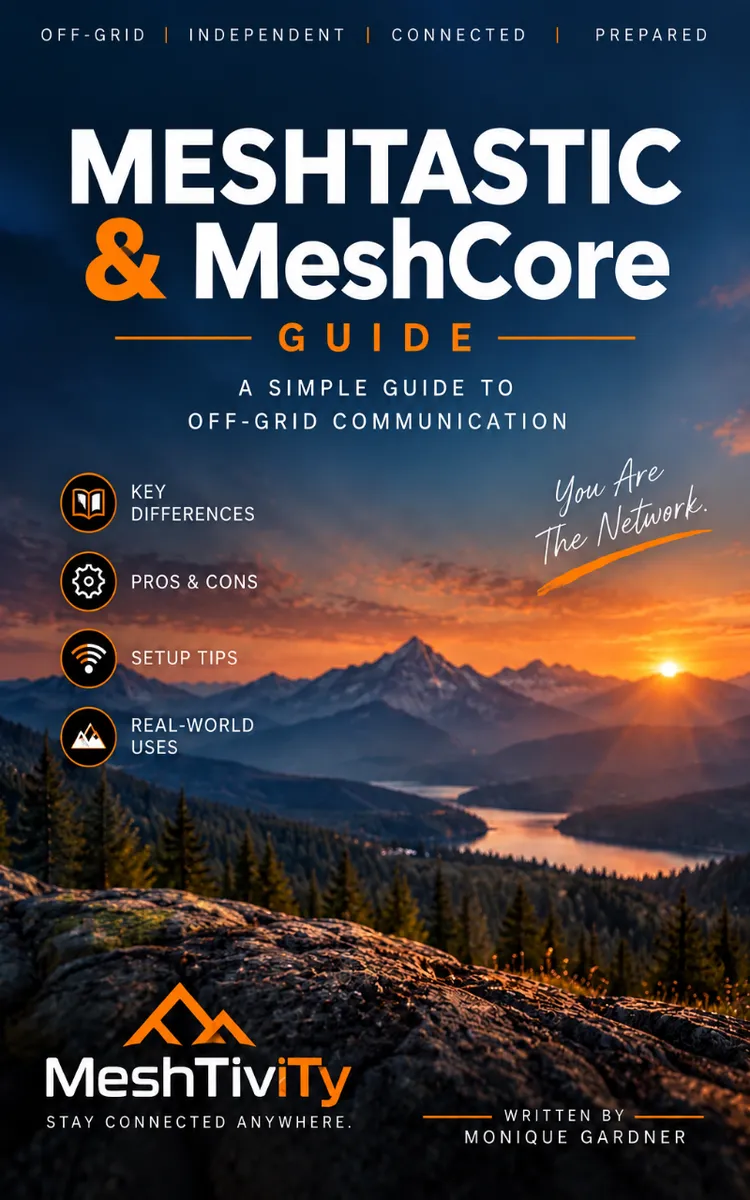
"Meshcore & Meshtastic Setup" is a how-to guide book by Monique Gardner with 5 chapters and approximately 9,747 words. How to use MeshCore and Meshtastic devices.
This book was created using Inkfluence AI, an AI-powered book generation platform that helps authors write, design, and publish complete books. It was made with the AI Ebook Generator.
Frequently Asked Questions
What is "Meshcore & Meshtastic Setup" about?
How to use MeshCore and Meshtastic devices
How many chapters are in "Meshcore & Meshtastic Setup"?
The book contains 5 chapters and approximately 9,747 words. Topics covered include MeshCore vs Meshtastic Basics, Choosing Radios, Antennas, Power, Step-by-Step Meshtastic Setup, MeshCore Nodes, Repeaters, Gateways, and more.
Who wrote "Meshcore & Meshtastic Setup"?
This book was written by Monique Gardner and created using Inkfluence AI, an AI book generation platform that helps authors write, design, and publish books.
How can I create a similar how-to guide book?
You can create your own how-to guide book using Inkfluence AI. Describe your idea, choose your style, and the AI writes the full book for you. It's free to start.
Write your own how-to guide book with AI
Describe your idea and Inkfluence writes the whole thing. Free to start.
Start writingCreated with Inkfluence AI


