
Read the first chapter
The whole of chapter one, free. About 4 min. Turn the pages with the arrows, your keyboard, or a swipe.
Chapter 1
Foundation (Understanding Your Child)
The next time you feel your voice rising, try something simpler than “be louder.” If you shout, you’re basically handing your child two messages at once: one is the instruction, and the other is that life is getting intense. Most kids don’t hear the instruction cleanly when the volume spikes—they hear the pressure. And pressure makes brains do what brains do: scramble, shut down, or tune out.
Think about it from the inside. When you’re calm, you’re easier to understand. When you’re frustrated, your words get tangled with tone. Kids aren’t ignoring you because they’re “bad.” They’re often ignoring you because they’re overloaded, distracted, or still trying to figure out what you want them to do. Shouting can work like a temporary alarm—sure—but alarms don’t teach. They just interrupt. Then the same problem shows up again, and you’re back at square one, louder than before.
So let’s get clear on what’s really going on under the noise. There are usually hidden reasons kids ignore instructions, and they’re not always about defiance. Sometimes it’s about attention: your child is chasing something else—an interest, a feeling, a need to finish what they’re doing. Sometimes it’s about timing: the instruction comes when their brain is already in the middle of something. And sometimes it’s about power—your child has learned that if they don’t move right away, the interaction keeps dragging on, and that attention (even angry attention) is still attention.
Here’s the piece that changes everything: attention and disobedience aren’t the same thing. A child can be “not listening” without being “defiant.” They might hear you and genuinely not have the ability—at that moment—to switch gears. Other times, they may be using delay as a way to get your focus. Either way, the goal isn’t to win the argument. The goal is to get cooperation in a way that makes sense to their brain.
Let me paint a common picture. You’re trying to leave the house. You say, “Shoes on!” Your child keeps doing what they’re doing. You repeat it—louder. Still nothing. Now you’re getting frustrated, and your child gets more stuck. What changed? The instruction didn’t get clearer. The interaction got hotter. If your child is already overwhelmed or absorbed, the extra volume doesn’t add understanding—it just raises the emotional temperature. And when emotions run high, listening drops.
That’s why we use a steady rule called the Connection Before Correction Principle. Before you correct behavior, you connect with your child in a quick, real way—something that helps them feel seen and safe enough to actually hear you. This isn’t about coddling or lowering expectations. It’s about ordering the moment so correction lands. When your child feels connected, they’re more likely to move. When they feel attacked, they’re more likely to dig in or drift away.
Connection can be small and practical. It can be a simple sentence that matches what you see, followed by a clear next step. You don’t need a speech. You need the right sequence: first, reduce the emotional chaos; then, give the direction. If you jump straight to correction while your child is still keyed up, you’re basically trying to steer a car while it’s skidding.
As you start this 30-day challenge, your job isn’t to guess what your child “should” be doing. Your job is to notice the pattern. That’s where the Action Page comes in, and it’s going to save you a ton of frustration. You’re going to look at the times when obedience breaks down and identify what your child is doing right before the problem. Not the full history—just the immediate pattern. When you know the pattern, you stop treating every moment like a brand-new mystery.
Action Page: Identify Your Child’s Behavior Pattern
Pick one behavior that happens a lot (like refusing to start a task, ignoring requests, or melting down during transitions). Then write down what you notice using the prompts below:
• When it usually happens (time of day or situation): - What you say right before it (your instruction, as close as you can): - What your child does right after (exact behavior, not your interpretation): - What happens next (how the interaction usually goes, including your reaction): - What seems to be the payoff for your child (attention, escape, control, finishing something, getting something, avoiding a demand): - What’s one sign your child is “about to” have the problem (restlessness, distraction, arguing, getting quiet, etc.)
Fill this in once, then keep it nearby. In the next step of the challenge, we’ll use what you wrote to spot attention versus disobedience in real life—and choose responses that lower the noise so your instructions actually land.
End of chapter one. 4 more chapters in the full book.
Swipe or use the arrows to turn the page
What's inside: 5 chapters
- 1. Foundation (Understanding Your Child)
- 2. The 3 Parenting Mistakes
- 3. The No-Shouting System
- 4. Holiday Structure Blueprint
- 5. Discipline Without Shouting
About this book
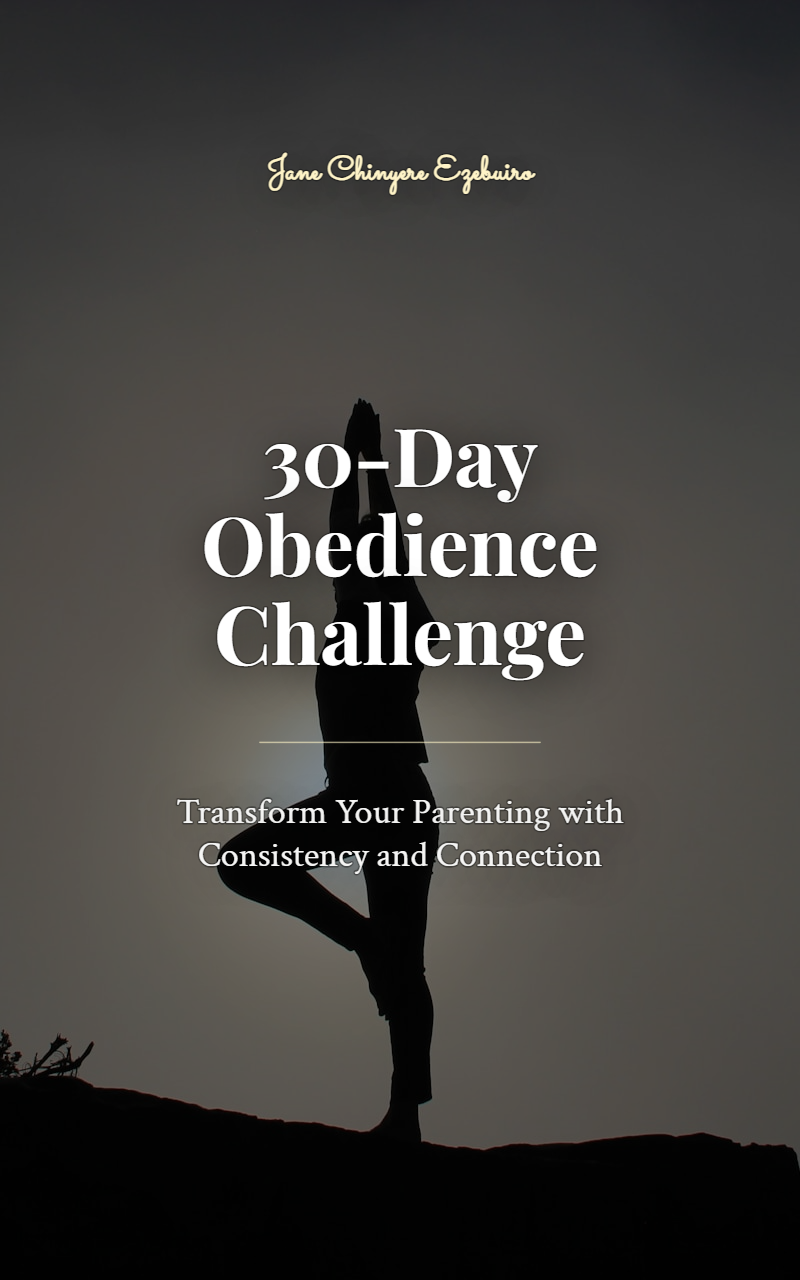
"30-Day Obedience Challenge" is a day challenge book by Jane Chinyere Ezebuiro with 5 chapters and approximately 4,490 words. Parenting strategies to improve child obedience and build peaceful home.
This book was created using Inkfluence AI, an AI-powered book generation platform that helps authors write, design, and publish complete books.
Frequently Asked Questions
What is "30-Day Obedience Challenge" about?
Parenting strategies to improve child obedience and build peaceful home
How many chapters are in "30-Day Obedience Challenge"?
The book contains 5 chapters and approximately 4,490 words. Topics covered include Foundation (Understanding Your Child), The 3 Parenting Mistakes, The No-Shouting System, Holiday Structure Blueprint, and more.
Who wrote "30-Day Obedience Challenge"?
This book was written by Jane Chinyere Ezebuiro and created using Inkfluence AI, an AI book generation platform that helps authors write, design, and publish books.
Write your own day challenge book with AI
Describe your idea and Inkfluence writes the whole thing. Free to start.
Start writingCreated with Inkfluence AI


