
Read the first chapter
The whole of chapter one, free. About 5 min. Turn the pages with the arrows, your keyboard, or a swipe.
Chapter 1
Daily Check-In Mood Tracker
A Simple Daily Check-In for Mood, Energy, and Symptoms (Before CBT Steps)
A daily check-in is your “before picture.” It helps you map what’s going on in your body and mind today, so you don’t guess when it’s time to do CBT steps. When you can name your mood, energy, and symptoms in a quick, consistent way, the CBT choice gets easier - because you’re matching the tool to the state you’re in, not forcing yourself to do the same thing every day.
In practice, you’ll track three signals: mood, energy, and symptoms. Then you’ll write one short “what’s most active right now?” line. That one line matters because it tells you what CBT target fits best (thoughts, behaviors, coping, or basics like sleep/food). Key takeaway: Your daily check-in is the switchboard - mood, energy, and symptoms tell you which CBT step to use next.
Use this structure as your map: 1. Mood (0-10): How bad/good it feels right now (not how you wish it felt). 2. Energy (0-10): How much fuel you have right now. 3. Symptoms (0-10 each): Pick 3-5 that actually show up for you (and rate them). 4. Top signal: One sentence naming what’s driving the day (e.g., “Anxiety + body tension are loud,” or “Low energy is killing momentum.”)
---
Your Turn: Do a 5-Minute Daily Check-In (Fill It In)
Time required: 5-7 minutes Materials needed: Pen + paper (or a notes app). If you already have a symptom list from earlier, use it.
Before you start: pick a time you can repeat. Most people do better when it’s around the same moment each day. Examples that work: right after meds, after breakfast, or before evening meds.
Steps 1. Set the date and time. Write: “Date: __ / Time:.” 2. Rate your mood (0-10). Write: “Mood: _/10” (0 = worst you can imagine today; 10 = best you can imagine today.) 3. Rate your energy (0-10). Write: “Energy: _/10” (0 = no usable energy; 10 = strong enough to do normal tasks.) 4. Rate your symptoms (0-10 each). Choose 3-5 symptoms you commonly notice. Rate each one for right now. Copy this line format and fill it in: - Symptom A (): _/10 - Symptom B (__): _/10 - Symptom C (__): _/10 - Symptom D (optional, __): _/10 - Symptom E (optional, __): _/10 5. Pick your top signal (one sentence). Write one sentence that answers: “What’s most active right now?” Keep it plain and specific (no big explanations yet). 6. Mark what feels “useful” today. Circle one option: Basics / Thoughts / Actions / Coping (This is just a label for now - you’ll choose the exact CBT step later.)
Completed example (copy the format) > Date: 6/11, Time: 9:10am > Mood: 3/10 > Energy: 2/10 > Symptoms: > - Anxiety (tight chest): 7/10 > - Intrusive thoughts (repeating worries): 6/10 > - Sleep hangover (heavy body): 8/10 > Top signal: “My chest tension and sleep hangover are driving everything this morning.” > Useful today: Basics
Quick check for “done” You’re finished when you have: (1) mood number, (2) energy number, (3) 3-5 symptom ratings, and (4) one top-signal sentence.
---
Applying the Check-In in Real Life (So It Actually Changes What You Do)
If you only track when you feel okay, the tracker becomes useless - because CBT steps are most helpful when things are rough. So use the check-in at moments where you’d normally start guessing: when you wake up, before a stressful task, after an argument, or when you notice symptoms ramping.
Here are a few situations and what you should expect to happen after you check in:
Scenario 1: Morning crash You wake up and feel flat, heavy, and slow. Your check-in might show Mood 2/10, Energy 1/10, sleep hangover 9/10. Expected outcome: you’ll label Basics as useful (instead of forcing “thought work” when your brain is running on low battery). Basics might mean focusing on the smallest stabilizers you can do that day (food, water, a short reset routine). The win is not “feeling better instantly.” The win is choosing the right starting point.
Scenario 2: Anxiety spike before leaving home You notice restlessness and tightness. Your check-in might look like Mood 4/10, Energy 6/10, anxiety 8/10, intrusive thoughts 7/10. Expected outcome: the top signal will likely point to “anxiety + thoughts,” and your label might tilt toward Thoughts or Coping. That helps you aim CBT where it fits - rather than trying to “solve everything” while your nervous system is loud.
Scenario 3: After a conversation that went badly You replay what you said. Your check-in might show Mood 3/10, Energy 3/10, shame 8/10, intrusive replay 7/10. Expected outcome: you’ll see the pattern: low energy + shame/replay. Your next CBT step will match that - often by starting with grounding/coping or a small behavior shift before deeper thought disputing. (Disputing thoughts while you’re exhausted can feel like pushing a car uphill with wet hands.)
Scenario 4: “I can’t tell what’s wrong” days Sometimes mood and energy are both messy, and symptoms are hard to name. In that case, pick the closest symptom signals you can notice (even if you’re not sure). Expected outcome: your “top signal” sentence will still give you a direction. Example: “I can’t focus and my body feels keyed up.” That’s enough to choose a next step later.
A small differentiator that matters: if your symptoms list includes physical signals (like chest tightness, stomach drop, body heaviness), your check-in usually becomes more accurate faster. Physical signs are often easier to rate than vague feelings.
---
Questions to Lock This In (And Plan Tomorrow’s Use)
Answer these right after you do your check-in, or the same day if possible.
1) What did your numbers tell you that your feelings didn’t? ________________________________________________ ________________________________________________
2) Which symptom (or body signal) was highest today, and what does that suggest your “top signal” should be? ________________________________________________ ______________________________________________ ________________________________________________
3) If tomorrow is similar, what CBT label do you want to start with: Basics, Thoughts, Actions, or Coping - and why (one line)? ________________________________________________ ________________________________________________
---
Closing: Your Check-In Becomes a Tool, Not a Task
Once you’ve done a few days, the check-in stops feeling like paperwork. It turns into a quick “truth scan” that helps you stop arguing with your experience. The numbers don’t judge you. They just show what’s loud, what’s low, and what’s asking for the next move.
And that’s the whole point: when your mood, energy, and symptoms are mapped, CBT choices get simpler - and you spend less time stuck in “I don’t know what to do.” Tomorrow, you’ll use the same format again, then we’ll start matching those signals to specific CBT steps.
End of chapter one. 23 more chapters in the full book.
Swipe or use the arrows to turn the page
What's inside: 24 chapters
- 1. Daily Check-In Mood Tracker
- 2. Linking Thoughts to Feelings
- 3. Challenging Thoughts with Evidence
- 4. Replacing with Balanced Self-Talk
- 5. Behavior Activation for Low Energy
- 6. Urge Surfing for Intense Moments
- 7. Problem-Solving for Daily Triggers
- 8. Scheduling Worry with Time Limits
- 9. Coping Cards for Grounding
- 10. Weekly Review and Relapse Prevention
- 11. Early Response: Short, Practical Crisis Steps
- 12. Rapid Response Variations for Specific Diagnoses
- 13. Focused Response Planning
- 14. Expanding Response Plans Across Conditions
- 15. Matching Short Response Plans to Specific Diagnoses and Moments
- 16. Fine-Tuning Short Response Plans for Specific Moments and Conditions
- 17. Short Plans for Mixed Moments
- 18. Matching Short Plans to Specific Diagnoses
- 19. Fine-Tuning Short Plans to Specific Diagnoses and Moments
- 20. Severe Mental Illness Overview & Supports
- 21. Self-Help Maps & 20 Worksheets
- 22. Practical Guide: Bonus Tips, Free Journaling, and Printable Worksheets
- 23. Final Check-In and Next Steps
- 24. Building Short Response Plans You Can Use Today
About this book
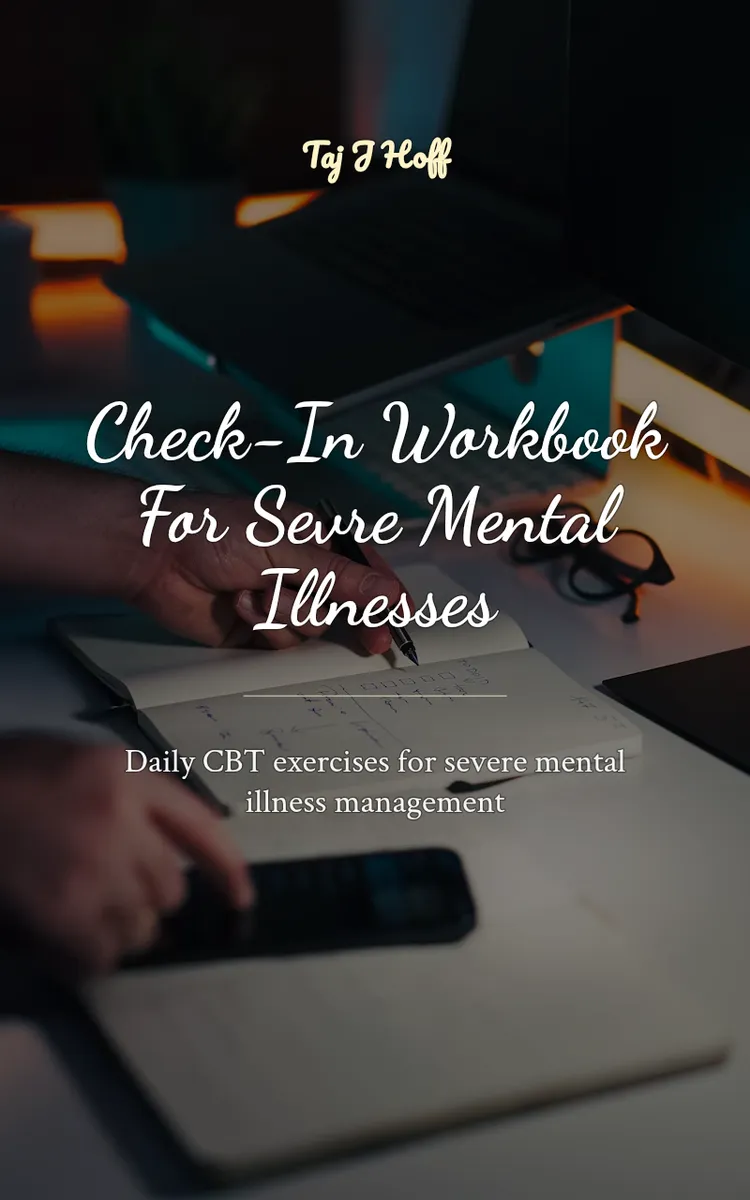
"CBT Check-In Workbook" is a workbook by Taj J Hoff with 24 chapters and approximately 25,172 words. Workbook with daily check-ins and CBT-style exercises.
This book was created using Inkfluence AI, an AI-powered book generation platform that helps authors write, design, and publish complete books. It was made with the Workbook Generator.
Frequently Asked Questions
What is "CBT Check-In Workbook" about?
Workbook with daily check-ins and CBT-style exercises
How many chapters are in "CBT Check-In Workbook"?
The book contains 24 chapters and approximately 25,172 words. Topics covered include Daily Check-In Mood Tracker, Linking Thoughts to Feelings, Challenging Thoughts with Evidence, Replacing with Balanced Self-Talk, and more.
Who wrote "CBT Check-In Workbook"?
This book was written by Taj J Hoff and created using Inkfluence AI, an AI book generation platform that helps authors write, design, and publish books.
How can I create a similar workbook?
You can create your own workbook using Inkfluence AI. Describe your idea, choose your style, and the AI writes the full book for you. It's free to start.
Write your own workbook with AI
Describe your idea and Inkfluence writes the whole thing. Free to start.
Start writingCreated with Inkfluence AI


