

Read the first chapter
The whole of chapter one, free. About 7 min. Turn the pages with the arrows, your keyboard, or a swipe.
Chapter 1
Choosing a Profitable Niche
Find the Demand Before You Build
What would happen if you spent three weeks building a store for a product people admire but rarely buy? You could choose a polished theme, write persuasive product descriptions, and contact several suppliers - only to discover that shoppers compare prices endlessly, distrust the shipping time, or solve the problem with products they already own.
That risk affects the practical business owner most. You may have limited time, a fixed advertising budget, and no desire to manage hundreds of products. You need a niche - a focused group of buyers with a shared problem or interest - that gives you a reasonable chance to earn sales. The goal is not to find a product that looks exciting. The goal is to prove that people want it, understand why they would buy it, and identify how you can compete before you build the store.
The Niche Viability Scorecard gives you that proof process. By the end, you will know how to test demand, inspect competition, read buyer intent, and reject weak ideas early. You will also have a clear decision: investigate further, test a small product range, or move on without wasting money.
I learned this lesson by treating product enthusiasm as evidence. It is not. A product can receive thousands of views and still produce weak buying interest. A stronger approach combines search behavior, competitor evidence, customer language, and realistic costs. That combination helps you make a business decision instead of guessing from personal taste.
Use the Niche Viability Scorecard
The Niche Viability Scorecard rates an idea across four checks: demand, competition, buyer intent, and business fit. Use a simple spreadsheet with one row per niche and columns for evidence, score, and notes. Score each area from 1 to 5. A score of 1 means weak evidence; a score of 5 means strong evidence. Do not score a category from instinct alone. Record what you found.
1. Demand: Check whether people actively search for, discuss, and purchase products in the niche. Use Google Trends to compare interest over time, Google search suggestions to find related phrases, and marketplace listings on Amazon, Etsy, or eBay to confirm that sellers receive attention. Search “portable dog water bottle,” for example, rather than the broad term “dog products.” Specific phrases reveal clearer demand.
2. Competition: Study what existing stores do well and where they leave buyers frustrated. Review the first page of Google results, large marketplaces, and social media shops. Record product prices, delivery promises, product quality, guarantees, photos, and customer complaints. Competition proves that money exists in a market, but crowded sellers raise the standard you must meet.
3. Buyer intent: Separate curiosity from purchase intent. A person searching “best camping chair for back pain” has a stronger buying reason than someone watching a video titled “camping gear ideas.” Look for phrases containing words such as “buy,” “price,” “review,” “size,” “near me,” “shipping,” and “alternative.” Read reviews and questions to learn what buyers worry about before checkout.
4. Business fit: Check whether the niche supports dependable fulfillment and useful margins. Contact suppliers before choosing a product. Ask for the exact product cost, shipping cost to your target country, processing time, tracking availability, return address, and defect policy. A product that sells for $40 but costs $28 after shipping leaves little room for payment fees, refunds, customer support, and advertising.
5. Testability: Confirm that you can reach buyers and test an offer without building a large catalog. A niche with clear search phrases, visible communities, and three to five related products gives you more ways to test. A niche that requires expensive education or a complicated product demonstration demands more time and money.
After scoring, add the five numbers. Treat the total as a filter, not a guarantee. A niche scoring 20 or more deserves deeper testing. A niche scoring 15 to 19 needs stronger evidence in its weakest category. A niche below 15 usually needs a different angle or a different market. The score matters less than the notes behind it. “People like this” carries little weight; “ten competing listings have more than 500 customer reviews, and buyers repeatedly complain about leaking lids” gives you something you can act on.
Use the Buyer Friction Map alongside the scorecard. Divide your notes into three columns: what buyers want, what stops them, and what proof would remove the concern. For a reusable travel water bottle, buyers may want leak-free use, worry about poor seals, and need close-up photos, a clear warranty, and verified testing information. This map turns research into an offer. It also shows whether you can improve the buying experience instead of copying another store.
Apply the Scorecard Before Building
Consider a niche built around compact home coffee equipment. The idea sounds attractive, but you need evidence before buying a domain or importing stock. Follow the process in order.
1. Define the buyer and problem. Write: “Apartment renters who want better coffee without a large machine.” This statement narrows the research. It directs you toward compact grinders, storage tools, reusable filters, and cleaning products rather than every item labeled coffee equipment.
2. Collect demand evidence. Spend 45 minutes using Google Trends, search suggestions, and marketplace results. Record ten specific phrases, such as “small coffee grinder,” “quiet coffee grinder,” and “coffee setup for small kitchen.” Mark whether each phrase shows a product search, a comparison, or general education. Expect to find several product-focused phrases rather than relying on the broad word “coffee.”
3. Inspect five competing stores and ten marketplace listings. Record prices between $18 and $85, delivery times from 5 to 18 days, and the complaints that appear repeatedly. Suppose seven listings mention noisy motors, difficult cleaning, or unclear grind settings. Those complaints create possible selling angles, but only if your supplier can provide a better product or clearer instructions.
4. Check buyer intent. Search product reviews and question sections. If buyers ask, “Will this fit under a 12-inch cabinet?” or “Can I use it before work without waking someone?” they reveal practical purchase conditions. Add those questions to your future product page only after confirming that the product specifications answer them accurately.
5. Verify supplier and margin details. A supplier quotes $21 for the grinder, $6 for tracked shipping, and a three-day processing time. You plan to sell it for $59. After allowing $3 for payment costs and $5 for refunds or replacements, $24 remains before advertising. That margin may support a small test, but it does not justify careless ad spending.
6. Score the niche. Give demand 4, competition 3, buyer intent 5, business fit 3, and testability 4. The total is 19. The niche needs more work, especially supplier quality and competition. You should not build a full store yet. Order one sample, test noise and cleaning, and compare the product against the complaints you recorded.
7. Set a decision date. Give yourself seven days to verify the sample and supplier answers. Choose a result before testing: proceed with three related products if the sample meets the claims, revise the angle if it solves only one complaint, or reject the niche if the supplier cannot provide reliable specifications.
Quick checklist
• Write one buyer group and one clear problem. - Record ten specific search phrases. - Compare five stores and ten listings. - Read at least 30 customer reviews and questions. - Note repeated complaints and desired features. - Confirm product, shipping, processing, tracking, and return details. - Calculate the selling price minus product, shipping, fees, and expected refunds. - Score all five Niche Viability Scorecard categories. - Order a sample before making product claims. - Set a deadline and a rejection rule.
This process may feel slower than launching immediately, but it protects the decisions that cost the most: store design, inventory commitments, and advertising. A weak score does not mean the entire market fails. It may mean your product angle, supplier, or buyer definition needs work.
Avoid Evidence That Misleads You
Mistaking attention for demand
A viral video or a large social media following can create excitement without creating steady purchases. People may share an unusual product because it entertains them, not because they need it.
Do this: Compare social attention with product searches, active listings, customer reviews, and price questions. Look for evidence across at least three sources.
Not this: Treat one popular video as proof that you can build a profitable store.
Choosing a niche because competition looks low
No competitors can signal an opportunity, but it can also signal weak demand, difficult delivery, poor product quality, or legal restrictions. A market with no sellers deserves investigation, not automatic celebration.
Do this: Search marketplaces, Google, social platforms, and supplier catalogs. If you find no meaningful buyer activity, lower the demand score and investigate the reason.
Not this: Assume an empty search page means you discovered an untouched market.
Ignoring buyer concerns until after launch
Returns and complaints often begin with information the seller failed to provide. Clothing sizes, battery safety, fragile materials, skin contact, and delivery deadlines require careful checks before you advertise.
Do this: Turn repeated questions into a supplier verification list. Confirm measurements, materials, certifications where required, packaging, and delivery expectations. Remove any claim you cannot prove.
Not this: Copy a supplier’s description and promise results you have not tested.
Your first practical action is simple: choose three possible niches, create one Niche Viability Scorecard sheet, and collect evidence before designing anything. When the numbers, buyer language, and supplier facts point in the same direction, you have earned the right to test. That discipline gives every later store decision a stronger foundation.
End of chapter one. 14 more chapters in the full book.
Swipe or use the arrows to turn the page


What's inside: 15 chapters
- 1. Choosing a Profitable Niche
- 2. Finding Suppliers and Product Fit
- 3. Building Your Drop Shipping Store
- 4. Designing High-Converting Product Pages
- 5. Pricing for Profit After Fees
- 6. Writing Product Descriptions That Sell
- 7. Setting Up Shipping and Returns
- 8. Creating a Winning Offer and Bundle
- 9. Launching with Email and SMS Flows
- 10. Running Product Research with Data
- 11. Mastering Facebook and Instagram Ads
- 12. Scaling with Google Shopping Campaigns
- 13. Improving Conversion Rate with CRO
- 14. Managing Customer Support and Chargebacks
- 15. Building a Sustainable Scaling System
About this book
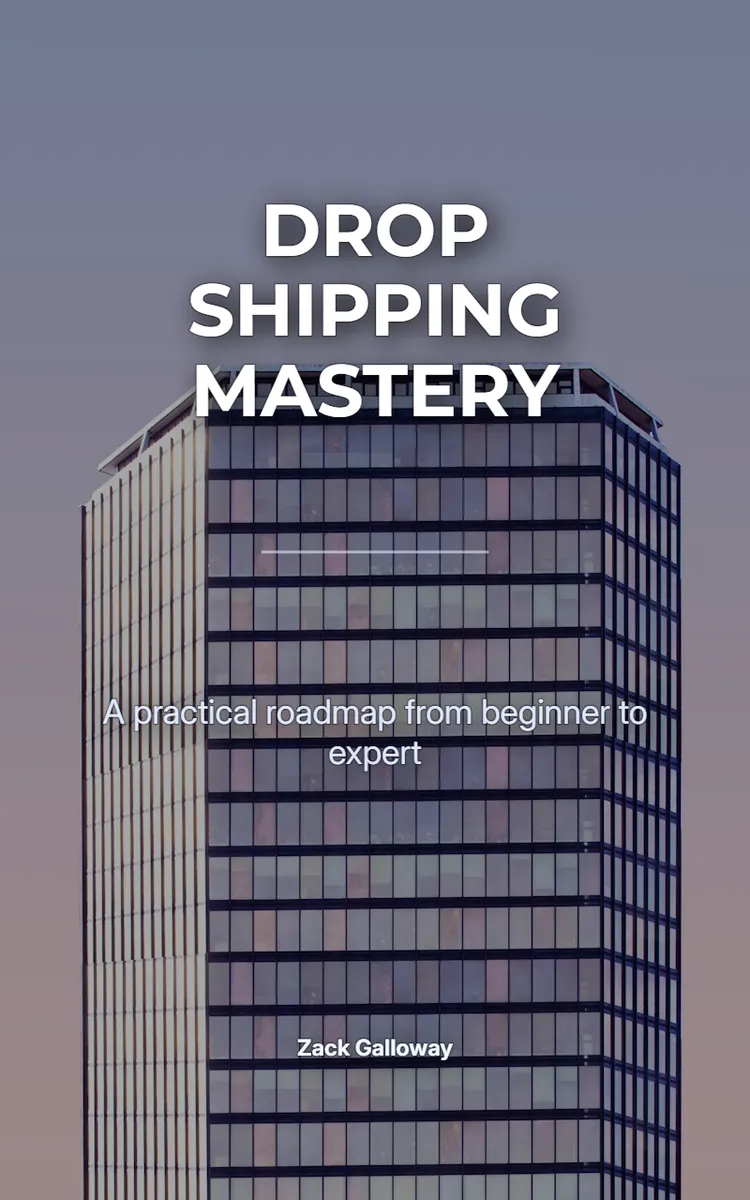
"Drop Shipping Mastery" is a business book by Zack Galloway with 15 chapters and approximately 27,698 words. Learning drop shipping from beginner to expert level.
This book was created using Inkfluence AI, an AI-powered book generation platform that helps authors write, design, and publish complete books. It was made with the AI Business Book Writer.
Frequently Asked Questions
What is "Drop Shipping Mastery" about?
Learning drop shipping from beginner to expert level
How many chapters are in "Drop Shipping Mastery"?
The book contains 15 chapters and approximately 27,698 words. Topics covered include Choosing a Profitable Niche, Finding Suppliers and Product Fit, Building Your Drop Shipping Store, Designing High-Converting Product Pages, and more.
Who wrote "Drop Shipping Mastery"?
This book was written by Zack Galloway and created using Inkfluence AI, an AI book generation platform that helps authors write, design, and publish books.
How can I create a similar business book?
You can create your own business book using Inkfluence AI. Describe your idea, choose your style, and the AI writes the full book for you. It's free to start.
Write your own business book with AI
Describe your idea and Inkfluence writes the whole thing. Free to start.
Start writingCreated with Inkfluence AI


