
Read the first chapter
The whole of chapter one, free. About 8 min. Turn the pages with the arrows, your keyboard, or a swipe.
Chapter 1
Unlearning What Sounds Biblical
Why Common Church Beliefs Can Still Be Wrong
Have you ever heard a phrase that sounded so comforting and spiritual you assumed it came from the Bible, only to discover later that it doesn't actually align with Scripture? Maybe it’s something you’ve repeated for years. Maybe you’ve heard it quoted like a verse. Maybe you didn’t even stop to ask, “Where is that in the Bible?”
Here’s the problem: a saying can sound and BE biblical and still be misunderstood, twisted, or taken out of context. Sometimes it’s missing the rest of the scripture and therefore intent is lost in translation. Sometimes it’s pulling one principle out of the Bible and using it like a free pass for whatever we want to do. Sometimes it’s just simply not what God said, yet it gets treated like truth anyway.
This is why Scripture matters, not just in theory, but in your everyday thinking. God doesn’t want you to run your faith on vibes, what your grandmother said or performative spirituality. He wants you grounded in His Word so you can recognize what’s true, what’s incomplete, and what’s actually misleading. Hosea 4:6 is clear: “My people are destroyed for lack of knowledge.” Not lack of feelings. Not for lack of effort. Not for lack of ability. Lack of knowledge, God’s truth.
The Difference Between “Knowledge” and Guesswork
There’s a kind of Bible knowledge that sits on a shelf and looks impressive. It sounds good, but IF IT NEVER touches your choices, your conversations or your reactions, then what you have isn’t really knowledge, it's a form of Godliness, not real relationship. It becomes little more than decoration, outward showmanship without inward transformation.
God’s knowledge is different. It’s living and active, because it trains your heart to think like Him. It doesn’t just inform your mind; it reshapes your instincts. When you know Scripture, you stop grabbing whatever phrase feels comforting and you start asking, “What does God actually say about this?”
Guesswork is quick, arguably lazy. It’s fast and easy, like grabbing the nearest tool from the shop without checking to see if it fits the job. Guesswork doesn’t build a steady life, it creates confusion. It makes you bounce between “well, everyone says…” and “I guess God wants…” without ever getting anchored.
The Bible doesn’t call you to be dramatic or defensive. It calls you to be discerning. Discernment starts with knowing what God has said, directly, personally, and consistently.
How Misquoted Sayings Get Inside Your Head
Popular sayings have a way of nesting. They don’t just stay in conversation; they start shaping your theology. They affect how you interpret God’s character, how you respond to people, and how you measure right and wrong.
A saying can sneak in through small things: a caption, a slogan, a sermon snippet, a Christian book quote that gets repeated until the original meaning disappears. Over time, you stop testing it against Scripture and start treating it like a shortcut: if it sounds biblical enough, it must be true.
Scripture doesn’t work like that. God’s Word is not a buffet where you pick whichever lines make you feel good inside. It’s a book of timeless messages with context, balance, and purpose. When you remove a verse from its surrounding meaning, you don’t just change the wording, you change the doctrine.
That’s why this book is built around clarification. Not to win arguments. Not to collect “gotchas.” The goal is to help you unlearn what sounds spiritual and learn what’s actually biblical.
A Simple Habit: Check the Saying Against Scripture
You don’t need a seminary degree to test what you hear. You just need a steady habit of communing with the Holy Spirit so that nothing flies under your prophetic radar. Yes, it’s possible to do this even with a busy schedule because the goal isn’t to read ten chapters a day. The goal is to stop trusting whatever floats in and start trusting what God has spoken.
When a saying comes up, especially one you’ve heard a lot, try this simple rhythm:
• Ask where it comes from.
• Ask what Scripture actually says.
• Ask what the spirit of the passage is in its context (who is speaking, who is being addressed, and what problem is being solved).
Once you've asked these questions, don’t just move on. Let it land. How does this change the way you think? How does it affect the way you respond when you’re stressed, hurt, or tempted to react?
That last part matters. Scripture isn’t only meant to correct your vocabulary; it’s meant to correct your direction.
Knowledge isn’t trivia, or something to be considered a collectable, it's transformative when applied and executed on.
Daily Faith Reflections That Don’t Leave You Confused
Some devotions feel like they’re trying to motivate you. Others feel like they’re trying to impress you. This one is trying to do something else: help you step away from conformity and stand on business behind the Word of God.
Clarity doesn’t mean you’ll never wrestle. Clarity means you won’t be tossed around by every phrase that claims to represent God. When Scripture is your reference point, there is no wavering. You can learn without feeling lost. You can grow without pretending.
Your daily reflection time will be built around three things that work together:
You’ll look at a Scripture that speaks directly to the misconception. You’ll reflect honestly on what you believed and why you believed it. And you’ll practice a spiritual habit that makes the truth stick, something you can actually do, not just nod at.
This is where a lot of people get tripped up. They think truth should feel easy. On the contrary, truth often requires you to let go of something familiar. Not because God is trying to ruin your life, but because God is trying to rescue your thinking.
Rescue comes with change.
Let Scripture Lead, Not Culture
Culture loves to act as the translator of Scripture, reshaping biblical truth into something more comfortable and convenient. Before long, repentance becomes "keep sinning and keep saying you're sorry." Forgiveness becomes "pretend nothing ever happened." Judgment becomes "never address sin." Grace becomes "God knows my heart."
When culture redefines God's words, it doesn't clarify the truth. It distorts it. God's Word means exactly what He intended it to mean, and our responsibility is not to rewrite it but to submit to it.
That’s not all culture, of course. There are good influences, but culture is NOT your authority, scripture IS.
So when you read, ask yourself a real question: “Where am I letting culture, my comfort, my circle, or my habits tell me what God means?” That question can feel uncomfortable, because it requires you to take responsibility for your own spiritual growth. The good news is there is freedom in that.
If you can identify where the influence is coming from, you can choose something better. You can choose God’s Word.
Hosea 4:6 becomes more than a verse. It becomes a warning with a rescue mission behind it: God wants you to know Him clearly, not vaguely, not through lenses created by culture. He wants you to understand what He says so your life doesn’t get pulled apart by misinformation.
Transformation Starts With Honest Accountability
Let’s be honest: unlearning isn’t always pleasant, actually it can be brutal. Sometimes the saying you’ve repeated has helped you protect yourself. Maybe it excused your attitude. Maybe it softened your responsibility. Maybe it gave you a way to stay comfortable or stagnant while calling it, waiting on the Lord.
Unlearning means you stop hiding behind what sounds spiritual and you start submitting to what God says.
Please don't confuse this with condemnation, it's spiritual accountability and accountability leads to clarity and clarity leads to better choices.
When you compare popular beliefs to Scripture, you’re not just collecting facts. You’re training your conscience. You’re learning to spot the difference between truth and religious, sounding language that doesn’t actually match God’s heart.
God’s heart is consistent. He doesn’t change his word to adapt to culture. He speaks to guide you. He corrects to heal you because He loves you.
The Purpose of This Devotional: Clarity Over Confusion
The point of this devotional isn’t to make you suspicious of every sentence you hear. The goal is for you to be rooted and help you to stop treating spiritual sounding phrases as automatic truth.
When you don’t check Scripture for yourself, you end up borrowing someone else’s interpretation, sometimes without even knowing it. You might be sincere. You might be trying, but sincerity without truth can still lead you astray.
God doesn’t want you destroyed for lack of knowledge. The Father wants you strengthened by the truth that comes from Him.
So here’s the goal for your time with this book: you’ll walk through common misconceptions and compare them to what Scripture actually says. You’ll reflect on how you’ve been influenced, and you’ll practice habits that keep you steady, so that you can recognize truth, respond with wisdom, and keep your faith from getting dragged around by opinions.
Truth isn’t only something you believe. It’s something you live.
Prayer and Posture: Asking God for Truth You Can Use
You don’t have to approach this like a test you’ll fail. You don’t have to come in defensive, scanning for what’s wrong. Instead, come in humble confidence that God’s Word is able to correct you.
Ask God for wisdom that actually changes how you think. Ask Him for discernment that doesn’t turn into judgment of other people. Ask Him for courage to let Scripture be your standard, even when the saying you’ve heard is popular, familiar, and easy to repeat.
That’s the posture this devotional is built on: honest engagement with God’s Word, paired with practical response.
If you’ve ever felt confused by Christian phrases that seem to clash with Scripture, you’re not alone. Confusion is common when truth isn’t checked, but it doesn’t have to stay that way.
Next, we’ll start with one of the most repeated lines in Christian circles, one that sounds spiritual to a lot of people, but doesn’t match what Scripture actually teaches about money and the heart.
End of chapter one. 6 more chapters in the full book.
Swipe or use the arrows to turn the page

What's inside: 7 chapters
- 1. Unlearning What Sounds Biblical
- 2. Money: The Love, Not the Resource
- 3. Justice vs. Revenge: The Jesus Standard
- 4. Salvation and Belonging: Who Can Be Sure?
- 5. Righteous Correction, Not Escape: How to Handle the Judgment conversation
- 6. Questions, Doubts, and the Heart of God
- 7. The Bible’s Truth: One Message, Many Books
About this book
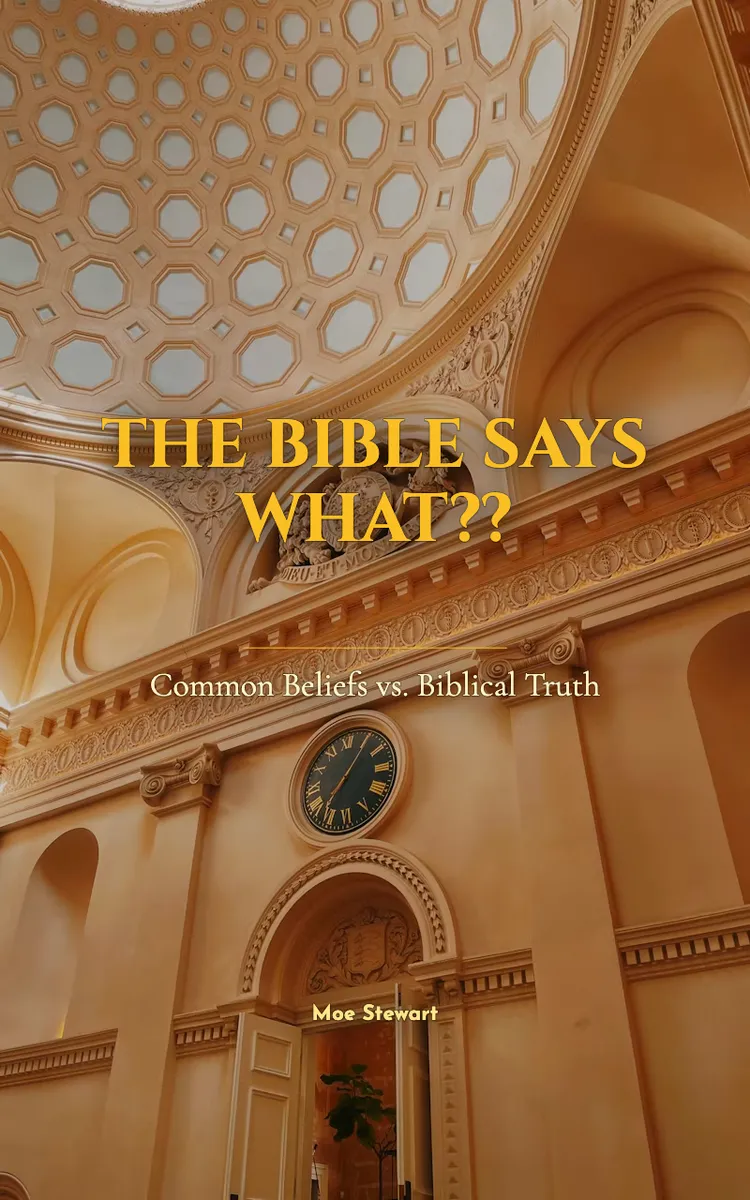
"The Bible Says What??" is a religious devotional book by Moe Stewart with 7 chapters and approximately 13,081 words. Clarifying misconceptions using Bible verses and reflection prompts.
This book was created using Inkfluence AI, an AI-powered book generation platform that helps authors write, design, and publish complete books.
Frequently Asked Questions
What is "The Bible Says What??" about?
Clarifying misconceptions using Bible verses and reflection prompts
How many chapters are in "The Bible Says What??"?
The book contains 7 chapters and approximately 13,081 words. Topics covered include Unlearning What Sounds Biblical, Money: The Love, Not the Resource, Justice vs. Revenge: The Jesus Standard, Salvation and Belonging: Who Can Be Sure?, and more.
Who wrote "The Bible Says What??"?
This book was written by Moe Stewart and created using Inkfluence AI, an AI book generation platform that helps authors write, design, and publish books.
Write your own religious devotional book with AI
Describe your idea and Inkfluence writes the whole thing. Free to start.
Start writingCreated with Inkfluence AI


