

Read the first chapter
The whole of chapter one, free. About 7 min. Turn the pages with the arrows, your keyboard, or a swipe.
Chapter 1
Electrical Basics: Voltage, Current, Power
Why the V-I-P-WH Compass Matters
A loose battery cable can turn a simple backyard solar project into a hot, damaged connection. Tomas, a 34-year-old rideshare driver, learned why when he planned a small solar setup to charge tools and electronics beside his garage. He first focused on panel wattage. Then he checked the battery label and saw voltage. The numbers looked unrelated until he connected them: voltage pushes, current flows, resistance restricts, watts describe working power, and watt-hours describe stored or used energy.
These five ideas form the V-I-P-WH Compass: Voltage, Current, Power, and Watt-hours. Resistance explains what limits current and creates heat. The compass gives you a practical way to read equipment labels, choose safe wires, understand battery capacity, and avoid connecting parts that do not belong together.
After learning these relationships, you can measure a simple circuit, estimate how long a battery can run a load, recognize why a fuse matters, and describe your planned system clearly to an electrician or inspector. You will also know where beginner testing ends: household wiring, service panels, grounding systems, and utility-connected equipment require the correct permits, inspections, and qualified electrical work.
Your first takeaway: never treat a number on a solar component as an isolated fact. Ask what it measures, what it connects to, and what could happen if the current becomes too high.
The V-I-P-WH Compass in Practice
Voltage measures electrical pressure. A 12-volt battery can push current through a circuit designed for that voltage. Current, measured in amperes or amps, describes the amount of electrical flow. A larger load usually draws more current at the same voltage. Resistance, measured in ohms, opposes current. Thin wire, a long cable, a poor connection, or a damaged component can add resistance and create heat.
Power describes how quickly a device uses or delivers energy. Measure it in watts. The basic relationship is:
Watts = volts × amps
A 12-volt device drawing 5 amps uses 60 watts. Rearrange the same rule when needed:
Amps = watts ÷ volts
A 120-watt load on a 12-volt system draws about 10 amps before accounting for equipment losses. The same 120-watt load on a 24-volt system draws about 5 amps. Higher system voltage can reduce current and cable heating, but you must use equipment designed for that voltage.
Watt-hours measure energy used or stored over time. A 60-watt lamp running for three hours uses 180 watt-hours. A battery rated at 1,200 watt-hours may not deliver all 1,200 watt-hours to your loads because inverters, wiring, temperature, and battery limits consume or reserve some energy.
Use the compass in this order:
1. Identify voltage. Read the label on the battery, panel, appliance, or inverter. Do not connect a 12-volt device to a voltage it cannot accept, because excess voltage can damage it. 2. Find current. Divide watts by volts when a label gives power but not amps. This number helps you select wire, fuses, and switches. 3. Check resistance paths. Look for long cables, undersized wire, loose terminals, corrosion, and warm connectors. Resistance wastes power and can cause fire. 4. Calculate power. Multiply volts by amps to understand the load on a circuit or the output from a device. 5. Calculate energy. Multiply watts by operating hours to estimate battery demand. Add each load together before sizing a battery.
Solar equipment also uses two kinds of electricity. Direct current (DC) flows in one direction, as it does from a solar panel or battery. Alternating current (AC) changes direction many times each second and powers ordinary household receptacles. An inverter changes DC into AC. Every conversion creates some loss, so a battery-powered AC appliance usually consumes more energy from the battery than its label alone suggests.
A circuit needs a complete path from the source, through the load, and back to the source. A breaker interrupts a circuit when excessive current flows and you reset it after correcting the problem. A fuse also interrupts excessive current, but it melts once and requires replacement. Both protect wires; they do not make an incorrectly sized wire safe. Grounding connects exposed metal parts or electrical systems to earth or to a protective path, depending on the system design. It helps control fault current and reduce shock risk, but it does not replace insulation, fuses, or careful work.
Before touching a circuit, shut off every possible source, including solar panels, batteries, generators, and utility power. Verify with a properly rated meter. A panel can produce voltage whenever light reaches it, even after you switch off an inverter. A battery can deliver dangerous current even when its voltage seems modest.
The practical takeaway is simple: voltage tells you what can connect, current tells you what the wire must carry, watts tell you the immediate workload, and watt-hours tell you how long the energy lasts.
Tomas Measures a Small Solar Circuit
Tomas wants to run a 60-watt laptop charger and a 20-watt LED work light from a 12-volt battery. He plans to use the system near his garage, not connect it to household wiring, and keep the first test at low power.
1. List the loads. The charger uses 60 watts and the light uses 20 watts, for a total of 80 watts. If both run for four hours, the estimated load is 320 watt-hours: 80 × 4. 2. Estimate battery current. At 12 volts, 80 watts requires about 6.7 amps: 80 ÷ 12. An inverter adds losses, so Tomas plans for roughly 8 amps rather than relying on the ideal calculation. 3. Check the battery energy. A 12-volt, 100-amp-hour battery has a simple nominal energy value of 1,200 watt-hours: 12 × 100. Tomas does not assume he can use every watt-hour. The battery instructions define the safe usable amount. 4. Protect the cable. Tomas selects cable based on the expected current, cable length, installation method, and the manufacturer’s instructions. He places the correctly rated fuse close to the battery’s positive terminal. The fuse protects the cable if it shorts against metal. 5. Build a complete DC path. He connects battery positive through the fuse and disconnect to the inverter positive, then connects inverter negative to battery negative using the specified cable. He tightens terminals to the manufacturer’s torque value and covers exposed positive terminals. 6. Test before loading. With all loads off, Tomas checks polarity and voltage with a meter. He turns on the disconnect, checks for abnormal heat or smell, and then starts one load at a time. A warm cable, sparking terminal, buzzing connection, or voltage collapse means he stops and investigates. 7. Compare the result. If the system runs for four hours, the meter may show more than 320 watt-hours removed because the inverter consumes energy. Tomas records actual readings instead of treating the label estimate as a guarantee.
He does not connect the inverter output to a wall receptacle. Backfeeding a house circuit can energize utility lines and seriously injure workers. A permanent backup connection needs approved equipment, a proper transfer method, permits, inspection, and qualified installation.
Quick checklist
• Read every voltage and polarity marking before connecting equipment. - Calculate amps with watts ÷ volts. - Calculate energy with watts × operating hours. - Use cable sized for current and length, not appearance. - Install overcurrent protection close to the energy source. - Keep DC and AC wiring separate unless the equipment instructions allow a combined enclosure. - Shut down and verify every source before handling conductors. - Stop immediately if a connection heats, smells, sparks, or changes color. - Never plug a backup inverter into a household receptacle.
Tomas’s expected outcome is not merely a working light. He should also have a documented voltage, current estimate, energy estimate, fuse location, cable route, and test result. That record makes later troubleshooting much safer.
Common Errors That Cause Trouble
Confusing watts with watt-hours
Watts describe the rate of use; watt-hours describe the amount used over time. A 500-watt tool running for 10 minutes does not use 500 watt-hours. It uses about 83 watt-hours, before losses.
Do this: multiply the load in watts by the hours of operation.
Not this: size a battery from the largest watt number alone.
Using a fuse that matches the appliance instead of the wire
A fuse protects the conductor between the source and the load. If a cable can safely carry 20 amps but someone installs a 40-amp fuse because the inverter label shows 40 amps, the cable can overheat before the fuse opens.
Do this: select cable first, then choose overcurrent protection according to the cable rating, installation conditions, equipment instructions, and applicable electrical rules.
Not this: install a larger fuse to stop nuisance blowing.
Assuming low voltage means no danger
A 12-volt battery may not normally produce the same shock conditions as household AC, but it can deliver enough current to melt tools, ignite insulation, or start a fire during a short circuit. An inverter creates AC output that can injure or kill.
Do this: remove metal jewelry, use insulated tools, cover exposed terminals, protect the positive conductor, and verify isolation with a meter.
Not this: work on a battery bank because “it is only 12 volts.”
Once you can follow voltage, current, resistance, watts, and watt-hours through a simple circuit, solar equipment labels become much easier to compare. The same compass will guide the larger decisions ahead: how much energy your home uses, how much a battery can store, and how safely each part can connect.
End of chapter one. 16 more chapters in the full book.
Swipe or use the arrows to turn the page
What's inside: 17 chapters
- 1. Electrical Basics: Voltage, Current, Power
- 2. DC vs AC: Circuits and Breakers
- 3. Grounding, Bonding, and Earthing
- 4. Wire Sizing and Voltage Drop
- 5. Overcurrent Protection and Disconnects
- 6. Reading Utility Bills and Usage Baselines
- 7. Energy Audits and Critical Load Lists
- 8. System Types: Grid-Tied, Off-Grid, Hybrid
- 9. Portable, RV, Cabin, and Workshop Setups
- 10. Starter 400-Watt System: Parts and Wiring Plan
- 11. Sizing Solar Arrays and Seasonal Production
- 12. Monocrystalline Panels and Mounting Best Practices
- 13. MPPT Charge Controllers and Battery Charging
- 14. LiFePO4 vs Lead-Acid Battery Banks
- 15. Battery Capacity Calculations and Runtime
- 16. Inverters, Surge Demand, and Whole-Home Backup
- 17. Troubleshooting Flowcharts and Final Case Study
About this book
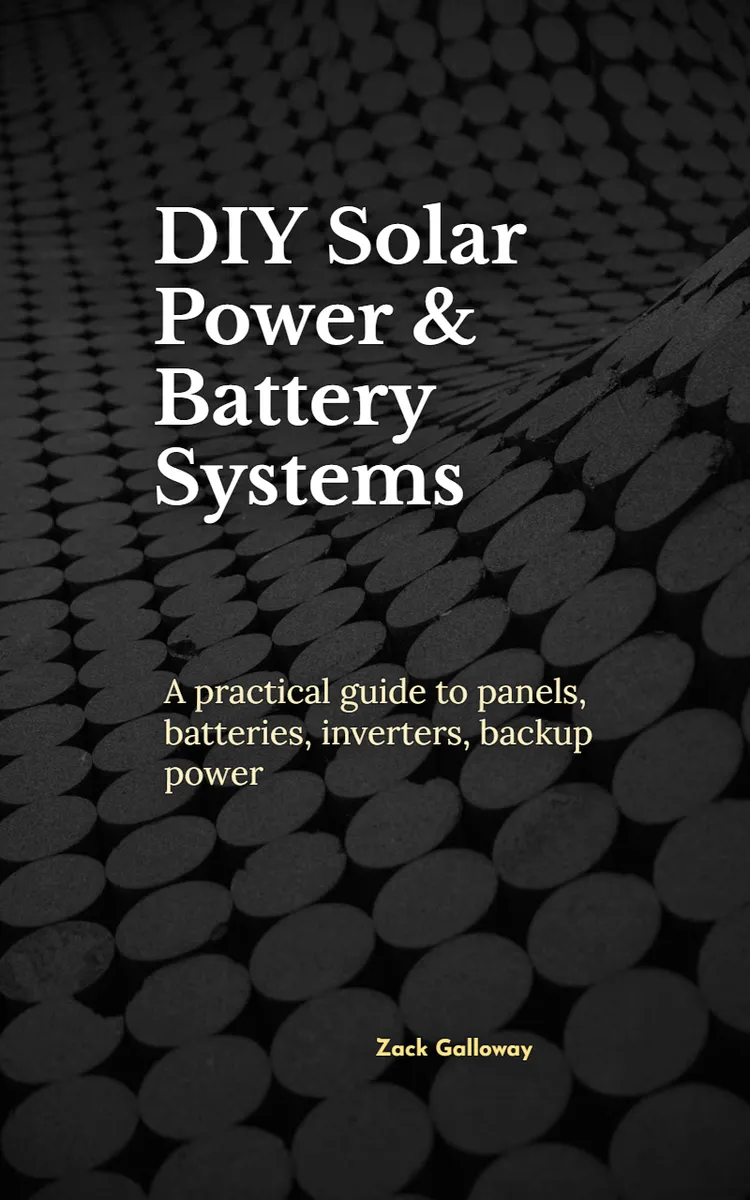
"DIY Solar Power & Battery Systems" is a how-to guide book by Zack Galloway with 17 chapters and approximately 29,475 words. Beginner-friendly technical guide to designing and installing solar and battery systems.
This book was created using Inkfluence AI, an AI-powered book generation platform that helps authors write, design, and publish complete books. It was made with the AI Ebook Generator.
Frequently Asked Questions
What is "DIY Solar Power & Battery Systems" about?
Beginner-friendly technical guide to designing and installing solar and battery systems
How many chapters are in "DIY Solar Power & Battery Systems"?
The book contains 17 chapters and approximately 29,475 words. Topics covered include Electrical Basics: Voltage, Current, Power, DC vs AC: Circuits and Breakers, Grounding, Bonding, and Earthing, Wire Sizing and Voltage Drop, and more.
Who wrote "DIY Solar Power & Battery Systems"?
This book was written by Zack Galloway and created using Inkfluence AI, an AI book generation platform that helps authors write, design, and publish books.
How can I create a similar how-to guide book?
You can create your own how-to guide book using Inkfluence AI. Describe your idea, choose your style, and the AI writes the full book for you. It's free to start.
Write your own how-to guide book with AI
Describe your idea and Inkfluence writes the whole thing. Free to start.
Start writingCreated with Inkfluence AI