

Read the first chapter
The whole of chapter one, free. About 7 min. Turn the pages with the arrows, your keyboard, or a swipe.
Chapter 1
Choosing What’s Up to You
If your morning starts with your brain already arguing with the day, you’re not “bad at coping” - you’re just mixing control with chaos. The first move of Stoic resilience is learning to sort what’s yours from what isn’t. Not someday. Not after you “get yourself together.” Right now, with a 5-minute morning ritual you can actually fit between coffee and getting moving.
Think about Nadia, 34, a hospital administrator who runs on calendars, approvals, and constant updates. Some mornings she wakes up and immediately feels the day pulling her by the collar - emails she hasn’t opened yet, decisions she hasn’t made yet, people who will need something “urgent” before lunch. She doesn’t exactly panic. She just starts acting like the chaos is already in the room, and her job is to wrestle it into shape.
So here’s the question to kick things off: Do you spend your morning trying to control what hasn’t happened yet?
• You can’t calm chaos by thinking harder about it.
• You can calm yourself by sorting reality into “mine” and “not mine.”
• A tiny ritual beats willpower because it gives your mind a job.
• The goal isn’t to feel good - it’s to act clearly when the day gets loud.
The Pattern: “Urgent” Thoughts Before Reality
Nadia recognized her loop fast once she named it. It went like this: she’d sit up, reach for her phone, and her mind would already be sprinting ahead. Not from facts - mostly from pressure. She’d picture the meeting she’d have, the staffing issue that might pop up, the angry message that was “probably” coming. Even when nothing was on the screen yet, her body would respond like something was already wrong. Chest tight. Shoulders up. Quick, sharp thoughts. She’d feel busy before she’d done anything.
Then the habit would drive her into a kind of pre-emptive control. She’d start planning as if she could outrun uncertainty: opening inboxes early, jumping into threads, drafting responses before she’d even read the latest details, and trying to “get ahead” of problems that were still just possibilities. The weird part? The more she tried to manage the not-yet, the more the day felt unstable. When an actual issue arrived, she was already tired, already tense, already behind the calm state she needed. Does your morning ever feel like you’re charging into a fight you haven’t even seen yet?
The Shift: What If Your Job Isn’t to Control the Day?
What if your job isn’t to control what happens - what if it’s to control what you do with what happens? That question sounds simple, but it hits a sore spot. Because the mind hates a limitation. It wants permission to push harder, worry more intelligently, and “prepare” until preparation feels like control. Stoics don’t buy that deal.
Here’s the answer that changes everything: the world gives you events; you give you actions. Events are outside your power. Your judgments, choices, and effort - those are inside. The Stoics weren’t saying “don’t care.” They were saying: don’t hand your peace to things you can’t steer. When you start sorting like that, the day stops feeling like a threat and starts feeling like a series of moments that require your character, not your control.
Before-and-after looked like this for Nadia. Before: she’d read the first email and immediately feel her mood tilt - then she’d respond fast, sharp, and defensive, because her nervous system already assumed the worst. Her tone would be “efficient,” but the urgency would leak through. After: she started using her Control Compass the moment she woke up, before checking her phone. She’d sort the day into “mine” and “not mine,” then pick one action that matched what was hers - like reviewing the schedule with a clear head or writing one calm, accurate reply. Same job, same hospital noise. Different internal stance. The chaos didn’t vanish. Her reaction stopped driving the bus.
That’s the Stoic pivot: you don’t get to choose the day, but you get to choose your orientation toward it. When you orient correctly, your actions get cleaner. And clean actions are what actually reduce stress.
Breaking It Down: The Cause-Effect Chain Your Mind Keeps Running
When you don’t separate control from chaos, your mind runs a predictable chain - usually without your permission.
• When you wake up and assume the day will hit you (even before anything happens),
• You feel tension and urgency - like you’re already late to a problem,
• So you try to control by jumping into planning, checking, and fixing early,
• Which leads to you being drained when real issues show up - and then your stress becomes a second problem stacked on top of the first.
The alternative chain is shorter, calmer, and more honest.
• When you wake up and you sort “what I can control” from “what I can’t” for the next few hours,
• You feel steadier because your mind finally has boundaries,
• So you choose one action that belongs to you - something specific and reasonable,
• Which leads to clearer decisions, better tone, and less emotional whiplash even when the day gets messy.
Here’s the differentiator Nadia used: she didn’t just “think positively” or “breathe.” She used a physical sorting cue - her Control Compass. She kept a small notepad by the bed and wrote two headings in big letters: MINE and NOT MINE. Under each, she wrote one line. That’s it. No essay. No debate. Just a boundary marker for her attention.
The chain matters because emotions follow judgment. If your judgment says “I must manage the unknown,” your body will treat uncertainty like danger. If your judgment says “I manage my actions,” your body stops bracing for a fight it can’t win.
Control the compass, not the weather.
Check In With Yourself: The Control Compass Rating
Before you run the ritual, you need a baseline. Not to judge yourself - just to see what your mind is doing when you’re not paying attention. Rate yourself honestly.
• When you wake up, how often do you feel stress before checking any real information? (1-10)
If you’re low, your stress is more event-driven. If you’re high, your stress is being generated by predictions, not facts.
• How often do you try to “solve” problems that haven’t arrived yet? (1-10)
A high score usually means you’re treating uncertainty like a task. That’s where exhaustion starts.
• When something goes wrong during the day, do you blame the situation first - or do you ask what you can do next? (Yes/No)
“Situation first” often means your mind is chasing control. “Next step first” means you’re already practicing the Stoic pivot.
• Do you have a repeatable way to sort MINE vs NOT MINE? (Yes/No)
If the answer is no, you’re relying on willpower. If yes, you’ve already built a mental muscle - this chapter will sharpen it.
Quick interpretation guide:
• Mostly 7-10: your stress is largely pre-emptive. Your mind is trying to manage chaos with control.
• Mostly 1-4: your stress likely comes from actual events. You’ll still benefit, but the ritual will feel more like sharpening than rebuilding.
• If you have no MINE/NOT MINE habit yet: your ritual becomes your anchor. Without it, the day will keep teaching you the lesson the hard way.
Start Today Challenge: The 5-Minute Control Compass Sort
The Control Compass Morning Sort
Difficulty: Easy
Step 1 (1 minute): As soon as you’re awake, write two headings on paper: MINE and NOT MINE.
Then add one line under MINE: “My job is to ___ today.” Keep it simple - examples: “be clear in my responses,” “handle today’s approvals,” “stay calm in meetings.”
Step 2 (2 minutes): Under NOT MINE, write one line starting with: “I can’t control ___.” Pick something real to your day, not a fantasy worry. Nadia’s example was: “I can’t control what surprises staff bring to me today.”
Step 3 (2 minutes): Choose one concrete action that fits under MINE and time it. Write: “At, I will for 10-20 minutes.”
This is the key: you’re not promising to fix the day. You’re promising to act on what’s yours.
Expected difficulty: Easy at first, because the steps are small. Medium on day two and three, because your mind will try to sneak in “just one more check” and “what if” thoughts. That’s normal. The ritual is your boundary.
You’ll know it’s working when…
• You feel a noticeable drop in pre-emptive urgency within the first few minutes of the ritual.
• You start picking actions that are specific and time-based, not vague and reactive.
• When chaos hits, you recover faster - because you’ve practiced sorting before you needed it.
What You Now Know: The Calm Comes From Sorting, Not Squeezing
Your stress doesn’t shrink because you become tougher. It shrinks because you stop trying to own what you can’t own. The Control Compass isn’t a feel-good exercise. It’s a decision-making tool your nervous system can learn from.
Here are the key insights to carry forward:
• Chaos is not yours. “Not yet” and “maybe” are still outside your power.
• Actions are yours. Your judgments and choices are where you actually have leverage.
• Sorting creates emotional boundaries. When MINE vs NOT MINE becomes visible, your body stops bracing.
• A timed next action beats endless planning. You don’t calm by thinking - you calm by choosing.
If you can sort in five minutes, you can handle a lot more than you think. Next, we’ll build on this by turning that morning clarity into evening reflection - so the day doesn’t get to keep rewriting your mood after the lights go out.
End of chapter one. 7 more chapters in the full book.
Swipe or use the arrows to turn the page


What's inside: 8 chapters
- 1. Choosing What’s Up to You
- 2. Replacing Catastrophizing With Stoic Frames
- 3. Stepping Out of the Approval Loop
- 4. Turning Rumination Into Actionable Review
- 5. Building Boundaries Without Guilt
- 6. Responding Calmly in Conflict
- 7. Training Resilience With Negative Visualization
- 8. Living With Purpose Through Daily Virtue
About this book
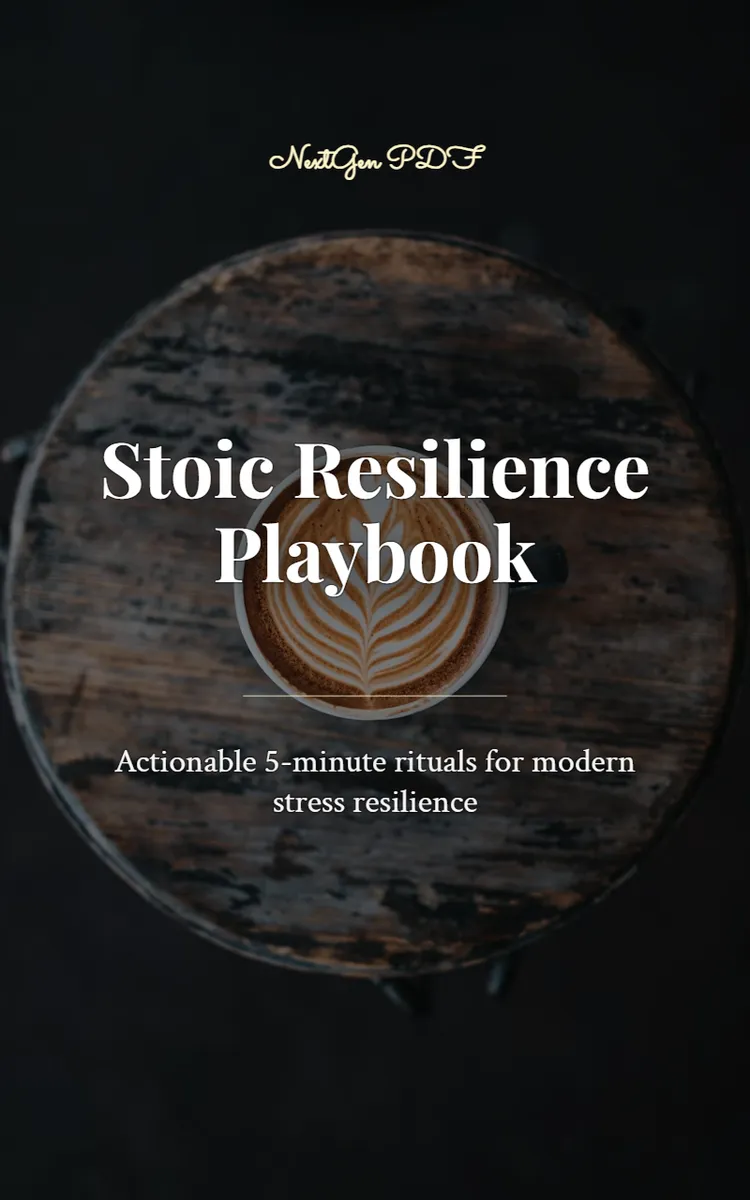
"Stoic Resilience Playbook" is a self-help book by NextGen PDF with 8 chapters and approximately 12,704 words. Stoic philosophy translated into short morning and evening stress rituals.
This book was created using Inkfluence AI, an AI-powered book generation platform that helps authors write, design, and publish complete books. It was made with the AI Self-Help Book Writer.
Frequently Asked Questions
What is "Stoic Resilience Playbook" about?
Stoic philosophy translated into short morning and evening stress rituals
How many chapters are in "Stoic Resilience Playbook"?
The book contains 8 chapters and approximately 12,704 words. Topics covered include Choosing What’s Up to You, Replacing Catastrophizing With Stoic Frames, Stepping Out of the Approval Loop, Turning Rumination Into Actionable Review, and more.
Who wrote "Stoic Resilience Playbook"?
This book was written by NextGen PDF and created using Inkfluence AI, an AI book generation platform that helps authors write, design, and publish books.
How can I create a similar self-help book?
You can create your own self-help book using Inkfluence AI. Describe your idea, choose your style, and the AI writes the full book for you. It's free to start.
Write your own self-help book with AI
Describe your idea and Inkfluence writes the whole thing. Free to start.
Start writingCreated with Inkfluence AI


