
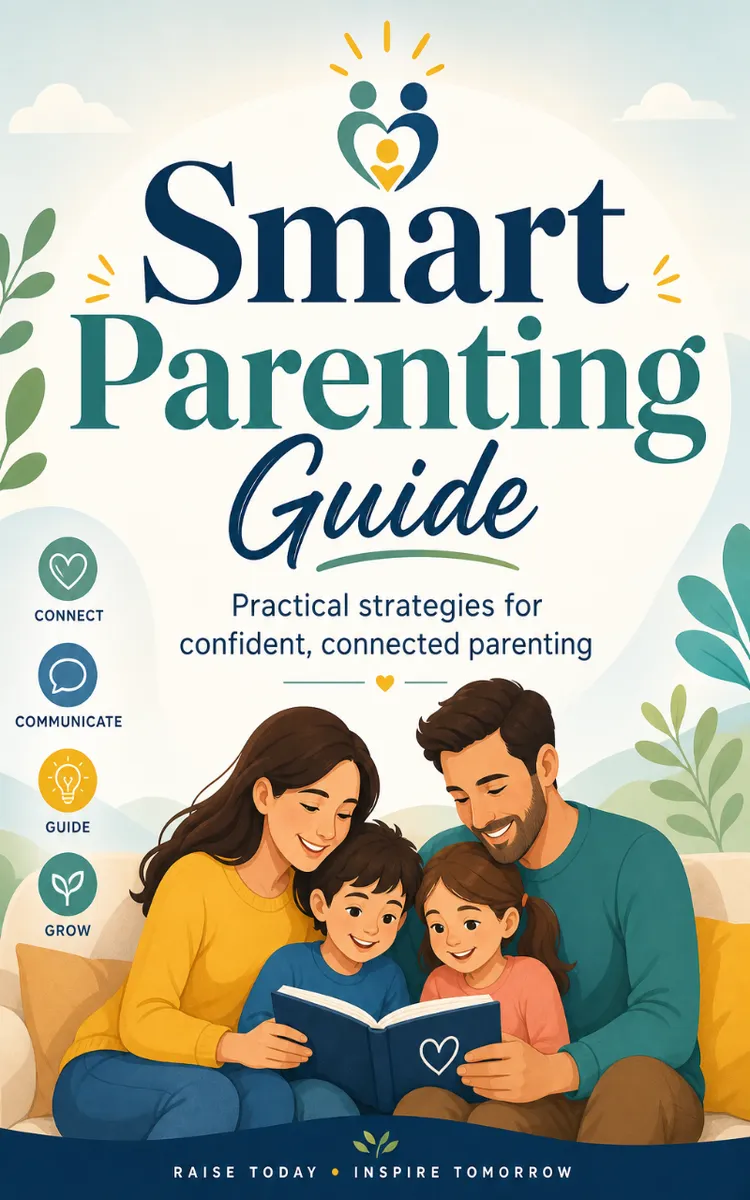
Smart Parenting Guide
Created with Inkfluence AI
Parenting strategies for emotional intelligence, discipline, and screen time
Table of Contents
- 1. Emotional Coaching for Daily Moments
- 2. Teaching Self-Regulation Skills
- 3. Screen Time Boundaries That Hold
- 4. Designing Screen-Free Routines
- 5. Positive Discipline With Clear Consequences
- 6. Repairing After Tantrums and Escalations
- 7. Building Strong Parent-Child Connection
- 8. Handling Common Parenting Triggers
Preview: Emotional Coaching for Daily Moments
A short excerpt from “Emotional Coaching for Daily Moments”. The full book contains 8 chapters and 14,710 words.
The moment your child melts down in the grocery store, you learn fast that “talking them out of it” usually makes it worse. Their body goes into alarm mode, and your calm voice can’t reach their brain while they’re flooded. What you need in that moment is a way to connect first - without giving in, ignoring the rule, or starting a power struggle.
Tanya, 34, a pediatric nurse and parent of two toddlers, describes the shift that finally helped her: she stopped trying to argue about what happened and started naming what her kids felt, right there in the chaos. When she did it consistently, she saw fewer blowups that stretched for twenty minutes, and more recoveries that happened faster. She also learned how to guide behavior while the emotion stayed acknowledged.
In this chapter, you’ll learn the CALM Coaching Loop - a simple step-by-step way to label feelings, validate emotions, and guide behavior without escalating conflict. After you read, you’ll be able to handle everyday moments like hitting, screaming “no,” or refusing bedtime with a repeatable script you can use in under a minute.
The CALM Coaching Loop: Label, Validate, Guide Without Escalating
When kids act “out,” it rarely means they don’t know right from wrong. It usually means they can’t manage the feeling yet. Your job isn’t to remove the emotion instantly; it’s to help them move through it safely while you hold the boundary. Emotional coaching solves a very practical problem: it turns the fight - “Stop!” “Why are you doing this?” - into a brief, predictable pattern your child can learn from.
Here’s the key: labeling and validating don’t mean you agree with the behavior. They mean you recognize the inside experience (“You’re mad / scared / disappointed”), which lowers the intensity enough for your guidance to land. Then you steer the behavior back onto a safe path.
Before you start, use this quick definition so you don’t guess in the heat of the moment:
- Labeling feelings means you name the emotion you see.
- Validating emotions means you acknowledge that feeling makes sense.
- Guiding behavior means you state the rule and offer the next action your child can take.
Tanya uses one extra anchor that helps her stay consistent: she keeps her sentences short - about 3 to 7 words - so her child hears them as instructions, not lectures. That matters because kids in distress miss details.
Step-by-Step: How to Label, Validate, and Guide With CALM
The CALM Coaching Loop gives you a repeatable sequence. You can use it during a meltdown, in the middle of arguing about screen time, or when your child refuses to leave the park. Use it the same way each time so your child starts to predict what will happen.
1. C - Catch the emotion (notice your child’s signal).
Watch for the “body cues” you can see: clenched fists, stomping, tears, shaking, refusal posture, or a sudden volume spike. Say what you notice, then move quickly to the next step.
Example: “You’re getting upset. I see it.”
2. A - Name the feeling (label it clearly).
Use one feeling word at a time. Pick the strongest one, not a list of emotions.
Example: “You’re mad.” / “You’re scared.” / “You feel disappointed.”
3. L - Let them know it makes sense (validate without bargaining).
Use a sentence that normalizes the feeling, not the misbehavior. Validation sounds like empathy, not negotiation.
Example: “Of course you’re mad. You wanted to keep playing.”
4. M - Move to the boundary and the next step (guide behavior).
State the rule in one sentence, then offer a concrete next action. Use “and” instead of “but.”
Example: “You can be mad and still use gentle hands. Hands stay on your body. We can stomp our feet.”
Two quick rules keep the loop from turning into a longer argument:
- Don’t ask “Why?” while they’re escalated. Save questions for calm moments. In the middle of a meltdown, “Why?” often sounds like pressure.
- Don’t add extra words you don’t need. If you say five sentences, your child hears five chances to argue. Keep it tight.
A concrete example you can copy (hitting)
If your toddler hits while you’re putting on shoes:
- “I see you’re upset.”
- “You’re mad.”
- “Of course - shoes mean we stop playing.”
- “You can be mad and still use gentle hands. Hands stay on your body.”
Expected outcome: Your child usually can’t “think” themselves calm, but the naming and validation reduce the intensity enough for you to reset the behavior with one clear instruction.
A concrete example for screen time refusal
When your child cries at the end of a show:
- “You’re disappointed.”
- “Of course you want one more minute.”
- “You can feel disappointed and we still turn it off.”
- “Pick one: two books or a snack while we get ready.”
Expected outcome: You don’t argue about whether the show was “fair.” You acknowledge the feeling and then offer choices that keep the boundary steady.
...
About this book
"Smart Parenting Guide" is a how-to guide book by NextGen PDF with 8 chapters and approximately 14,710 words. Parenting strategies for emotional intelligence, discipline, and screen time.
This book was created using Inkfluence AI, an AI-powered book generation platform that helps authors write, design, and publish complete books. It was made with the AI Ebook Generator.
Frequently Asked Questions
What is "Smart Parenting Guide" about?
Parenting strategies for emotional intelligence, discipline, and screen time
How many chapters are in "Smart Parenting Guide"?
The book contains 8 chapters and approximately 14,710 words. Topics covered include Emotional Coaching for Daily Moments, Teaching Self-Regulation Skills, Screen Time Boundaries That Hold, Designing Screen-Free Routines, and more.
Who wrote "Smart Parenting Guide"?
This book was written by NextGen PDF and created using Inkfluence AI, an AI book generation platform that helps authors write, design, and publish books.
How can I create a similar how-to guide book?
You can create your own how-to guide book using Inkfluence AI. Describe your idea, choose your style, and the AI writes the full book for you. It's free to start.
Write your own how-to guide book with AI
Describe your idea and Inkfluence writes the whole thing. Free to start.
Start writingCreated with Inkfluence AI


