

Read the first chapter
The whole of chapter one, free. About 7 min. Turn the pages with the arrows, your keyboard, or a swipe.
Chapter 1
What Exchanges Actually Do
A live market doesn’t “decide” price the way a human decides a bet. It runs a machine that repeatedly does three jobs: it discovers willingness to trade, it matches opposing intent, and it gives participants a reliable way to access that matching engine. When those jobs line up, you get orderly price discovery. When they don’t, you get stuck books, stale quotes, and execution surprises that show up as unexplained slippage.
Talia, 31, a trading desk execution coordinator, knows the pain: a trader wants size in a hurry, her execution system sends orders, and the fills either show up cleanly or they don’t. The difference usually isn’t “bad judgment.” It’s a gap in how the exchange actually plays its end-to-end role - what happens before the first trade prints, during matching, and right after the trade becomes a confirmed event. This chapter gives you a practical mental model you can use to reason from “I sent an order” to “I know why the market behaved that way.”
You’ll learn a single framework - the Exchange Lifecycle Map - to trace price discovery, matching, and access from the first quote to the final confirmation. By the end, you can: (1) map each action in your stack to a specific exchange function, (2) predict what signals you should see in the order book and trade prints, and (3) debug common edge cases without guessing.
The Exchange Lifecycle Map: price discovery, matching, and market access
Start with one concrete idea: an exchange is not just an order book display. It runs a lifecycle for every order and every trade. Your goal is to follow that lifecycle end-to-end so you can tell whether the market moved because demand changed, because liquidity changed, or because your access path changed.
The Exchange Lifecycle Map organizes the lifecycle into four exchange roles that you can observe with market data and execution reports:
1. Ingest and validate orders The exchange receives your order, checks it against rules (format, price bands, trading hours, permitted order types), and decides whether it can enter the book. If it fails validation, it never reaches the matching logic.
2. Publish and maintain the state of the book The exchange updates the order book state so market data reflects current liquidity. This matters because price discovery depends on everyone seeing the same “truth” of what sits at each price level, and for how long.
3. Match orders using the exchange’s priority rules The exchange pairs incoming liquidity against resting liquidity according to its priority model (price first, then time priority, with specific tie-break rules). When matching triggers a trade, the exchange produces the trade print and updates remaining quantities on both sides.
4. Confirm the trade and route it to clearing and settlement The exchange turns a match into an agreed trade event, then hands it to the clearing system so the market can settle obligations. Even if you only care about execution quality, this stage affects what you can rely on downstream (fills, cancellations, and post-trade status).
Now tie those roles to what you actually observe. When price “moves,” it usually means the book state changed: either someone removed liquidity (cancellation or execution) or someone added liquidity (new limit orders) or both. When a trade “prints,” it means the exchange’s matching step found compatible orders and consumed quantities according to priority. When you “get a fill,” it means your order participated in that lifecycle and the exchange confirmed the resulting trade.
Here’s the practical mental model: treat the exchange as four sequential gates - validate → publish → match → confirm. For any execution problem, you ask which gate failed to do what you expected. That keeps debugging grounded instead of turning it into “the market was weird.”
Putting it into practice: a realistic Talia workflow from intent to confirmed trades
Let’s walk a real desk workflow using Talia’s execution coordinator perspective. Assume she’s coordinating an order for a liquid equity on a lit exchange during regular trading hours. Her execution stack sends an order, her OMS (order management system) logs events, and her market data feed shows book updates and trade prints.
She uses the Exchange Lifecycle Map to predict what should happen at each stage, and she checks the right evidence at the right time.
1. She sends a new limit order to buy 10,000 shares at 50.25 Expected outcome: the exchange acknowledges the order as accepted (or rejects it). What to check: your execution report should show acceptance or a rejection reason (for example, price outside allowed bands, invalid quantity, or order type not permitted).
2. She watches for book publication at 50.25 Expected outcome: the order (or its posted quantity) appears in the displayed book at 50.25, and the best bid/ask levels adjust if necessary. What to check: market data updates should show increased visible bid depth at 50.25 (or decreased ask depth if the buy lifts through, but that implies matching, not just resting).
3. She monitors whether matching happens immediately If 50.25 crosses the current best ask, matching can execute right away. Expected outcome A (crossing): you see trade prints and a partial or full fill report quickly. Expected outcome B (non-crossing): you see the order rest, and you only see fills later if sellers come into range.
4. She reconciles fills against matching evidence Expected outcome: filled quantity aligns with trade prints that the exchange confirms, and remaining quantity (if any) remains as resting liquidity at 50.25. What to check: compare your fill quantity from execution reports to the trade prints and the book state after the event. If you expected 10,000 total but only got 6,500, check whether the other 3,500 got canceled, partially filled later, or never posted due to validation.
5. She confirms post-trade status through the clearing handoff Expected outcome: the trade becomes a confirmed event that downstream systems can treat as binding for settlement. What to check: post-trade feeds (or clearing confirmations) should show the trade with correct identifiers and quantities. If your system shows “pending” fills, you treat them as not fully confirmed until clearing reports arrive.
Quick checklist (what Talia actually does when she cares about end-to-end correctness): - Verify acceptance vs rejection right after submission. - Confirm book state updates at the intended price level (or confirm immediate matching if it crosses). - Match fill reports to trade prints and remaining book depth. - Reconcile post-trade confirmation so ops knows what’s settlement-ready.
This workflow teaches the key practical skill: you stop asking “did the exchange execute me?” and start asking “which lifecycle gate produced the outcome I saw?”
What to watch for: mistakes and edge cases that break the lifecycle model
Once you use the Exchange Lifecycle Map, the next step is to recognize where real-world systems distort the signals. Here are common failure modes that hit traders, quants, and trading ops - each one points to a specific lifecycle gate.
Tuning peg slips If you use an order type that adjusts its price (for example, a peg that tracks the best bid/ask), you may expect the exchange to treat “your intended price” as static. It often doesn’t. The exchange will validate and then continuously re-evaluate the order’s effective price relative to the book state rules. Do this: Log the exact effective price your order took at submission time and during the period it could have repriced. Then compare that to the book snapshots you used for your decision. Not this: Compare your fill to a single “target price” and ignore repricing windows. You’ll misattribute matching outcomes to liquidity changes when they actually came from the order’s changing price eligibility.
Mistaking data latency for exchange behavior Market data feeds can lag, and different feeds can update in different orders. If you see the book move before the fill arrives (or after), you might conclude matching didn’t happen as expected. Do this: Use the timestamps from execution reports and trade prints as your primary timeline, then use market data to explain how the book looked at those event times. Not this: Infer causality from arrival order in your data pipeline. Arrival order in your system is not the exchange’s matching timeline.
Assuming “accepted” means “posted” Acceptance usually means the exchange validated the order. It does not always guarantee that the order becomes resting liquidity in the way you think, especially if your order depends on dynamic conditions (trading halts, price bands, post-only rules, or other constraints). Do this: Treat each gate as separate evidence. Confirm posting by checking book state at the intended price level, not just the acceptance message. Not this: If you only see an acceptance report, assume the order sat in the book until filled or canceled. You’ll miss cases where the order never entered the matching book state.
The Exchange Lifecycle Map gives you a clean way to debug: validate, publish, match, confirm. Once you train yourself to ask which gate produced the observed outcome, you stop blaming “market conditions” and start identifying the exact mechanism - order eligibility, book state, priority matching, or post-trade confirmation - that changed your execution.
That’s the foundation for everything else in this book: when we later dig into order book dynamics and clearing, you’ll already know where to look for the responsible subsystem, and you’ll read prints and reports like an execution engineer, not like a spectator.
End of chapter one. 7 more chapters in the full book.
Swipe or use the arrows to turn the page
What's inside: 8 chapters
- 1. What Exchanges Actually Do
- 2. Order Types and Time-in-Force
- 3. Inside the Matching Engine
- 4. Order Lifecycle: Send to Fill
- 5. Market Data Feeds and Microstructure
- 6. Clearing and Settlement Fundamentals
- 7. Margin, Collateral, and Default Risk
- 8. Failure Modes and Execution Debugging
About this book
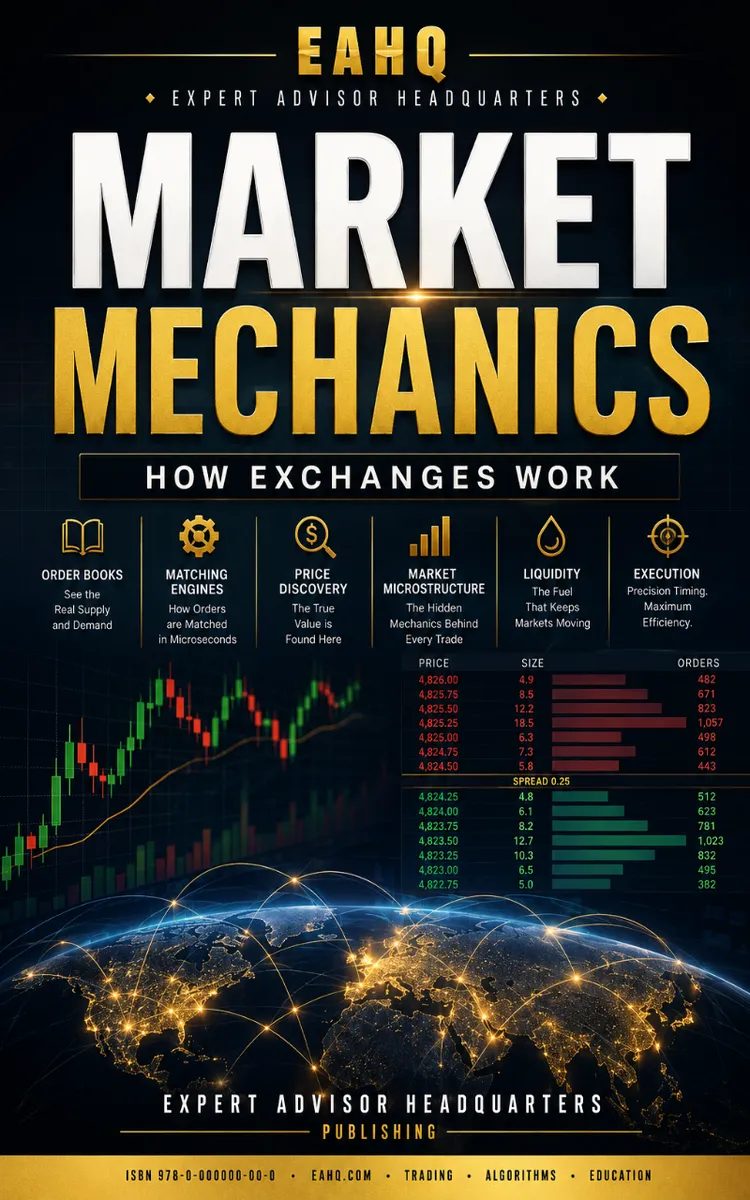
"Market Mechanics: How Exchanges Work" is a finance book by Michael Prescott Burney with 8 chapters and approximately 14,742 words. A live market doesn’t “decide” price. It runs a machine that discovers willingness to trade, matches opposing intent, and gives you reliable access to that matching engine.
This book was created using Inkfluence AI, an AI-powered book generation platform that helps authors write, design, and publish complete books. It was made with the AI Ebook Generator.
Frequently Asked Questions
What is "Market Mechanics: How Exchanges Work" about?
A live market doesn’t “decide” price. It runs a machine that discovers willingness to trade, matches opposing intent, and gives you reliable access to that matching engine. When those pieces misalign, you get stuck books, stale quotes, and execution surprises that look like unexplained slippage. The fix is not better guessing, it is better mapping: from the moment you send an order, to the moment a fill becomes a confirmed event. In Market Mechanics, you’ll build expertise with one practical framework, the Exchange Lifecycle Map, and a second method for reasoning through matching behavior. You will trace price discovery, predict what signals should appear, and debug edge cases end to end. Read now if you want execution competence, not vague explanations.
How many chapters are in "Market Mechanics: How Exchanges Work"?
The book contains 8 chapters and approximately 14,742 words. Topics covered include What Exchanges Actually Do, Order Types and Time-in-Force, Inside the Matching Engine, Order Lifecycle: Send to Fill, and more.
Who wrote "Market Mechanics: How Exchanges Work"?
This book was written by Michael Prescott Burney and created using Inkfluence AI, an AI book generation platform that helps authors write, design, and publish books.
How can I create a similar finance book?
You can create your own finance book using Inkfluence AI. Describe your idea, choose your style, and the AI writes the full book for you. It's free to start.
Write your own finance book with AI
Describe your idea and Inkfluence writes the whole thing. Free to start.
Start writingCreated with Inkfluence AI


