
Read the first chapter
The whole of chapter one, free. About 7 min. Turn the pages with the arrows, your keyboard, or a swipe.
Chapter 1
Stabilize First: Scene-to-Care Flow
Why Order Comes Before Action
What should you do first when three people need help, a crowd is closing in, and no one can clearly explain what happened? The safest answer rarely begins with treatment. It begins with making the scene understandable enough to act on.
Confusion creates two immediate hazards: you may miss a danger, and you may spend time on a visible but less urgent problem while a life-threatening one worsens. The Scene-to-Care Ladder (SCL) solves this by turning a noisy scene into an ordered sequence. You check the setting, sort the needs, start the most important care, and keep reviewing your decisions as conditions change.
Renee, a 34-year-old community responder, may face a multi-person incident with limited equipment and incomplete information. She does not need a perfect explanation before acting. She needs a repeatable flow that answers four practical questions: Is the scene safe? Who needs help first? What can I do now? What has changed since my last check? By the end of this process, Renee can move from uncertainty to specific action without losing control of the scene.
The SCL also creates a clear record of reasoning. If another responder arrives, Renee can state what she saw, what she prioritized, what care she gave, and what still needs attention. That matters because field care is not a single decision. It is a cycle of action and review.
The Scene-to-Care Ladder
The SCL has five stages. Move through them in order, but do not treat them as a one-time checklist. After you begin care, return to the ladder whenever a person worsens, a new hazard appears, or new information changes the priority.
1. Secure the scene. Look for traffic, fire, electrical hazards, violence, unstable structures, chemicals, or anything else that could injure you or others. Keep a safe distance until you can approach. This step comes first because an injured responder cannot help anyone, and a dangerous scene can create more patients.
2. Build a quick picture. Scan the whole area before focusing on one person. Count the people who need help, note obvious injuries, and identify who can speak or move. Ask short questions such as, “Who is hurt?” and “Who cannot breathe normally?” This prevents the loudest person from automatically becoming the first priority.
3. Set priorities. Give attention first to problems that threaten life immediately, especially trouble with breathing, severe bleeding, or a person who cannot respond normally. Use simple categories: urgent now, needs help soon, and can wait briefly. The purpose is not to diagnose every injury. The purpose is to decide where your next minute will do the most good.
4. Start immediate care and connect help. Give the basic care you are trained and equipped to provide. At the same time, direct someone to contact emergency services and bring a first-aid kit, automated external defibrillator, or other available resource. State the location, number of patients, major dangers, and most serious problems. Early, specific communication brings the right help faster.
5. Recheck and hand over. Return to each person after the first intervention. Check whether breathing, responsiveness, bleeding, or pain has changed. A handover should include what you found, what you did, when you did it, and what still concerns you. Rechecking matters because a person’s condition can change while you help someone else.
The ladder works because each stage controls a different failure. Scene security prevents additional injury. The broad scan prevents tunnel vision. Priority setting protects time. Immediate care addresses the most urgent problem. Rechecking catches change. Skipping any stage leaves a gap.
Use plain observations rather than uncertain labels. Say, “The person is not responding and is breathing abnormally,” rather than guessing a medical diagnosis. Say, “Blood is soaking through the cloth,” rather than saying, “The wound is probably minor.” Clear observations help emergency dispatchers and arriving responders understand what they must do next.
When several people need help, assign simple jobs. Point to one person and say, “Call emergency services now and return when they confirm the call.” Point to another and say, “Bring the first-aid kit and wait beside me.” Direct instructions work better than calling out, “Someone call for help,” because a crowd may assume someone else has acted.
Putting the Ladder Into Practice
Renee arrives at a community recreation area at 3:20 p.m. after a collision near a parking entrance. Three people need attention: one adult sits against a vehicle holding a bleeding forearm, one adult lies on the pavement and does not answer questions, and a child stands nearby crying but walking normally. Cars continue to move through the entrance.
Renee applies the SCL rather than treating the first visible injury.
1. Secure the scene. Renee stays behind the curb, asks a bystander to stop approaching cars, and checks for moving vehicles and leaking fuel. Expected outcome: she creates a safer working area before kneeling beside anyone.
2. Build a quick picture. From a safe position, she counts three affected people. She sees one person who does not respond, one person with heavy arm bleeding, and one walking child. She asks the child, “Can you walk with that person to the sidewalk?” Expected outcome: she identifies the person with the most urgent signs without abandoning the others.
3. Set priorities. Renee directs a bystander to call emergency services and report three patients, a vehicle collision, an unresponsive adult, and continued traffic. She tells another bystander to bring the first-aid kit and an automated external defibrillator if one is available. She prioritizes the unresponsive adult, while keeping the bleeding adult in view. Expected outcome: professional help receives useful information, and supplies begin moving toward the scene.
4. Start immediate care. Renee approaches the unresponsive adult only after checking for immediate danger. She checks for a normal response and breathing, then follows her training and emergency-dispatch instructions. If the adult has life-threatening bleeding, Renee applies firm direct pressure with available dressing material. She tells the bleeding adult to keep pressure on the wound if able and asks another person to monitor that patient. Expected outcome: Renee addresses the most dangerous problems while preventing the second patient from being ignored.
5. Recheck and hand over. At 3:24 p.m., Renee checks whether the unresponsive adult responds, whether breathing has changed, and whether the arm bleeding continues through the dressing. She also checks the child for new symptoms and keeps the child away from traffic. When emergency responders arrive, she reports: “Three patients. One adult initially unresponsive on the pavement; I checked response and breathing and followed dispatch instructions. One adult has heavy forearm bleeding; direct pressure started at 3:21 p.m. One child is walking and alert but upset. Traffic was moving, and bystanders blocked the entrance.” Expected outcome: the arriving team can continue care without repeating the entire assessment.
The exact care depends on the responder’s training, local guidance, and the patient’s condition. The SCL does not replace emergency services or certified instruction. It provides order when information arrives in fragments.
Quick checklist
• Check for traffic, fire, violence, electricity, chemicals, and unstable structures. - Count the people who need help before focusing on one person. - Find anyone who cannot respond normally or breathe normally. - Identify severe bleeding and control it with trained, appropriate care. - Assign one person to contact emergency services. - Send another person for the first-aid kit or automated external defibrillator. - Keep less urgent patients visible and monitored. - Recheck each patient after every major action or change. - Give arriving responders times, observations, actions, and remaining concerns.
Mistakes That Break Scene-to-Care Flow
Treating the most visible injury first
A bloody arm attracts attention, but an unresponsive person may face a more immediate threat. Renee should not let the amount of blood alone determine priority.
Do this: scan all patients, identify breathing and responsiveness problems, then address severe bleeding.
Not this: kneel beside the first person who calls for help and ignore the rest of the scene.
Giving a crowd an unclear assignment
A group may look helpful while no one actually calls emergency services or retrieves equipment. Vague requests create delay because each person expects another person to act.
Do this: point to one person, name the task, and request confirmation: “Call emergency services, report three patients, and tell me when the call connects.”
Not this: shout, “Someone get help,” and assume the task is complete.
Failing to return after the first intervention
A dressing may soak through, a responsive person may become confused, or a safe area may become dangerous when vehicles move again. Initial care does not end the decision process.
Do this: set a short review cycle. After helping one patient, check the others and the scene before continuing.
Not this: stay with one patient until professional help arrives while losing sight of everyone else.
Approaching a changing hazard
A scene that looked safe can change. A vehicle may roll, smoke may spread, or an aggressive person may enter the area. Care never justifies walking into a danger you cannot control.
Do this: pause, move to safety, warn others, and tell emergency services about the new hazard.
Not this: remain in place because you already started treatment.
The SCL turns urgency into sequence: secure, scan, prioritize, act, and recheck. Run that sequence until professional care takes over. Clear order does not remove uncertainty, but it keeps uncertainty from deciding your next move.
End of chapter one. 4 more chapters in the full book.
Swipe or use the arrows to turn the page
What's inside: 5 chapters
- 1. Stabilize First: Scene-to-Care Flow
- 2. Triage by Priorities, Not Panic
- 3. Assessment Loops: Recheck, Don’t Guess
- 4. Injury Management as a Sequence
- 5. Documentation & Accountability Under Pressure
About this book
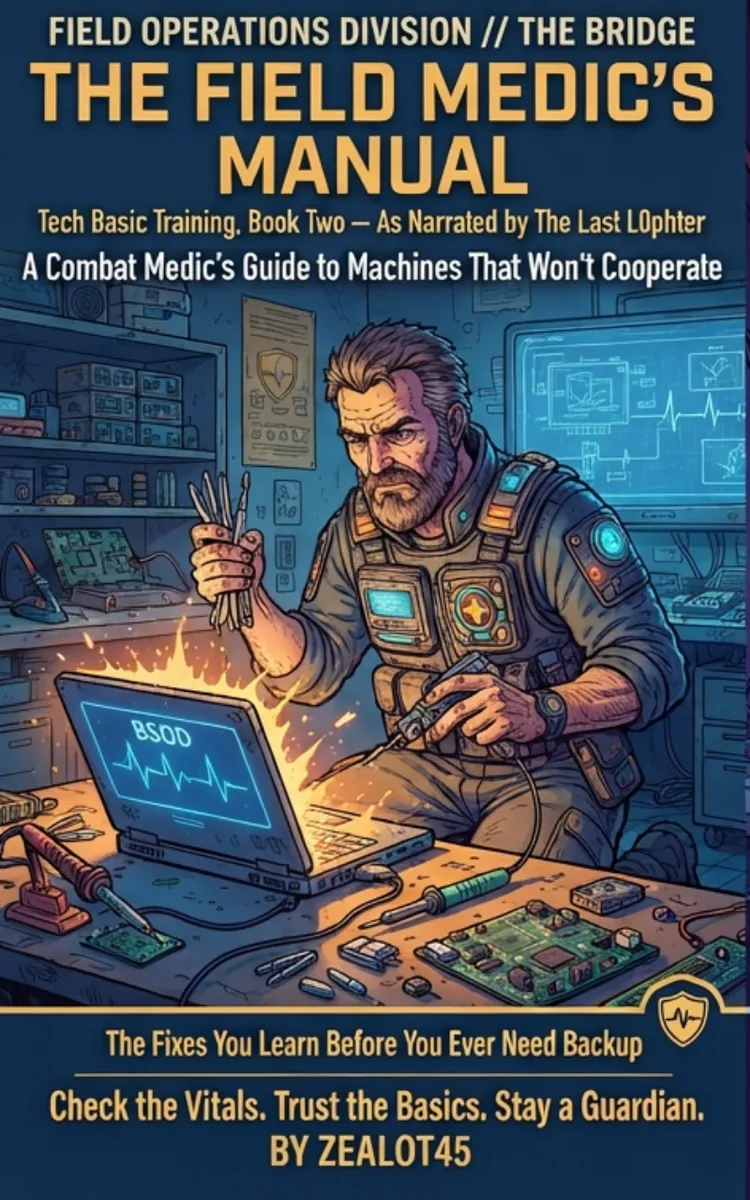
"Field Medic Decision Playbook" is a how-to guide book by Anonymous with 5 chapters and approximately 8,357 words. A step-by-step guide for making rapid, defensible field decisions—organized into repeatable procedures inspired by the Field Medic’s Manual..
This book was created using Inkfluence AI, an AI-powered book generation platform that helps authors write, design, and publish complete books. It was made with the AI Ebook Generator.
Frequently Asked Questions
What is "Field Medic Decision Playbook" about?
A step-by-step guide for making rapid, defensible field decisions—organized into repeatable procedures inspired by the Field Medic’s Manual.
How many chapters are in "Field Medic Decision Playbook"?
The book contains 5 chapters and approximately 8,357 words. Topics covered include Stabilize First: Scene-to-Care Flow, Triage by Priorities, Not Panic, Assessment Loops: Recheck, Don’t Guess, Injury Management as a Sequence, and more.
Who wrote "Field Medic Decision Playbook"?
This book was written by Anonymous and created using Inkfluence AI, an AI book generation platform that helps authors write, design, and publish books.
How can I create a similar how-to guide book?
You can create your own how-to guide book using Inkfluence AI. Describe your idea, choose your style, and the AI writes the full book for you. It's free to start.
Write your own how-to guide book with AI
Describe your idea and Inkfluence writes the whole thing. Free to start.
Start writingCreated with Inkfluence AI


