
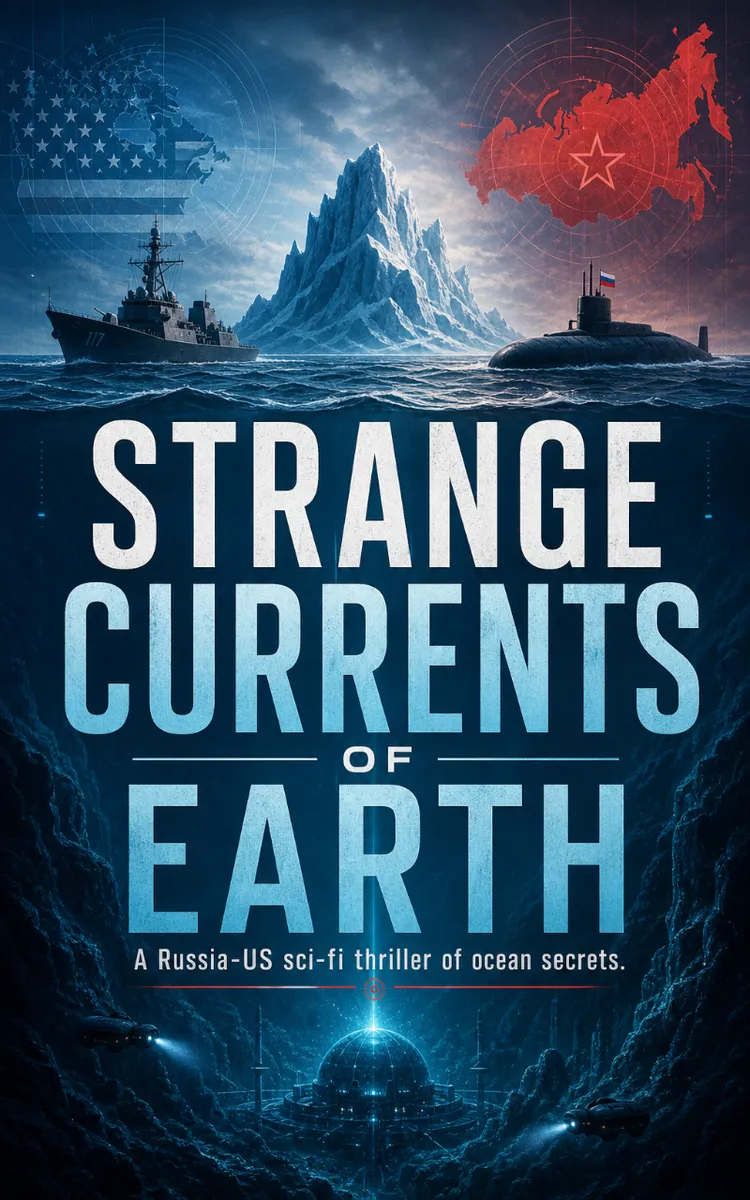
Strange Currents Of Earth
Created with Inkfluence AI
A strange science fiction story set between Russia and the US
Table of Contents
- 1. The Ocean That Wouldn’t Match
- 2. A US Ship Changes Its Course
- 3. The Deleted File Still Breathes
- 4. A Storm Swallows the Buoy
- 5. Alina Chooses the Unofficial Channel
- 6. The Liaison’s Office Goes Dark
- 7. Strange Currents Has a Russian Owner
- 8. The Decoy University Runs a Test
- 9. Alina’s Confession to a Rival
- 10. The Drive Image Is Poisoned
- 11. Who Programmed the Ocean Clock?
- 12. The Relay Station Refuses Access
- 13. Alina Finds Sergei’s Hidden Ledger
- 14. The Signature Frame Collapses
- 15. Kestrel Group Uses Ocean Cover
- 16. The Flip Current Test Fails
- 17. Alina Hears the Ocean Speak
- 18. US and Russia Trade Blame
- 19. A Russian Submarine Leaves Tracks
- 20. The Mid-Atlantic Relay Answers Back
- 21. Alina Breaks With Sergei
- 22. The Lab Purge Kills the Evidence
- 23. The Checksum Points to a Shipyard
- 24. Security Locks the Dock Gate
- 25. Alina Saves Ethan From the Vent
- 26. The Crate Opens to a Trap
- 27. The Beacon Guides Them to Kestrel
- 28. Lockdown Triggers a Coastal Blackout
- 29. Alina Learns the Ocean’s Purpose
- 30. Ethan Loses Alina in the Noise
- 31. The Receiver Address Appears in Data
- 32. Chasing the Buoy Through Whitewater
- 33. Alina Rewrites the Handshake Signal
- 34. Kestrel Fires a Counter-Response
- 35. The Ocean Turns Against the Operators
- 36. Ethan’s Testimony Saves Alina
- 37. The Currents Return to Normal-Mostly
- 38. A Quiet Buoy Calls Their Names
- 39. Kestrel Group Vanishes Into Water
- 40. Strange Currents Keeps Listening
- 41. Final Current
Preview: The Ocean That Wouldn’t Match
A short excerpt from “The Ocean That Wouldn’t Match”. The full book contains 41 chapters and 114,517 words.
The sonar console on Platform Severodvinsk didn’t so much beep as it argued - a tight, metallic cadence that lived in Alina Morozova’s teeth. The screen showed a live scan from the port array, a clean ribbon of returns over a depth grid, until the ribbon fractured into a pattern that shouldn’t survive physics. It wasn’t noise. It wasn’t a ghost echo. It was too deliberate, too spaced, like somebody tapping a code into the water with a knuckle.
“Repeat that,” Alina said, leaning so close her breath fogged the protective glass. The air inside the sonar bay tasted of hot plastic and brine that had worked its way in from the hull. Outside the portholes the Kola Peninsula coast sat dim and hard under a low sky, but in here everything was controlled - temperatures, currents, the way the sound should behave. The ocean was supposed to be messy. This wasn’t.
Her tablet - restricted, offline, and stubbornly old - sat open beside the console, ready to pull raw pings from the acquisition buffer. That was her comfort: raw data meant she could argue with the machine instead of begging it to agree. She keyed in a manual export, watching the progress bar crawl while the signature kept unfolding on the main display. Three pulses. A gap. Two pulses. A longer gap. The sequence returned at an interval that aligned with the system clock, not with any known tidal cycle. The platform’s timekeeping was stable; the ocean was not.
“Dr. Morozova,” came a voice behind her, flat with the clipped patience of someone who didn’t want to be there. “You’re over our buffer limit.”
Alina didn’t turn. If she looked away from the screen, she knew it would feel like losing a witness. “I’m not exporting. I’m confirming. This scan is anomalous.”
The technician’s footsteps scratched across the deck grating. “Anomalous is a category. Classified is a category. You’re in the wrong one.”
She finally glanced over her shoulder. Sergei Karpov, platform systems, wore the same navy coveralls as everyone else but his badge was turned outward, as if the metal itself demanded respect. His eyes flicked to the console, then to the tablet, then away, like he’d been trained to notice without acknowledging.
“Send me the raw file,” Alina said. “The signature’s consistent enough to test against the model.”
Sergei’s mouth tightened. “The model is for civilian reports. This isn’t.”
“That’s not an answer.” Her voice sounded sharper than she intended, cutting through the low hum of fans and the distant throb of station power. “I saw it. I’m telling you I saw it.”
He didn’t deny it. He only lowered his gaze to her tablet as if it were a weapon. “You saw something. That’s why you’re being watched.”
A warning bell didn’t sound, but the console’s interface dimmed by a fraction. The acquisition buffer status on the side panel shifted from green to amber. A system message slid into the log, in small, polite Russian: Access revoked by order. The words were so clean they felt obscene.
Alina’s fingers hovered above the tablet screen. “Who signed the order?”
Sergei hesitated. That hesitation was the first real crack in the wall. “Not me.”
“Say the name.”
He exhaled through his nose. “Commander Vlasov. Maritime Security Liaison. He’s assigned to the anomaly corridor.”
Alina turned back to the sonar display. The impossible pattern was still there, still threading itself through the depth slices like a wire pulled tight. She could feel the momentum of it, the way it refused to settle into randomness. Her stomach clenched - part anger, part fear she didn’t want to admit. If the raw access was revoked during a live scan, then either the platform was protecting her, or it was protecting something else from her.
“Why now?” she demanded. “Why revoke access mid-scan? If you’re wrong, you let me check.”
Sergei’s hand moved, palm up, a subtle stop gesture. “Because if you’re right, it becomes… different.”
Different. That word carried a weight in his mouth, like it belonged to a folder with no return address.
Alina forced her hands to steady. “I need the trace before it changes. I can’t verify a pattern I can’t hold.”
Sergei leaned closer, lowering his voice until the fans swallowed most of it. “You don’t need it. They do. And they don’t want you to see what they already decided.”
“Who are ‘they’?”
He looked toward the ceiling, toward the ladderwell that led to administrative decks sealed with keyed locks and camera coverage. “People who write orders, not reports.”
Alina’s mind ran the math even as her nerves ran ahead of it. The signature’s interval was clocklike. If the acquisition buffer was being altered or scrubbed, the pattern would be tailored into something deniable - smeared into noise, shifted into calibration error, rendered harmless by paperwork. She couldn’t stop them from changing the system. She could stop the system from taking everything.
...
About this book
"Strange Currents Of Earth" is a fiction book by Nichole Haines with 41 chapters and approximately 114,517 words. A strange science fiction story set between Russia and the US.
This book was created using Inkfluence AI, an AI-powered book generation platform that helps authors write, design, and publish complete books. It was made with the AI Novel Writer.
Frequently Asked Questions
What is "Strange Currents Of Earth" about?
A strange science fiction story set between Russia and the US
How many chapters are in "Strange Currents Of Earth"?
The book contains 41 chapters and approximately 114,517 words. Topics covered include The Ocean That Wouldn’t Match, A US Ship Changes Its Course, The Deleted File Still Breathes, A Storm Swallows the Buoy, and more.
Who wrote "Strange Currents Of Earth"?
This book was written by Nichole Haines and created using Inkfluence AI, an AI book generation platform that helps authors write, design, and publish books.
How can I create a similar fiction book?
You can create your own fiction book using Inkfluence AI. Describe your idea, choose your style, and the AI writes the full book for you. It's free to start.
Write your own fiction book with AI
Describe your idea and Inkfluence writes the whole thing. Free to start.
Start writingCreated with Inkfluence AI


