
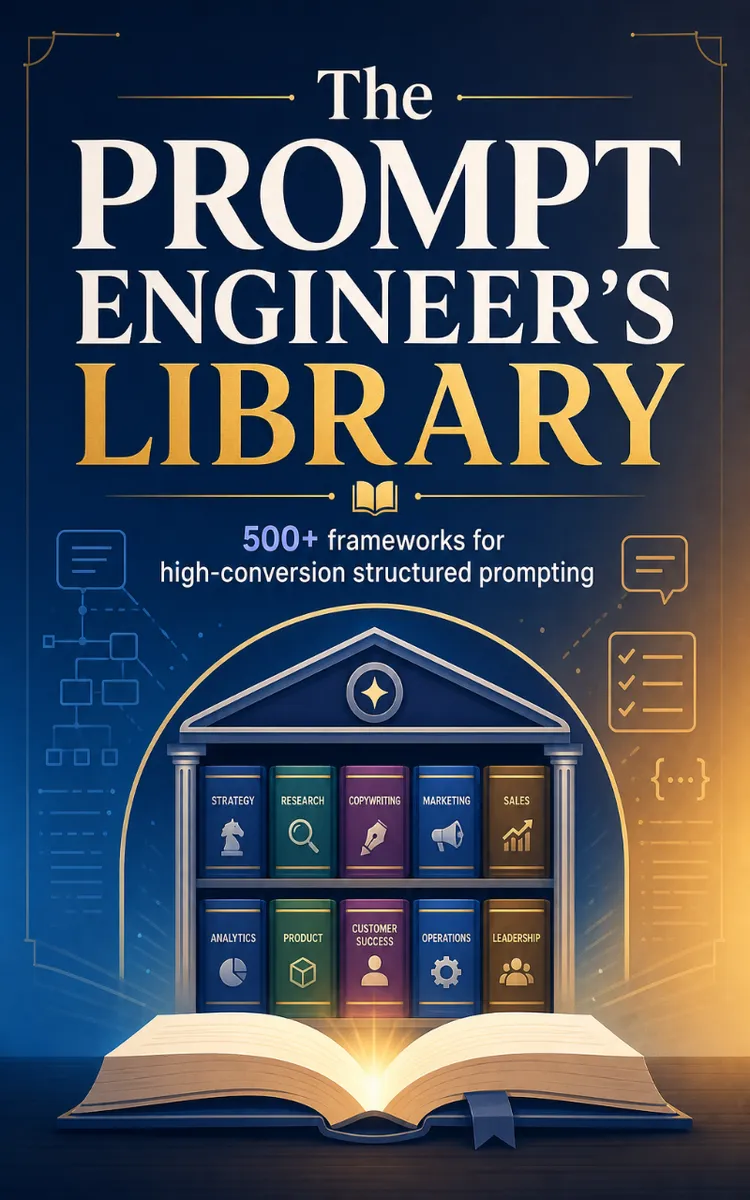
The Prompt Engineer's Library
Created with Inkfluence AI
High-conversion prompt engineering frameworks and meta-prompting
Table of Contents
- 1. Conversion Foundations: Prompting for Outcomes
- 2. Offer Engineering: Value Props, Pricing Hooks, and Packages
- 3. Audience & Segmentation: Personas, Jobs-to-be-Done, and Objection Maps
- 4. Message Architecture: Hooks, Story, Proof, and CTA Systems
- 5. Landing Page Prompting: Sections, Layout Logic, and Conversion QA
- 6. Email & Sequence Engineering: Welcome, Nurture, and Win-Back Loops
- 7. Ad Creative & Social Copy: Angle Testing and Format Variants
- 8. Meta-Prompting: System Prompts, Role Design, and Output Contracts
- 9. Multi-Shot Learning: Few-Shot Examples, Self-Critique, and Iteration Loops
- 10. Measurement & Optimization: Testing Plans, Analytics Prompts, and Conversion QA
Preview: Conversion Foundations: Prompting for Outcomes
A short excerpt from “Conversion Foundations: Prompting for Outcomes”. The full book contains 10 chapters and 44,539 words.
OverviewIf your prompts don’t sell, it’s rarely because the model is “bad.” It’s because your prompt never locks the outcome: what you’re offering, who it’s for, what rules it must follow, how you’ll judge success, and what the final response must look like. This chapter builds that baseline prompting system - then gives you 50 plug-in frameworks you can reuse for high-conversion outputs.
You’ll get a repeatable structure for positioning and conversion (offer + audience + constraints + success metrics + response format), plus quick checks you can run before you hit “send.” Differentiator: every framework below includes an explicit response format and at least one concrete “constraint” you can copy-paste (price, word count, tone, compliance rules, or scoring rubric).
Takeaway prompt: After you finish the chapter, pick one real offer you’re working on (landing page, ad, outreach, proposal) and write your baseline prompt using the structure from the first few frameworks - then run it through the checklist in each item.
The Breakdown#1: Outcome-First Prompt Skeleton (OFS)Problem: Most prompts fail because they ask for “content” without pinning the outcome. You end up with good writing that doesn’t convert, because the model never knows what counts as a win (click, booking, signup) or how to measure it.
Solution: Start every prompt with 5 lines: Offer, Audience, Goal metric, Constraints, Response format. Use this exact order, and include numbers (e.g., “Goal: book 1 call per 50 messages” or “Target: 120-160 words”). End with a strict format block like: “Return: Subject | Hook | Proof | CTA | 1-sentence close.”
Result: You get outputs that match your funnel, not just your topic. Conversion improves because the model is optimizing for your metric and your layout.
#2: Offer Definition Card (ODC)Problem: If your offer is fuzzy (“help with marketing”), the model can’t position it sharply. Fuzzy offers cause generic benefits, weak specificity, and CTAs that don’t land.
Solution: Fill a card before prompting: Who gets results, What changes, Time to value, What’s included, Price anchor (even if it’s “from $X”), Risk reducer (guarantee, trial, refund). Paste the card into the prompt under “Offer Definition Card.” Ask the model to reuse your exact phrases where possible.
Result: Your output sounds like you, because the model is working from a fixed offer blueprint.
#3: Audience Slice + Objection MapProblem: Prompts that target “business owners” miss the specific trigger points that drive action. Without objections mapped, the model writes benefits but not the rebuttals that remove friction.
Solution: Provide 3 audience slices (e.g., “dentists with 2-5 locations,” “gym owners with declining memberships,” “local SaaS with long sales cycles”) and list the top 3 objections for each slice (time, trust, budget). Instruct: “Write for Audience Slice #1 only; address Objection #1 and #3 explicitly in the copy.”
Result: The copy becomes targeted and pre-sells the rebuttals, which typically lifts response rate.
#4: Constraint Stack (CS) for High-Converting CopyProblem: When you don’t set constraints, the model defaults to safe, broad language. That kills conversions because it avoids the exact emotional and logical moves your audience expects.
Solution: Add a “Constraint Stack” section with at least 6 constraints: word limit, reading level, forbidden phrases, claim rules (no guarantees), CTA style (direct booking link vs “reach out”), format. Example constraints: “Max 150 words,” “No buzzwords,” “No ‘guaranteed results’,” “CTA: ‘Book a 15-min fit check: [link]’.”
Result: You reduce variance and get sharper, more consistent outputs.
#5: Success Metrics Contract (SMC)Problem: “Make it persuasive” is not a metric. Without a success definition, the model can’t prioritize clarity, proof, or urgency in the right proportions.
Solution: Define a scoring rubric for the model to follow. Use 5 criteria with 0-2 points each, like: Hook clarity, Proof specificity, Objection handling, CTA directness, Constraint compliance. Ask: “After drafting, output a score table and revise once if any criterion < 1.”
Result: You get measurable persuasion instead of vibes.
#6: Response Format Lock (RFL)Problem: Even strong prompts drift in structure, and your sales funnel needs consistent blocks. Inconsistent formatting makes it harder to test and reuse copy across channels.
Solution: Provide a response template with exact headings and line counts. Example for email: “Subject (<= 60 chars) / Opening (1 line) / Problem (2 lines) / Proof (2 lines) / Offer (2 lines) / CTA (1 line) / P.S. (1 line).” Tell the model: “If you can’t fill a field, write ‘N/A’.”
Result: Faster iteration and cleaner A/B testing because outputs match your system.
...
About this book
"The Prompt Engineer's Library" is a list book book by NextGen PDF with 10 chapters and approximately 44,539 words. High-conversion prompt engineering frameworks and meta-prompting.
This book was created using Inkfluence AI, an AI-powered book generation platform that helps authors write, design, and publish complete books.
Frequently Asked Questions
What is "The Prompt Engineer's Library" about?
High-conversion prompt engineering frameworks and meta-prompting
How many chapters are in "The Prompt Engineer's Library"?
The book contains 10 chapters and approximately 44,539 words. Topics covered include Conversion Foundations: Prompting for Outcomes, Offer Engineering: Value Props, Pricing Hooks, and Packages, Audience & Segmentation: Personas, Jobs-to-be-Done, and Objection Maps, Message Architecture: Hooks, Story, Proof, and CTA Systems, and more.
Who wrote "The Prompt Engineer's Library"?
This book was written by NextGen PDF and created using Inkfluence AI, an AI book generation platform that helps authors write, design, and publish books.
Write your own list book book with AI
Describe your idea and Inkfluence writes the whole thing. Free to start.
Start writingCreated with Inkfluence AI


