
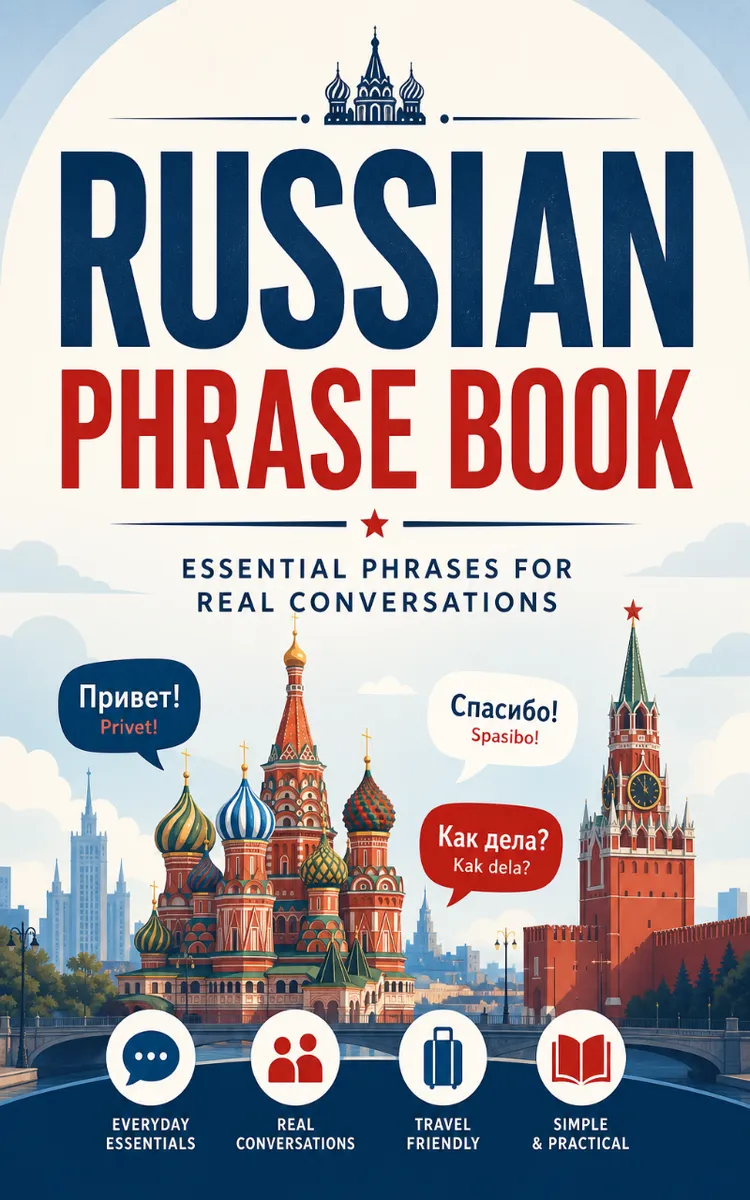

Read the first chapter
The whole of chapter one, free. About 4 min. Turn the pages with the arrows, your keyboard, or a swipe.
Chapter 1
Greetings, Introductions, and Polite Essentials
Overview If you walk into a shop in Russia and say the wrong level of “you,” you can accidentally sound rude in 3 seconds - then you spend the next 10 minutes fixing it with awkward smiles. This chapter gives you the core greetings and introductions that work in real places (street, café, hotel, office) and the quick “start/stop” lines that keep conversations smooth.
You’ll get 5 focused items: how to choose formal vs. informal “you,” how to say “hello” and “nice to meet you,” and the polite essentials for opening and ending a talk without dragging it out.
Quick self-check: By the end, you should be able to pick the right “you” form in under 5 seconds.
The Breakdown
#1: Choose the Right “You” (formal vs. informal) Problem: Russian uses two common forms of “you,” and using the wrong one can land you as too casual (or too stiff). A common mistake is using the informal ты (ty) with a shop clerk, stranger, or older person, then watching the conversation cool down fast. Solution: Use вы (vy) by default with people you don’t know - especially in shops, hotels, taxis, and offices. Switch to ты only if the other person clearly uses ты first (for example, they say “да, конечно” in an informal way) or you’re invited to. If you’re unsure, start with вы and stay there; it’s the safer travel choice. Result: You’ll sound respectful from the first sentence, and you won’t have to “repair” your tone halfway through.
#2: Core Greeting: “Hello” that actually fits Problem: Beginners often translate “hello” too literally and end up with phrases that sound unnatural or overly heavy. Another problem is timing - saying the same greeting all day without matching the moment can feel off, even if it’s not “wrong.” Solution: Use these reliable basics: - Здравствуйте (Zdravstvuyte) - formal “Hello,” works in most daytime situations. - Привет (Privet) - informal “Hi,” use only with friends or people who clearly use ты. Tip for speed: If you’re talking to someone you met today, use Здравствуйте. Result: Your first word will sound natural, and the conversation starts without friction.
#3: “My name is…” + “Nice to meet you” Problem: If you introduce yourself unclearly, people may ask you to repeat your name, and you lose momentum right when you need it most (hotel check-in, meeting a guide, asking directions). A second common issue: skipping “nice to meet you” makes the intro feel abrupt. Solution: Use this simple pair: - Меня зовут… (Menya zovut…) = “My name is…” - Очень приятно (Ochen’ priyatno) = “Very nice to meet you.” Step-by-step: 1) Say Меня зовут Анна. 2) Add Очень приятно. If you want a polite add-on for strangers: Рад(а) знакомству (Rad/а znakomstvu) - “Nice to meet you” (the form changes by gender). Result: People understand your name immediately, and the tone feels friendly but still correct.
#4: Polite “Excuse me” and “Please” (the conversation openers) Problem: In Russia, getting someone’s attention often needs a polite buffer. If you skip извините (izvinite) (“excuse me/sorry”) or пожалуйста (pozhaluysta) (“please”), your request can sound demanding - even when you’re polite in English. Solution: Keep these two go-to lines ready: - Извините, пожалуйста… = “Excuse me, please…” (start your question) - Пожалуйста = “please/you’re welcome,” used when someone helps you or when you ask for something Example you can use anywhere: Извините, пожалуйста, где метро? = “Excuse me, please, where is the subway?” Mini check: After you ask, add пожалуйста once in the sentence, and you’ll sound properly courteous without overdoing it. Result: You’ll get help faster and keep the interaction smooth instead of stiff.
#5: Closing lines: “Thank you,” “All the best,” and a clean exit Problem: Many beginners end conversations awkwardly - either they stop mid-sentence or just say “bye” in a way that sounds abrupt. In service situations (café, reception, store), an unclear ending can leave you unsure whether you’re done or you owe more questions. Solution: Use a simple closing routine: 1) Спасибо (Spasibo) = “Thank you.” 2) Большое спасибо (Bol’shoe spasibo) = “Thank you very much” (use when they helped a lot). 3) Всего доброго (Vsego dobrogo) = “All the best / Take care.” Polite exit tip: If you asked a question, thank them before leaving - even if you got a short answer. Result: Your interaction ends cleanly, and people remember you as polite, even when you’re still learning.
What Comes Next Next, you’ll learn the most useful “small conversation” bridges - how to ask simple questions (time, directions, prices) and how to respond when someone asks you something back. That’s where greetings turn into real travel conversations.
End of chapter one. 9 more chapters in the full book.
Swipe or use the arrows to turn the page


What's inside: 10 chapters
- 1. Greetings, Introductions, and Polite Essentials
- 2. Directions, Places, and Getting Around Town
- 3. Restaurants, Cafés, and Ordering Food
- 4. Shopping, Sizes, Prices, and Bargaining Basics
- 5. Travel by Train, Metro, and Bus
- 6. Hotels, Check-in, and Daily Requests
- 7. Health, Emergencies, and Getting Help
- 8. Communication Basics: Phone, Email, and Clarifying
- 9. Socializing: Small Talk, Likes, and Invitations
- 10. Culture & Sightseeing: Museums, Tickets, and Common Questions
About this book
"Russian Phrase Book" is a list book by Nichole Haines with 10 chapters and approximately 7,962 words. Russian phrases for everyday speaking and travel.
This book was created using Inkfluence AI, an AI-powered book generation platform that helps authors write, design, and publish complete books.
Frequently Asked Questions
What is "Russian Phrase Book" about?
Russian phrases for everyday speaking and travel
How many chapters are in "Russian Phrase Book"?
The book contains 10 chapters and approximately 7,962 words. Topics covered include Greetings, Introductions, and Polite Essentials, Directions, Places, and Getting Around Town, Restaurants, Cafés, and Ordering Food, Shopping, Sizes, Prices, and Bargaining Basics, and more.
Who wrote "Russian Phrase Book"?
This book was written by Nichole Haines and created using Inkfluence AI, an AI book generation platform that helps authors write, design, and publish books.
Write your own list book with AI
Describe your idea and Inkfluence writes the whole thing. Free to start.
Start writingCreated with Inkfluence AI


