
Read the first chapter
The whole of chapter one, free. About 7 min. Turn the pages with the arrows, your keyboard, or a swipe.
Chapter 1
Reclaim Your Identity After Change
When the Old Version of You No Longer Fits
Nadia is thirty-four, standing in her bedroom with one work shirt in her hand and a half-packed box at her feet. After the breakup, she moved into a smaller apartment, paused her routines, and took time away from her customer-support manager role. Now she’s preparing to return to work, but the question bothering her isn’t only, “What should I wear?” It’s, “Who am I walking back in as?”
Her life still contains the same pieces: her experience, her skills, her sense of humor, her ability to calm an angry customer before lunch. Yet the story in her head has shrunk around what happened. She catches herself saying, “I’m the woman whose relationship ended,” instead of, “I’m a capable woman rebuilding her life.” One sentence keeps her trapped in the past. The other gives her somewhere to go.
What happened to you may explain your life, but it does not get to define who you become next.
From the Story You Inherited to the Identity You Choose
Old Belief: My worth and direction depend on what happened to me and how other people see me now. New Reality: My past is part of my story, but I can choose the values, strengths, and actions that shape my identity from here.
Change can make your identity feel like a house after a storm. Some rooms are damaged. Some belongings are gone. For a while, you may walk through the place touching what remains, trying to decide whether it still feels like home. That uncertainty doesn’t mean you’re lost forever. It means your old definition of yourself no longer covers the life you’re living.
Nadia had spent years thinking of herself as a partner, a reliable employee, and the person who kept everything steady. After her breakup and time away from work, she worried that she had lost her place in all three roles. The Identity Reset Compass helped her separate identity from circumstance. Instead of asking, “What did I lose?” she began asking, “What qualities do I want to carry forward?” Her answers were clear: courage, fairness, independence, and warmth. Those became her direction.
That distinction matters because self-worth built only on roles is fragile. A relationship can end. A job can change. Children can grow up. A move can take you away from familiar people. But the values underneath those roles can travel with you. Nadia didn’t have to pretend the breakup hadn’t hurt. She had to stop treating the breakup as evidence that she was less valuable.
Try replacing one identity sentence today. Change “I’m starting over because I failed” to “I’m rebuilding because I’m willing to face the truth and choose again.” The second sentence isn’t sugarcoating. It’s a more complete description.
The Identity Reset Compass for Finding Your Direction
When your confidence is low, your mind often reaches for the easiest available label. “Abandoned.” “Behind.” “Unsuccessful.” “Too old to begin.” These labels feel definite, which can seem comforting when everything else feels uncertain. But they’re not the whole truth. They’re snapshots taken during a difficult season.
The Identity Reset Compass gives you four points to check when you’re redefining yourself: Values, Strengths, Evidence, and Direction. Values show what matters to you now. Strengths remind you what you can bring into a new season. Evidence keeps your identity grounded in real experiences, not wishful thinking. Direction turns self-knowledge into one next move.
Nadia used the compass after noticing that she kept introducing herself through the breakup. She wrote “customer-support manager” under Evidence, because she had handled complex problems and led a team. She wrote “fairness and independence” under Values. Under Strengths, she listed patience, clear communication, and calm decision-making. Under Direction, she wrote one practical next step: update her résumé and contact a former colleague by Friday.
A stronger identity is built by noticing what is still true, then practicing it on purpose.
Signs this pattern is running your life
1. You describe yourself mainly through what ended, such as “I’m divorced,” “I was laid off,” or “I’m the one who got left,” while rarely naming your abilities or values.
2. You wait to feel confident before taking action, even though confidence usually grows after you collect new evidence that you can handle things.
3. You reject opportunities because they don’t match the old version of you. A new role, friendship, or routine feels “not like me,” when really it may be asking you to expand.
4. You treat one painful event as a verdict. A breakup becomes proof you’re unlovable. A career pause becomes proof you’re incapable. A move becomes proof you don’t belong anywhere.
Notice the pattern without scolding yourself. Your brain is trying to create a simple explanation for a complicated change. The goal isn’t to argue with every painful thought. It’s to give yourself a truer, wider identity to return to.
Questions That Separate Your Worth from Your Past
1. Which label have I been using as if it explains my entire identity? Be specific. Nadia might write, “The woman whose relationship ended.” Then she can add what the label leaves out: “I’m also a manager, a loyal friend, a problem-solver, and a woman learning to trust herself.”
2. What values became clearer because of what I went through? Hard seasons often reveal what you can’t ignore anymore. Maybe you now value honesty, financial independence, peace, creativity, or mutual effort. Choose three values and write one way each could guide your next decision.
3. What is one piece of evidence that I’m more capable than my current self-image suggests? Don’t wait for a dramatic success. Nadia could count the times she coached a struggling employee, handled a difficult customer, or kept showing up during a painful week. Small evidence still counts.
4. If I stopped trying to return to my old self, what part of me would I develop next? Starting over isn’t always about recovering who you were. It may involve becoming more direct, adventurous, financially aware, rested, or willing to ask for help.
5. What is one action this week that would make my chosen identity believable to me? Pick something visible and measurable. If you want to see yourself as independent, review your budget for twenty minutes. If you value courage, send the application. If you want to be connected, invite one trusted person for coffee.
Write the answers by hand if you can. A phone note works too, but handwriting often slows the mind enough for the honest answer to appear.
The Seven-Day Identity Reset Compass Challenge
Challenge: Gather New Evidence About Who You Are
For the next seven days, spend ten minutes each evening using the Identity Reset Compass. You’re not trying to reinvent your whole life in a week. You’re collecting proof that your identity is larger than the event that changed it.
• Day 1 - Values: Choose three values you want your next season to reflect. Write one decision each value might influence. - Day 2 - Strengths: List five abilities you’ve used in real life. Include ordinary ones, such as organizing, listening, negotiating, learning quickly, or staying calm. - Day 3 - Evidence: Record three moments when you handled something difficult. Write what you did, not just how you felt. - Day 4 - Direction: Choose one area to move forward: work, money, health, friendship, home, or personal confidence. Name one next step. - Day 5 - Language: Catch one identity statement that keeps you stuck. Rewrite it using both truth and possibility. “I’m recovering from a painful breakup, and I’m learning to build a life that fits me.” - Day 6 - Action: Take the step you named on Day 4. Keep it small enough to complete within thirty minutes. - Day 7 - Review: Read your notes and answer, “What did I learn about the woman I’m becoming?”
Difficulty: Medium
You’ll know it’s working when...
• You describe yourself using more than the change you went through. - You notice strengths you had been dismissing. - Your next step feels clearer, even if the whole future doesn’t. - You make one decision from your values instead of your fear. - You begin to trust your own observations again.
Expect resistance. On some evenings, you may write, “I don’t know who I am anymore.” That counts as an honest starting point. Add one small fact beside it: “I showed up and wrote this down.” Identity grows through repeated proof, and showing up is proof.
Your Worth Can Travel With You
You are not required to become your old self again; you are allowed to build a truer one.
• What happened can be acknowledged without becoming your permanent label. - Your values and strengths give you a steadier foundation than changing roles. - The Identity Reset Compass helps you turn self-reflection into direction. - Small actions create new evidence, and new evidence helps self-worth feel believable again.
Nadia’s next step wasn’t a perfect five-year plan. It was updating her résumé, calling a former colleague, and walking into work with a fuller description of herself. That’s how a new identity often begins - not with a grand announcement, but with one choice that says, “This is also who I am now.”
As you continue, let your direction come from the woman you’re choosing to become, not only from the life you’re leaving behind.
End of chapter one. 4 more chapters in the full book.
Swipe or use the arrows to turn the page
What's inside: 5 chapters
- 1. Reclaim Your Identity After Change
- 2. Challenge the Inner Critic’s Beliefs
- 3. Set Boundaries Without Losing Love
- 4. Build a Confidence Habit Loop
- 5. Turn Setbacks Into Purpose Fuel
About this book
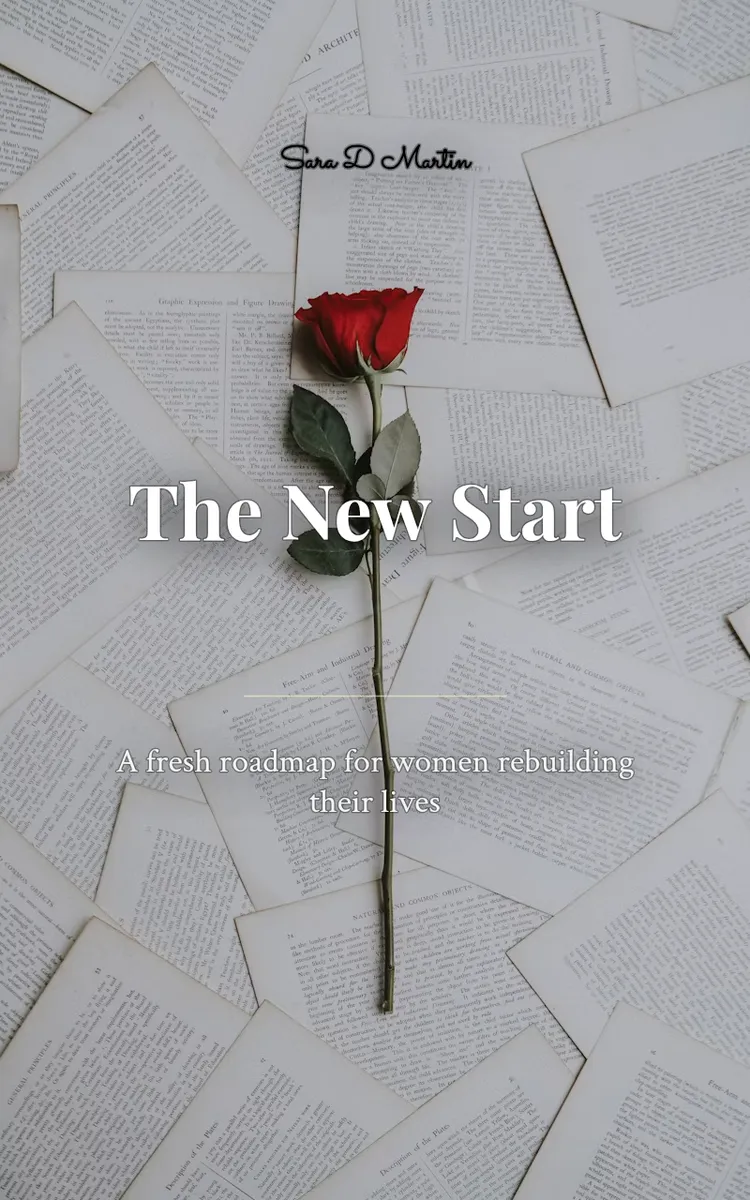
"The New Start" is a self-help book by Sara D Martin with 5 chapters and approximately 7,599 words. Personal development guide for women starting over.
This book was created using Inkfluence AI, an AI-powered book generation platform that helps authors write, design, and publish complete books. It was made with the AI Self-Help Book Writer.
Frequently Asked Questions
What is "The New Start" about?
Personal development guide for women starting over
How many chapters are in "The New Start"?
The book contains 5 chapters and approximately 7,599 words. Topics covered include Reclaim Your Identity After Change, Challenge the Inner Critic’s Beliefs, Set Boundaries Without Losing Love, Build a Confidence Habit Loop, and more.
Who wrote "The New Start"?
This book was written by Sara D Martin and created using Inkfluence AI, an AI book generation platform that helps authors write, design, and publish books.
How can I create a similar self-help book?
You can create your own self-help book using Inkfluence AI. Describe your idea, choose your style, and the AI writes the full book for you. It's free to start.
Write your own self-help book with AI
Describe your idea and Inkfluence writes the whole thing. Free to start.
Start writingCreated with Inkfluence AI


