
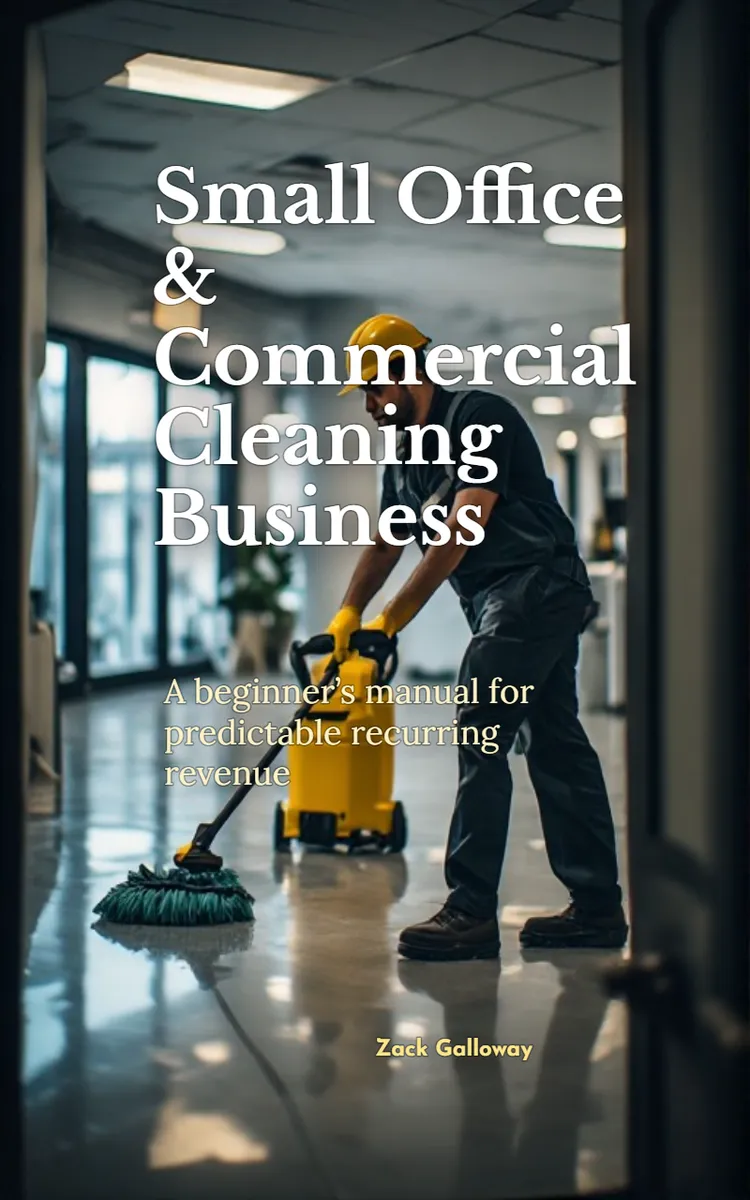
Small Office & Commercial Cleaning Business
Created with Inkfluence AI
Launching and operating a small commercial cleaning service
Table of Contents
- 1. Commercial vs Residential Cleaning
- 2. Recurring Service Frequency Pricing
- 3. Organizing Your 10×10 Home Base
- 4. Commercial Walkthrough and Task Inventory
- 5. Measuring Square Footage and Areas
- 6. Estimating Labor Hours Accurately
- 7. Building a Commercial Cleaning Bid
- 8. Writing Scope of Work and Exclusions
- 9. Creating a Site-Specific Cleaning Sequence
- 10. Managing Keys, Badges, and Alarms
- 11. Restocking Janitorial Kits and Consumables
- 12. Cleaning Science and Disinfecting Principles
- 13. Chemical Safety, SDS, and PPE Basics
- 14. Microfiber Control and Surface Identification
- 15. Floor Care Fundamentals for Hard Floors
- 16. Carpet Vacuuming and Entry Mat Systems
- 17. Restrooms, Kitchens, and Break Rooms
- 18. Desks, Offices, Touchpoints, and Glass
- 19. Quality Control, Inspections, and Complaints
- 20. Scaling From Solo to Route Crew
Preview: Commercial vs Residential Cleaning
A short excerpt from “Commercial vs Residential Cleaning”. The full book contains 20 chapters and 71,013 words.
Learn How Commercial Expectations
A commercial client does not judge cleaning only by whether a room looks tidy at the end of one visit. The client judges whether the same standard appears every time, whether the cleaner arrives during the agreed window, whether doors remain secure, and whether the company can explain what happened when something goes wrong. That difference changes the entire business model.
Tanya, 31, worked as a dental assistant before starting her cleaning company. She understood that a professional workplace depends on routines. Instruments must return to the correct place, rooms must meet a defined standard, and a missed step can affect the next person’s work. She carried that same thinking into small office cleaning. Her first commercial prospect did not ask only, “Can you mop and vacuum?” The office manager asked when Tanya would arrive, who would hold the key, what would happen if the alarm activated, how the company would handle a complaint, and how the office would receive proof that service occurred.
Tanya had cleaned homes for friends, so she initially thought the work would transfer easily. The physical tasks did transfer. The customer expectations did not. A residential customer may accept a changed arrival time if the cleaner explains it. A commercial customer may have employees arriving at a fixed hour, a security system that arms automatically, or a landlord expecting common areas to meet a stated standard. Commercial cleaning requires a repeatable operating system, not simply the ability to make a space look clean.
The Commercial-Expectations Ladder gives you a practical way to build that system. At the bottom, you complete the physical work. Above that, you meet the agreed schedule. Next, you protect the property and control access. Then, you deliver the same result consistently. At the top, you document performance and communicate clearly. Each level supports the next. A company that skips a lower level cannot reliably reach the higher ones.
Start with the physical result, but define it in observable terms. “Clean the office” creates disagreement because different people attach different meanings to it. A usable expectation names the work: empty waste containers, vacuum carpeted traffic areas, mop hard floors, clean restroom fixtures, wipe reachable touchpoints, and leave the entry free of visible soil. The exact tasks depend on the property and the written scope. The important point is that both sides must recognize completion in the same way.
Ask yourself what a customer could inspect without special training. A full waste container, streaked glass, dust along a reception counter, or a restroom that still smells dirty creates a visible failure. A missed task hidden behind a door can still become a complaint later. Before accepting a recurring account, walk the property and record the areas, surfaces, and tasks that the customer expects. Do not rely on memory or a casual conversation.
Commercial work also differs because the building remains connected to business operations. A residential cleaning visit usually serves one household. A commercial visit supports employees, customers, tenants, patients within an appropriate non-medical cleaning scope, or members of a community facility. A missed restroom, slippery entry, overflowing trash station, or locked office can disrupt people who were not part of the original sales conversation.
Scheduling therefore becomes part of the service itself. Commercial arrangements may run nightly, weekly, twice-weekly, three-times-weekly, or biweekly. Nightly service may suit a busy office, retail location, or facility that needs waste removal and restroom attention after each operating day. Weekly service may fit a low-traffic professional suite with limited food activity. Twice-weekly service can control soil and trash without requiring a visit every night. Three-times-weekly service can support a busier site while limiting the labor commitment compared with nightly work. Biweekly service may fit a small, lightly occupied office that can maintain acceptable conditions between visits.
Frequency affects more than the number of appointments on your calendar. It changes the amount of soil, trash, odor, and restroom buildup that your worker faces at each visit. A nightly account may require shorter routine visits because the cleaner removes problems before they accumulate. A biweekly account may require more time per visit because dust, waste, fingerprints, and restroom soil remain longer. You must price and schedule from the actual task load, not from the label attached to the frequency.
Never promise a frequency without confirming the customer’s operating pattern. Ask how many people use the space, whether customers enter, whether staff eat on site, how many restrooms operate, and whether the building hosts events....
About this book
"Small Office & Commercial Cleaning Business" is a how-to guide book by Zack Galloway with 20 chapters and approximately 71,013 words. Launching and operating a small commercial cleaning service.
This book was created using Inkfluence AI, an AI-powered book generation platform that helps authors write, design, and publish complete books. It was made with the AI Ebook Generator.
Frequently Asked Questions
What is "Small Office & Commercial Cleaning Business" about?
Launching and operating a small commercial cleaning service
How many chapters are in "Small Office & Commercial Cleaning Business"?
The book contains 20 chapters and approximately 71,013 words. Topics covered include Commercial vs Residential Cleaning, Recurring Service Frequency Pricing, Organizing Your 10×10 Home Base, Commercial Walkthrough and Task Inventory, and more.
Who wrote "Small Office & Commercial Cleaning Business"?
This book was written by Zack Galloway and created using Inkfluence AI, an AI book generation platform that helps authors write, design, and publish books.
How can I create a similar how-to guide book?
You can create your own how-to guide book using Inkfluence AI. Describe your idea, choose your style, and the AI writes the full book for you. It's free to start.
Write your own how-to guide book with AI
Describe your idea and Inkfluence writes the whole thing. Free to start.
Start writingCreated with Inkfluence AI


