
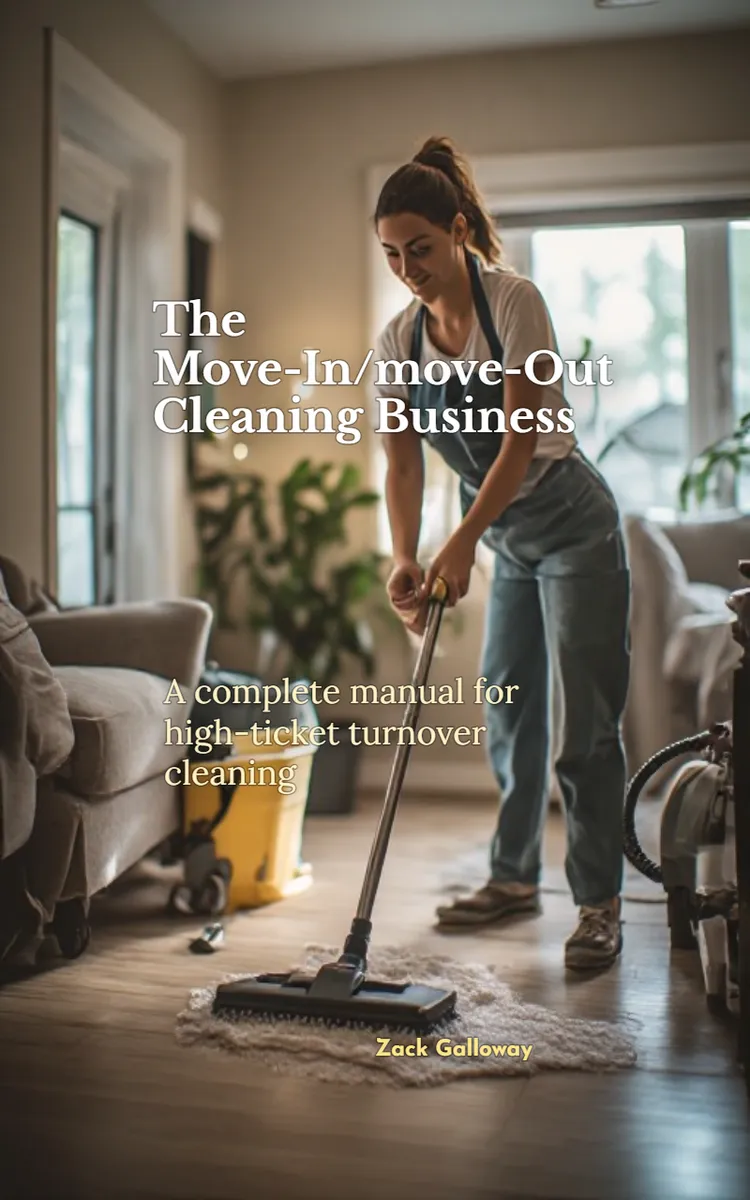
The Move-In/move-Out Cleaning Business
Created with Inkfluence AI
Building and operating a property turnover cleaning service
Table of Contents
- 1. Turnover Cleaning vs Ordinary Cleaning
- 2. Service Tiers and Add-On Menu Design
- 3. What You Must Not Clean (Scope Boundaries)
- 4. Property Assessment Checklist for Turnovers
- 5. Photo Estimates vs On-Site Inspections
- 6. Labor Estimating and Severity Scoring
- 7. Building Turnover Quotes That Hold
- 8. Property-Manager Scope and SLA Templates
- 9. Supply Kits, Product Categories, and Safety
- 10. Vacant Property Cleaning Sequences
- 11. Cleaning an Empty Kitchen Restoration
- 12. Cleaning Appliance Interiors Safely
- 13. Restoring Neglected Bathrooms Within Scope
- 14. Processing Cabinets and Closets Interiors
- 15. Completing Floors, Corners, and Baseboards
- 16. Photo Documentation and Quality Standards
- 17. Responding to Failed Inspections
- 18. Managing Rush Turnovers and Deadlines
- 19. Property-Manager Accounts and Profitability
- 20. Scaling From Solo to Multi-Crew Turn Vendor
Preview: Turnover Cleaning vs Ordinary Cleaning
A short excerpt from “Turnover Cleaning vs Ordinary Cleaning”. The full book contains 20 chapters and 68,306 words.
Learn What Makes Move-in/move-out Turnover Cleaning Different
At 4:00 p.m., a vacant apartment can look clean until someone opens the kitchen drawers, runs a finger along the baseboard, checks the refrigerator seal, and looks behind the bathroom door. A regular house cleaning may leave the home comfortable for the current occupant. A turnover cleaning must make the property ready for the next occupant, inspection, showing, lease handoff, or closing deadline. Those are different jobs with different standards.
Darla, 32, worked as a warehouse shift supervisor before starting to clean. Her first turnover job seemed simple: a mostly empty apartment with a kitchen, one bathroom, and hard floors. She cleaned the obvious surfaces and finished on time. The property manager returned the job because the cabinet interiors still held crumbs, the oven had grease around the door, the closet shelves had dust, and the bathroom fan cover showed buildup. Darla had cleaned the apartment as if someone still lived there. The manager had expected her to reset the entire space for its next use.
That distinction forms the foundation of the Turnover Promise Model: you promise a property that is ready for its next occupant within a clearly defined scope, condition, and deadline. The model has three parts. First, define what “ready” means for that property. Second, clean the areas the customer expects to inspect, including the areas people overlook. Third, document what you completed and identify anything outside cleaning before you begin. If one part remains unclear, the customer may judge the job against a standard you never priced.
Ordinary cleaning usually protects an occupied home’s day-to-day comfort. The cleaner works around furniture, personal belongings, food, clothing, decorations, and the occupant’s routines. The customer may ask for dusting, vacuuming, mopping, bathroom cleaning, kitchen cleaning, and surface wiping. The cleaner can often return later to address a missed area because the home remains in use.
Turnover cleaning works under a different condition: the property must change from “left behind” to “ready to use.” The home may be empty, partly furnished, or filled with items the previous occupant abandoned. The next occupant may arrive the same day. A landlord may need photographs before releasing a deposit. A property manager may need approval before advertising the unit. A homeowner may need the property clean before a buyer’s final walkthrough. The work connects directly to a handoff, so timing and completeness matter as much as appearance.
Vacancy changes the cleaning target. Empty cabinets, drawers, closets, appliances, baseboards, doors, switches, floors, corners, fixtures, and reachable vents become visible and accessible. These areas may receive little attention during ordinary cleaning because furniture or belongings hide them. A turnover cleaner must inspect the property as a series of surfaces and spaces, not merely as rooms that look presentable from the doorway.
The contamination also differs. A regular visit may involve light dust, fingerprints, crumbs, bathroom moisture, and normal floor soil. A turnover may add dried food, grease, pet hair, adhesive residue, mineral deposits, stale odors, hair in drains, grime along trim, and residue inside appliances. A property can look acceptable at first glance while requiring substantial labor in small, overlooked areas. Your price and schedule must account for the real condition rather than the number of rooms alone.
The deadline creates another difference. An occupied-home customer may accept a two-hour arrival window. A turnover customer may need the property completed before a tenant receives keys at noon, before a photographer arrives, or before a closing appointment. When the deadline matters, a missed area can create a second visit, a delayed handoff, or an argument about responsibility. You must treat the promised completion time as part of the service, not as a casual scheduling preference.
The Turnover Promise Model helps you explain this difference without using complicated language. When a customer asks, “How much for a cleaning?” do not answer only with a number. Ask what happens after the cleaning. Will a new renter move in? Will a landlord inspect the unit? Will a buyer walk through it? Will the property manager compare the result against a checklist? The answer tells you what “ready” means and helps you define the work.
Darla changed her intake questions after the apartment callback. She stopped asking only for square footage and the number of bathrooms. She also asked whether the property was vacant, whether belongings remained, whether the kitchen and bathroom appliances needed interior cleaning, whether the customer expected cabinet and closet interiors, and when the next occupant or inspector would arrive. Those questions did not make the sale harder....
About this book
"The Move-In/move-Out Cleaning Business" is a how-to guide book by Zack Galloway with 20 chapters and approximately 68,306 words. Building and operating a property turnover cleaning service.
This book was created using Inkfluence AI, an AI-powered book generation platform that helps authors write, design, and publish complete books. It was made with the AI Ebook Generator.
Frequently Asked Questions
What is "The Move-In/move-Out Cleaning Business" about?
Building and operating a property turnover cleaning service
How many chapters are in "The Move-In/move-Out Cleaning Business"?
The book contains 20 chapters and approximately 68,306 words. Topics covered include Turnover Cleaning vs Ordinary Cleaning, Service Tiers and Add-On Menu Design, What You Must Not Clean (Scope Boundaries), Property Assessment Checklist for Turnovers, and more.
Who wrote "The Move-In/move-Out Cleaning Business"?
This book was written by Zack Galloway and created using Inkfluence AI, an AI book generation platform that helps authors write, design, and publish books.
How can I create a similar how-to guide book?
You can create your own how-to guide book using Inkfluence AI. Describe your idea, choose your style, and the AI writes the full book for you. It's free to start.
Write your own how-to guide book with AI
Describe your idea and Inkfluence writes the whole thing. Free to start.
Start writingCreated with Inkfluence AI


