
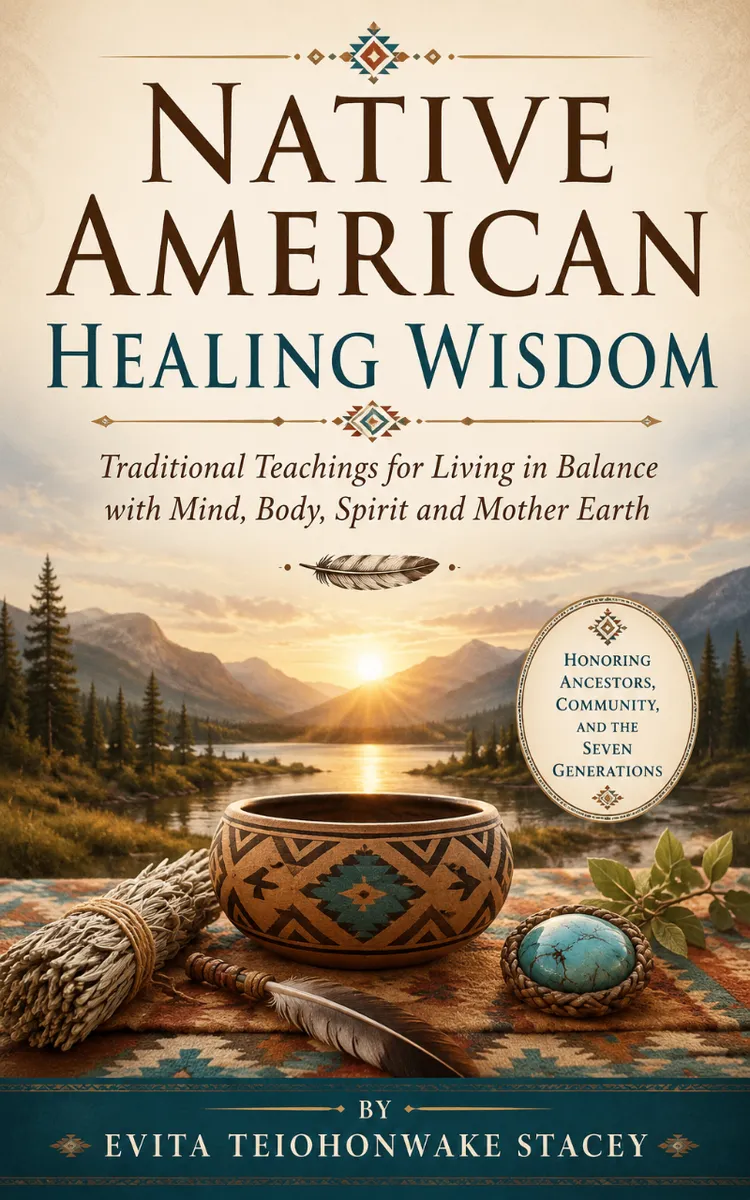
Read the first chapter
The whole of chapter one, free. About 8 min. Turn the pages with the arrows, your keyboard, or a swipe.
Chapter 1
Living in Balance: The Map
Chapter 1
Living in Balance: The Map
Why Balance Matters Across the Whole Life
What happens when your mind keeps working after your body asks for rest, your relationships need attention, and the land that feeds you receives none of your care? You may still finish your tasks, but something important has moved out of balance.
Many Indigenous Nations teach that health does not belong to one part of a person. Teachings differ from Nation to Nation, and no single map represents every Indigenous tradition. Still, many Indigenous perspectives connect personal well-being with relationships, community, responsibility, and the natural world. Healing means looking at the whole pattern instead of treating one problem as if it stands alone.
The Balance Compass Model offers a simple beginner’s map. It helps you check six connected areas: mind, body, spirit, relationships, community, and Mother Earth. The model does not replace Nation-specific teachings, cultural guidance, medical care, or professional support. It gives you a practical way to notice where your daily life needs attention and to choose one responsible action.
After using the map, you should be able to complete a short balance check, identify one area that needs care, and take a step that supports more than yourself. The goal is not perfect balance every day. The goal is to notice, respond, and return.
Ask yourself: Which part of my life receives the most attention? Which part receives the least? Your answer gives you a starting point.
How the Balance Compass Model Works
Picture six points on a compass. Each point matters, and each one affects the others. If your body lacks sleep, your mind may become short-tempered. If your relationships carry unresolved conflict, your spirit may feel heavy. If you spend every day indoors and treat water, food, or land as unlimited, your personal wellness remains incomplete.
Use the Balance Compass Model in five steps:
1. Pause and notice. Stop for two quiet minutes. Name what you feel, what your body needs, and what demands your attention. This step matters because you cannot care for what you refuse to see.
2. Check the six points. Give each area a simple score from 1 to 5. A score of 1 means “needs immediate care.” A score of 5 means “receives steady care.” Use the score as a prompt, not a judgment.
| Compass point | Ask yourself | |---|---| | Mind | What thoughts need clarity, rest, or support? | | Body | Have I slept, eaten, moved, and attended to health needs? | | Spirit | What gives my life meaning, connection, humility, or inner steadiness? | | Relationships | Do I listen, speak honestly, and repair harm? | | Community | How do I receive help, contribute, and honor shared responsibilities? | | Mother Earth | How do I care for land, water, air, plants, and animals? |
3. Look for the connection. Do not treat the lowest score as an isolated problem. Ask what other points influence it. For example, a low body score may come from overwork, weak boundaries in relationships, or a lack of community help.
4. Choose one small action. Select an action you can complete within twenty-four hours. A small action works better than a large promise because you can repeat it and observe its effect.
5. Return and review. Check the compass again after seven days. Notice what changed, what stayed difficult, and what support you need. Balance requires regular returning, not a single perfect decision.
The six points also carry responsibilities. Mind asks for honest attention. Body asks for care. Spirit asks for meaning and humility. Relationships ask for respect and repair. Community asks for participation rather than isolation. Mother Earth asks for reciprocity - giving care in response to what sustains you.
A balance check should lead to a behavior. If you write “I need more community” but take no step, the map remains on paper. Instead, identify one person or group, choose a date, and decide what you will offer or request. If you write “I need a better relationship with Mother Earth,” choose one action such as reducing food waste, caring for a local green space, or learning whose traditional territory you live on.
The map works because it keeps personal wellness connected to responsibility. Your choices affect other people and the living world. Ask yourself: What can I repair, protect, or strengthen today?
Putting the Map Into Practice
Ava is 34, a busy parent returning to wellness after months of interrupted sleep, rushed meals, and little time alone. She wants to feel better, but she cannot add a complicated program to an already full week. The Balance Compass Model gives her a manageable starting point.
1. Ava sets a ten-minute check on Sunday evening. She turns off notifications, places both feet on the floor, and takes five slow breaths. She does this first because a rushed assessment would repeat the same pressure she is trying to understand.
2. She scores each compass point from 1 to 5. Her notes read: mind 2, body 1, spirit 2, relationships 3, community 2, Mother Earth 2. Her lowest score is body, but she sees connections. Poor sleep affects her patience and concentration. Limited help from others leaves no time for recovery.
3. She chooses one body action and one relationship action. For the next seven days, she goes to bed thirty minutes earlier on four nights. She also asks a relative to watch her child for one hour on Saturday so she can rest and walk outside. She chooses these actions because they address both physical recovery and shared responsibility.
4. She adds a daily Mother Earth connection. After school drop-off, she spends five minutes outside noticing the season, the temperature, and the condition of the ground. She does not treat this as a performance or claim a ceremony. She simply practices attention and avoids leaving litter behind.
5. She completes a seven-day review. Her body rises from 1 to 3, her mind rises from 2 to 3, and her community score rises from 2 to 3 because she accepted help instead of trying to manage everything alone. Her spirit remains at 2, so she plans to speak with a trusted elder, family member, or appropriate cultural teacher rather than borrowing a practice that does not belong to her.
A realistic outcome does not mean every score reaches 5. Ava has not solved every pressure. She has learned which actions help and which support she needs next. That information gives her a useful map for the following week.
Use this quick checklist before you finish your own first balance check:
• Set aside ten quiet minutes. - Score all six compass points from 1 to 5. - Circle the lowest score. - Name one connected area that affects it. - Choose one action that fits within twenty-four hours. - Ask one person for help or offer useful help. - Spend five attentive minutes with Mother Earth. - Review the results after seven days.
Keep your actions specific. “Care for my body” becomes “drink water with breakfast and go to bed by 10:30 p.m.” “Support community” becomes “call my aunt on Wednesday and ask what help she needs.” Specific actions show you whether the map works.
Your practical takeaway: begin with ten minutes, six scores, and one action. A clear map turns concern into responsibility.
What to Watch For When the Compass Feels Uneven
Treating balance as a perfect score
Balance does not mean keeping every area at 5. Life changes with illness, grief, work, parenting, aging, and seasonal responsibilities. A low score may signal a temporary need rather than a personal failure.
Do this: Ask, “What needs care first, and what support will help?”
Not this: Shame yourself because one area needs more attention.
Write down the condition you are facing. If your body score is low because of pain, seek appropriate medical care. If your spirit feels troubled because of grief or trauma, speak with a qualified counselor, trusted elder, or cultural support person. The compass helps you choose support; it does not ask you to handle serious problems alone.
Focusing only on yourself
A private wellness routine can still ignore relationships, community, and Mother Earth. For example, buying more products for personal comfort does not automatically create balance if the purchase increases waste or if you refuse needed help from family.
Do this: Connect each personal action to a wider responsibility. Rest so you can care well. Accept help so another person can participate. Reduce waste because land and water carry life.
Not this: Treat wellness as a private project with no effect on anyone else.
Choose one outward action each week. Share food, check on a relative, help with a community task, repair something instead of replacing it, or learn about the land where you live. Keep the action respectful and practical.
Borrowing teachings without permission or context
Indigenous Nations hold distinct languages, histories, ceremonies, medicines, and teachings. A general map cannot give permission to copy a ceremony, use a sacred item, or speak for a Nation. Respect also requires knowing what you do not know.
Do this: Name the source of a Nation-specific teaching, learn from Indigenous authors or cultural educators, and follow the guidance of the appropriate community.
Not this: Combine pieces from different Nations and call the result an ancient universal tradition.
The Balance Compass Model remains useful when you use it honestly: as a reflection and responsibility tool, not as a substitute for living Indigenous teachings or receiving cultural instruction.
Before closing your daily check, ask one final question: Did my action strengthen connection, reduce harm, or make care more possible? If the answer is yes, record what you did and return tomorrow. If the answer is no, adjust without pretending.
Balance is not a fixed place on a chart. It is a practice of noticing how mind, body, spirit, relationships, community, and Mother Earth depend on one another. Carry the map into your ordinary decisions: when you rest, when you ask for help, when you repair a relationship, and when you choose how to treat the living world. Each choice prepares the ground for deeper gratitude, responsibility, and connection.
End of chapter one. 8 more chapters in the full book.
Swipe or use the arrows to turn the page
What's inside: 9 chapters
- 1. Living in Balance: The Map
- 2. The Good Mind in Practice
- 3. Reciprocity with Mother Earth
- 4. Oral History and Family Memory
- 5. Gratitude That Changes Choices
- 6. Healing Through Community Bonds
- 7. Seven Generations Planning
- 8. Becoming a Good Ancestor
- 9. Your 30-Day Balance Routine
About this book
"Native American Healing Wisdom" is a how-to guide book by Anonymous with 9 chapters and approximately 16,067 words. Indigenous teachings on balance, gratitude, community, ancestors, and responsibility.
This book was created using Inkfluence AI, an AI-powered book generation platform that helps authors write, design, and publish complete books. It was made with the AI Ebook Generator.
Frequently Asked Questions
What is "Native American Healing Wisdom" about?
Indigenous teachings on balance, gratitude, community, ancestors, and responsibility
How many chapters are in "Native American Healing Wisdom"?
The book contains 9 chapters and approximately 16,067 words. Topics covered include Living in Balance: The Map, The Good Mind in Practice, Reciprocity with Mother Earth, Oral History and Family Memory, and more.
Who wrote "Native American Healing Wisdom"?
This book was written by Anonymous and created using Inkfluence AI, an AI book generation platform that helps authors write, design, and publish books.
How can I create a similar how-to guide book?
You can create your own how-to guide book using Inkfluence AI. Describe your idea, choose your style, and the AI writes the full book for you. It's free to start.
Write your own how-to guide book with AI
Describe your idea and Inkfluence writes the whole thing. Free to start.
Start writingCreated with Inkfluence AI


