
Read the first chapter
The whole of chapter one, free. About 7 min. Turn the pages with the arrows, your keyboard, or a swipe.
Chapter 1
AI Customer Communication Baseline
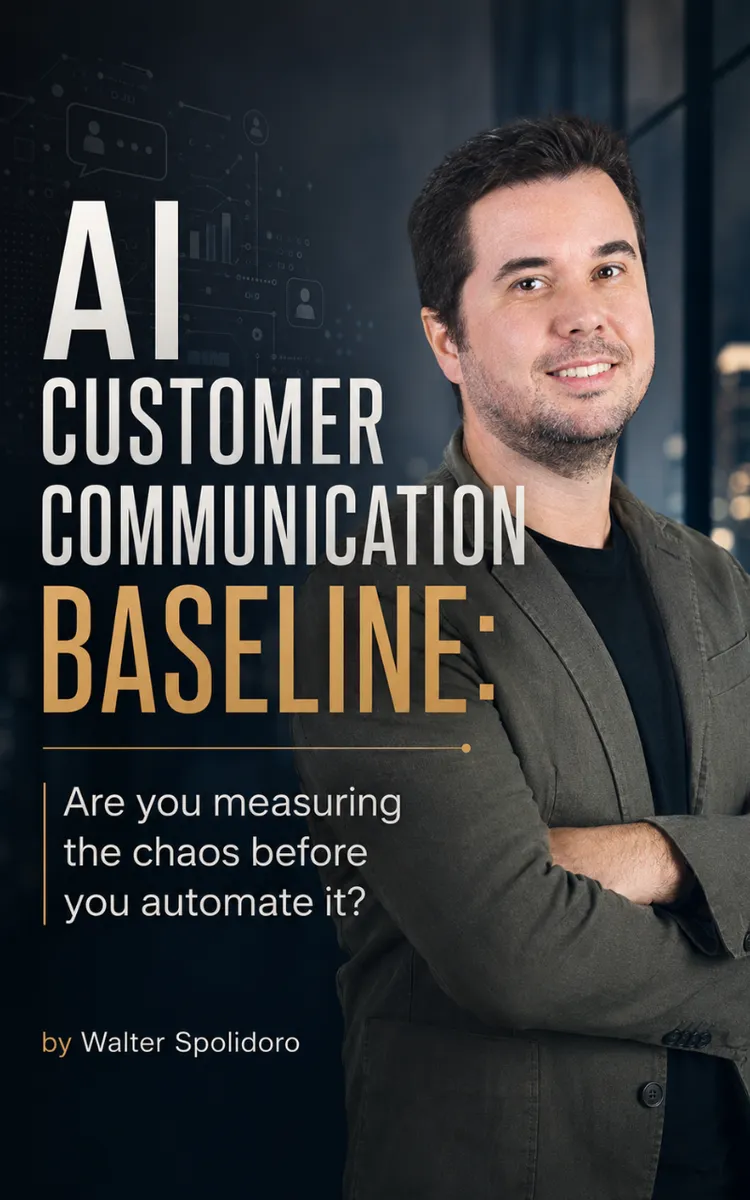
AI Customer Communication Baseline: Are you measuring the chaos before you automate it?
How many customer messages do you route, re-route, and re-answer every day because your team does not have one clear starting point? If your inbox feels like a moving target - sales questions in support lanes, support issues in sales follow-ups, follow-ups that miss the context - AI will not fix that by itself. It will just move the same confusion faster.
This chapter gives you a baseline you can build on: a way to align your support and sales goals, your communication channels, and your current customer pain points before you connect AI assistants. After you finish, you will know exactly what to measure, what to standardize first, and what inputs to feed AI so it answers correctly, escalates cleanly, and helps your team spend time on the work that actually needs a human.
You will also see where this approach comes from. I have over 10 years in software development, and I have served more than 200 clients worldwide with technology solutions for customer service. Today I lead Arom Abern in the USA and ZiiZ in Brazil and Europe (ZiiZ.pt). My focus stays practical: AI should free time for family, children, and strategic business thinking, not turn your day into endless monitoring and manual correction.
---
The Communication Readiness Scorecard: Your baseline for support + sales AI
AI customer communication fails for predictable reasons. Teams connect a chatbot or an assistant to a knowledge base, then wonder why it gives inconsistent answers, ignores your tone, or escalates the wrong cases. The root cause is usually not “AI quality.” It is missing alignment: unclear goals, messy channel rules, and pain points you never translated into inputs the assistant can use.
The solution I use with teams is the Communication Readiness Scorecard. It turns your current reality into a scored baseline across three areas: (1) goals, (2) channels, and (3) pain points. You run the Scorecard once, fix what blocks accuracy, then feed AI with the cleaned-up structure. You do this before you ask AI to “be helpful.” You ask it to operate inside a defined system.
Here is how the Scorecard works. You score each section from 1 to 5 using your real workflows and message history. Then you create a short “first AI inputs” list based on the lowest-scoring items.
1. Goal clarity (1-5): define what support and sales must achieve - Write one sentence for support and one for sales that you can test in practice. Example: “Support closes billing disputes with the correct policy and next steps within one reply.” If you cannot write a testable sentence, AI will not know what “good” looks like.
2. Channel rules (1-5): set the handoffs and ownership - List every customer-facing channel you use (email, web form, chat, phone transcripts, marketplace messages). Then define who owns each message type and what happens when a message crosses lanes. AI needs these rules so it does not create duplicate work.
3. Pain point inventory (1-5): map the top reasons customers contact you - Pull the last 30 days of tickets and message threads. Group them into categories you can act on: “order status,” “refund request,” “setup help,” “pricing question,” “wrong item,” “delivery delay,” and so on. For each category, capture the exact customer question phrasing you see most often.
4. Knowledge + escalation (1-5): ensure AI can answer or route correctly - Check whether each pain point category has: (a) a correct answer source, (b) the exact steps or policy wording you want used, and (c) a clear escalation condition. AI must know when to answer and when to route to a human with context.
When you score these areas, you stop debating and start building. For example, if your channel rules score a 2 because sales follow-ups keep re-asking support questions, you fix lane ownership before you deploy AI to “speed up responses.” Speed without correctness just increases customer frustration.
---
Putting the baseline to work: Build your AI inputs from what customers already say
You do not need a big AI project to start. You need a clean first set of inputs that match your current customer reality. Use Nadia, 41, Customer Service Director, as the reference point. Nadia’s team handles both support and early sales questions. They also see the same issues repeating: customers ask about pricing in support threads, and sales tries to “close” before the customer confirms delivery or setup details. Nadia wants AI help, but she refuses to add another layer of confusion.
Start with a structured, measurable baseline run. Then translate it into an AI-ready input list.
1. Collect evidence for the last 30 days - Export your support tickets and sales messages. Include subject lines, message bodies (or summaries), and tags you already use. - Expected outcome: you can name your top 8-12 customer reasons for contacting you, based on actual wording.
2. Run the Communication Readiness Scorecard - Score goal clarity, channel rules, and pain point inventory, plus knowledge + escalation. - Expected outcome: you identify the single biggest blocker. Most teams find it is not “AI.” It is missing escalation rules or inconsistent lane ownership.
3. Create a “Top Pain Points” table - For each pain point category, write: - the top customer question you actually see, - the correct internal answer source (policy doc, FAQ, order system instructions), - the escalation trigger (what condition forces a human), - the information the assistant must include when escalating. - Expected outcome: AI can either answer with the correct steps or route with the right context.
4. Define channel handoffs in plain rules - Example rule: “If the message includes an order number + asks for delivery timing, route to Support Order Status.” Another rule: “If the message asks for pricing without product details, ask 2 qualifying questions first; do not promise a specific price.” - Expected outcome: your assistant stops guessing and your team stops redoing.
5. Write your first “assistant behavior” constraints - Limit answers to what your table covers. Require the assistant to confirm missing details before taking action. - Expected outcome: fewer wrong promises, faster correct responses.
Quick checklist (do this in order)
• Pull the last 30 days of messages from support and sales - List your top 8-12 customer reasons for contacting you, using their wording - Score the Communication Readiness Scorecard (1-5) across the four areas - Build the Top Pain Points table: question, answer source, escalation trigger, escalation context - Write channel ownership and handoff rules in plain language - Limit the assistant’s first deployment to categories with clear sources and triggers
Nadia’s team used this approach to stop a common loop: sales kept sending “next steps” before setup issues resolved. The Scorecard showed channel rules at a 2. After they fixed lane ownership and added escalation triggers (setup blockers always route to the setup workflow with the customer’s device/app details), AI responses became consistent enough that Nadia’s team stopped correcting the same mistakes daily.
---
What to watch for: mistakes that break AI accuracy in support + sales
Mixed goals create mixed answers When support and sales goals conflict, AI produces responses that try to satisfy both at once. You see it when the assistant offers discounts or “closing language” inside support threads, or when it over-explains policies in sales messages. Fix: Write two testable goal sentences and map each pain point category to the goal it serves. If a category belongs to support, block sales-style language and route instead when needed.
Unclear escalation triggers create silent failures Teams often say “escalate to a human when it’s complex,” which sounds reasonable but does not work. AI needs concrete triggers you can detect in text. Fix: Turn ambiguity into conditions. Example triggers: “refund request without order number,” “charge dispute language,” “technical failure after steps,” “requested cancellation within a restricted window.” Require the assistant to include the exact missing fields it needs before escalation.
Channel handoffs stay tribal If only one person “knows” who owns what, AI will inherit that confusion. Your customers feel it as delays and repeated questions. Fix: Publish the channel rules in the same place your team already checks daily (even a simple doc). Then enforce lane ownership based on message content, not based on who is on shift.
---
Chapter roadmap: from baseline score to your first AI assistant that behaves
Use this progression so you do not skip the foundation:
First, you run the Communication Readiness Scorecard and build your Top Pain Points table from the last 30 days of messages. Second, you lock channel handoffs and escalation triggers in plain language. Third, you deploy AI only to the categories you can support with correct sources and clean routing. You treat the first rollout as a controlled baseline, not as a full replacement.
When your team stops re-asking the same questions and stops fixing the assistant’s predictable mistakes, you will feel it quickly: faster resolution, fewer escalations that lack context, and less time spent chasing “who owns this.”
Next, we will connect this baseline to the actual assistant setup - how you structure prompts and knowledge so the assistant answers in your voice, follows your rules, and hands off to humans with the details they need. The goal stays the same: you get time back - time for family, children, and strategic thinking - because you no longer manage every interaction personally.
If you do one thing before you touch any AI tool, score your current readiness and write your Top Pain Points table. That single move turns AI from a gamble into a system.
End of chapter one. 7 more chapters in the full book.
Swipe or use the arrows to turn the page
What's inside: 8 chapters
- 1. AI Customer Communication Baseline
- 2. Designing AI Support Assistants
- 3. AI-Driven Sales Outreach Workflows
- 4. Personalization with Customer Intent Signals
- 5. Post-Sales AI for Onboarding and Adoption
- 6. AI for Ticket Triage and Knowledge Management
- 7. Measuring Customer Satisfaction and ROI
- 8. Optimizing Time for Strategy and Family
About this book
"AI For Customer Communication" is a business book by Walter Oliveira with 8 chapters and approximately 16,505 words. Using AI to optimize customer communication, sales, and service.
This book was created using Inkfluence AI, an AI-powered book generation platform that helps authors write, design, and publish complete books. It was made with the AI Business Book Writer.
Frequently Asked Questions
What is "AI For Customer Communication" about?
Using AI to optimize customer communication, sales, and service
How many chapters are in "AI For Customer Communication"?
The book contains 8 chapters and approximately 16,505 words. Topics covered include AI Customer Communication Baseline, Designing AI Support Assistants, AI-Driven Sales Outreach Workflows, Personalization with Customer Intent Signals, and more.
Who wrote "AI For Customer Communication"?
This book was written by Walter Oliveira and created using Inkfluence AI, an AI book generation platform that helps authors write, design, and publish books.
How can I create a similar business book?
You can create your own business book using Inkfluence AI. Describe your idea, choose your style, and the AI writes the full book for you. It's free to start.
Write your own business book with AI
Describe your idea and Inkfluence writes the whole thing. Free to start.
Start writingCreated with Inkfluence AI


