
Read the first chapter
The whole of chapter one, free. About 8 min. Turn the pages with the arrows, your keyboard, or a swipe.
Chapter 1
Odoo Fit-Gap Discovery Workshop
Priya’s restaurant looked “busy” on paper, but her numbers didn’t match what she felt every day. She had walk-ins, online orders, and catering calls coming from different places. Her team tracked some items on a whiteboard, some in spreadsheets, and some in the POS. When she asked for a weekly report, she got three versions of the truth - each one delayed, and each one missing something important. That gap between “we run the business” and “we can see and control the business” is where most Odoo projects break.
If you start an Odoo implementation without a structured discovery workshop, you end up building the wrong thing first, and you pay for it twice: once in rework, and again in adoption. This chapter gives you a practical way to run an Odoo Fit-Gap Discovery Workshop that maps your business needs to specific Odoo modules, then defines a clear implementation scope you can approve. After you finish, you will know exactly what to ask in the workshop, how to translate messy workflows into a fit-gap map, and how to produce a scope document your team can actually sign off on.
You will also learn how the Fit-Gap Discovery Blueprint keeps the conversation grounded in deliverables: a module-by-module plan, a list of required gaps, and a decision-ready scope. That means you stop guessing, you stop debating opinions, and you start implementing with a shared target.
---
Odoo Fit-Gap Discovery Workshop: the scope-first workshop that prevents rework
The problem is simple: businesses don’t run on modules. They run on workflows - quoting, ordering, cooking, invoicing, inventory movement, payroll, and follow-ups. Odoo runs on modules - Sales, Purchase, Inventory, Accounting, Invoicing, and more. When discovery stays at the “we want Odoo” level, you miss the translation step from workflow needs to module capabilities.
A structured discovery workshop solves that translation problem. It forces you to capture how work really happens today, identify where Odoo fits, and document where you need gaps (and what those gaps cost in time, change, and risk). You then lock an implementation scope that includes what you will build, what you will configure, and what you will not touch yet.
This chapter also gives you a reader-ready deliverable outcome: a Fit-Gap Summary and a scoped Implementation Plan you can take into estimation and kickoff. You will leave with a clear next move, not a stack of notes nobody trusts.
---
The Fit-Gap Discovery Blueprint: map needs to modules, then define scope
Our branded method in this chapter is the Fit-Gap Discovery Blueprint. It turns a workshop into a decision machine by using three outputs: a workflow inventory, a fit-gap map, and an approved scope.
Here is how it works in real terms, using Priya’s restaurant as the anchor case. Priya didn’t need “more software.” She needed one system that could handle menu pricing, track inventory impact, capture sales across channels, and produce weekly reports without chasing spreadsheets.
Use these four components to run your workshop in a way that produces scope, not debate:
1. Run a “Workflow-to-Module Translation” pass Capture each core workflow as a short chain: start event → steps → decision points → end result. Then assign likely Odoo modules for each workflow. Example: “Customer places order” maps to Sales and/or POS; “Order affects ingredient usage” maps to Inventory; “Orders become invoices” maps to Accounting and Invoicing.
2. Use the Fit-Gap Map to separate configuration from change For every workflow step, decide whether Odoo can handle it out-of-the-box (fit), can handle it with configuration (fit-with-setup), or requires a gap (needs customization or a process change). Differentiator example for Priya: POS can record sales, but it might not handle every custom menu modifier the way her current system does; that becomes a documented gap, not an assumption.
3. Define scope with “In-Scope / Not-Yet / Out-of-Scope” Scope means you can estimate and implement. So you must be explicit about what you will implement now, what you will delay, and what you will avoid. If you do not separate these, the project scope quietly expands into everything the business has ever asked for.
4. Write decisions into a workshop output you can approve You produce two documents: - Fit-Gap Summary (what fits, what gaps exist, and why it matters) - Implementation Scope (what you will configure/build now, and what you will postpone) Priya’s team didn’t need more meetings; they needed a scope they could approve so the build could start.
These steps work because they keep the workshop anchored to measurable workflow outcomes. You stop talking in circles about “features” and you start talking about whether a workflow step produces the right result inside Odoo.
One more rule that keeps the room productive: you only allow “gap” labels after someone describes the exact workflow step that fails. “We need customization” is not a gap. “We need customization to track ingredient usage per menu modifier so inventory levels update correctly” is a gap.
---
Putting the Fit-Gap Discovery Workshop into practice (Priya’s restaurant example)
Run the workshop as a fixed agenda with clear inputs and outputs. You do not need fancy tools - just disciplined preparation and a tight facilitation rhythm.
Use this scenario structure to mirror what you will do in your business:
Workshop setup (before the meeting) Gather these materials from Priya’s side (or your own team) at least two days before the workshop: - Current menu list and how pricing works (base price, modifiers, combos) - Sales channels list (POS, online ordering, phone/catering) - Current inventory tracking method (spreadsheet, manual counts, vendor receipts) - Month-end closing checklist (what reports they need and when they need them) - A list of “pain points” people mention repeatedly (late reporting, missing ingredient usage, stock mismatches)
Expected outcome: the workshop starts with facts, not arguments.
Run the workshop (day 1) 1. Kick off with scope language Ask everyone to agree on what “success” looks like for the first release: for example, “Weekly sales and inventory impact report by Monday morning, using one system.” Expected outcome: you align on outcomes before you discuss modules.
2. Map core workflows Create a simple workflow list on a shared screen. For Priya, start with: - Order capture (walk-in, online, catering) - Menu pricing and modifiers - Inventory impact from completed orders - Invoicing and payment posting - Weekly reporting
Expected outcome: you cover the business’s critical loops, not random feature requests.
3. Build the Fit-Gap Map step-by-step Take one workflow at a time. For each step, record: - Step description (what must happen) - Odoo module candidate(s) - Fit vs fit-with-setup vs gap - Notes on required change and who owns the decision
Differentiator example for Priya: you do not mark “Inventory” as a fit just because it exists. You check whether it updates inventory based on the way modifiers change the ingredient list.
4. Decide scope categories Convert the fit-gap findings into scope categories: - In-Scope: workflows you will implement in the first release - Not-Yet: workflows you will postpone to later phases - Out-of-Scope: workflows you will not include because they blow up timeline or require major organizational change
Expected outcome: the team stops bringing new “must-haves” during the build phase.
Quick checklist - Confirm workshop success outcome in plain language (example: weekly report by Monday morning) - List core workflows and assign module candidates - For each workflow step, mark Fit, Fit-with-setup, or Gap (and describe the exact failing step) - Produce a Fit-Gap Summary and an In-Scope / Not-Yet / Out-of-Scope scope - Assign owners for every decision (who confirms pricing rules, who confirms inventory logic)
Workshop output (same day) By the end of day 1, you should have: - A Fit-Gap Summary with enough detail to estimate work - A scope draft your business owner can approve or reject If you cannot estimate after the workshop, you captured too little detail or you marked gaps without describing the failing step.
---
What to watch for: common discovery mistakes that wreck scope
Even smart teams make predictable mistakes during discovery. Here are the ones that most often distort module mapping and scope decisions.
Mistake 1: You only discuss features, not workflow outcomes When you talk about “we need Sales and Inventory,” you skip the translation that turns features into outcomes. That leads to mis-scoping because the team argues about what “should be possible” instead of what must happen in the real workflow.
Do this: For each workflow step, write the “must result” sentence. Example: “When a customer orders a combo with modifiers, the inventory movement must reflect the exact ingredients used.” Not this: “We need inventory and we need modifiers support.”
Mistake 2: You mark everything as a gap If you label every difference as a customization need, you inflate scope and kill the project timeline. Some differences are actually configuration changes or even process decisions you can standardize.
Do this: Split each step into Fit, Fit-with-setup, or Gap. Then only escalate to Gap when Odoo cannot produce the required result without a change. Not this: “We will customize later” without proving the failing workflow step.
Mistake 3: You skip decision ownership If nobody owns pricing rules, inventory logic, or approval steps, you end up with unresolved questions during build. That creates rework and delays.
Do this: Assign an owner per gap decision during the workshop. If Priya’s team cannot confirm pricing rules on day 1, you postpone only the affected part and keep the rest moving. Not this: “We’ll decide during implementation.”
---
Chapter roadmap and the promise you should expect from this workshop
Here is the roadmap you will follow as you build your Odoo implementation service delivery framework with this book: - This chapter: You run a structured discovery workshop using the Fit-Gap Discovery Blueprint, and you produce module mapping plus a scope you can approve. - Next chapters will turn that approved scope into build-ready plans: configuration approach, data preparation, testing expectations, and a service delivery rhythm your team can repeat.
Your transformation promise for this chapter is practical: you will walk away with a workshop output that reduces rework. Specifically, you will stop the “we thought it would work” problem by documenting workflow steps, matching them to Odoo modules, and deciding what you will implement now versus later.
I built this blueprint from the frustration of watching teams spend weeks debating features while the real workflow logic stayed undocumented. You don’t need more meetings. You need a workshop that produces decisions.
Action you can take today: pick one core workflow in your business (order capture, service booking, billing, or inventory movement) and write it as a step-by-step chain. Then mark which steps you believe Odoo can fit, which steps need setup, and which steps you suspect create gaps. When you can do that on paper, you can run the Fit-Gap Discovery Workshop with confidence.
Send your workshop outputs to yourself as a proof of progress, and keep this momentum - because the next part of the implementation journey depends on the scope you lock right now.
For service support or implementation discussions, email sales@ksolves.com.
End of chapter one. 4 more chapters in the full book.
Swipe or use the arrows to turn the page
What's inside: 5 chapters
- 1. Odoo Fit-Gap Discovery Workshop
- 2. Process Mapping for Odoo Workflows
- 3. Estimating Timeline with Delivery Sprints
- 4. Testing and UAT Acceptance Criteria
- 5. Go-Live Enablement and Post-Launch Support
About this book
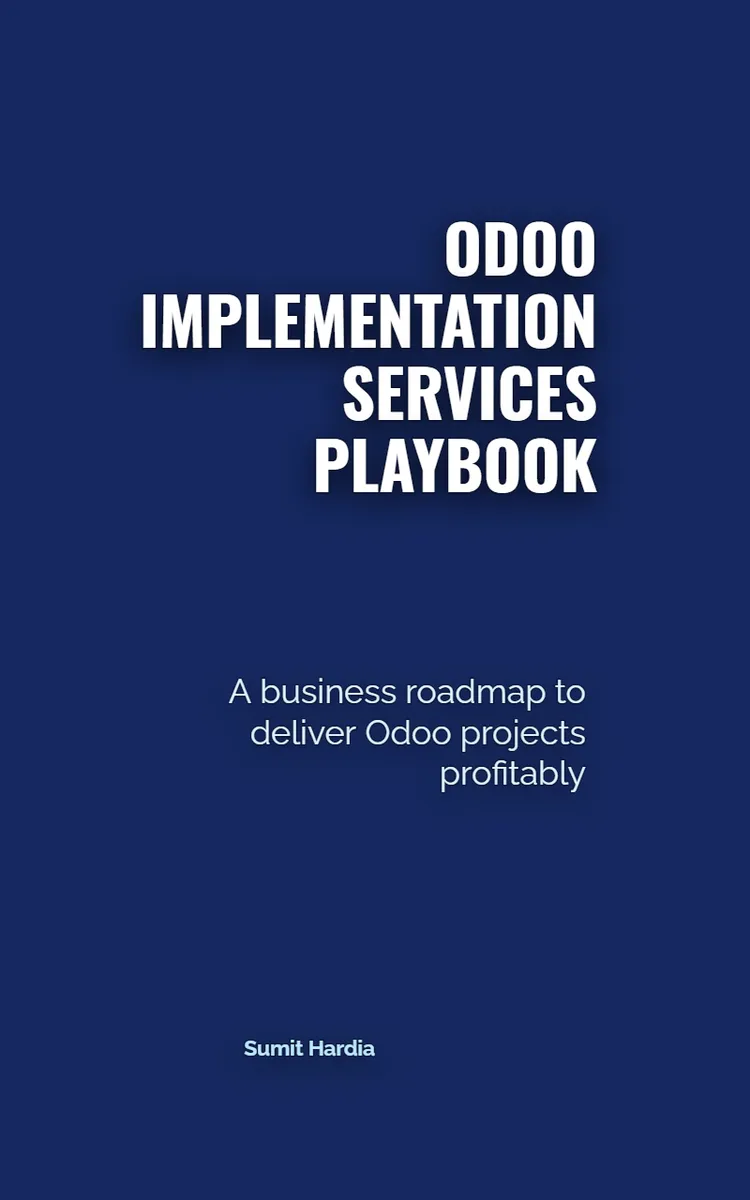
"Odoo Implementation Services Playbook" is a business book by Sumit Hardia with 5 chapters and approximately 10,684 words. Process and service delivery framework for Odoo implementation.
This book was created using Inkfluence AI, an AI-powered book generation platform that helps authors write, design, and publish complete books. It was made with the AI Business Book Writer.
Frequently Asked Questions
What is "Odoo Implementation Services Playbook" about?
Process and service delivery framework for Odoo implementation
How many chapters are in "Odoo Implementation Services Playbook"?
The book contains 5 chapters and approximately 10,684 words. Topics covered include Odoo Fit-Gap Discovery Workshop, Process Mapping for Odoo Workflows, Estimating Timeline with Delivery Sprints, Testing and UAT Acceptance Criteria, and more.
Who wrote "Odoo Implementation Services Playbook"?
This book was written by Sumit Hardia and created using Inkfluence AI, an AI book generation platform that helps authors write, design, and publish books.
How can I create a similar business book?
You can create your own business book using Inkfluence AI. Describe your idea, choose your style, and the AI writes the full book for you. It's free to start.
Write your own business book with AI
Describe your idea and Inkfluence writes the whole thing. Free to start.
Start writingCreated with Inkfluence AI


