
Read the first chapter
The whole of chapter one, free. About 5 min. Turn the pages with the arrows, your keyboard, or a swipe.
Chapter 1
Why Boundaries Feel Impossible
Unpack the Hidden Reasons Your “no” Feels Unsafe
If your “no” comes with a side of panic, shame, or a sudden urge to over-explain - good news: you’re not broken. Your body is reacting to childhood conditioning and learned family dynamics, not to the person in front of you. That’s why “no” can feel like you’re doing something dangerous, even when you’re not.
Let’s name what might be running the show. When you default to people pleasing, you’re trying to protect connection by shrinking your needs. The fawn response is the “stay safe by being agreeable” part - your nervous system going, “If I’m helpful enough, nobody gets mad.” And if you’ve been doing emotional labor for so long it feels like your personality, your “no” can trigger guilt like it’s an alarm system. Not because your boundaries are wrong. Because your system thinks they’re a threat.
Your Turn: Boundary Audit
Check one box per line - only what you actually notice right now.
• When I want to say “no,” I usually feel: ☐ tight chest ☐ stomach drop ☐ racing thoughts ☐ throat closing ☐ other: __________
• I worry that saying “no” will lead to: ☐ conflict ☐ rejection ☐ punishment ☐ guilt ☐ losing love ☐ other: __________
• My most common “stall” move is: ☐ over-explaining ☐ apologizing ☐ negotiating ☐ rescuing ☐ silence ☐ other: __________
Reflect: Circle the one sentence that fits best: “My ‘no’ feels unsafe because ________.”
Also - quick reality check. Sometimes your guilt isn’t just conditioning. Sometimes it’s manipulation tactics wearing a smile, like “After all I’ve done…” or “You always do this.” If you’ve been trained to doubt yourself, those tactics can hijack your self-worth fast.
Apply It: Coffee Filter Exercise
Write one sentence you’re tempted to soften: “I can’t ______.” Now put the “extra” on the filter:
“I can’t ____.” + “Because __.” + “But __.” + “Sorry __.” + “If it helps ____.”
Your goal: keep only the core sentence. Fill in: “I can’t ______.” (no extra fuel)
Nervous System Alarms
Here’s the deal: boundaries aren’t just words. They’re signals to your nervous system regulation. If your system is used to conflict being unsafe, it will treat your “no” like a live wire. You’ll feel it in your body before you can talk yourself out of it. That’s why a boundary can be “reasonable” and still feel impossible.
Let’s track what your body does right before you speak. When guilt shows up, ask: is it guilt - a signal that you care - or is it panic wearing guilt’s costume? Either way, we work with it. We don’t argue with your nervous system. We help it learn a new pattern.
Your Turn: Emotional Backpack
Fill in the blanks with what you’re carrying into boundary moments:
“I’m bringing: ________ (old fear).”
“I’m also bringing: ________ (old rule).”
“I’m done carrying: ________ (what isn’t mine).”
The boundary my body wants to practice is: “________.”
Your Turn: Burnout Check-In
Rate 0-10 (0 = none, 10 = constant):
My stress is: ____/10
My urge to people-please is: ____/10
My resentment is: ____/10
My “I can’t keep doing this” feeling is: ____/10
Apply It: Emotional Bar Tab (fillable)
Write the last boundary you avoided.
Request: “________”
What I actually did: “________”
Cost I paid (time/energy/peace): “________”
If I repeat this next time, the price will be: “________”
To make this more concrete, use a progress tracker you can actually see. When you track, your brain stops treating each boundary like a one-time leap off a cliff.
Your Turn: Weekly Boundary Tracker
For each day, circle one: ☐ Yes boundary ☐ Partial boundary ☐ No boundary ☐ No opportunity
Write the smallest win from this week: “________”
Difficult Conversation Planner (fillable)
What’s the conversation about? “________”
My real need is: “________”
My boundary is: “________”
A boundary script I can say once, calmly: “________”
Boundary Script Builder (fillable)
Pick one template and fill it in:
“I’m not able to ____.” / “I won’t __.” / “I need ____.”
Complete sentence: “I’m not able to ______.”
Red Flag & Green Flag Checklists
Red flags I notice (check any): ☐ guilt trips ☐ urgency pressure ☐ “after all I’ve done” ☐ twisting my words ☐ threats ☐ other: ________
Green flags I notice (check any): ☐ clear ask ☐ calm tone ☐ respect for a “no” ☐ willingness to problem-solve ☐ other: ________
Now, let’s talk about where guilt gets weird. Sometimes your emotional labor shows up as “I should fix this.” You take responsibility for someone else’s feelings, then call it love. That’s how family dynamics can train you to treat your needs like background noise. And when a boundary interrupts the pattern, your brain reads it as danger - because that’s what it learned.
Manipulation tactics can also make your “no” feel unsafe. If someone acts like your boundary is an attack, your body may try to smooth it over. That’s not “being dramatic.” That’s your system trying to prevent conflict. Your job isn’t to win a debate - it’s to protect your nervous system and your self-worth at the same time.
Reflect: Emotional Bar Tab
Write a boundary you want to hold. Then list what you’re paying right now to avoid it.
Boundary I want: “________”
Cost I keep paying (pick what fits): ☐ swallowed feelings ☐ extra explaining ☐ last-minute changes ☐ silent resentment ☐ other: ________
The story my guilt tells me: “________”
The truer story I’m practicing: “________”
One more tool for when your brain starts bargaining. You’re not trying to “be nice.” You’re trying to be clear.
Apply It: Boundary Script Builder
Choose the closest script and fill it in.
Script A (simple): “I’m not able to ______.”
Script B (clear + kind): “I’m not able to ____, but I can ____.”
Script C (time boundary): “I can’t do this today. I can ____ by ____.”
My filled script: “________”
If you want to spot patterns fast, use a quick relationship scan.
Your Turn: Relationship Inventory
For each person, circle one: ☐ safe-ish ☐ shaky ☐ unsafe
What I notice they do when I set a boundary: “________”
What I notice they do to respect my “no”: “________”
Moody Brews time - because your nervous system deserves a break, not a lecture.
Moody Brews: The “No” Is a Boundary, Not a Doom Signal
Make a cup of something warm. Put one hand on your chest and read this out loud once:
“My boundary is information, not a threat.”
Then rate: my body feels 0-10: ____/10.
Circle what helped most: ☐ warmth ☐ voice ☐ touch ☐ quiet ☐ other: ________
When you’re ready, we’ll also name the “maintenance” part. Boundaries aren’t a one
End of chapter one. 4 more chapters in the full book.
Swipe or use the arrows to turn the page
What's inside: 5 chapters
- 1. Why Boundaries Feel Impossible
- 2. Breaking People-Pleasing and Fawn
- 3. Emotional Labor, Guilt, and Family Dynamics
- 4. Healthy Communication and Boundary Scripts
- 5. Maintaining Boundaries Without Guilt
About this book
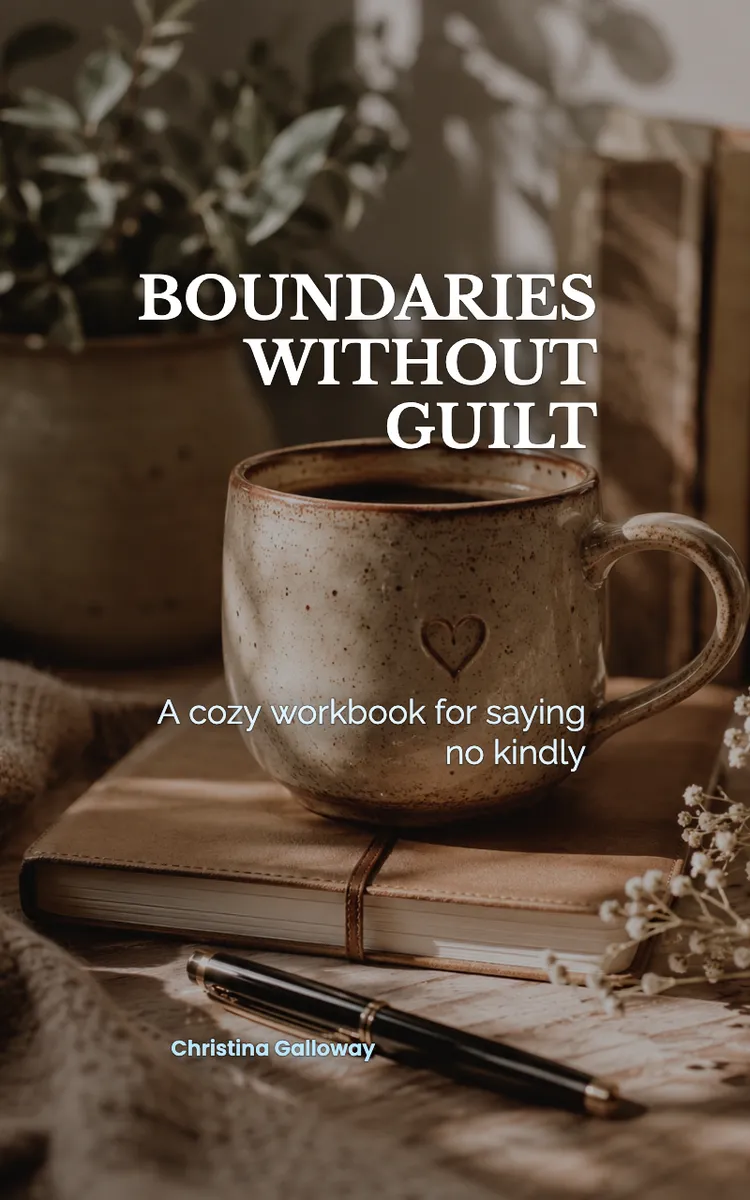
"Boundaries Without Guilt" is a workbook by Christina Galloway with 5 chapters and approximately 7,509 words. Trauma-informed boundary setting, guilt, and communication exercises.
This book was created using Inkfluence AI, an AI-powered book generation platform that helps authors write, design, and publish complete books. It was made with the Workbook Generator.
Frequently Asked Questions
What is "Boundaries Without Guilt" about?
Trauma-informed boundary setting, guilt, and communication exercises
How many chapters are in "Boundaries Without Guilt"?
The book contains 5 chapters and approximately 7,509 words. Topics covered include Why Boundaries Feel Impossible, Breaking People-Pleasing and Fawn, Emotional Labor, Guilt, and Family Dynamics, Healthy Communication and Boundary Scripts, and more.
Who wrote "Boundaries Without Guilt"?
This book was written by Christina Galloway and created using Inkfluence AI, an AI book generation platform that helps authors write, design, and publish books.
How can I create a similar workbook?
You can create your own workbook using Inkfluence AI. Describe your idea, choose your style, and the AI writes the full book for you. It's free to start.
Write your own workbook with AI
Describe your idea and Inkfluence writes the whole thing. Free to start.
Start writingCreated with Inkfluence AI


