
Read the first chapter
The whole of chapter one, free. About 8 min. Turn the pages with the arrows, your keyboard, or a swipe.
Chapter 1
Skills Education That Boosts Hiring
The first time you bring in a “good” candidate, and they still can’t do the job, you feel it in real time. Your service slows down, your customers notice, and your team spends the next few weeks teaching basics instead of hitting targets. Then you do the math: every hour you spend training a new hire is time you didn’t spend running your business, and every month you carry a weak fit costs you more than the salary ever will.
If you run a growing business-whether you own a restaurant, a trade company, or a small service shop-this chapter tackles the hiring problem you already know too well: you place ads, you interview, you hire… and you still pay for training because the education level you’re relying on doesn’t match what the role actually needs. The result looks like “high turnover” from the outside, but inside it usually feels like: wrong skills, unclear expectations, and an onboarding plan that keeps getting patched.
After this chapter, you will be able to build a simple Hiring Fit Scorecard that targets the exact skills your role needs, so you hire job-ready people faster and reduce training costs without lowering your standards.
Why This Matters
Growing businesses don’t fail because they can’t find workers. They fail because they can’t predict who will perform on day one. Traditional hiring often checks credentials-what school they attended, what degree they earned, what title they previously held. Credentials can help, but they don’t guarantee the candidate can run your systems, meet your standards, and handle your real workload.
The training cost shows up in three places: pay for training hours, mistakes that force rework, and the slow drift of team performance while everyone “catches up.” When you hire someone who needs weeks of coaching just to reach baseline, you also weaken your team’s confidence. Your best employees end up acting as backup instructors, and they quietly start looking elsewhere.
Targeted education solves this by narrowing the gap between what you need and what the candidate already knows. In the real world, that means you stop treating hiring like a gamble and start treating it like a measurable fit between your job and the training the person received. By the end of this chapter, you will know how to define job-ready skills, score candidates consistently, and connect education pathways to your hiring pipeline-so you hire with less waste and train less.
How It Works
The core idea behind the Hiring Fit Scorecard is simple: you turn your role into a checklist of skills that matter on your shop floor (or kitchen line, jobsite, front desk). Then you score candidates based on evidence that they can perform those skills, not on vague claims like “fast learner” or “works hard.”
This works because education, when it’s targeted, builds repeatable competence. A person who practiced the same kinds of tasks during their training can transfer those skills to their environment. A person who has only learned theory might still succeed, but you will spend more time testing, correcting, and reteaching.
Here’s how to build and use the scorecard.
• Define “day-one performance” for the role
Write what the person must do correctly in their first week to keep work moving. Use actions, not traits (for example, “takes correct orders using our menu flow” beats “communicates well”).
Concrete tip: for Tanya’s restaurant expansion, day-one performance for a line cook includes “runs a station without calling for constant help” and “follows plating and timing standards.”
• List the “Skill Blocks” tied to your workflow
Break the job into 5 to 8 Skill Blocks that match how your business actually runs. Each block should describe a cluster of tasks that usually go together.
Concrete tip: for a restaurant, Skill Blocks might include “order accuracy,” “prep discipline,” “food safety basics,” “ticket timing,” and “closing routine.”
• Attach evidence to each Skill Block
Decide what counts as proof. Evidence can come from work samples, a training certificate tied to the skill, a short practical test, or a structured interview question with a scoring rubric.
Concrete tip: Instead of asking “Are you good with food safety?” you can ask for a specific safe handling example and run a 10-minute scenario test.
• Score candidates with the same rubric every time
Use a 1-5 scale for each Skill Block, then total the score. The score tells you who needs minimal training versus who needs a full ramp-up.
Concrete tip: You can set a hiring threshold like “Hire if total score is 28 or higher out of 40,” then adjust after you review outcomes.
To make this real, let’s anchor it in Tanya, 34, a restaurant owner expanding to two locations. Tanya had a common problem: she hired based on experience, but her second location still took too long to reach steady service. Her team trained new hires on the same mistakes again and again: menu confusion, inconsistent timing, and sloppy closing habits. She didn’t need more interviews. She needed a consistent way to measure job-ready skills before hiring.
Tanya built her Hiring Fit Scorecard around the behaviors that kept service smooth: ticket timing, order accuracy, food safety basics, and closing routine. She replaced “tell me about yourself” with short practical checks and used the scorecard to compare candidates fairly. That change didn’t just make hiring faster; it made training shorter and less stressful, because the onboarding plan matched the gaps she could actually predict.
Putting It Into Practice
Use the Hiring Fit Scorecard in a repeatable way. The goal is to reduce training costs by hiring people who already match your baseline skills.
Step-by-step scenario: Tanya hires for her second location
• Pick one role to start
Tanya chose one role first: line cook for the busiest station. She resisted scoring every role at once because she wanted clean results.
• Write day-one performance in plain actions
She listed what a new line cook must do within seven days to keep tickets moving without constant correction. She ended up with 6 items, such as:
• follows prep list for the station with correct amounts
• uses the menu flow during rush without mixing items
• maintains ticket timing so food reaches the pass at the right pace
• Completes closing steps in order and leaves the station ready for open
• Build 6 Skill Blocks and define “good” for each
Tanya made 6 Skill Blocks. For each one, she wrote what “baseline” looks like and what “strong” looks like. Example Skill Blocks:
• Order accuracy on the line (baseline: catches obvious mistakes; strong: prevents mistakes under pressure)
• Ticket timing and pacing (baseline: keeps up most of the time; strong: stays consistent during rush)
• Food safety basics (baseline: follows safe handling steps; strong: explains why and avoids shortcuts)
• Prep discipline (baseline: completes assigned prep; strong: completes correctly and labels/organizes consistently)
• Station cleanliness and closing (baseline: completes steps; strong: finishes on time with correct setup)
• Team coordination (baseline: asks for help appropriately; strong: communicates before problems hit)
• Create evidence for each Skill Block
Tanya used three sources of evidence:
• a short scenario question for food safety basics
• a practical “station setup” check, where the candidate organizes prep correctly
• a structured interview prompt for ticket timing (“Describe how you handle a rush when tickets pile up”)
• Score candidates immediately after each part
Tanya didn’t wait until the end of the interview to remember details. She scored right after each check while the evidence still felt fresh.
• Set a hiring threshold and track training time
Tanya used a simple rule: if a candidate scored below baseline on two Skill Blocks, she hired only if the role allowed closer supervision. If they scored above baseline across most Skill Blocks, she hired and shortened onboarding.
• Turn the score into an onboarding plan
Tanya matched the onboarding effort to predictable gaps. If a candidate needed help in ticket pacing, she scheduled extra shadow shifts focused on timing, not general food safety lectures they already knew.
Quick checklist
• Write day-one performance as 5-8 action items for the role
• Split the job into 5-8 Skill Blocks that match your workflow
• Define “baseline” and “strong” for each Skill Block
• Choose evidence you can actually measure (scenario, practical check, work sample, rubric interview)
• Score every candidate the same way right after each evidence step
• Set a hiring threshold and record training hours for the next 30-60 days
Expected outcomes you can measure quickly
When you hire with the Hiring Fit Scorecard, you should see three measurable changes within the first month:
• You reduce “surprise training” because you hire for the skills you can test.
• You shorten onboarding because your training targets specific gaps, not general fundamentals.
• You improve team stability because your new hires reach baseline faster, so your staff stops repeating the same corrections.
What to Watch For
Over-scoring “experience” instead of scoring Skill Blocks
Many owners default to “They worked in a kitchen before, so they should know this.” That thinking breaks the scorecard because work history doesn’t prove your day-one performance.
Do this: Score candidates using your Skill Blocks and evidence (scenario test, practical station check, structured questions).
Not this: Use one job title as a shortcut and skip the evidence steps.
Making the Skill Blocks too broad
If your Skill Blocks cover everything, your score becomes blurry. You end up with the same problem you had before: training surprises and inconsistent performance.
Do this: Keep each Skill Block focused on a cluster of tasks your team can observe and correct quickly. Aim for 5-8 blocks for the first role.
Not this: Create 12-15 blocks with vague definitions like “communication” or “work ethic” that you can’t test fairly.
Skipping the feedback loop after hires
A scorecard that never improves turns into a rigid form. You’ll keep hiring the same “type” of candidate even if your onboarding needs change or your menu updates shift the required skills.
Do this: After each hire, review their score versus training hours and where they struggled. Adjust baseline definitions and evidence checks.
Not this: Keep the same rubric for six months without checking whether it predicts real day-one performance.
You now have the foundation: targeted education becomes useful for hiring when you translate it into job-ready Skill Blocks and measure them with the Hiring Fit Scorecard. Next, we’ll connect this scorecard to education choices-how to spot training programs, certificates, and course structures that actually produce the skills you scored, so your hiring pipeline feeds your standards instead of fighting them.
End of chapter one. 4 more chapters in the full book.
Swipe or use the arrows to turn the page

What's inside: 5 chapters
- 1. Skills Education That Boosts Hiring
- 2. Education as a Competitive Advantage
- 3. Training ROI Using Learning Metrics
- 4. Building a Workforce Learning Culture
- 5. Education’s Role in Local Economic Growth
About this book
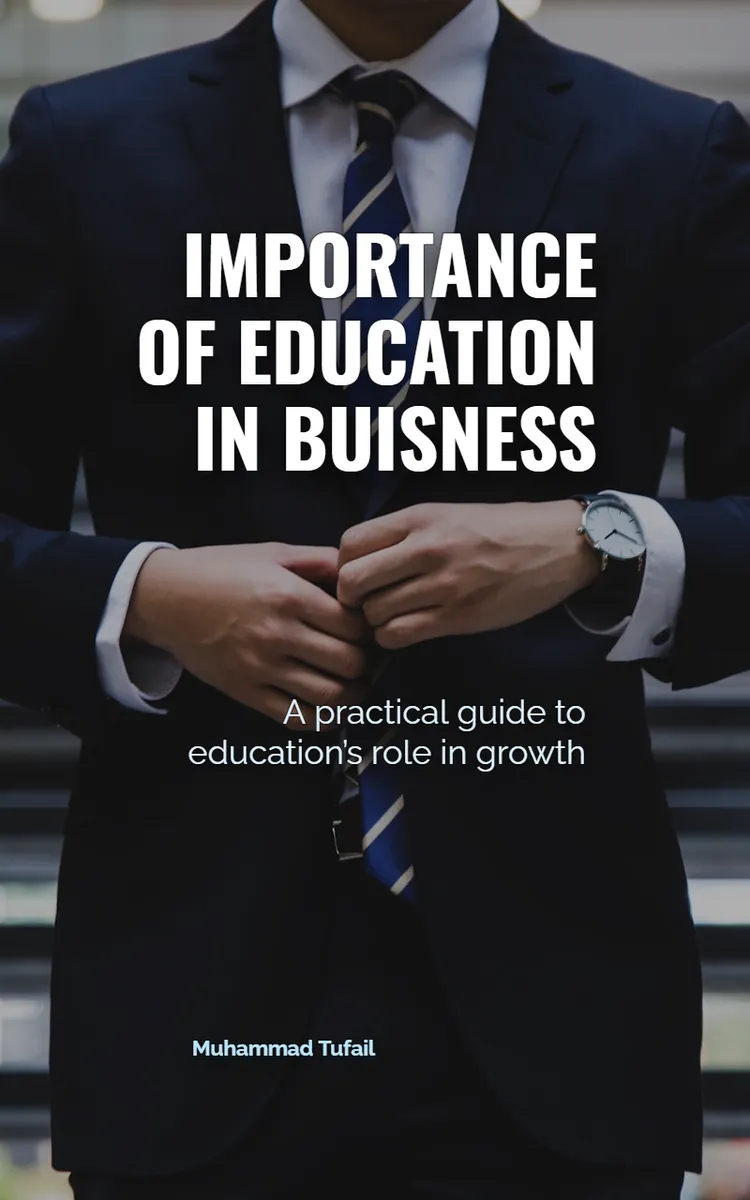
"Business Importance Of Education" is a business book by Muhammad Tufail with 5 chapters and approximately 9,359 words. How education impacts business success and economic growth.
This book was created using Inkfluence AI, an AI-powered book generation platform that helps authors write, design, and publish complete books. It was made with the AI Business Book Writer.
Frequently Asked Questions
What is "Business Importance Of Education" about?
How education impacts business success and economic growth
How many chapters are in "Business Importance Of Education"?
The book contains 5 chapters and approximately 9,359 words. Topics covered include Skills Education That Boosts Hiring, Education as a Competitive Advantage, Training ROI Using Learning Metrics, Building a Workforce Learning Culture, and more.
Who wrote "Business Importance Of Education"?
This book was written by Muhammad Tufail and created using Inkfluence AI, an AI book generation platform that helps authors write, design, and publish books.
How can I create a similar business book?
You can create your own business book using Inkfluence AI. Describe your idea, choose your style, and the AI writes the full book for you. It's free to start.
Write your own business book with AI
Describe your idea and Inkfluence writes the whole thing. Free to start.
Start writingCreated with Inkfluence AI


