
Read the first chapter
The whole of chapter one, free. About 12 min. Turn the pages with the arrows, your keyboard, or a swipe.
Chapter 1
A Morning That Won’t Return
The kettle began to scream before Mara was fully awake, a thin, bright sound that cut through the dim blue of the morning. In the hallway, the floorboards answered with a small creak as Theo padded out of his room in socks that didn’t match-one dinosaur, one plain grey. He paused by the kitchen doorway, hair sticking up on one side, and said, “Is it time for pancakes?”
Mara turned the stove knob down with her wrist still half asleep. The kitchen was warm from yesterday’s cooking, but the window glass had a film of frost that made the streetlights look like they were trapped behind gauze. She nodded toward the table where a plate was already set, as if the day had always been planned to keep going. “We’ll do pancakes. But you need to wash your hands first.”
Theo’s shoulders loosened in a way that made him seem older than he was. He took off across the kitchen, bare feet slapping the tile, and Mara heard the water start, steady, familiar. Beside her, Eli found the syrup bottle without looking, his fingers moving the way they always did, like muscle memory could protect them from anything that might come. His shirt was on inside out, and he didn’t seem to notice. Mara did, and it made her chest feel tight with something that was almost laughter.
She poured batter, watching the first bubble rise and pop. The smell of flour and warm milk filled the room, softening the sharp edge of the morning. Eli leaned in to help, shoulder brushing hers. “We’re going to be late,” he said, but his voice was light. “Theo’s going to eat the whole stack.”
“Then we’ll be late with full bellies,” Mara answered.
Theo reappeared with wet hands, rubbing his palms together too hard. “I want the one with the blueberries,” he said, and then, as if he’d remembered something important, he added, “The ones you said are ‘tiny suns.’”
Mara smiled, though her lips felt stiff. “Tiny suns,” she confirmed, and Eli’s laugh came out like a quick exhale.
The pancakes turned out golden at the edges. Theo sat with his back straight, legs kicking under the chair, and Eli began cutting and stacking as though they were building something that couldn’t break. Mara watched them both, the way her mind liked to store moments for later-Eli’s dark lashes against his cheek when he leaned close, the crumbs Theo wiped onto his sleeve like he was marking a victory. She pressed her thumb into a blueberry on her plate, waiting for the burst of sweetness, and for a few minutes the world stayed exactly the size of their kitchen.
Then the knock came.
It wasn’t loud. It was the kind of knock that belonged to neighbors, to someone who’d forgotten a package, to a delivery that had the wrong address. But it struck the air like a dropped spoon, small, unmistakable, wrong in the middle of breakfast.
Eli’s fork hovered. Mara felt the motion of the room shift, as if the walls had leaned in to listen. Theo blinked, syrup on his chin, and said, “Is it for us?”
Eli stood slowly, wiping his hands on a towel that already had his handprints on it. “Stay seated,” he told Theo, soft but firm. His eyes flicked to Mara. In them was a question without words: neighbor, mail, something ordinary. Mara nodded once, because nodding was something she could do.
Eli opened the front door.
Cold air pushed in, carrying the smell of damp pavement and the faint metallic tang of winter. A woman stood on the porch in a thick coat, hair pulled back tight, her face pale in a way that made Mara’s stomach sink before she could name why. She held a clipboard against her chest with both arms, like she was trying to keep herself from shaking.
“Eli Calder?” the woman asked.
Eli’s mouth opened, then closed. “Yes. Can I help you?”
The woman swallowed. “I’m sorry to bother you so early. I’m from the school bus contractor-” She stopped, and her voice tightened around the edges. “There’s been an issue with the route.”
Theo’s chair scraped against the kitchen tile behind Mara, and she heard the quick, eager way his voice rose. “Is the bus late? Can we still go to the library?”
Mara’s hand went to the counter without her thinking, fingers curling around the edge to steady herself. “We’re not-” she started, then stopped. The woman’s eyes slid past Eli to Mara, and the clipboard shifted in her grip.
“It’s not late,” the woman said. “It’s… It’s cancelled. For today.”
Eli’s expression didn’t change at first. It stayed blank, as though his face didn’t know how to react yet. Then he let out a breath that sounded like it had been trapped in his lungs for too long. “Cancelled? Why?”
The woman looked down at her clipboard and back up again. “There was a mechanical failure reported overnight. The replacement bus isn’t available until later. The school will send a note.” Her words were careful, rehearsed-sounding, but her hands betrayed her. They were trembling just enough.
Mara tried to keep her voice calm. “Theo has school. He’s got-” She stopped herself from saying more. She didn’t want to list the parts of their day like they were evidence. “What time does the school say?”
The woman hesitated. “They said… they’re asking parents to keep their children home until they can confirm alternate transportation. I’m sorry.”
Theo’s face fell so quickly it startled Mara. The blueberry on his plate had gone soft. He set his fork down with a clack. “But today is show-and-tell,” he said, as if the fact could make the world obey him. “I have my dinosaur.”
Eli’s hand moved to Mara’s shoulder for a second, warm through her shirt. “It’s okay,” he said to Theo, and the words were meant to be a bridge. “We’ll figure it out.”
Mara watched the woman on the porch. “Who told you this?” she asked, and her tone sharpened despite her effort to keep it gentle.
The woman blinked. “The dispatch line. And the school’s automated message.”
Eli shifted his weight. “When will the message come through?”
The woman’s eyes flicked toward the street, toward a car idling somewhere out of sight. “It should be soon. I don’t have-” Her voice caught again. “I’m sorry.”
Mara realized the woman hadn’t introduced herself. She realized she hadn’t offered a phone number, hadn’t said she’d help. She realized that her apology sounded like a door closing.
Eli opened his mouth, then closed it, as if he didn’t trust his own words. Mara stepped forward, pulling the door wider with her hip. “Thank you,” she said, and made her face friendly because politeness was a habit, not a shield.
When the woman finally walked down the porch steps, her coat brushed the rail with a whisper. The engine of her car started, then faded into the morning noise of distant traffic. The door clicked shut, and the kitchen felt suddenly too quiet, as if the pancakes had stopped being pancakes and started being something else.
Theo stared at his plate. “So… no school,” he said, but it sounded like he was testing the sentence to see if it could change.
Eli crouched to Theo’s level, smoothing his hand over Theo’s hair. “We’ll do something else,” he promised. “A new plan.”
Mara’s mind ran through options so fast she could almost hear the wheels. Daycare might have space. A neighbor might drive. The library was on their list because it was safe and bright and familiar. She could still make it happen. She could still keep the morning from collapsing.
She reached for her phone. The screen lit up in her palm with the familiar glow, and she tapped until the school’s contact page appeared.
The message on the bus contractor’s website was there already, posted at dawn. Route cancelled. Alternate transportation pending. Keep children at home until further notice.
It wasn’t the information itself that tightened her throat. It was the timing. The way the cancellation landed was like a hand closing over their plans.
Eli stood and leaned on the counter, looking at her phone as if it might change if he stared hard enough. “We can call the school,” he said.
“We should,” Mara agreed. She dialed, listening to the ringing fill the kitchen. Each ring sounded longer than it should have.
Theo climbed into his chair again, hands twisting together. “But Mr. Finch will be sad,” he said. “He likes dinosaurs.”
Mara forced her eyes down to Theo’s face. “We’ll tell him,” she said, and her voice softened. “We’ll tell him later.”
The line clicked. A woman answered, cheerful in the way people were trained to be before bad news entered the room. “School office, how can I help?”
Mara gave the name of the school, and then her own information, and then the woman on the phone began speaking about dispatch lines and safety protocols. Words like “pending” and “until further notice” sounded like a fog rolling in.
Eli’s hand came down on the counter beside Mara’s, grounding her. “When can we expect confirmation?” he asked.
The woman paused. “I-” Another pause, longer. “I’m not seeing the alternate route update yet. The message went out. It should be-”
Mara could hear a sound in the background on the call: a murmur, maybe a radio, maybe someone else talking. The voice on the phone shifted, as if someone had leaned in to whisper.
Then she said, very quietly, “There’s been an incident.”
Eli straightened so fast that Mara felt it in her own body. “What incident?” he demanded, and Theo flinched, the way children did when adult voices turned sharp.
The woman on the phone cleared her throat. “A call came in about a vehicle. We’re… we’re still waiting on details. For now, keep children at home.”
Mara didn’t breathe. She heard her own heartbeat under the words, a steady insistence that something was wrong and she needed to catch up to it.
“What kind of incident?” Mara asked.
The phone woman hesitated again, and Mara realized she was choosing each word as if it could cut. “We don’t have- not for sure. I’m sorry.”
Eli took the phone from Mara’s hand before she could stop him. “Can you transfer me to dispatch?” he asked.
“I can try-”
Eli didn’t wait for permission. He held the phone to his ear and paced the kitchen, boots squeaking on tile. “Theo,” he said quickly, as if he could hold the child’s world still by naming him. “We’re not going anywhere until we hear more.”
Theo’s lower lip trembled. “Is someone hurt?” he asked. He was too young to understand how to ask that question gently.
Mara knelt beside him, keeping her hands on his shoulders. “No one is hurt,” she said, and she heard how it sounded-too much like a wish. She tried again, softer. “Not that we know. We’re waiting to hear.”
Eli’s voice returned from the phone, clipped and urgent. “Dispatch?” he said, and then, “Yes, this is Eli Calder, I need-”
Mara listened without meaning to. The kitchen seemed to sharpen around the edges. The refrigerator hum grew louder. The window frost glittered where the light hit it. Theo’s breath came fast, and Mara could feel the warmth of his body through her palms.
Eli ended the call too quickly, pressing a finger to the screen as if he could stop the conversation from continuing. He turned to Mara, eyes wide and dark.
“What?” Mara asked.
Eli swallowed. “They said… there’s a delay. They said the vehicles are involved in an accident. They didn’t say whose.” He rubbed his face with the heel of his hand, leaving a red mark at his jaw.
Theo let out a small sound, half question, half grief. “Our bus?”
Eli’s mouth tightened. “They don’t know,” he repeated, like saying it enough times could fill in the blanks. “But they said to keep Theo home.”
Mara’s head spun, but one thought steadied her like an anchor. If the bus were involved, then other parents would be calling, checking, and panicking. The school would send a message with names or numbers, and they would know soon enough.
She reached for her phone again, tapping until the school’s alerts loaded. The Wi-Fi icon spun and spun as if it couldn’t decide whether to help. Mara stared at the screen until her eyes burned.
Eli leaned in close, his forehead almost touching hers. “We’re going to get the message,” he said.
“We have to,” Mara replied.
Theo’s hands were damp now, palms slick against Mara’s fingers. He looked between them as if trying to read the future off their faces. “Can I go play?” he asked, and his voice was small, a child offering normal because he didn’t know what else to offer.
Mara managed a nod. “Ten minutes,” she said, and the lie felt like a blanket she could wrap around him. “Then we check again.”
Eli stood and guided Theo toward the living room, where a toy dinosaur sat on the rug like it had been waiting for this exact moment. Theo clutched it in both hands. “It’s a good dinosaur,” he whispered, as if the dinosaur could defend them.
Mara watched them from the kitchen doorway. Eli picked up Theo’s backpack and set it by the door, though they weren’t going anywhere. He straightened a small blanket on the couch with unnecessary care, then smoothed it again.
The phone buzzed suddenly, a hard vibration that made Mara flinch.
A new alert filled the screen. School district emergency update. Limited information at this time. Avoid calling the office. Stay tuned for further instructions.
Underneath, a second line appeared as the system tried to pull more data: “Please keep students at home. If your child is on Route 12, remain available for contact.”
Route 12.
Theo’s dinosaur clacked against the rug as he shifted his weight. Mara felt Eli’s gaze on her, sharp and searching. She read the message twice, then a third time, as if repetition could soften it.
Eli walked back into the kitchen and took the phone from her hand without asking this time. “Theo takes Route 12,” he said, and his voice didn’t sound like Eli’s voice. It sounded like someone else wearing it.
Mara’s mouth went dry. “Theo,” she called, and her voice cracked on the word. She stood and went to him, kneeling again so she could see his face. She needed him to look at her, to anchor to something that didn’t change.
Theo stared up at her, eyes bright and frightened. “Does that mean my dinosaur is coming?” he asked, and the question was so innocent it hurt.
Mara swallowed. The kitchen was too warm. The air felt thick, like it had been poured. She squeezed Theo’s shoulders gently, careful not to startle him. “It means we’re going to be patient,” she said, and heard herself trying to sound like the person he knew.
Eli stood behind her, one hand on the back of the couch. He looked toward the window as if the street might explain. “We’ll hear from the school,” he said, but it didn’t sound like a promise anymore. It sounded like a prayer.
Mara opened her mouth to say something reassuring, something solid-and then her phone rang again, not a notification, not an alert. A call. Unknown number.
Eli’s eyes snapped to the screen.
Theo’s breathing stopped for a beat, and when it resumed, it was too fast. Mara felt the vibration in her palm as she answered, the world holding steady on the edge of whatever came next.
End of chapter one. 4 more chapters in the full book.
Swipe or use the arrows to turn the page

What's inside: 5 chapters
- 1. A Morning That Won’t Return
- 2. The Phone Call No One Wants
- 3. When Blame Splits the Bed
- 4. The Hospital Room’s Quiet After
- 5. Learning to Love the Loss
About this book
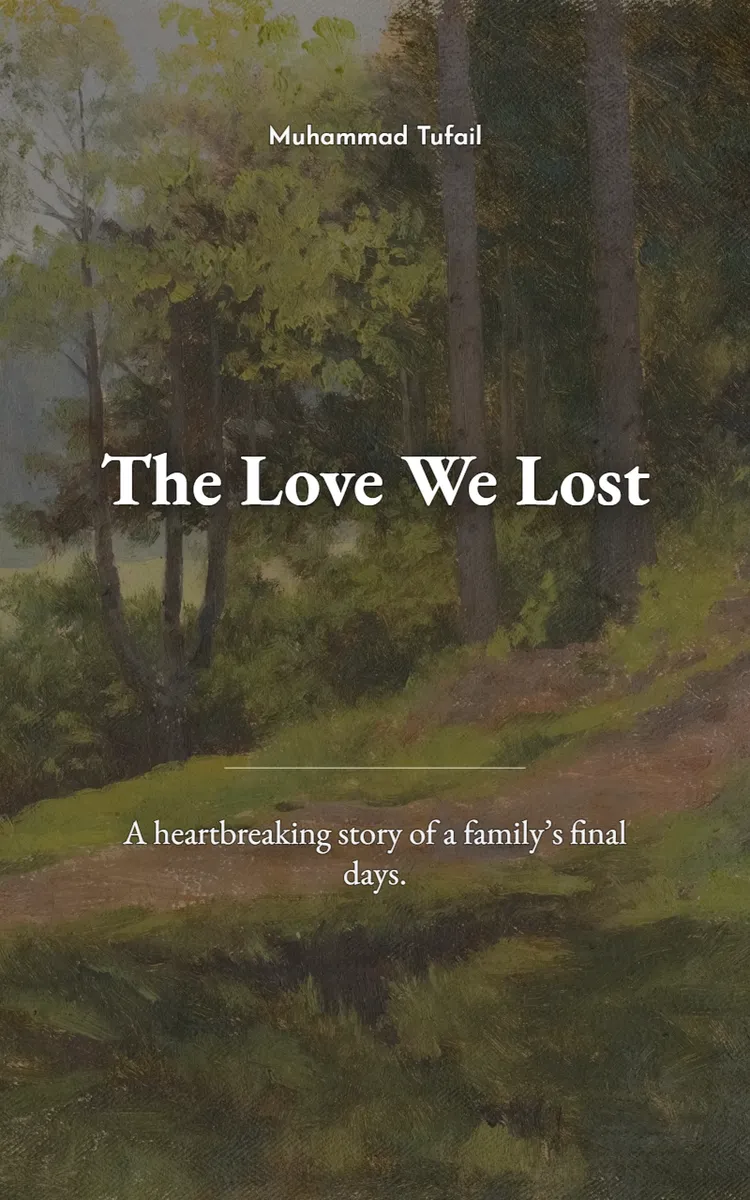
"The Love We Lost" is a fiction book by Muhammad Tufail with 5 chapters and approximately 14,811 words. A couple and their child facing a tragic loss.
This book was created using Inkfluence AI, an AI-powered book generation platform that helps authors write, design, and publish complete books. It was made with the AI Novel Writer.
Frequently Asked Questions
What is "The Love We Lost" about?
A couple and their child facing a tragic loss
How many chapters are in "The Love We Lost"?
The book contains 5 chapters and approximately 14,811 words. Topics covered include A Morning That Won’t Return, The Phone Call No One Wants, When Blame Splits the Bed, The Hospital Room’s Quiet After, and more.
Who wrote "The Love We Lost"?
This book was written by Muhammad Tufail and created using Inkfluence AI, an AI book generation platform that helps authors write, design, and publish books.
How can I create a similar fiction book?
You can create your own fiction book using Inkfluence AI. Describe your idea, choose your style, and the AI writes the full book for you. It's free to start.
Write your own fiction book with AI
Describe your idea and Inkfluence writes the whole thing. Free to start.
Start writingCreated with Inkfluence AI


