
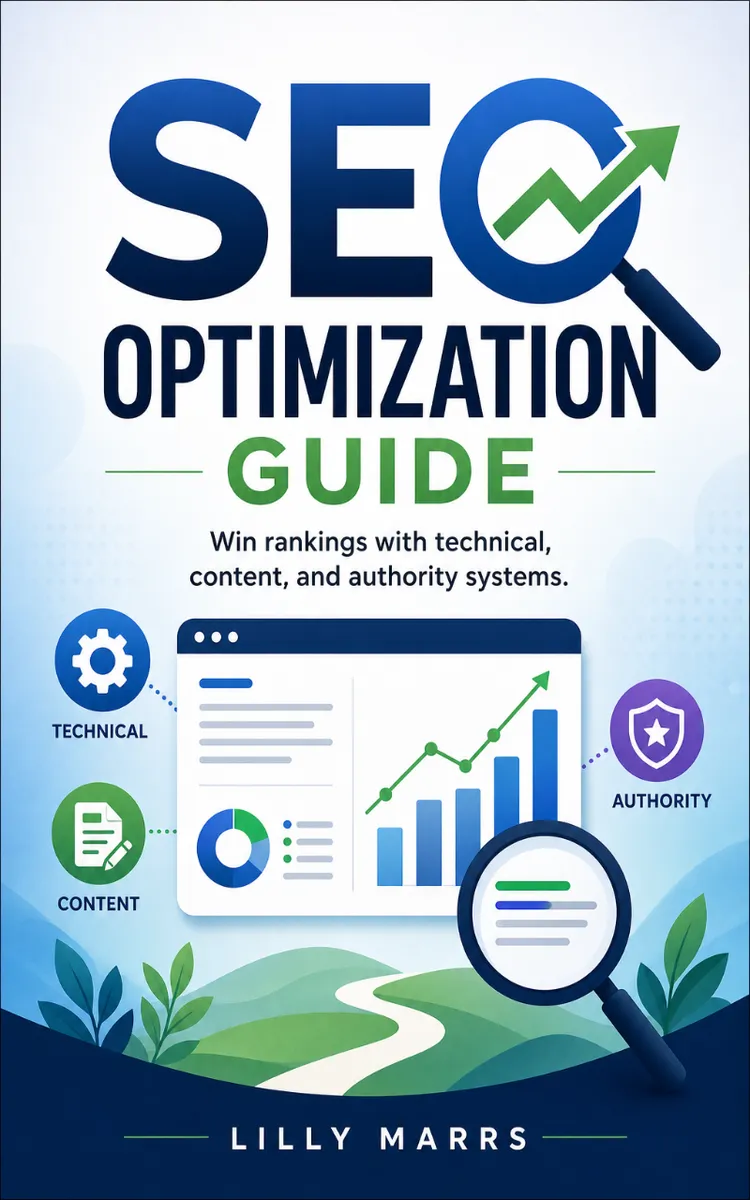

Read the first chapter
The whole of chapter one, free. About 11 min. Turn the pages with the arrows, your keyboard, or a swipe.
Chapter 1
SEO Fundamentals
Understanding Search Engine Optimization: The Long Game That Wins
Search engine optimization can feel like dark magic. You implement changes, wait weeks or months, and hope Google notices. Rankings fluctuate mysteriously. Competitors appear and disappear from results without obvious explanation. Advice is contradictory: some experts say keywords matter most, others insist it's all about links, still others claim technical factors dominate. Most businesses dabble in SEO half-heartedly, see mediocre results, and conclude it doesn't work. They're wrong. SEO works exceptionally well-but only when you understand how search engines actually work and commit to strategies aligned with that reality rather than shortcuts and myths.
The fundamental misunderstanding about SEO is thinking it's about tricking search engines into ranking your content higher. This mindset leads to manipulative tactics that sometimes work temporarily but eventually get penalized. The reality is simpler and more profound: search engines want to deliver the best possible results to users. Your goal isn't tricking Google-it's genuinely being the best result for specific searches. When you provide the most valuable, relevant, comprehensive content for a search query, search engines want to rank you highly because it makes them look good. Your success and theirs align perfectly.
This chapter establishes the foundational understanding that separates businesses succeeding with SEO from those perpetually frustrated by it. You'll learn how search engines actually work, what they're trying to accomplish, and how to align your website and content with those goals. This isn't about gaming algorithms-it's about building online presence that deserves visibility because it genuinely helps people. That approach creates sustainable, long-term SEO success immune to algorithm updates and competitive pressure.
Overview
• Understand how crawling, indexing, and ranking actually work.
• Use a four-pillar framework to prioritize what matters.
• Set goals tied to leads and revenue, not vanity metrics.
How Search Engines Actually Work: Crawling, Indexing, and Ranking
Understanding search engine mechanics removes the mystery and reveals exactly what you need to optimize. Search engines follow a predictable three-stage process that, once understood, makes SEO logic obvious rather than mystical.
Crawling is how search engines discover content. Google's bots (called "spiders" or "crawlers") constantly navigate the internet following links. They start on known pages and follow every link to discover new pages. They return regularly to known pages checking for updates. If your page isn't linked from anywhere, crawlers can't find it. If your page is linked from many high-quality sites, crawlers visit frequently. This is why new websites with no inbound links struggle initially-search engines simply don't know they exist yet.
Your technical responsibility is ensuring crawlers can easily discover and navigate your entire site. This means a logical link structure where every important page is linked from somewhere. It means having an XML sitemap (a file listing all your pages) that you submit to Google Search Console. It means avoiding technical barriers that block crawlers like complex JavaScript or pages hidden behind login requirements. When crawlers can easily discover and navigate your site, you've cleared the first hurdle.
Indexing is how search engines understand and store content. After crawling a page, search engines analyze its content: What's it about? What topics does it cover? What questions does it answer? What's the quality level? This information gets stored in massive databases indexed by topic, allowing near-instant retrieval when someone searches. If Google hasn't indexed a page, it can't appear in search results regardless of quality.
Most pages get indexed automatically if they're crawlable and contain unique, valuable content. Problems arise when pages have duplicate content (exact copies of other pages), thin content (too little substance to judge quality), or technical issues preventing understanding. Ensuring your important pages are indexed is foundational-check Google Search Console to see which pages are indexed and troubleshoot any that aren't.
Ranking determines what order indexed pages appear for specific searches. This is where most SEO focus goes because ranking directly impacts traffic. When someone searches, Google's algorithm evaluates billions of indexed pages in milliseconds, scoring each on hundreds of factors to determine which are most relevant and valuable for that specific query. The highest-scoring pages rank first.
Ranking factors are famously complex and constantly evolving, but several categories consistently dominate: relevance (does the page actually address the search query?), authority (is this source credible and trustworthy?), user experience (is the page fast, mobile-friendly, and easy to use?), and engagement (do users find this result satisfying?). Obsessing over specific ranking factors is less useful than understanding these broad categories and optimizing your entire web presence across all of them.
The Four Pillars of SEO: A Holistic Framework
SEO isn't one thing-it's an integrated system where multiple components work together. Neglecting any pillar undermines the others. Mastering all four creates compound advantages competitors struggle to match.
Technical SEO is your foundation. If your website has technical problems, brilliant content won't save you. Technical SEO ensures search engines can easily crawl, index, and understand your site. It encompasses site speed (faster sites rank better and retain users more effectively), mobile-friendliness (most searches now happen on mobile, so mobile optimization is mandatory), secure connections (HTTPS is now expected), clean site architecture (logical URL structure and internal linking), and structured data markup (code helping search engines understand your content).
Technical SEO isn't sexy, but it's essential. You can't out-content your way past slow page loads or mobile usability disasters. Many businesses ignore technical SEO until it becomes crisis. Smart businesses audit technical health regularly and fix issues proactively. Tools like Google Search Console, Screaming Frog, and GTmetrix identify technical problems clearly. Investment in technical excellence pays dividends across all other SEO efforts.
On-page SEO optimizes individual pages for both search engines and users. This encompasses keyword targeting (what specific searches should this page rank for?), content quality and comprehensiveness (does this page thoroughly address its topic?), title tags and meta descriptions (do they accurately summarize content while encouraging clicks?), header structure (is content organized logically with H1, H2, H3 tags?), internal linking (do you link to relevant related content on your site?), and image optimization (are images properly sized, compressed, and described with alt text?).
On-page optimization is where content strategy and SEO intersect. Every page should target specific search queries while providing exceptional value to human visitors. This isn't keyword stuffing or optimizing for robots-it's creating the most helpful resource available for topics you target. When you nail on-page SEO, individual pages become powerful organic traffic drivers that continue generating visitors for years with minimal ongoing effort.
Off-page SEO builds your site's authority and credibility. The most important off-page factor is backlinks-links from other websites to yours. Search engines view backlinks as votes of confidence: if respected sites link to your content, it must be valuable. But not all backlinks are equal. One link from a major industry publication is worth more than dozens of links from random blog comments or directory submissions. Quality dramatically outweighs quantity.
Building high-quality backlinks requires creating genuinely valuable content people want to reference, building relationships with others in your industry, contributing expert perspectives to publications, and earning media mentions. It's the slowest, hardest aspect of SEO, which is exactly why it's so valuable-competitors can't easily replicate years of accumulated link authority. Patience and consistency in off-page SEO compound into nearly unassailable competitive advantages.
User experience determines whether SEO translates to business results. You can rank first, but if users immediately bounce back to search results because your site is slow, confusing, or unhelpful, rankings will degrade. Modern search algorithms incorporate user experience signals: do people click your result? Do they stay or immediately return to search? Do they navigate to other pages or leave quickly? Positive engagement signals reinforce rankings. Negative signals erode them.
User experience optimization is SEO insurance ensuring rankings translate to actual traffic and business value. Fast load times, mobile-friendly design, clear navigation, readable typography, compelling visuals, and valuable content create positive experiences users reward with engagement. This isn't just good for SEO-it's good for conversions. The overlap between SEO best practices and conversion optimization best practices is enormous. Optimizing for one benefits both.
Setting Realistic SEO Goals Aligned With Business Outcomes
Bad SEO goals produce bad outcomes. "Rank #1 for [competitive keyword]" sounds clear but might not drive business results. "Increase organic traffic 50%" sounds great but what if it's all low-quality traffic that never converts? Strategic SEO goals connect rankings and traffic to actual business outcomes like leads, sales, and revenue.
Start with business goals and work backward to SEO metrics. If you need to generate 50 qualified leads per month from your website, and your lead conversion rate is 2%, you need 2,500 visitors. If 30% of traffic comes from organic search currently, you need roughly 850 organic visitors monthly. Now you have a clear SEO target connected to business outcomes. Breaking this down further: which keywords do qualified prospects search? How much traffic does ranking for each keyword typically generate? Which keywords are achievable given your current authority?
This backward planning from business outcomes prevents vanity metric obsession. Who cares if you rank for thousands of keywords if none drive qualified traffic? Who cares if organic traffic doubles if it's all information seekers who never buy? Connect SEO metrics to revenue and leads from the start. This focuses efforts on SEO that actually matters.
Short-term vs long-term goal balance. SEO is inherently long-term-major results typically require 6-12 months of consistent effort. But you need shorter-term wins maintaining momentum and demonstrating progress. Balance long-term goals (rank for competitive head terms, build domain authority to 50+, generate 50% of leads from organic) with short-term milestones (publish 20 optimized articles this quarter, earn 10 quality backlinks, improve technical SEO score to 90+, rank in top 10 for 5 long-tail keywords).
Short-term milestones provide concrete targets your team can control through execution. Long-term goals provide direction and vision. Both are necessary for sustained SEO success.
Competitive reality check. If you're a brand new website in a competitive space, ranking for ultra-competitive keywords in six months is unrealistic. Established sites with years of content and backlinks dominate those searches. This doesn't mean SEO won't work-it means targeting appropriately. New sites should target long-tail, less competitive keywords first, building authority gradually before attacking competitive terms. A realistic 12-month goal might be ranking for dozens of long-tail keywords generating meaningful traffic rather than ranking for a few ultra-competitive head terms.
Analyze what competitors actually rank for. How much content do they have? How many backlinks? How long have they been established? This reveals what's actually achievable given your starting point and resources. Ambitious goals are good. Impossible goals are demoralizing and lead to abandoning SEO before it has time to work.
Debunking Common SEO Myths That Waste Time and Money
SEO advice is rampant, much of it outdated, oversimplified, or outright wrong. These myths persist because they contain tiny kernels of truth wrapped in massive misunderstanding. Debunking them prevents wasted effort on tactics that don't work or actively harm your rankings.
Myth: Keyword density is what matters most. Old-school SEO obsessed over keyword density-using your target keyword exactly 2-3% of the time supposedly optimized perfectly. This led to awkward, repetitive writing stuffed with keywords at the expense of readability. Modern search algorithms are far more sophisticated, understanding context, synonyms, and related concepts. They penalize obvious keyword stuffing while rewarding natural, comprehensive content.
Reality: Write naturally for humans first. Include your target keyword where it makes sense (title, first paragraph, headers) but focus on thoroughly covering the topic. Use synonyms and related terms. If your content is genuinely about the topic, relevant keywords will appear naturally without forced optimization.
Myth: You need thousands of backlinks to rank. The focus on backlink quantity leads to spammy link building: buying links, participating in link schemes, submitting to hundreds of directories. These tactics either don't work or actively trigger penalties. What actually matters is quality links from relevant, authoritative sources. One link from a major industry site is worth more than 1,000 low-quality directory links.
Reality: Focus on earning high-quality links through exceptional content, strategic relationships, and genuine value creation. Ten great links beat 1,000 mediocre ones. Link building is slow, but quality links compound dramatically over time while low-quality links provide little value and potential risk.
Myth: SEO is a one-time project. Many businesses treat SEO like website design: hire someone to "do SEO," implement changes, then forget about it. This fails because search algorithms evolve, competitors improve their SEO, new content opportunities emerge constantly, and technical issues develop over time. SEO is ongoing, not one-time.
Reality: Successful SEO requires continuous effort: regularly publishing new content, updating existing content, monitoring technical health, building relationships for links, analyzing performance and adjusting strategy. Think of SEO as gardening rather than construction-it requires consistent tending, not just initial building.
Myth: Social media directly impacts search rankings. Social shares and engagement feel like they should improve SEO-and indirectly they sometimes do-but social signals aren't direct ranking factors. Google has repeatedly confirmed social metrics don't directly influence rankings. However, viral content often earns backlinks and traffic, which do impact rankings.
Reality: Focus social media efforts on building audience and driving traffic rather than expecting social activity to directly boost rankings. The indirect benefits can be substantial, but don't sacrifice link building or content creation to boost social metrics that don't directly impact SEO.
Myth: More pages automatically means better SEO. The belief that sheer content volume matters most leads to factories pumping out thin, mediocre content hoping quantity compensates for lack of quality. Modern algorithms punish thin content and reward comprehensive, valuable content. Ten exceptional pages dramatically outperform 100 mediocre ones.
Reality: Quality over quantity, always. One exceptional, comprehensive guide ranking for dozens of related keywords generates more traffic than ten shallow articles each targeting one keyword. Build depth before breadth. Master your core topics with world-class content before expanding to tangential topics.
SEO fundamentals haven't changed as much as tactics and best practices. Search engines want to deliver valuable, relevant results. Your job is genuinely being that valuable, relevant result-not just appearing that way through manipulation. Build technical excellence. Create exceptional content. Earn credibility through quality backlinks. Provide outstanding user experience. Do this consistently for months and years, and SEO becomes your most valuable, sustainable marketing channel. Cut corners or chase shortcuts, and you'll perpetually fight algorithm updates and competitors while getting mediocre results. The choice, and the results, are yours.
Action Steps
• Verify crawl + index status in Google Search Console.
• Audit one core page for relevance, UX, and technical issues.
• Identify 10 keywords your best customers likely search.
• Choose one content topic to build authority around this quarter.
• Set one SEO goal that maps to revenue (e.g., qualified leads/month).
Key Takeaways
• SEO rewards being the most helpful, credible result.
• Technical health, content, authority, and UX work together.
• Sustainable growth comes from consistent execution over time.
End of chapter one. 2 more chapters in the full book.
Swipe or use the arrows to turn the page

The World In Chaos 6x9 Interior

When Everyone Else Has Moved On 8 5x11 196p REVISED v3

The Blind Spot of Reality EDITED Garamond 6x9
What's inside: 3 chapters
- 1. SEO Fundamentals
- 2. Keyword Research & Content Strategy
- 3. Technical SEO & Performance
About this book
"SEO Optimization Guide" is a general book by Lilly Marrs with 3 chapters and approximately 7,809 words. Practical SEO strategies to improve search rankings, drive organic traffic, and grow online visibility..
This book was created using Inkfluence AI, an AI-powered book generation platform that helps authors write, design, and publish complete books.
Frequently Asked Questions
What is "SEO Optimization Guide" about?
Practical SEO strategies to improve search rankings, drive organic traffic, and grow online visibility.
How many chapters are in "SEO Optimization Guide"?
The book contains 3 chapters and approximately 7,809 words. Topics covered include SEO Fundamentals, Keyword Research & Content Strategy, Technical SEO & Performance.
Who wrote "SEO Optimization Guide"?
This book was written by Lilly Marrs and created using Inkfluence AI, an AI book generation platform that helps authors write, design, and publish books.
Write your own book with AI
Describe your idea and Inkfluence writes the whole thing. Free to start.
Start writingCreated with Inkfluence AI


