

Read the first chapter
The whole of chapter one, free. About 8 min. Turn the pages with the arrows, your keyboard, or a swipe.
Chapter 1
Identity Declaration
A disciplined life doesn’t start with willpower. It starts with a name. Not a nickname or a vibe - an identity declaration so clear you could point at it and say, “That’s the person I’m building.”
Because here’s the trap: your brain can’t reliably protect what it can’t describe. When you don’t name who you are, you end up negotiating with yourself every time something gets uncomfortable. And discomfort is where discipline lives. So we’re going to do the one thing most people avoid because it feels… too real. We’re going to write your declaration.
The foundation is simple and brutal: You cannot pursue what you haven't named. If your goals are loud but your identity is fuzzy, you’ll chase hard - then stall the moment the chase stops feeling heroic. Naming fixes that. It turns “someday” into “this is what I do,” and it makes your future self harder to ignore.
The Power of Naming: Why Your Brain Follows Labels
Your mind is always running two tracks. One track is your actions. The other track is your explanations. The problem is that most people let the explanations stay vague until they’re drowning in choices.
When you name your identity, you give your brain a stable reference point. Then every decision becomes a comparison: Does this match the person I declared? Not Do I feel like it? Not Am I in the mood? The declaration becomes a filter.
Think about the last time you told yourself a story like, “I’m just not that kind of person.” That story wasn’t neutral. It was a command. It set the boundary before you even tried. The same thing happens in the other direction. When you declare, “I’m the kind of person who finishes,” you’re not changing your circumstances - you’re changing your decision rules. Your behavior gets dragged toward the label, even when it’s annoying.
Naming also changes the emotional temperature of your work. Without a declaration, effort feels like a random bet. With one, effort feels like maintenance. You’re not “trying.” You’re showing up as yourself.
And if that sounds intense, good. Intensity is the signal that you’re touching something real.
Choosing Your Identity Declaration: Specific, Not Cool
Your declaration can’t be a slogan. It has to be specific enough that your actions will either confirm it or betray it. If it’s too broad - “I’m successful,” “I’m disciplined,” “I’m a better version” - you’ll get away with sloppy behavior because the target is fuzzy.
A strong identity declaration answers three questions without you having to think hard:
First, what do you do consistently? Not once, not when it’s convenient - consistently. Second, what do you protect even when you’re tired? Third, what do you refuse to bargain away?
Here’s the shift: you’re not naming an outcome. You’re naming a pattern. “I’m someone who keeps promises” beats “I’m someone who wins.” Outcomes can fluctuate. Patterns are what you can build.
You can use simple language. You don’t need poetry. The goal is clarity you can feel in your day.
Try this approach while you write: start with “I’m the kind of person who…” then finish with a behavior. Then add the condition you’ll face. “Even when…” and describe the moment you usually fold.
That last part matters. Most declarations fail because they ignore friction. You want a declaration that survives the moment you normally make excuses.
If you’re stuck, pick the behavior you’re already pretending you’ll do later. The one you keep “almost” doing. That’s usually the identity hiding behind your current habits.
Writing the Declaration: A Fill-in-the-Blank You’ll Actually Follow
Let’s make this concrete. You’re going to produce one declaration you can read out loud. One sentence. Not a paragraph. Not a manifesto. One sentence that makes your choices easier.
Use this structure:
“I’m the kind of person who __ even when __.”
Fill the first blank with a repeatable action. Fill the second with the real-world pressure you’ll meet. Not an imaginary obstacle. Your actual obstacle.
Examples (and yes, you should tailor them, not copy them): - “I’m the kind of person who starts before I feel ready, even when I’m drained.” - “I’m the kind of person who honors my training schedule, even when work runs late.” - “I’m the kind of person who tells the truth about my numbers, even when I’d rather spin them.”
Notice what these do. They don’t beg for motivation. They describe the behavior you’ll default to under stress. That’s the whole game.
Now here’s the part people skip because it feels like homework: test the sentence against reality. Can you imagine yourself breaking it? If yes, you’ve found your real pressure point. Good. That gives you something to train.
Then make it sharper. Replace vague words with specific commitments. - Instead of “works hard,” say “shows up for the session.” - Instead of “stays focused,” say “removes distractions for the first hour.” - Instead of “improves,” say “tracks the next rep, the next call, the next draft.”
Your declaration should be sturdy enough that you can feel proud when you follow it - and uncomfortable when you don’t. That discomfort is useful. It’s your internal alarm system waking up.
The Identity Test: When Your Actions Must Match Your Words
A declaration isn’t valuable because it sounds good. It’s valuable because it creates accountability inside your own head.
Here’s how you’ll know if yours is strong: your behavior will either start lining up or your brain will start arguing. And the arguing isn’t a failure - it’s feedback.
If you declare “I’m the kind of person who keeps promises,” but you consistently miss commitments, you’ll notice two things. First, you’ll feel a subtle tension when you’re about to break the pattern. Second, you’ll get better at catching yourself earlier. That’s what we want.
Because discipline isn’t only doing the thing. It’s also noticing the moment you start drifting away from your declaration.
So run an identity test on a normal day, not a perfect day. Take one recurring decision you usually mess up - your late start, your doom-scroll, your “I’ll do it later” moment, your tendency to under-prepare, your habit of avoiding hard conversations. Then ask:
“Does what I’m about to do match the person I declared?”
If the answer is no, you’re not “bad.” You’re simply unaligned. Unaligned is fixable. Bad is sticky. Unaligned is a training session.
When you catch the mismatch, don’t overthink it. Just correct the action in the smallest meaningful way. The declaration is the compass; the correction is the walk.
The psychology here is simple: your identity creates permission and prohibition. When you align action with identity, you build self-trust. Self-trust compounds. When you repeatedly violate your declaration, you erode self-trust. That erosion shows up later as procrastination, avoidance, and weird self-bargaining.
So the test isn’t to judge yourself. It’s to protect your internal credibility.
Your Foundation Ritual: Declare, Read, and Lock It In
You don’t just write an identity declaration. You install it.
A declaration that lives only in your notes will fade the moment life gets loud. A declaration that lives in your environment becomes part of your routine. That’s why you need a ritual - short, repeatable, and slightly annoying (in a good way).
Here’s a simple foundation ritual you can do today:
• Write your one-sentence declaration on a single sheet of paper. - Put it somewhere you’ll see it during the moment you usually hesitate (desk, gym bag, dashboard, kitchen counter - your life, your placement). - Read it once in the morning, once before your main work block, and once before you end your day.
The reading matters because it forces your brain to rehearse the decision rules. You’re not chanting for power. You’re reminding yourself what you’re doing when you choose discipline.
Then add one micro-action that proves you mean it. Not something huge. Something immediate. If your declaration is about starting early, your micro-action is starting something within five minutes. If it’s about telling the truth, your micro-action is writing the real number down before you adjust your story.
That’s how you lock it. The declaration becomes an identity, and the identity becomes behavior.
One more thing: keep your declaration stable for long enough to build traction. If you rewrite it every week, it never becomes a foundation. You can refine it later, but first you need reps. Identity is trained like anything else - by repeated alignment.
Common Mistakes That Break Declarations (And How to Fix Them)
The first mistake is making your declaration too flattering. If it’s so perfect that you’ll never have to fight for it, it won’t steer you when it counts. You want a declaration that challenges your default behavior.
The second mistake is using outcome language instead of pattern language. “I’m rich” isn’t a pattern. “I’m the kind of person who tracks my spending before I buy” is a pattern. You can’t control results directly, but you can control the behaviors that create them.
The third mistake is ignoring the “even when” part. Your declaration should name your real stress. If you don’t, you’ll still negotiate when pressure hits. The “even when” clause is where discipline gets built.
The fix for all three is the same: make the declaration testable. If you can’t imagine what you would do differently tomorrow, it’s not specific enough yet. If your declaration doesn’t create a clear decision rule, it’s not doing its job.
Here’s the truth nobody says out loud: your declaration is going to expose you. Not in a humiliating way. In a clarifying way. It will show you the gap between who you want to be and who you’ve been letting yourself be.
That gap is not your enemy. It’s your map.
Your Takeaway: One Name That Drives Everything Else
This is the foundation: name the person you’re building. Then let that name steer your next decision.
If you do this right, the rest of the system becomes easier to use because you’re no longer trying to force discipline from scratch. You’re aligning with an identity you’ve already claimed.
So go write your one-sentence declaration. Make it specific. Make it testable. Make it survive the moment you usually fold. And once you’ve named it, treat your own words like a contract - because that’s what they are.
Next, we’ll build the structure that turns that declaration into daily action. But without the name, the action is just movement. With the name, it becomes becoming.
End of chapter one. 14 more chapters in the full book.
Swipe or use the arrows to turn the page

What's inside: 15 chapters
- 1. Identity Declaration
- 2. Radical Ownership
- 3. The Standard
- 4. Directional Clarity
- 5. The Discipline Contract
- 6. Performance Systems
- 7. The Reset Protocol
- 8. Emotional Regulation
- 9. Pressure as Fuel
- 10. Service Architecture
- 11. Cohort Power
- 12. The Identity Lock
- 13. The Non-Negotiables
- 14. The Thinking Partner Era
- 15. The Blueprint to Becoming
About this book
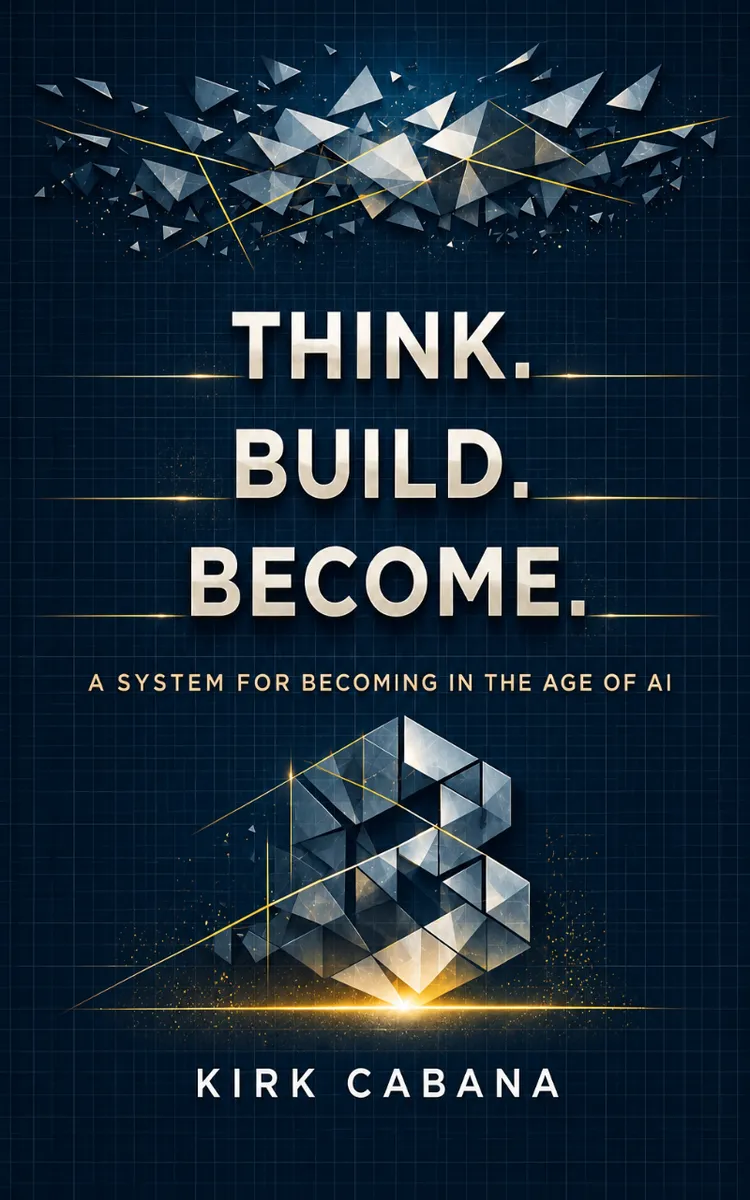
"Think. Build. Become" is a self-help book by Kirk Cabana with 15 chapters and approximately 25,024 words. Personal formation system using AI as a thinking partner.
This book was created using Inkfluence AI, an AI-powered book generation platform that helps authors write, design, and publish complete books. It was made with the AI Self-Help Book Writer.
Frequently Asked Questions
What is "Think. Build. Become" about?
Personal formation system using AI as a thinking partner
How many chapters are in "Think. Build. Become"?
The book contains 15 chapters and approximately 25,024 words. Topics covered include Identity Declaration, Radical Ownership, The Standard, Directional Clarity, and more.
Who wrote "Think. Build. Become"?
This book was written by Kirk Cabana and created using Inkfluence AI, an AI book generation platform that helps authors write, design, and publish books.
How can I create a similar self-help book?
You can create your own self-help book using Inkfluence AI. Describe your idea, choose your style, and the AI writes the full book for you. It's free to start.
Write your own self-help book with AI
Describe your idea and Inkfluence writes the whole thing. Free to start.
Start writingCreated with Inkfluence AI


