
Read the first chapter
The whole of chapter one, free. About 32 min. Turn the pages with the arrows, your keyboard, or a swipe.
Chapter 1
47 Calls at 2:13 a.m.
Rain worried the gutters outside Mara Whitaker’s kitchen window, tapping soft fists against the glass as if it had someplace to be. The house was too quiet for that kind of weather. Even the refrigerator sounded cautious, humming in short bursts like it was trying not to wake anyone. Lila slept upstairs in the back bedroom, door half-closed, her shoes kicked under the chair where she’d left them days ago. Mara could see the faint line of the hallway nightlight spilling under the door if she leaned close enough.
At 2:30 a.m., Mara was wide awake in a way that felt physical. Her phone sat face down beside her mug of tea that had gone cold hours ago. She’d told herself she was only checking the time, only making sure she hadn’t missed anything in the day’s rush - only listening for the smallest sound that would explain why her stomach had felt knotted since dinner. But the longer she waited, the harder it became to pretend her body wasn’t already answering questions.
The first time she looked at Lila’s phone, it was because she couldn’t stop thinking about the blank look on Lila’s face at the dinner table, the way she’d nodded at Mara’s questions without taking them in. The second time, it was because Mara had found a smear of something sticky on the kitchen counter that wasn’t there earlier, and when she wiped it with a paper towel the smell reminded her of cheap vanilla lip balm. The third time, she told herself, was just to confirm what she already knew.
Lila’s phone was still on the coffee table from earlier in the evening. Mara had meant to move it before bed - meant to tidy the house the way she used to, before the hours of being a mother started to feel like living at the edge of someone else’s mind. Instead she’d walked past it, too tired to deal with anything that required asking questions.
Now she picked it up.
The screen lit under her thumb, bright as a small stage. There was no new message alert, no missed calls. The wallpaper was a picture Lila had taken last spring of a row of tulips in the community garden - pink and red cups pushing up through dark soil. Mara’s thumb hovered over the call log icon before she could talk herself out of it.
She didn’t even think about the ethics of it. She thought about the way Lila sometimes woke with her hair stuck to her forehead and a phone in her hand, eyes wide but unfocused, like she’d been pulled from sleep mid-dream. She thought about the day Lila had come home with a bruise on her wrist from tripping in gym class and said it was nothing, nothing, nothing. Mara had believed her then because she wanted to. Because what else do you do when you want your child to be okay?
Mara tapped.
The call history opened, listing times down the screen like a row of footprints in wet sand. The first few entries were normal - calls to school contacts, to her friend Nia, to their neighbor Mrs. Alvarez about a package. Mara’s chest loosened just a fraction. Then she reached the late-night entries.
The times started clustering the way birds do when a storm rolls in: 12:47 a.m., 1:09 a.m., 1:33 a.m. And then, like a cruel pattern she couldn’t ignore, each call had the same number.
Unknown.
Mara stared at the label until it blurred. The number wasn’t saved. There was no contact name, no little heart icon, no “Dad” or “Mom” or “Nia.” Just a blank line where explanation should have been.
She scrolled back further, her thumb moving slower than it had any right to. The list wasn’t long at first. Then it became longer and longer, and the word UNKNOWN stayed there, stubborn, as if the phone itself was refusing to confess.
Forty-seven.
Mara didn’t see it as a total right away, not like a big number slapped across the screen. She counted the way people count when they’re trying to make fear behave: one call at 12:12, another at 12:31, another at 12:58. A few times there were no answer, just “missed.” Other times it said “call ended.” The times were all night, all within a few hours, always the same unknown adult number.
Each time her thumb paused, her mind filled in a sentence she didn’t want to read. Someone calling. Someone waiting. Someone listening.
The rain made a sharper sound when a gust hit the house, and Mara flinched hard enough that her tea mug rattled against the counter. The noise was small, but the whole house seemed to hear it. Mara pressed her palm to the phone as if she could quiet it.
Upstairs, Lila didn’t stir.
Mara’s first thought was that Lila was being catfished, that this was some new kind of internet trap where adults learned how to sound kind and harmless. Her second thought was worse: that Lila had been talking to a stranger who’d learned her schedule, who’d known when she was alone. Her third thought was the one she couldn’t stop returning to, the one that made her throat go dry.
What if it isn’t a stranger.
Mara locked the screen, then unlocked it again, as if the act would change what she’d seen. The call log returned, the list unchanged. She turned the phone over, stared at her own reflection in the dark glass. Her face looked older than it did in daylight. Her eyes didn’t look like her eyes.
She told herself she was going to wake Lila. She told herself she was going to be calm, that she was going to ask, that she was going to give her daughter a chance to explain instead of jumping straight to conclusions. She pictured herself walking upstairs, kneeling beside the bed, touching Lila’s shoulder. She pictured Lila’s face scrunched in confusion, then sharp fear, then defensive anger.
Mara pictured it because she needed to believe there would be an easy moment of truth. But the phone in her hand felt heavy, like evidence. And evidence didn’t leave room for easy.
Instead of going upstairs, Mara opened a browser and typed the unknown number into a search box. She didn’t have any idea what she was doing, not really, but fear makes people invent skills. The results came back bland and useless: “No match found.” Another attempt showed a forum post about spam calls. Another attempt spun in circles until the screen dimmed and the rain filled the silence again.
Mara turned the phone off and on as if she could reset the world.
When she finally moved, it wasn’t out of courage. It was out of urgency. She grabbed her keys from the bowl by the back door, then stopped. The keys clinked too loudly. She held them still a moment, listening for any sign upstairs - an unexpected cough, a door opening, the soft thump of Lila shifting in bed.
Nothing.
Mara set the keys back down without thinking. She didn’t want to wake Lila by being clumsy. She didn’t want to wake Lila by being dramatic. She didn’t know which kind of wake-up was worse.
Her gaze dropped to the kitchen counter where Lila had left her backpack earlier that day. The zipper was half-open. A pencil stub lay on top like a small fallen tooth. Mara reached in, found a folder where Lila kept her school papers. Her hands shook just slightly. She flipped the folder open, looking for something - anything - that might explain the calls.
There was an oral-history project sheet inside, the kind of handout that had been taped to the fridge in bright colors last month. Lila had been excited about it then, talking about interviews and keeping history alive. Mara remembered that excitement, not because it was important, but because it was rare. Lila didn’t talk like that about anything else.
The sheet had a list of steps written in marker: choose someone, ask questions, record answers, write the story. Mara stared at the words until they blurred. She could almost hear Lila’s voice from the car ride to school: “It’s not like homework-homework, Mom. It’s like, you know, real.”
The paper had a note on it - Lila’s handwriting, slanted and crowded. It said she’d chosen a person for her interview, and it gave an address and a name. Mara had glanced at it before and moved on, because Mara had been busy and Lila had been fine. She’d assumed that meant the project was contained in daylight hours.
Now Mara couldn’t stop wondering if the calls were connected to that name. She couldn’t stop imagining Lila staying up at night to ask more questions, to hear more stories, to keep the conversation going when the house was empty.
Then her mind snapped to the other possibility: that the calls weren’t about the project at all. That Lila had lied about the interview. That the phone number wasn’t tied to a sweet, aging neighbor who wanted to be remembered. That it belonged to someone who didn’t deserve the word “neighbor.”
Mara’s fingers tightened around the paper until the edges crinkled.
A sound came from upstairs, faint but real - Lila shifting in bed, a mattress spring sighing. Mara froze with the folder still open in her hands, the phone log still burning in her mind.
Footsteps were soft at first, then faster, as if Lila had woken and remembered she needed water or the bathroom. Mara expected a sleepy shuffle. Instead, Lila’s voice drifted down the hallway, muffled by distance.
“Mom?”
Mara’s heart lurched so hard it made her dizzy. She closed the folder quickly, too quickly, and when she stood her knee knocked the edge of the chair. The chair scraped on the kitchen tile with a sharp sound that made Lila’s footsteps stop.
“Mara?” Lila’s voice came again, closer now. “What are you doing down there?”
Mara forced her breathing to slow. She walked toward the hallway, keeping her hands visible. The kitchen light spilled behind her, making her shadow stretch long across the floor. Her mouth felt full of cotton.
“I couldn’t sleep,” she said, and hated how thin it sounded. “Did you… wake up?”
Lila appeared in the doorway, hair a mess, a T-shirt hanging on her like it was borrowed. Her eyes were half-lidded, but they sharpened as soon as she saw Mara’s face. Lila’s gaze flicked to the kitchen table, to the phone in Mara’s hand, to the folders on the counter.
“What’s wrong?” Lila asked. It wasn’t accusation. It was fear trying to act like concern.
Mara swallowed. The phone in her hand felt like a confession.
“Nothing,” Mara lied, because she didn’t know what else to do with the word. Then she corrected herself, because lying made everything worse. “I mean - Lila. Why are you calling someone? At night.”
Lila stared at her for a second like she hadn’t understood the sentence. Then her expression shifted, the way a face changes when a light turns on too suddenly. Her eyes darted again toward Mara’s hand.
“What do you mean?” she said, voice careful.
Mara held the phone up just enough to show the call log without showing everything. Her thumb hovered over the list. She could feel the numbers like they were burned into her skin. “This. The calls. There are so many.”
Lila’s throat bobbed. “You looked at my - ”
“You were asleep,” Mara cut in, harsher than she meant to be. Rain slapped harder against the window, as if it was agreeing. “I found your call history. Forty-seven calls. To an unknown number.”
Lila’s mouth opened, then shut again. She looked suddenly younger, like the girl who used to ask if storms meant the world was angry. Her shoulders rose toward her ears.
“Mom,” she said, and the word was both plea and warning. “That’s not - ”
“Then what is it?” Mara demanded, and hated herself for the edge in her voice. “Who is he? Is he someone from school? Is someone - ” She couldn’t finish the sentence. She didn’t want to say “dangerous” out loud. Saying it would make it real.
Lila’s eyes filled, but she blinked hard, fighting tears like she was angry at them for showing up. “He’s not dangerous,” she said quickly. “He’s just… an old guy. It’s for my project.”
Mara felt the tension in her chest loosen and tighten at the same time. Relief, sharp and immediate, then suspicion, because “old guy” didn’t explain the unknown number. It didn’t explain forty-seven calls. It didn’t explain why her daughter was awake at hours when normal teenagers slept.
“Your project,” Mara repeated, holding onto the phrase like a handhold. “The oral-history thing?”
Lila nodded too fast, hair sticking to her forehead. “I told you. I - I chose someone. I’ve been calling him when I can’t - when I need to talk.”
“Need to talk,” Mara echoed, and the words tasted wrong. Lila was fifteen. She didn’t need to talk to a stranger at 2 a.m. She needed to be a kid, to cry into her pillow or complain about homework. Mara had always believed that.
“But you didn’t tell me you were calling him every night,” Mara said.
Lila’s eyes flicked to the stairs behind her, like she wanted to run back to bed and bury the conversation under blankets. Then she looked at Mara again and steadied herself.
“I didn’t want you to worry,” she said. “I thought - I thought it was stupid. It’s just… silence. When the house is quiet, it gets loud in my head. And he - he answers.”
Mara stared at her daughter. Rain hissed along the window frame. The kitchen smelled faintly of dish soap and stale tea. Mara could hear the refrigerator’s motor start up, a deep chug that sounded like a tired sigh.
“Why forty-seven times?” Mara asked, voice quieter despite herself.
Lila’s lips pressed together. She looked away, then back. “Because he’s the only one who doesn’t make me feel like I’m bothering him,” she said, and the sentence cracked around the last word.
Mara wanted to argue. She wanted to say that was exactly what someone dangerous would say. She wanted to say adults didn’t deserve that kind of access to a child’s private hours.
But Lila’s face didn’t look like a liar’s face. It looked like someone holding something heavy in her hands and trying not to drop it.
Mara lowered the phone slightly. “What’s his name?”
Lila hesitated. “Harold.”
The name hit the air like it belonged to an old story. Mara didn’t recognize it, but it sounded like the kind of name that could be on a school project sheet. She remembered the paper on the counter and the penciled note. She could check. She could confirm. She could stop this from spiraling into something worse.
Mara’s gaze darted to the counter. Her fingers moved, almost without permission. She picked up the folder from where she’d left it and flipped it open to the page with Lila’s notes. The handwriting was unmistakable.
Mara’s eyes scanned the lines. Name: Harold Kessler. Address: a street Mara had passed a thousand times without ever noticing the house numbers. It was only a few neighborhoods over. A small, quiet place.
Mara looked back at Lila. “So why is the number showing as unknown?”
Lila blinked. “Because I don’t - I didn’t save it. I didn’t want it in my contacts. If Mom - ” She stopped herself, swallowed. “If you saw it, you’d think it was… something else.”
The way she said “something else” made Mara’s stomach turn. Lila didn’t sound like she was hiding a crime. She sounded like she was hiding fear.
Mara stood very still. She could feel her own thoughts moving too quickly, circling. She wanted to ask more questions, but the questions felt like opening doors that might lead to rooms she couldn’t close again.
“You called him forty-seven times,” Mara said again, because she couldn’t let the number go. “At night.”
Lila nodded, tears now slipping free. “I’m sorry,” she whispered, and the apology was so small Mara almost missed it. “It’s not like I… I’m not - I’m not doing anything bad.”
Mara wanted to believe her. She wanted to reach out and wipe the tears from Lila’s cheeks with her thumb. She wanted to pull her into a hug and promise that whatever had been making the house feel loud would get quieter.
But then Mara remembered the call log. The times. The way it didn’t show anything but an unknown number. The fact that Lila had chosen to keep it secret, even though secrecy was its own kind of admission.
“What time did you call him last?” Mara asked.
Lila’s voice shook. “Tonight. Earlier. I fell asleep and then… I called because I woke up again.”
Mara’s mind flashed to the hallway nightlight spilling under Lila’s door, to the stillness between the rain taps. If Lila had woken and called, Mara could have been asleep upstairs and missed it. Mara could have missed it completely, and the secret could have grown like mold in a corner no one looked at.
Mara looked at the folder again, at the address. Her eyes lingered on it long enough that the letters seemed to shift into a destination.
She didn’t say that out loud. She just felt it.
“How many hours have you been calling him?” Mara asked.
Lila swallowed. “Months,” she said, then winced at how big that sounded. “Not every night. Sometimes I go two nights without it. But… when it gets bad.”
Mara’s throat tightened. “When it gets bad,” she repeated, and she knew she couldn’t ask what that meant without opening a door that might swing wide enough to let everything in.
Lila stepped closer, careful on the tile like she was trying not to startle Mara. “Please don’t be mad,” she said. “He’s lonely. He told me stories. He… he likes talking.”
Mara’s lips parted. The word “lonely” should have softened things. Instead it made her fear sharpen. Lonely people could be sweet. Lonely people could also be manipulative. Lonely people could be the kind of adult who knew exactly how to use a teenager’s need for comfort.
Mara forced herself to speak with control. “Does he know you’re fifteen?”
Lila nodded. “Yes.”
“Does he ask you for anything?” Mara asked, and the question felt like a line she didn’t want to cross, but she had to know it anyway. “Does he ask to meet? Does he ask you to send pictures or - ”
“No,” Lila said quickly. “No. He never - He’s just old. He talks slow. He tells me about things that happened before I was born. Like… like he’s reading the world to me.”
Mara stared at her daughter’s face, searching for signs of a lie. Lila’s eyes were shiny, her lashes clumped from sleep and tears. Her hands were clenched at her sides, and her knuckles were pale. She looked like she was bracing for impact.
Mara realized then that her daughter wasn’t only afraid of being punished. She was afraid of being understood incorrectly. Afraid that Mara would see a pattern and decide it meant something sinister when the truth might be something else entirely.
Mara could feel her own suspicion fighting her empathy. She hated how easily suspicion took the wheel.
“Show me,” Mara said suddenly.
Lila’s brows drew together. “Show you what?”
“Your calls,” Mara said, and held out her hand. “The last one. The number. Everything.”
Lila hesitated. Then she reached for Mara’s phone with two hands, as if it might bite. Her fingers moved quickly, bringing up the call log again. Mara watched, eyes tracking the entries. She didn’t let herself flinch when she saw the same unknown number repeatedly.
Then Lila tapped on one of the entries. A small contact card popped up with nothing but the number and the time. No name. No saved contact. Just data, cold and blank.
Mara stared at it, and the blankness made her feel sick. “So how do you know where he lives?” she asked.
Lila’s face fell. “He told me,” she said. “He mailed me the questions he wanted me to ask. He… he sent it in an envelope.”
Mara’s mind snagged on the detail. Mailed. Envelope. Something physical. Evidence in the mailbox instead of a faceless phone number.
“Where is it?” Mara asked.
Lila’s shoulders rose and fell. “In my room. I kept it.” She looked at Mara carefully. “Why? What are you thinking?”
Mara didn’t answer right away. The kitchen felt too small, too bright. The rain noise filled in the silence between questions and answers. Mara could hear her own pulse in her ears like a distant drum.
She was thinking about the address on the project sheet. She was thinking about the way Lila had called someone and kept the number unsaved. She was thinking about how, even if this wasn’t dangerous in the way her fear wanted it to be, it was still her job to know what was happening to her daughter.
She was thinking about the fact that Lila was fifteen and should not have to find comfort by talking to someone at 2 a.m.
Mara grabbed her phone again and thumbed through the browser search she’d tried earlier. The dead ends stared back at her. She couldn’t trace the number easily. She couldn’t find anything that would reassure her.
So she looked at the address on the folder again. It was there in black marker, the kind of handwriting that came from a kid who believed school assignments were safe. The kind of handwriting Mara had trusted without question.
Mara’s voice came out steadier than she felt. “Get back to bed,” she said to Lila. “I’m going to call him.”
Lila’s eyes widened. “Call him?”
“Yes,” Mara said. “If it’s harmless, he’ll answer. If he’s not harmless, I’ll know now.”
Lila swallowed hard. “He might be asleep,” she said, as if that was a reason Mara shouldn’t act. “It’s late.”
Mara looked at the clock. 2:34 a.m. The minute hand moved like it was impatient with her doubt.
“I’m not waiting,” Mara said, and the firmness in her voice surprised even her. She didn’t say it to be dramatic. She said it because her fear was turning into something sharper, something that would keep chewing at her until she did something.
Lila backed up one step, then another. Her gaze flicked toward the stairs like she might try to find a way around Mara’s decision. “Mom,” she said, and her voice broke on the word. “Please don’t go. Please. I’m not in trouble.”
Mara held her daughter’s gaze. In the kitchen light, Lila’s face looked too pale, too young for the kind of secrecy she’d carried. Mara wanted to tell her she wasn’t in trouble. Mara wanted to promise it.
Instead Mara said the only honest thing she could manage. “I don’t know what kind of trouble this is,” she said. “But I’m not letting it stay a mystery.”
Lila’s lips trembled. “He’s not… he’s not the kind of person who hurts kids,” she whispered. “He’s just - he’s just alone. That’s why he answers.”
Alone. The word landed again, heavy. Mara’s fear didn’t dissolve; it just shifted. She could see the possibility now: a lonely old man on the other end of the line, a lonely house on Mara’s side where the silence got too loud. A school assignment turning into nightly comfort. A connection built out of necessity rather than safety rules.
Mara hated that necessity could feel like love. She hated that it could make boundaries blur.
She grabbed her keys from the bowl and this time didn’t put them back. The metal was cold against her palm. Her hands moved with purpose, but her heart didn’t feel brave. It felt like it was dragging itself through mud.
Lila stepped in front of her, not blocking completely, but close enough that Mara couldn’t pretend she wasn’t seeing the plea in her posture. “Where are you going?” Lila asked, voice small.
“To talk to him,” Mara said.
Lila’s eyes filled again. “You can’t. Please. He doesn’t like strangers. He’ll think - he’ll think I did something wrong.”
Mara stared at her daughter’s face and felt her own anger wobble. The anger wasn’t really at Lila. It was at a situation that had grown without her, at the months Mara had missed.
Mara’s voice softened without becoming kind. “I’m not here to punish you,” she said, though she knew it was a promise she couldn’t fully back up. “I’m here to make sure you’re safe.”
Lila shook her head, tears spilling now. “I am safe,” she said. “I swear.”
Mara wanted to believe the swear. She wanted to believe Lila’s sincerity the way she’d believed it in small moments before: the bruise, the grades, the stories about friends. But sincerity didn’t erase the fact that Mara had found forty-seven calls at night to an unknown number.
Mara reached for Lila’s shoulders, not gripping, just steadying. Lila flinched at first, then let Mara’s hands rest there. Mara could feel the warmth of her daughter through the thin fabric. She could smell Lila’s shampoo, faint and sweet, and it made Mara’s fear feel both sharper and more ridiculous.
Mara pulled back just enough to grab her jacket from the chair. It was still folded from the day. She slipped her arms into it, fingers clumsy with adrenaline.
“Stay in bed,” Mara said. “Lock your door.”
Lila’s breath hitched. “You’re leaving me here?”
Mara looked at her daughter. The rain tapped harder, steady as a heartbeat.
“I’ll be back,” Mara said, and hated how little she could control the world even with the words.
Lila’s voice rose, not loud but urgent. “Mom. Don’t go to his house. Don’t. If he sees you, he’ll call the police. Or the neighbors. Or - I don’t know. He’ll make it weird.”
Mara froze with her hand on the doorknob. “Why would he call the police?” she asked.
Lila’s eyes darted away. Her mouth opened, then shut. She looked like she was trying to hold onto a secret that had suddenly turned into a trap.
Mara waited. The house creaked around them, the old bones of it settling under the rain.
Lila finally whispered, “Because he’s scared of getting in trouble.”
Mara felt a strange twist of understanding and dread. A lonely old man who was scared of getting in trouble. A teenage girl who was scared of being discovered. A secret built like a bridge between two kinds of loneliness, and both sides were afraid of the moment someone inspected it.
Mara’s hands tightened on the doorknob. “You should have told me,” she said, and the words came out like a confession too. “I would’ve listened.”
Lila shook her head, tears falling onto her shirt. “I tried,” she said. “You were always busy. You were always - ” She stopped, swallowed, and tried again. “I thought if I could just keep it quiet, it would be okay.”
Mara’s chest ached. She wanted to argue that she hadn’t been ignoring Lila, that she’d been working late, dealing with bills, keeping the lights on. But Mara knew those explanations wouldn’t land the way she needed them to. Not at 2:35 a.m. not with her daughter crying in the kitchen doorway.
Mara inhaled, slow. The air smelled like wet pavement drifting through the cracks around the window. She could hear the rain, could hear the distant rush of tires on the street outside. Somewhere far away, a car alarm chirped once
as if the neighborhood itself was trying to warn them to wake up and pay attention.
Lila stood with her arms wrapped around her knees, her socks damp where they’d brushed the cold kitchen tile. The hallway light behind her flickered once, then steadied. Mara noticed the small tremor in Lila’s lower lip, the one that always appeared when Lila was trying not to cry too hard.
“Show me,” Mara said.
Lila blinked. “Show you what?”
Mara stepped into the kitchen. The motion made the refrigerator hum sound louder, the way machines do when the house is otherwise quiet. “The phone,” she said. “The calls. The number.”
Lila’s shoulders lifted, then dropped, like she’d been bracing for impact and had to decide whether to shield herself or surrender. She reached for her phone on the counter where Mara had left it earlier, screen dim, case smudged with fingerprints.
Mara didn’t touch it right away. She watched Lila’s hands. Lila’s thumb hovered as if she needed permission to make the truth appear.
“Mom,” Lila said, and the word came out thin. “I didn’t - I didn’t do anything bad.”
“I didn’t say you did,” Mara replied, even though her throat felt tight with all the things she was thinking. Her own mind ran ahead of her like a dog off a leash. Stranger danger. Late-night calls. A grown man. A teenager alone at 2 a.m. in a house that suddenly felt too big.
Still, she forced her voice to stay steady. “Please. Show me.”
Lila swallowed. She unlocked the phone, the screen lighting up her face in a pale wash. The kitchen looked different with that glow, sharper around the edges, every surface too visible - countertops, crumbs in the corners, the sink where last night’s dishes still waited to be rinsed.
Mara leaned closer. Rain made a soft, constant hiss against the window. Somewhere inside the phone, silent time had stacked itself into evidence.
Lila tapped Call Log. Mara watched the list populate, one entry at a time, each line stamped with a time that made Mara’s stomach tighten. The same number over and over. No name. Just digits.
Forty-seven times.
The number itself looked ordinary - nothing about it screamed danger. It was just a sequence of numbers like any other. But Mara knew how ordinary things could hide the worst intentions. Ordinary didn’t mean harmless. It meant plausible.
“Why doesn’t it have a name?” Mara asked, although she already knew the answer might be the cruelest one: because Lila hadn’t saved it.
Lila’s eyes shone. “I didn’t want to,” she said. “I didn’t want it to… be real.”
Mara stared at the screen. “Real,” she echoed, and the word felt like a key turning in a lock.
Lila nodded quickly, as if she could knock the fear loose by moving her head. “It’s not like that. It’s not - It’s not someone who wants something from me.”
Mara’s fingers curled against her palm. She made herself look at Lila instead of the screen. “Then what is it like?”
Lila hesitated long enough that Mara’s mind filled in gaps with scenarios it didn’t have permission to build. Mara imagined a man who had found a way to reach into a girl’s night. A man who said things that sounded harmless at first. A man who relied on secrets because secrets made it easier to control.
Lila finally said, “It’s a person.”
“People are - ” Mara started, then stopped. People were people. She didn’t need a lecture. She needed the truth from her daughter.
Lila’s voice lowered. “He… he answered. That’s all. I called, and he picked up.”
Mara felt her body react before her brain could catch up. Her heart thudded hard enough that she could feel it in her throat. “You called him,” she said, “and he answered.”
Lila nodded, tears gathering again. “At first I didn’t even know what I was doing. I just - I got the number from school. From a project.” She looked down at the phone like it could rescue her. “Oral history.”
Mara’s mind snagged on the phrase. Mara had heard the words oral history once, months ago, when Lila had come home excited about something she’d been assigned. Lila loved projects that made her feel like she belonged to a bigger story.
“Who gave you the number?” Mara asked.
Lila shook her head. “It’s not like - It’s not like I picked him. I got assigned to… to listen. To ask questions. To write down what he said.” She wiped at her cheek with the heel of her hand and left a damp streak. “But then the house got loud, and I didn’t know where else to put it.”
Mara stared at the call log again. The times weren’t clustered in the way a school assignment would require. They weren’t normal hours. They were all night, all the way through the middle of the night, as if Lila had made a habit of stepping into darkness to keep something worse from swallowing her.
“How loud,” Mara asked, and hated herself for how she sounded like a detective.
Lila’s mouth tightened. “You know,” she said, and that was almost worse than an explanation. Mara did know. She knew the way the house sounded when it was quiet enough to hear the pipes click and the distant hum of traffic. She knew the way Lila’s silence could stretch thin until it felt like it might tear.
Mara forced her voice to soften. “Tell me anyway.”
Lila’s gaze darted to the hallway, then back to the phone. “When everyone’s asleep,” she said, “it’s just me and the walls. And the thoughts start getting… sticky.”
Mara didn’t move. The rain sounded steadier now, as if it had decided to stay. The kitchen clock ticked too loudly, counting seconds like it was impatient.
Mara swallowed. “And you thought calling a man would help.”
Lila’s eyes flashed with hurt. “I didn’t know it would be a man,” she blurted. “I mean, I knew he was a person, but I didn’t - I didn’t know how old he was. I didn’t know he’d be… like that.”
“Like what?” Mara asked, even though she felt the answer forming in her imagination, the way a storm forms on the horizon.
Lila’s shoulders sagged. “Like he was alone.”
That sentence didn’t make Mara feel better. It made her feel worse, because her mind leapt to the idea of a man using loneliness like a hook. She pictured a widower reaching for companionship, saying the right things, learning a teenager’s soft spots.
But Mara also pictured Lila, fifteen and too smart for her own good, trying to be careful with the people she let into her life. Lila wasn’t reckless. Lila was careful in the way some kids were careful because they didn’t feel safe.
Mara breathed in. The kitchen smelled like rain and dish soap, the faint lemon Mara had used earlier when she’d wiped down the counters and convinced herself she was in control.
“Show me the number,” Mara said.
Lila scrolled, and the unknown digits sat there, plain and undeniable. Mara stared at them until they blurred. She tried to read meaning into the sequence, tried to imagine a name attached to it, tried to picture the man on the other end of the call.
“Where does it say he lives?” Mara asked.
Lila blinked, confusion flickering across her face. “It doesn’t,” she said. “It doesn’t show an address. It’s just… numbers.”
Mara shook her head slowly, the way she did when she was trying to keep her hands from shaking. “Then how do you know it’s the same person?”
Lila hesitated, then lifted her chin. “Because he talks,” she said. “He remembers things. Not just… not just my voice. He remembers what I asked him in school.”
Mara’s mind went cold. “In school,” she repeated. “So this isn’t some random number.”
Lila gave a small nod. “No.”
Mara wanted to accept that. She wanted to believe it enough to put her fear back in its box. But she couldn’t unsee the call log. She couldn’t unfeel how late-night habits could grow teeth.
She glanced at the time on her phone. 2:13 a.m. The rain had turned the street outside into a glossy ribbon. Mara thought about driving to work in the dark, the way she’d done when the roads were slick and you had to focus hard to keep your tires from sliding. She thought about what it would mean to focus hard on something else - her daughter’s safety.
“Where is your school folder?” Mara asked suddenly.
Lila’s face tightened. “What?”
Mara held her gaze. “The one with the oral history,” she said. “The one you used to get the number.”
Lila looked like she might refuse. Then she glanced toward the stairs, toward her bedroom, as if her room could still be a safe place even after this. “It’s in my room,” she said.
Mara felt anger flare, sharp and hot, aimed at the wrong thing. She wasn’t angry at Lila for needing comfort. She was angry at herself for not noticing the comfort had become an emergency.
“Go get it,” Mara said.
Lila stood too fast, wobbling for a second. Mara reached out automatically, catching Lila’s elbow before she could fall. Lila’s skin was warm, but her body felt tense underneath, like a wire pulled too tight.
“I’m not in trouble,” Lila said quickly, as if Mara’s grip could hear her thoughts.
Mara released her elbow and let Lila pass. “I’m not promising anything,” Mara said. “I’m trying to figure out what’s happening.”
Lila flinched, then nodded anyway, and hurried down the hallway toward her room.
Mara stayed in the kitchen. Her hands hovered over the counter near the phone but didn’t touch it. She listened to the house - the rain, the refrigerator hum, the occasional creak from the floorboards that sounded like someone shifting their weight in another room.
She found herself thinking about the unknown number again, about how it showed up without a name. How it had no place to be filed in her mind except inside the word danger.
In the living room, the old lamp beside the couch cast a dim pool of light. Mara could see the edge of a picture frame on the shelf - Lila at some school event, hair pinned back, laughing with her whole face. Mara had taken that picture. She remembered the exact moment, because it had been a good day. She remembered thinking, See? She’s fine.
Fine was a lie people told themselves to sleep.
Lila returned a few minutes later, clutching a folder with curled corners, the plastic sleeve scuffed. She moved quietly at first, then remembered Mara was awake and stood straighter.
She opened the folder on the kitchen table. The paper inside smelled like old printer ink and the faint sweetness of whatever snack Lila had eaten earlier while working on assignments. Mara’s stomach twisted.
Lila flipped through pages until she found the section with contact information. She pointed with a trembling finger.
“There,” she said.
Mara leaned over. A name was typed at the top of the page, neat and familiar in the way school handwriting often was. The name itself meant nothing to Mara yet, not really. The phone number beside it matched the digits on Lila’s call log.
Mara’s throat tightened. She forced herself to read it again, slower, as if the second glance might change what she saw. “You called him,” she murmured.
“Yes,” Lila said, almost pleading.
Mara looked up at her daughter. “Why didn’t you tell me?” she asked, and her voice broke on the last word despite her effort.
Lila stared at the folder like it was a judge. “Because I thought you’d hate it,” she said. “Because it’s… it’s not something you’re supposed to do.”
Mara swallowed. “Who told you that?”
Lila shook her head. “Nobody had to,” she whispered. “It just felt wrong. But it also felt… like someone was there.”
Mara’s mind flashed to the call times again - 2:00 a.m., 2:07 a.m., 2:21 a.m. She pictured Lila’s thumb pressing call, again and again, waiting for the ring to stop and a voice to come through. Mara pictured Lila listening to that voice as if it could keep the house from turning into something else.
Mara’s anger shifted, becoming more complicated. She didn’t want to punish. She wanted to protect, but protection could look like punishment in the moment.
“Did he ever tell you not to call?” Mara asked.
Lila shook her head quickly. “No,” she said. “He never said that.”
Mara stared at the folder. The rain sounded louder now, as if the world outside was trying to drown out any chance of calm. Mara felt the weight of the folder in her hands, the paper too light, too fragile to hold forty-seven nights of fear.
She could keep interrogating Lila. She could demand details until the truth came out like a confession. But she couldn’t unspool the call log with questions. Mara needed to see who the calls were reaching.
Her gaze dropped to the page again. The name sat there, calm and ordinary, as if it wasn’t attached to an unknown number that had haunted her for the last hour. Next to it, in small typed letters, an address.
Mara’s pulse jumped. “He has an address,” she said.
Lila’s eyes widened. “That’s part of the project,” she replied. “It’s not - I didn’t - ”
Mara stood so fast her chair scraped the tile. The sound made Lila jump.
Mara reached for her keys on the hook by the back door. She didn’t remember deciding. She only remembered the feeling that had taken over - like
End of chapter one. 19 more chapters in the full book.
Swipe or use the arrows to turn the page


What's inside: 20 chapters
- 1. 47 Calls at 2:13 a.m.
- 2. Lila’s Quiet, Too-Perfect Smile
- 3. The Number That Isn’t Saved
- 4. Voicemail Like a Stranger’s Hand
- 5. A House That Smells Like Tea
- 6. Lila’s Backstory in a School Folder
- 7. The Silence in the House Got Loud
- 8. Harold’s Rules for Late-Night Calls
- 9. The Fall That Changed Everything
- 10. Lila’s Hospital Notes and Stolen Hours
- 11. The Nurse Who Asked Too Many Questions
- 12. A Letter to the School Principal
- 13. Harold’s Voice on the Phone Again
- 14. Daytime Only, Nighttime Temptation
- 15. Mara’s Apology She Can’t Swallow
- 16. When Harold Can’t Stand Up
- 17. The Oral-History Interview That Goes Public
- 18. A Story Told in the Dark
- 19. Mara Finally Sees Lila’s Kindness
- 20. The Silence Between Calls Returns
About this book
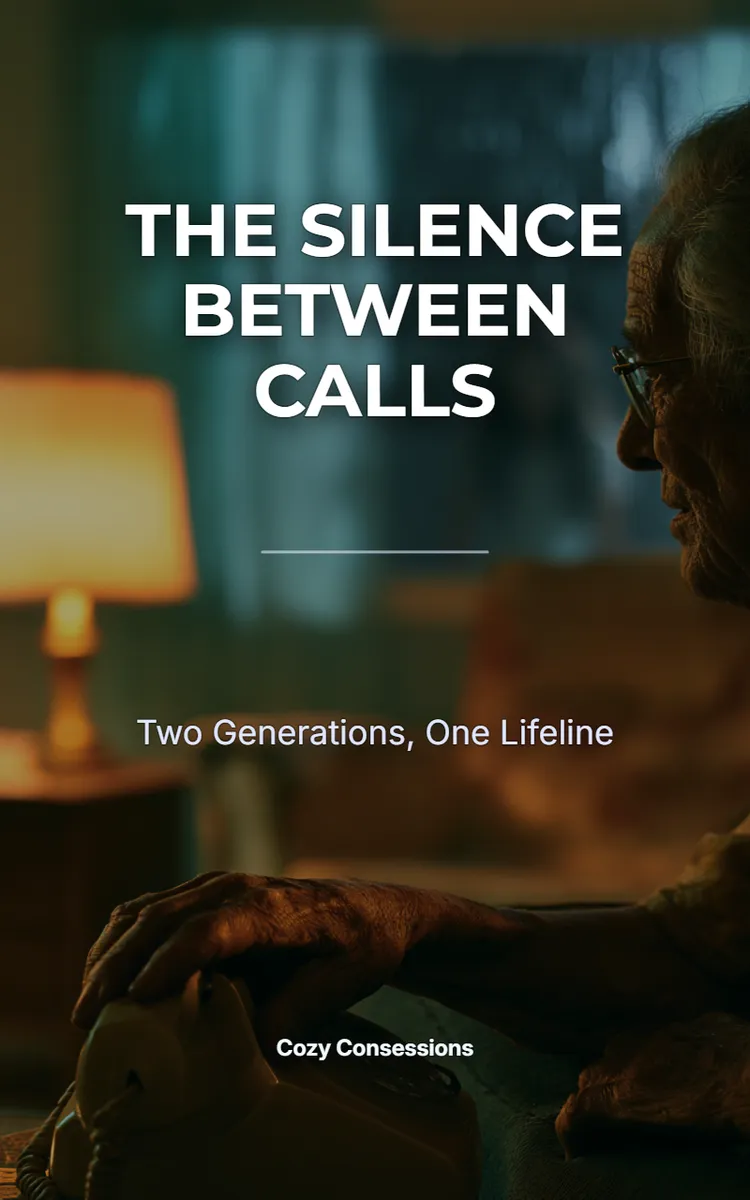
"The Silence Between Calls" is a fiction book by Cozy Consessions with 20 chapters and approximately 117,127 words. At 2:13 a.m.
This book was created using Inkfluence AI, an AI-powered book generation platform that helps authors write, design, and publish complete books. It was made with the AI Novel Writer.
Frequently Asked Questions
What is "The Silence Between Calls" about?
At 2:13 a.m., a mother finds 47 calls on her daughter's phone. Same number. Every night. An adult man. She's ready for the worst. What she finds instead is an old man alone with his silence — and a girl who found the one person who knew how to listen. What started as a school project became the only thing keeping them both afloat. But not everyone believes a friendship like this can be innocent. As the calls keep coming and the questions get louder, one family has to decide what they're willing to risk to protect something the world doesn't understand. A story about the quiet ways people save each other — and the noise that almost stops them.
How many chapters are in "The Silence Between Calls"?
The book contains 20 chapters and approximately 117,127 words. Topics covered include 47 Calls at 2:13 a.m., Lila’s Quiet, Too-Perfect Smile, The Number That Isn’t Saved, Voicemail Like a Stranger’s Hand, and more.
Who wrote "The Silence Between Calls"?
This book was written by Cozy Consessions and created using Inkfluence AI, an AI book generation platform that helps authors write, design, and publish books.
How can I create a similar fiction book?
You can create your own fiction book using Inkfluence AI. Describe your idea, choose your style, and the AI writes the full book for you. It's free to start.
Write your own fiction book with AI
Describe your idea and Inkfluence writes the whole thing. Free to start.
Start writingCreated with Inkfluence AI


